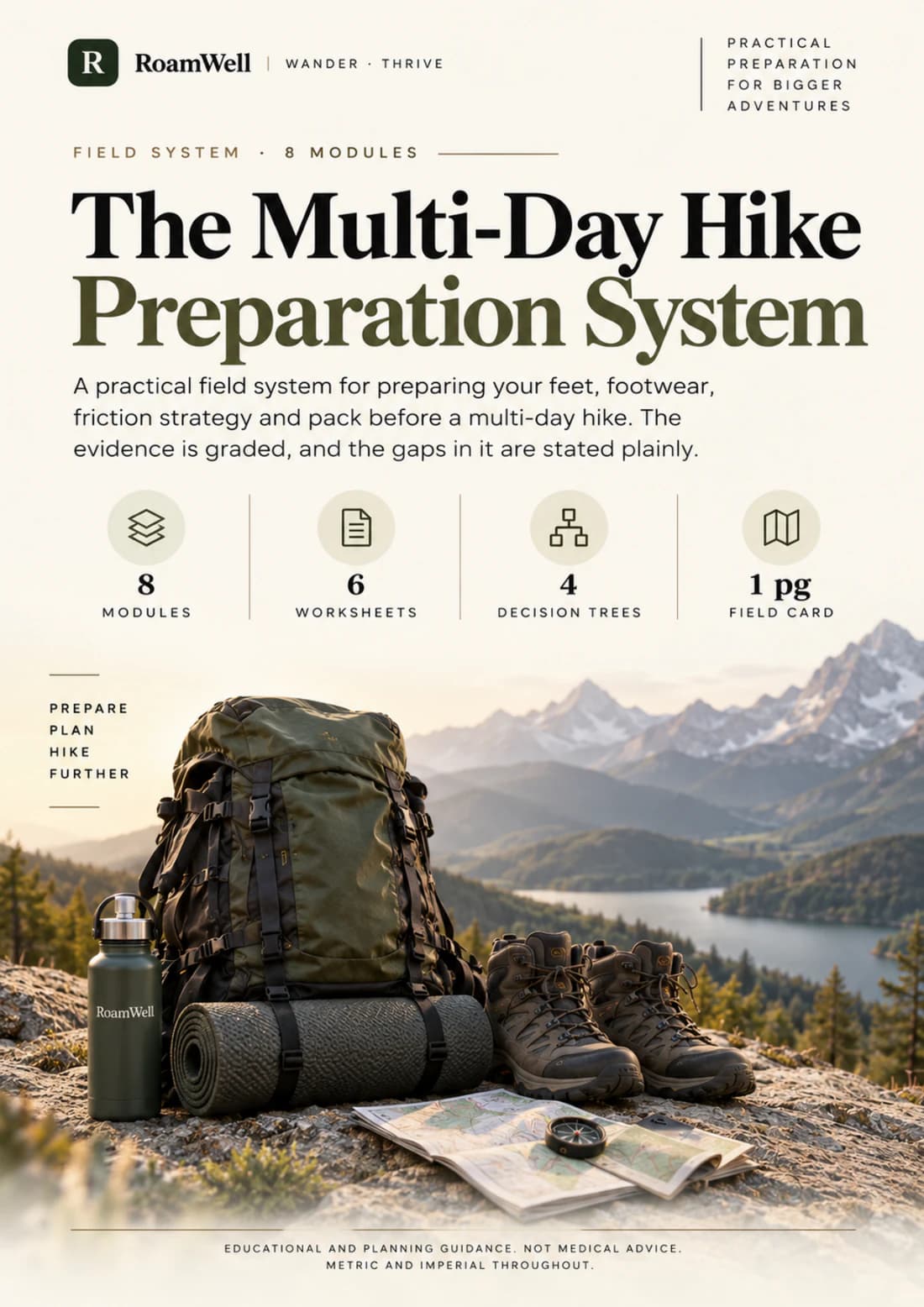
The Multi-Day Hike Preparation System
You've booked the trek. Your feet haven't.
A preparation system for your feet, footwear and pack before a multi-day hike, evidence rated honestly, gaps included.
- A4 and US Letter, both included
- Metric and imperial throughout
- No brand or country assumed
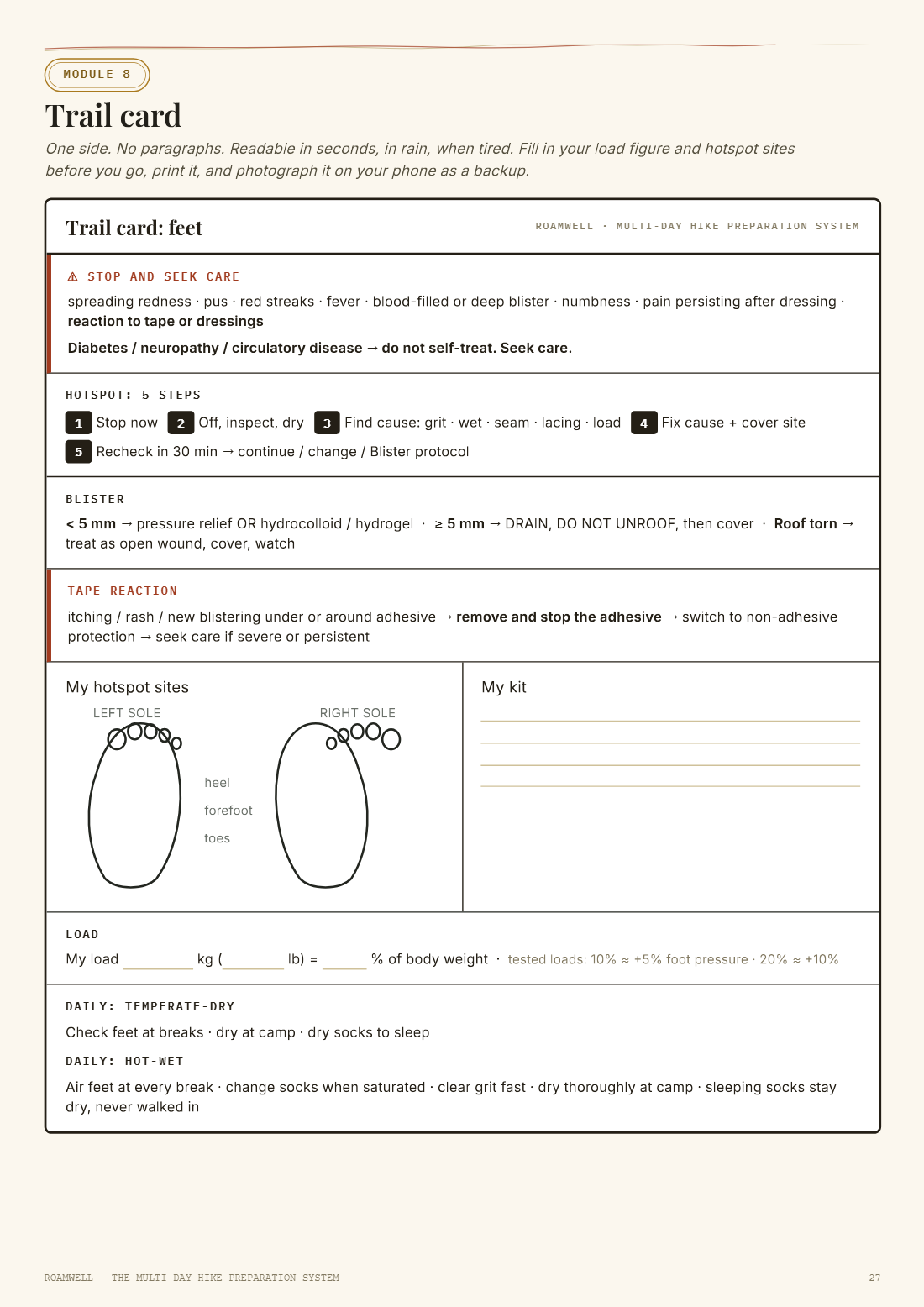
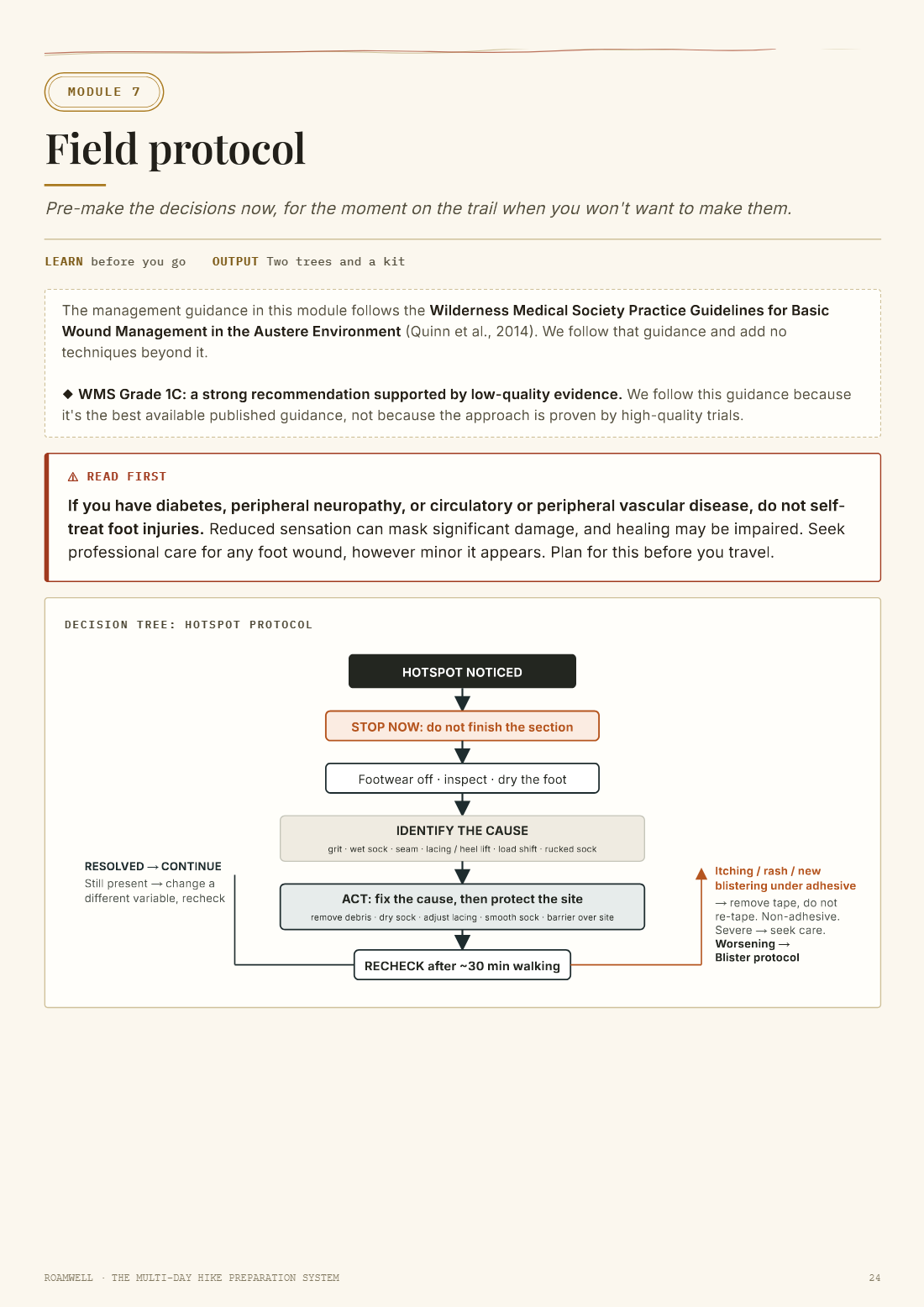
Most first-time hikers plan the route. Fewer plan what happens to their feet.
- Footwear
- Whether what you already own is ready to use, needs adjusting or should be replaced, decided while there's still time to act.
- Pack load
- What your pack weighs as a share of your body weight, and where that sits against the loads a study actually measured.
- Climate
- Most foot advice assumes somewhere cold and dry. In humidity the primary threat and the correct strategy both change.
- Friction
- Six options, ranked by what the evidence actually shows rather than by what's easiest to recommend.
- Hotspots
- What to do at the moment one starts, decided in advance rather than at kilometre twelve.
One clear plan instead of scattered advice
Six stages, each ending in something you can hold: a verdict, a number, a kit list, a card. If you have the artifact, you have the stage.
- Assess, then Decide, then Calculate, then Test, then Track, then Respond
- 01Assess
- 02Decide
- 03Calculate
- 04Test
- 05Track
- 06Respond
- Whether the footwear you already own is ready to use, needs adjusting, or should be replaced, while there's still time to act
- What your pack weighs as a share of your body weight, and where that sits against the loads a study actually measured
- Which moisture strategy applies to the climate you'll actually walk in. The correct answer changes
- How well-supported each friction option really is, so you can choose knowing what's proven and what isn't
- What to do at the moment a hotspot starts, decided in advance rather than at kilometre twelve
8 chapters, run in order
Each chapter builds on the last one. You're never asked to guess at something an earlier chapter already covered.
Set up
Four inputs turn your departure date into a dated preparation timeline, including a salvage plan if you're under three weeks out.
Foot & footwear audit
Six structured checks produce a GO / MODIFY / REPLACE verdict and your personal hotspot map.
Climate track
Temperate-dry or hot-wet. The moisture strategy that governs every module after it.
Break-in & load exposure
Progressive time in your actual footwear under your actual load, with a hold rule when something goes wrong.
Pack load
Your load ratio, your position against the two tested loads, and a ranked cut list.
Friction system
Six options, each with what we suggest first and what the evidence actually shows second.
Field protocol
Two decision trees for hotspots and blisters, following published wilderness medicine guidance.
Trail card
One page you carry, with your own hotspot sites, your kit and your load figure.
Everything included
PDF in A4 and US Letter, plus the companion Load-Ratio Calculator on the website
- 32
Page PDF
The eight-module system in one document, written to be worked through, not skimmed.
- 2
Editions
A4 and US Letter, both included. Print either one without resizing anything.
- 6
Printable worksheets
One per module that produces something. Print them, or annotate them in a PDF app.
- 4
Decision trees
Hotspot and blister protocols, following published wilderness medicine guidance.
- 1
Departure timeline
Four inputs turn your date into a dated plan, including a salvage plan under three weeks.
- 1
Trail card
One side, carrying your own hotspot sites, your kit and your load figure. Print it or screenshot it.
- 2
Foot diagrams
Left and right sole maps for marking your own hotspot sites and carrying them with you.
- 1
Interactive calculator
A web tool for your pack-to-body-weight ratio, against the two loads the study measured.
See the actual pages
Six pages from the plan, shown in full. Open any one to see it at full size.
The load-ratio calculator
Module 5 as a web tool. Enter your body weight, your pack weight and your load type; it returns your pack-to-body-weight ratio and shows where that sits against the two loads the source study measured.
- You enter
- Body weight, pack weight, load type. Metric or imperial.
- You get
- Your ratio, and its position against the measured 10% and 20% loads.
It doesn't call a pack safe, unsafe, ideal or risky. The study measured pressure, not harm, so the tool reports a comparison and stops there.
Companion web tool, free for everyone. It runs on the RoamWell website, so it is not part of the downloadable ZIP. The address is printed in the guide too.
Open the Load-Ratio Calculator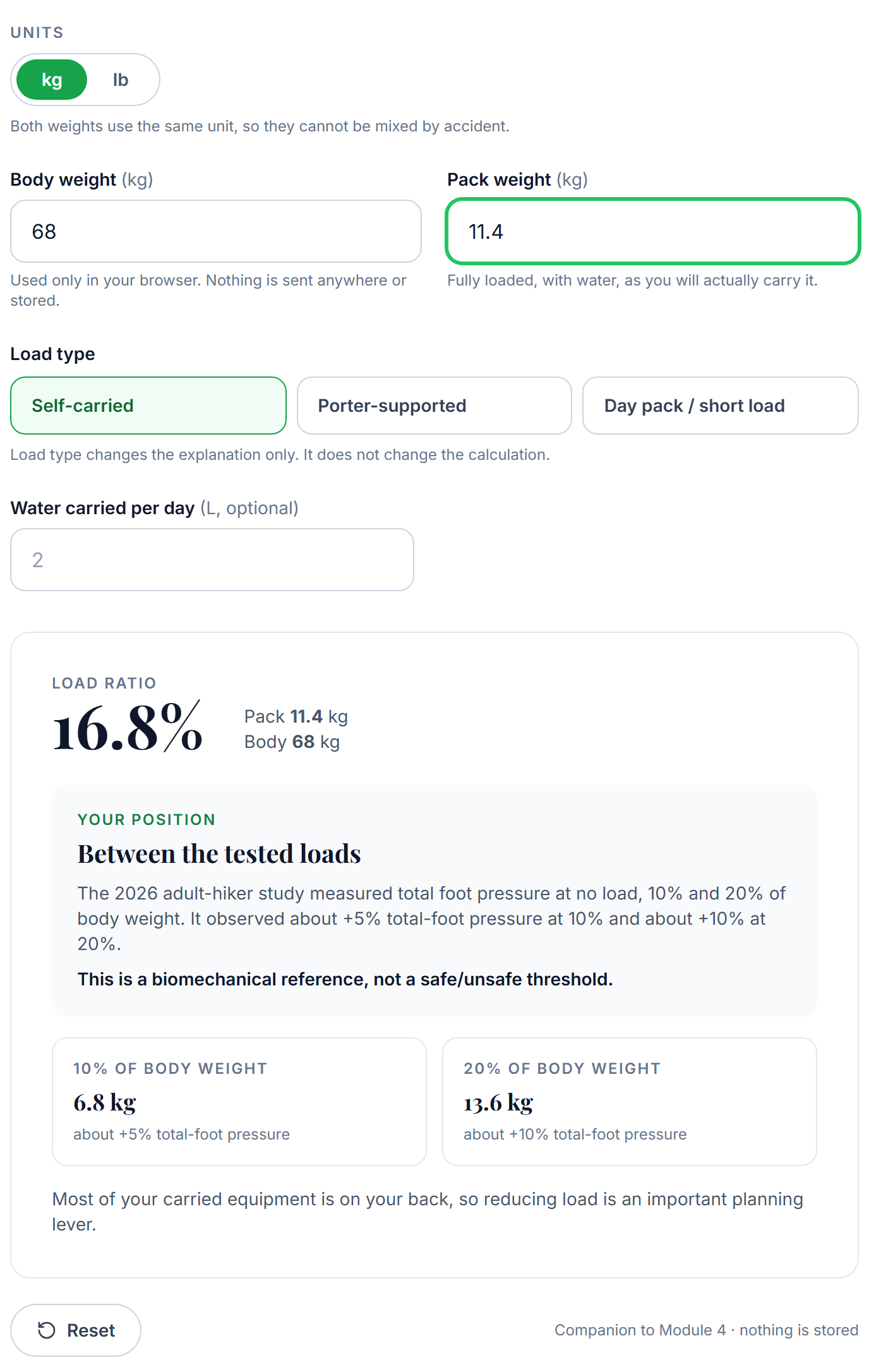
The evidence, and where it's thin
The systematic review of blister prevention in outdoor pursuits screened 806 studies, included 11, and found not much high-quality evidence supporting socks, antiperspirants or barriers. Only two of the included studies reached moderate confidence, and paper tape was the one intervention the review singled out as showing promise.
That's the honest state of this field, and it shapes how the whole system is written. Every substantive claim carries a label: strong, moderate, limited, practitioner guidance, product heuristic, or evidence conflicts. Where a number comes from our own design choices rather than research, it says so. Where the field protocol follows published guidance, the grade of that guidance is disclosed too.
You'll also find results that don't flatter the advice. One trial found that adding a liner sock to an unchanged sock didn't reduce blister incidence. An antiperspirant that cut blisters from 48% to 21% also produced skin irritation in 57% of users against 6% on placebo. Both appear in full, because leaving them out would make the rest less trustworthy.
- Prevention of Friction Blisters in Outdoor Pursuits: A Systematic ReviewWorthing RM, Percy RL, Joslin JD · Wilderness & Environmental Medicine, 2017
- Plantar Pressure Responses to Backpack Load in Long-Distance HikersMoya-Cuenca C, Zúnica-García S, Gracia-Sánchez A, et al. · Journal of Functional Morphology and Kinesiology, 2026
- Wilderness Medical Society Practice Guidelines for Basic Wound Management in the Austere EnvironmentQuinn RH, Wedmore I, Johnson E, et al. · Wilderness & Environmental Medicine, 2014
- Paper Tape Prevents Foot Blisters (Pre-TAPED II)Lipman GS, Sharp LJ, Christensen M, et al. · Clinical Journal of Sport Medicine, 2016
- Influence of an antiperspirant on foot blister incidence during cross-country hikingKnapik JJ, Reynolds K, Barson J · Journal of the American Academy of Dermatology, 1998
The evidence is graded, not asserted
Every claim carries a confidence label. Where the research is thin, the system says so instead of rounding it up into advice.
Study populations are named
Military cadets, Marine recruits, ultramarathon runners. You're probably none of those, and the numbers may not transfer, so we tell you.
Limitations are printed alongside the findings
The pack-load study measured 39 hikers, barefoot, at two load levels, and never measured injury. That appears next to the result, not in a footnote.
Climate changes the recommendation
Most foot advice assumes somewhere cold and dry. In humidity the primary threat and the correct strategy both change.
Load is treated as a measured relationship
Not a safe-pack rule. You get a ratio, two real reference points, and a direction, never a verdict.
Every module ends in an artifact
A verdict, a number, a kit list, a card. If you have the artifact, you have the module.
That 10% pack rule you've probably heard about
You'll find it everywhere: your pack should weigh no more than 10% of your body weight, and that this is the "safe" limit.
We couldn't trace where that rule came from, and we're not going to claim an origin we can't source. What we can tell you is what the adult hiker evidence actually measured.
A 2026 study of 39 recreational hikers measured plantar pressure at no load, at 10% of body weight and at 20%. Total foot pressure rose about 5% at the 10% load and about 10% at the 20% load. The authors call this early evidence of a dose–response relationship, with a change-point around 10% of body weight, and suggest that figure as a rough biomechanical reference point.
Read the limitations alongside it, because they matter. The sample was small. It was cross-sectional. Only two load levels were tested. Measurements were taken barefoot, not in hiking footwear. And the study didn't measure blisters or injuries at all.
So: load and foot pressure move together. That's a measurement, not a safety threshold. And for a self-carried multi-day pack, 10% of body weight isn't realistic for most people anyway.
The system gives you your ratio, your position against those two tested loads, and a ranked list of what to leave behind. It never tells you a pack is safe or unsafe. It can't know that, and neither can anyone else.
From start to finish, one full example
Alex: first 7-day multi-day hike, 8 weeks out
- Before
Departure in eight weeks, so the standard timeline applies. Currently walking 5–15 km (3–9 mi) a week.
- Decision
Warm days, rain expected most afternoons, footwear unlikely to dry overnight, so the climate track is HOT-WET. Heel lifts on the walk, laced with a heel lock, retest passes. Verdict: MODIFY AND RETEST, then GO.
- Calculation
Body weight 68 kg (150 lb), pack fully loaded 13 kg (28.7 lb), ratio 19.1%. Cut list: two refill points found so 1 L less is carried, second fleece and spare power bank removed. New figure 11.4 kg (25.1 lb), 16.8%.
- Trial
Dense outer sock with a thin liner, paper tape over the two mapped sites only. All of it trialled, with the tape worn two days running as an adhesive-sensitivity screen. No reaction.
- Field-ready
Trail card printed and photographed, carrying the two mapped hotspot sites, the kit actually trialled, 11.4 kg (25.1 lb) at 16.8%, and the hot-wet daily routine.
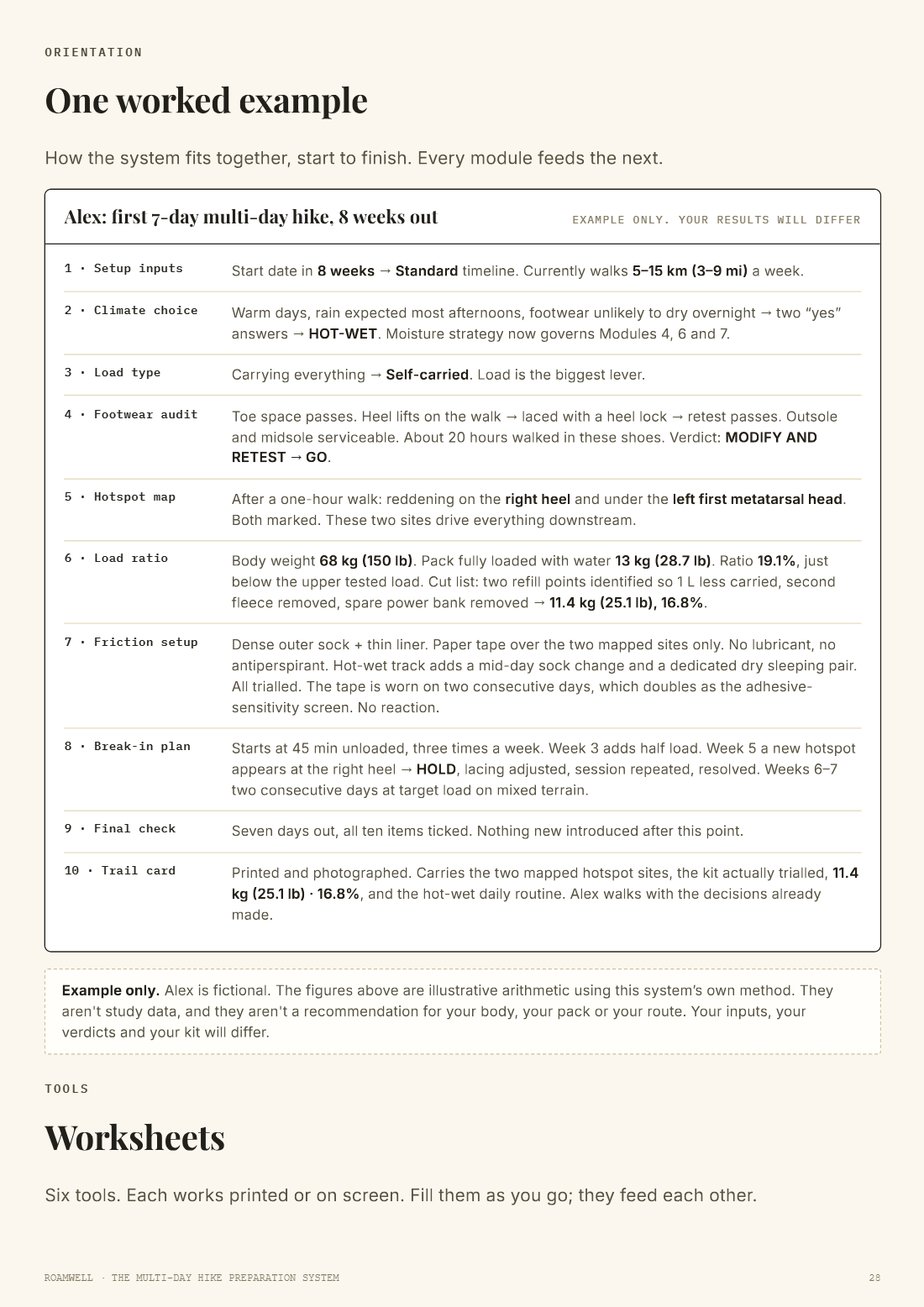
Example only. Alex is fictional. The figures are illustrative arithmetic using this system’s own method. They aren’t study data, and they aren’t a recommendation for your body, your pack or your route.
Who it's for, and who it's not
The second list matters just as much as the first. If you're on it, this isn't the thing to buy.
Built for
- Preparing for your first multi-day hike, typically 6–12 weeks out
- Carrying everything yourself, walking with a porter-supported bag, or on a day pack
- Walking anywhere, since the system runs on climate and load, not on a country or a named trail
- You want a structured process rather than another list of tips
Not built for
- Anyone wanting a fitness, strength or running programme. Good ones already exist, and this isn't one
- Altitude or acute mountain sickness guidance
- Route planning, stage guides or destination advice
- Advanced expedition training or coaching
- Medical treatment of any kind
Works wherever you are
- Every measurement in metric and imperial: kg and lb, km and miles, °C and °F
- A4 and US Letter editions, both included
- No country-specific rules, permits, healthcare systems or insurance
- No brand or retailer dependency. Products are described by function, so you buy the local equivalent
- Climate is an input you choose, not a country we assume
What this is, and what it is not
Educational and planning guidance only. This isn't medical advice, and it doesn't diagnose, treat or cure anything, or guarantee you'll avoid blisters or injury. Foot problems can have causes this system doesn't cover. If you have a health condition affecting your feet, circulation or sensation, or any symptom that concerns you, talk to a qualified professional.
Before you decide
Who is this for?
Someone preparing for their first multi-day hike, usually 6–12 weeks before departure. It works whether you're carrying everything yourself, walking with a porter-supported bag, or on a day pack.
Is this a fitness training plan?
No, and deliberately so. There's no gym work, no intervals and no strength programming. It covers feet, footwear, load and friction. If you want structured conditioning, buy a training programme. Several good ones exist, and the system says so.
Does it work for any country?
Yes. Nothing in it depends on a country, currency, retailer, brand, permit or healthcare system. Measurements are given in metric and imperial, and it ships in A4 and US Letter. The one variable that changes the advice is climate, which you select yourself.
What do I receive?
The download is a ZIP holding both PDF editions, A4 and US Letter: an eight-module preparation system of 32 pages, with six printable worksheets, four decision trees, a departure-date timeline, foot and hotspot diagrams and a one-page trail card. Alongside it there is the companion Load-Ratio Calculator, a web tool that runs on this website rather than a file inside the ZIP. Its address is printed in the guide.
What is the Load-Ratio Calculator?
A companion web tool that works out your pack-to-body-weight ratio and shows where it sits relative to the two loads the source study measured. It runs on the RoamWell website, so it is not part of the downloadable ZIP, and its address is printed in the guide. It is free and open to everyone: you do not need to buy the system, or an account, to use it.
Can I use it on my phone?
The calculator is a web page built mobile-first, so it works on a phone in your browser. The PDF is a standard A4 or Letter document, so on a phone you'll zoom as you would with any PDF. The trail card is designed to be screenshotted for exactly this reason.
Can I print the worksheets?
Yes. The worksheets and the trail card are designed for printing, and they also work annotated digitally in a PDF app.
What if my trek is less than six weeks away?
The timeline covers that. Under three weeks it switches to a salvage plan: no new footwear, prioritise load reduction and the friction setup, and learn the field protocol properly. It treats a short window as a real constraint to plan around, not a lack of motivation to fix.
Does it prevent blisters?
No, and it doesn't claim to. The systematic review in this field found little high-quality evidence supporting socks, antiperspirants or barriers. The system tells you what has actually been tested, how strongly, and how to decide anyway. Anyone promising prevention is going beyond what's actually been shown.
Is this medical advice?
No. It's educational and planning guidance. The field protocol follows published Wilderness Medical Society guidance and adds nothing beyond it. If you have diabetes, peripheral neuropathy or a circulatory condition, the system tells you not to self-treat and to see a professional instead.
Can I get a refund?
Once a digital product has been delivered, we generally don't offer refunds just because you changed your mind or didn't get around to using it, which is why this page goes into so much detail about what's included, what the limits are, and who it's not for. That is subject to the law that applies to you, and it is not a promise that every request will be refused. If a charge was made twice, a file is corrupted or you can't open it, something the page promised is missing, or the product is materially different from its description, contact us and we'll try to put it right first, and give any remedy the law requires if we can't. We also look into unauthorised payments and payment disputes. The full policy is on our refund page.
What happens after I buy?
Checkout opens in a new tab and payment is handled by Razorpay, so RoamWell never sees your card details. Once Razorpay reports the payment, our server verifies it against the order before anything is granted. You are then taken to a thank-you page where both PDF editions download as a single ZIP. Where checkout asks you to sign in with your email, the purchase is linked to that account, and the download stays available whenever you sign in to it, on any browser or device. Otherwise, and for purchases made before sign-in checkout opened, the download stays available for 30 days, in the browser you paid from: if you clear your browser data or switch device, contact us and we will review it. We do not email the download. The Load-Ratio Calculator is a free web tool and needs no purchase at all. Our delivery and refund terms are on the refund policy page.
The Multi-Day Hike Preparation System
Prepare your feet, footwear and pack before the trail does it for you
- Modules
- 8
- Worksheets
- 6
- Decision trees
- 4
- Field card
- 1 page
We research travel, fitness and wellness, and publish what holds up. See our editorial policy.
Last updated August 28, 2026
Related articles
Rucking for Beginners: How Much Weight and What It Burns
Rucking for beginners: how much weight to start with, a 4-week plan, and what the research says it really burns.
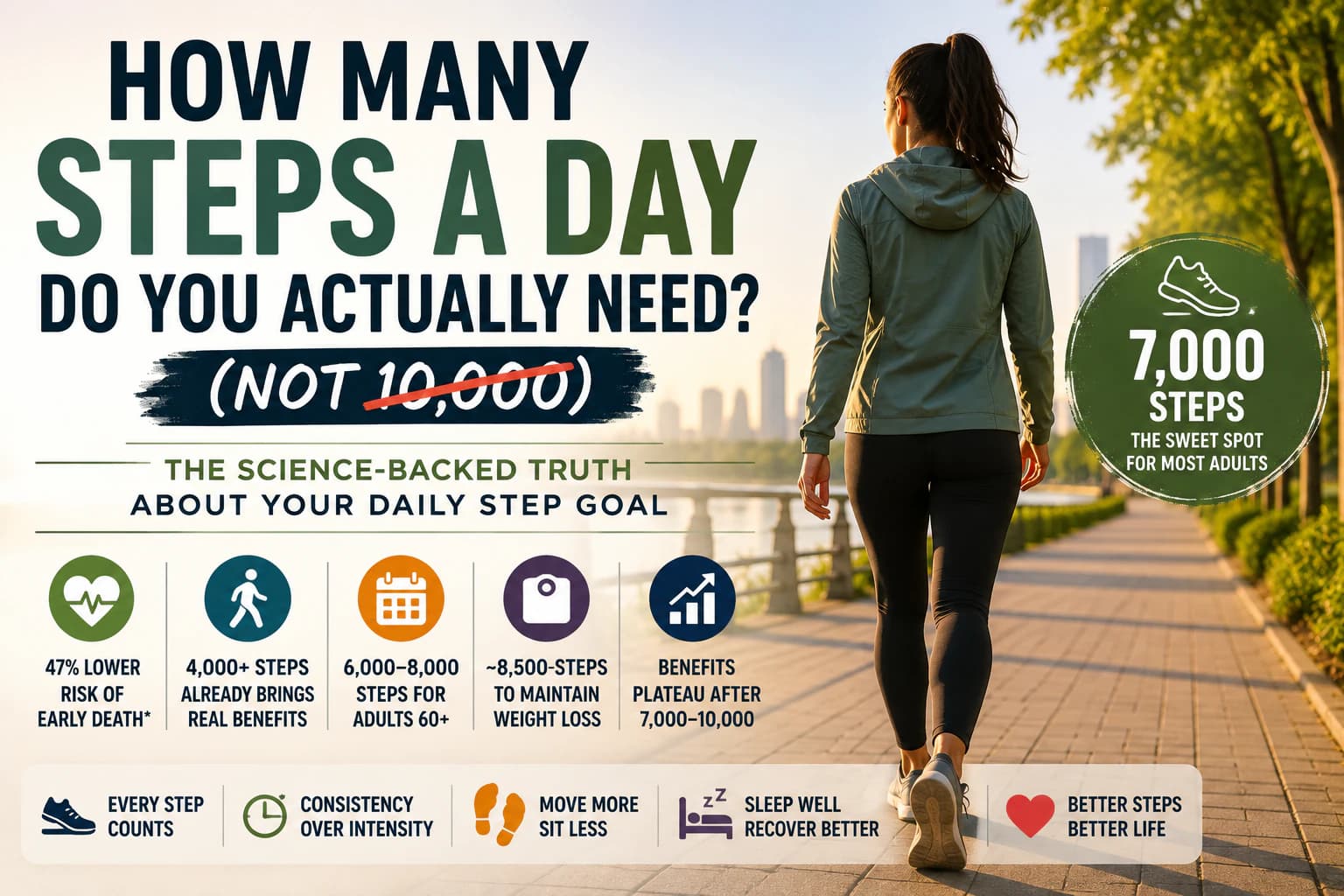
How Many Steps a Day Do You Actually Need? (Not 10,000)
How many steps a day you actually need: research points to 7,000, not 10,000, and less after 60. Your target by age.
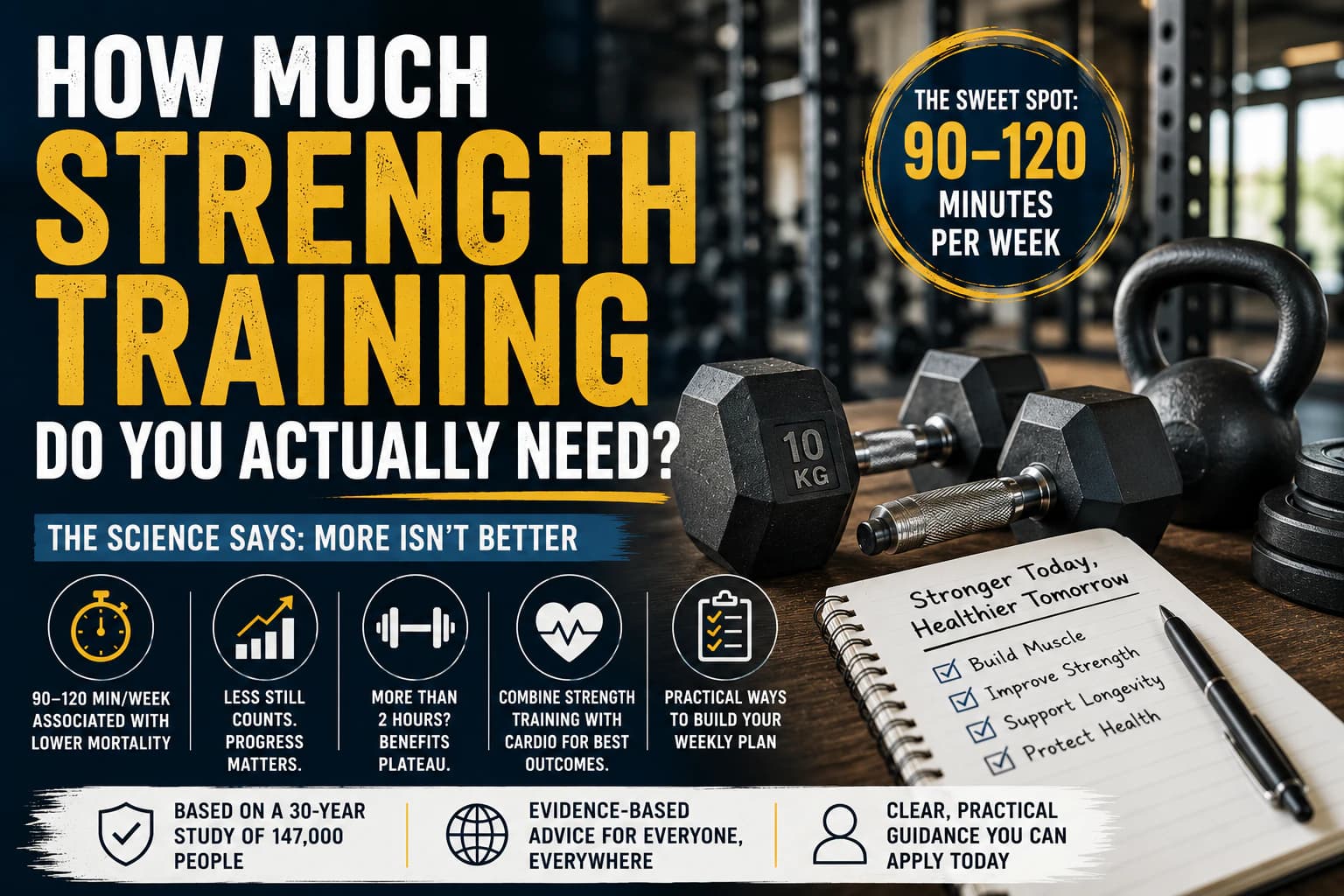
How Much Strength Training Do You Actually Need?
How much strength training per week? What a 30-year study of 147,000 people found, and why more than 2 hours adds nothing.