How Many Steps a Day Do You Actually Need? (Not 10,000)
How many steps a day you actually need: research points to 7,000, not 10,000, and less after 60. Your target by age.
Ask how many steps a day you actually need and you will get one answer everywhere: 10,000. It is one of the most widely followed health rules in the world, and it was invented to sell a pedometer.
That does not make walking less valuable, the research supporting it is genuinely strong. It means the specific number most people organise their day around has no scientific basis, and the figure that does have evidence behind it is meaningfully lower. This guide covers what the research actually supports, how it changes with age, what walking cannot do, and how to act on it.
A note on health advice: This is general information, not medical advice. Step targets from population research describe averages, not individuals. If you have an existing health condition or have been inactive for a long time, discuss changes with a doctor before substantially increasing activity.
The 30-second answer
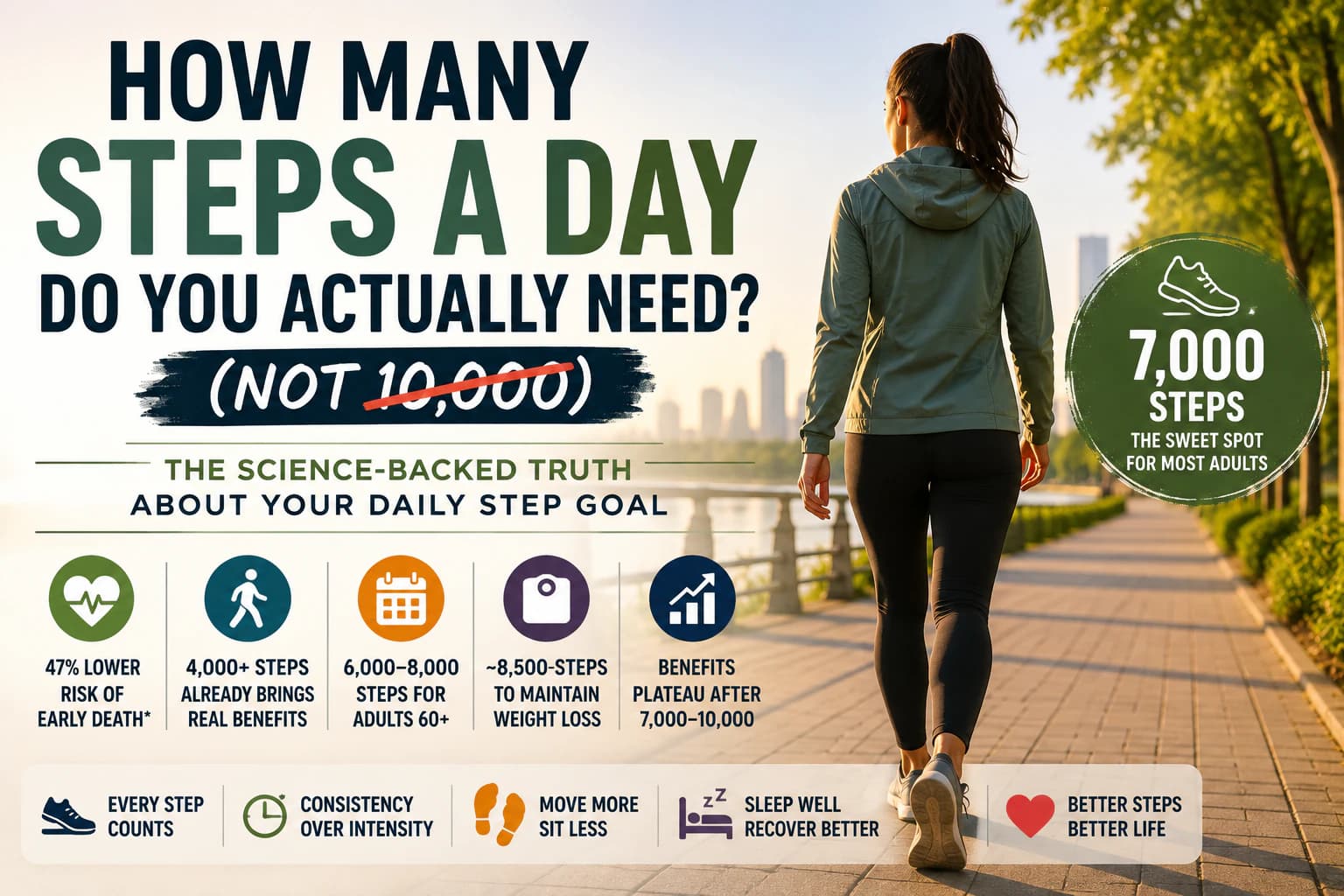
There isn't one required number for everyone, but around 7,000 steps a day is a strong practical target for many adults based on current population research, associated with roughly a 47% lower risk of early death compared with 2,000 steps. The curve flattens after that, with no clear additional mortality benefit found beyond around 10,000 in the cited analysis. Adults over 60 tend to plateau earlier, around 6,000-8,000 steps a day.
- Most adults: 7,000/day is the evidence-backed practical target, not a mandatory 10,000
- Over 60: 6,000-8,000 is a reasonable range, the curve tends to flatten sooner
- Starting low: 2,000 → 4,000 already produces measurable improvement
- Currently very low (e.g. ~400/day): that's a starting point, not a failure, gradually building up from there brings meaningful benefits
- Weight maintenance: around 8,500/day is the figure associated with it in the research
- Beyond 10,000: no clear additional mortality benefit found in the cited analysis, not evidence that more steps stop helping in every way
- What walking won't do: meaningfully build strength or bone density on its own, pair it with resistance training
Where the 10,000-step goal actually came from
In 1965, the Japanese company Yamasa Tokei Keiki launched a pedometer named the Manpo-kei. The name breaks down as man (10,000), po (steps), kei (meter), literally "10,000-step meter."
The number was picked because it was round, memorable and marketable. No research had examined 10,000 steps as a threshold at the time. It was a slogan.
It spread from Japanese consumers to health-conscious walkers worldwide, and is now the default daily goal preset into most fitness wearables, which is why it feels like a clinical recommendation rather than a piece of 1960s advertising copy.
How many steps a day the research actually supports
The strongest recent evidence is a systematic review and dose-response meta-analysis of 57 studies published in The Lancet Public Health, led by Professor Melody Ding at the University of Sydney. It drew on studies from 2014-2025 across more than ten countries.
Measured against 2,000 steps a day, 7,000 steps was associated with:
| Outcome | Risk reduction |
|---|---|
| All-cause mortality | 47% |
| Dementia | 38% |
| Falls | 28% |
| Cardiovascular disease | 25% |
| Depression | 22% |
| Type 2 diabetes | 14% |
| Cancer | 6% |
Two qualifiers matter. Around 4,000 steps already delivers meaningful benefit, and while a few outcomes keep improving past 7,000, most plateau there.
A separate cohort study following 2,110 adults for around 11 years found that participants taking at least 7,000 steps daily had a 50-70% lower mortality risk than those below that mark.
The shape of that curve is the practical takeaway. Benefits accumulate fastest at the low end and flatten out well before 10,000. The distance from 2,000 to 5,000 steps matters more to your health than the distance from 8,000 to 11,000.
Your step target by age and goal
| Group or goal | Target | Basis |
|---|---|---|
| Adults under 60 | 7,000-10,000 | Mortality risk plateaus around 8,000-10,000 |
| Adults 60+ | 6,000-8,000 | Risk tends to level off earlier; more shows no clear added longevity benefit in the research |
| Adults in their 70s | 5,000-7,000 | Realistic and beneficial; benefits appear from ~4,500 |
| Currently sedentary | +2,000 on current | The steepest gains are at the low end |
| Maintaining weight loss | ~8,500 | Associated with preventing regain in ECO 2026 research |
| General longevity | ~7,000 | The clearest single figure in the evidence |
If you are currently averaging 3,000 steps, the useful target is 5,000, not 10,000. Chasing a number you will abandon in a fortnight is worse than reliably hitting a lower one.
Does walking actually burn enough to lose weight?
Honestly: it helps, but it is not the main lever.
Roughly 1,000 steps burns an estimated 30-40 calories for a 150-pound adult. So 10,000 steps is somewhere around 300-400 calories: real, but modest against daily intake, and easily cancelled by a single snack.
These are estimates rather than precise measurements, actual calorie burn depends on body weight, pace and terrain. Brisk walking at 3.5 mph, for a 155-pound adult:
| Duration | Calories |
|---|---|
| 10 minutes | ~50 |
| 20 minutes | ~100 |
| 30 minutes | ~150 |
| 60 minutes | ~300 |
A 160-pound adult burns around 256 calories per hour at a moderate 3.0 mph, rising to about 315 at 3.5 mph. Heavier adults can exceed 400 in an hour.
The more interesting finding is about keeping weight off. Research presented at ECO 2026 found around 8,500 steps a day was associated with a lower likelihood of weight regain following an initial diet and lifestyle programme. Walking appears stronger as a maintenance tool than as a fat-loss tool. For losing fat in the first place, a calorie deficit does the work, our belly fat guide covers how to set one up.
What counts as a brisk walk
Intensity is where most step counts quietly fail. Ten thousand slow steps around a house is not the same stimulus as 7,000 brisk ones.
The usable threshold is cadence, useful as a rough practical marker rather than a fixed physiological rule, since height, fitness level and terrain all shift the relationship between cadence and actual intensity:
| Cadence | Intensity |
|---|---|
| Under 100 steps/min | Light |
| ~100 steps/min | Moderate: the threshold (~3 METs) |
| 100-130 steps/min | Brisk range |
| ~130 steps/min | Vigorous |
| ~140 steps/min | Jogging |
In speed terms, brisk walking is generally 3.0-4.5 mph. The field test without a device: you should be breathing harder but still able to hold a conversation. If you can sing, go faster. If you cannot speak a full sentence, ease off.
This matters because brisk walking sits in the moderate-intensity band used by the CDC's adult activity guidelines and the American Heart Association, so it counts toward the 150 weekly minutes those recommend. Strolling steps still beat sitting, but they do not reach that threshold.
The 6-6-6 walking challenge, examined
The structure: 6-minute warm-up, 60-minute brisk walk, 6-minute cooldown: 72 minutes total. The name also references walking at 6 am or 6 pm as a habit anchor, though the hour itself is not important.
What it gets right. It prioritises consistency over intensity, includes a warm-up and cooldown, and the 60-minute brisk block comfortably clears weekly moderate-activity guidelines.
What to know before committing. Seventy-two minutes daily is a significant time commitment, and it is the completeness rather than the walking that draws expert criticism: walking alone does not provide sufficient stimulus for strength, power, flexibility, mobility, balance or bone density. As one component of a broader routine it is sound. As an entire fitness programme it leaves real gaps.
The 12-3-30 workout, examined
The structure: 12% incline, 3 mph, 30 minutes on a treadmill. It spread after Lauren Giraldo shared it in 2019 and 2020, describing a 30-pound weight loss.
The incline is what makes it work. As an example, a 155-pound person burns roughly 267 calories per hour walking flat at 3.5 mph, but can exceed 420 calories walking uphill at the same speed: an increase of around 58% from gradient alone in that example. Actual numbers shift with body weight, incline and pace.
Load is another lever. Measured under different conditions, on level ground at a slower pace, beginner pack weights raised energy expenditure by closer to 10-25%, which our guide to rucking for beginners covers alongside how much weight to start with.
A 2025 study comparing incline walking with running found:
| Measure | Incline walking | Self-paced run |
|---|---|---|
| Calories burned | Roughly equivalent | Roughly equivalent |
| Energy from fat | ~41% | ~33% |
| Time to ~300 calories | ~30 min | ~24 min |
Running is more time-efficient. Incline walking is substantially lower impact and draws a higher proportion of energy from fat. Neither is universally better, the low-impact quality is what makes incline walking sustainable for people who cannot tolerate running volume.
Where 6-6-6 varies duration and 12-3-30 varies incline, a third viral routine varies intensity directly: our Japanese walking guide covers the 3-minute-brisk, 3-minute-easy interval structure, and what the underlying research actually tested versus what the trend simplifies.
What walking will not do
This is the section most walking content omits, and it is the one that matters most as you age.
Walking is genuinely excellent for cardiovascular health, longevity, mood, blood glucose control and weight maintenance. It does not meaningfully develop:
- Muscular strength and power
- Bone density
- Flexibility and mobility
- Balance
Adults lose muscle mass progressively from their 30s onward, and walking does not arrest that. The fix is not complicated: two or three resistance sessions a week alongside your walking covers what walking cannot, and how much strength training you need sets out the weekly amount worth targeting. Bodyweight work is enough to start, our 30-day beginner home workout needs no equipment.
Treat walking as the foundation, not the whole structure.
How to add steps without adding time
Distributing steps works better than scheduling them, because it survives a bad week.
- Take calls walking. The single highest-yield swap for desk workers.
- Walk the first 10 minutes of a lunch break. Roughly 1,000-1,200 steps.
- Get off one stop early, or park at the far end of the car park.
- Use stairs deliberately rather than opportunistically.
- Add a loop after dinner. Also blunts the post-meal glucose rise.
- Pace during anything you would otherwise sit through: podcasts, phone queues, waiting.
Three scattered 10-minute walks add roughly 3,500 steps without setting aside a single dedicated block. For keeping this going while away from home, our travel fitness guide covers routines that survive hotels and airports.
How accurate is your step counter?
Accurate enough to track your own progress, with a known bias.
| Device | Accuracy note |
|---|---|
| Apple Watch | Tracked closest to validated accelerometers |
| Smartphone apps | Next closest; within 5-10% on flat ground |
| Galaxy Watch 4 | Lower correlation than the above |
| Garmin vs Fitbit | ~1.8% vs ~8.0% error rate |
| Any device on stairs | Errors of 9-41% recorded |
Two practical points. First, wearables systematically overcount rather than undercount, so your real total is likely a little lower than displayed. Second, a phone only counts steps while it is on your body, every trip around the house without it is invisible.
Because devices disagree with each other, compare yourself against your own baseline on your own device, not against someone else's number.
Common mistakes
- Treating 10,000 as a pass mark. People who hit 6,500 conclude they failed, when they have captured most of the available benefit.
- Ignoring intensity entirely. Ten thousand shuffling steps and 7,000 brisk ones are not equivalent stimuli.
- Jumping straight to a large target. Going from 3,000 to 12,000 overnight is how people acquire shin splints and quit in week two.
- Assuming walking covers everything. It does not touch strength, bone density or balance.
- Expecting walking alone to drive fat loss. At 300-400 calories per 10,000 steps, diet is doing the heavy lifting.
- Walking in worn-out shoes. Compressed midsoles are a more common source of complaints than the walking itself.
- Comparing device totals with other people. Different devices, different errors, meaningless comparison.
What nobody tells you
- The benefit curve is steepest where you are weakest. If you are sedentary, your first 2,000 extra steps are worth more than an enthusiast's last 2,000.
- Downhill loads knees harder than uphill. People blame flat walking volume for knee pain that came from steep descents.
- Treadmill and outdoor walking are not mechanically identical. The same displayed speed may not feel exactly the same outdoors. A 1-2% incline closes most of that gap for many walkers.
- Post-meal walks have a specific effect on blood glucose that pre-meal walks do not, even a short one, commonly cited around 10-15 minutes as a practical example, appears enough to matter.
- Cadence is easier to control than speed. Most people cannot judge 3.5 mph, but almost anyone can count steps for 15 seconds and multiply by four.
- Your device's default 10,000 goal is a 1965 advertising decision that nobody at the manufacturer has revisited.
A realistic 4-week plan
Built for someone currently averaging around 3,000-4,000 steps a day.
| Week | Daily target | Focus |
|---|---|---|
| 1 | Current + 1,000 | Establish a baseline. Measure before changing anything. |
| 2 | Current + 2,000 | Add one deliberate 10-minute brisk walk. |
| 3 | Current + 3,000 | Extend the brisk block to 20 minutes at ~100 steps/min. |
| 4 | 7,000, or current + 3,500 | Hold. Add two short resistance sessions. |
If week three feels difficult, repeat it rather than advancing. The target is a habit that survives month six, not a fortnight of impressive numbers.
Who should talk to a doctor first
Walking is among the safest activities available, but a large increase in volume is still a change in physical stress. Check first if you have:
- Existing cardiovascular disease or uncontrolled blood pressure
- Diabetes with complications, particularly affecting the feet
- Joint conditions, or a history of falls
- A long period of inactivity or significant deconditioning
Stop and seek medical advice if activity brings on chest pain, unusual breathlessness, dizziness or fainting. General guidance on activity levels is published by the World Health Organization.
The bottom line
Seven thousand steps a day captures most of the measurable benefit for most adults, and the number drops further after 60. The 10,000 figure is not dangerous, just arbitrary, a 1965 product name that outlived its pedometer and got written into everybody's phone.
The two things worth changing: aim for a number you will actually hit consistently rather than one that makes you feel behind, and add resistance training, because the one thing walking genuinely cannot do is the thing that matters most as you get older.
Related reads:
Frequently asked questions
Answers to the most common questions about this topic.
Both work for total volume. Accumulated steps throughout the day count toward your total and toward overall activity. However, one continuous brisk walk of 20-30 minutes is more likely to reach and sustain the moderate-intensity threshold that formal exercise guidelines are built around. A reasonable approach is a deliberate brisk walk most days, with incidental steps on top rather than instead.
The evidence is consistent. The Lancet Public Health meta-analysis found 7,000 steps a day associated with a 22% lower risk of depression compared with 2,000. Walking combines light physical activity, daylight exposure and, when done outdoors, a change of environment, all of which independently support mood. It is not a treatment for clinical depression or anxiety on its own, but as a low-cost, low-barrier daily habit the supporting evidence is strong. See our anxiety techniques guide for approaches with clinical evidence behind them.
For most people, walking is a low-impact form of activity that can support mobility and overall joint health. It is low-impact compared with running and helps maintain joint mobility and the muscle that supports the knee. Problems more often come from sudden large increases in volume, worn-out footwear, or steep downhill walking, which loads the knee joint considerably more than flat ground. Increase volume gradually. If you have existing joint problems or pain that worsens with walking, get it assessed rather than pushing through.
Outdoors has some advantages: uneven terrain engages stabilising muscles, daylight supports circadian rhythm and mood, and there is no cost. Treadmills offer controlled incline, weather independence and precise pacing, which makes structured sessions like 12-3-30 possible. Treadmill and outdoor walking are not mechanically identical, so the same displayed speed may not feel exactly the same outdoors, many walkers find a small incline of 1-2% on the treadmill brings the effort closer to equivalent.
Mood and energy changes are often noticed within one to two weeks. Cardiovascular fitness improvements typically appear over four to eight weeks of consistent activity. Visible body composition change depends far more on diet than on step count, since 10,000 steps represents roughly 300-400 calories. Set expectations accordingly: walking is a strong health and maintenance habit, and a supporting rather than leading tool for fat loss.
A walk after eating has a specific advantage. Even short walks after a meal can help blunt the post-meal blood glucose rise, commonly cited around 10-15 minutes as a practical example, though the exact amount needed likely varies by person. If your main goal is general health and habit-building, the timing matters far less than whether the walk happens at all. Choose the slot you will actually keep.
Not special, but appropriate. Shoes with adequate cushioning and a fit that leaves room at the toe are the practical requirements. Dedicated walking or running shoes are designed for repetitive forward motion; flat casual shoes and worn-out trainers are the more common source of foot and knee complaints. Replace shoes when the midsole feels compressed rather than waiting for visible wear on the outsole.
Filed under
Written by
We research travel, fitness and wellness, and publish what holds up. See our editorial policy.