How Much Strength Training Do You Actually Need?
How much strength training per week? What a 30-year study of 147,000 people found, and why more than 2 hours adds nothing.
If you have ever looked up how much strength training per week you should be doing, you have probably met the same answer everywhere: at least twice a week. It is not wrong. It is just a floor, expressed in sessions, and it does not tell you how much training to actually aim for.
A large study published in mid-2026 gives a more useful lens. It tracked how many minutes of resistance training people did each week, over decades, and looked at what happened to them.
The answer it points to is more specific than "twice a week," and more interesting than "more is better."
A note on health advice: This is general information, not medical advice. The research below is observational, which means it can show associations but cannot prove that strength training causes the outcomes described. If you have a medical condition, are returning to exercise after a long break, or are unsure where to start, consider discussing your plan with a healthcare professional.
The 30-second answer
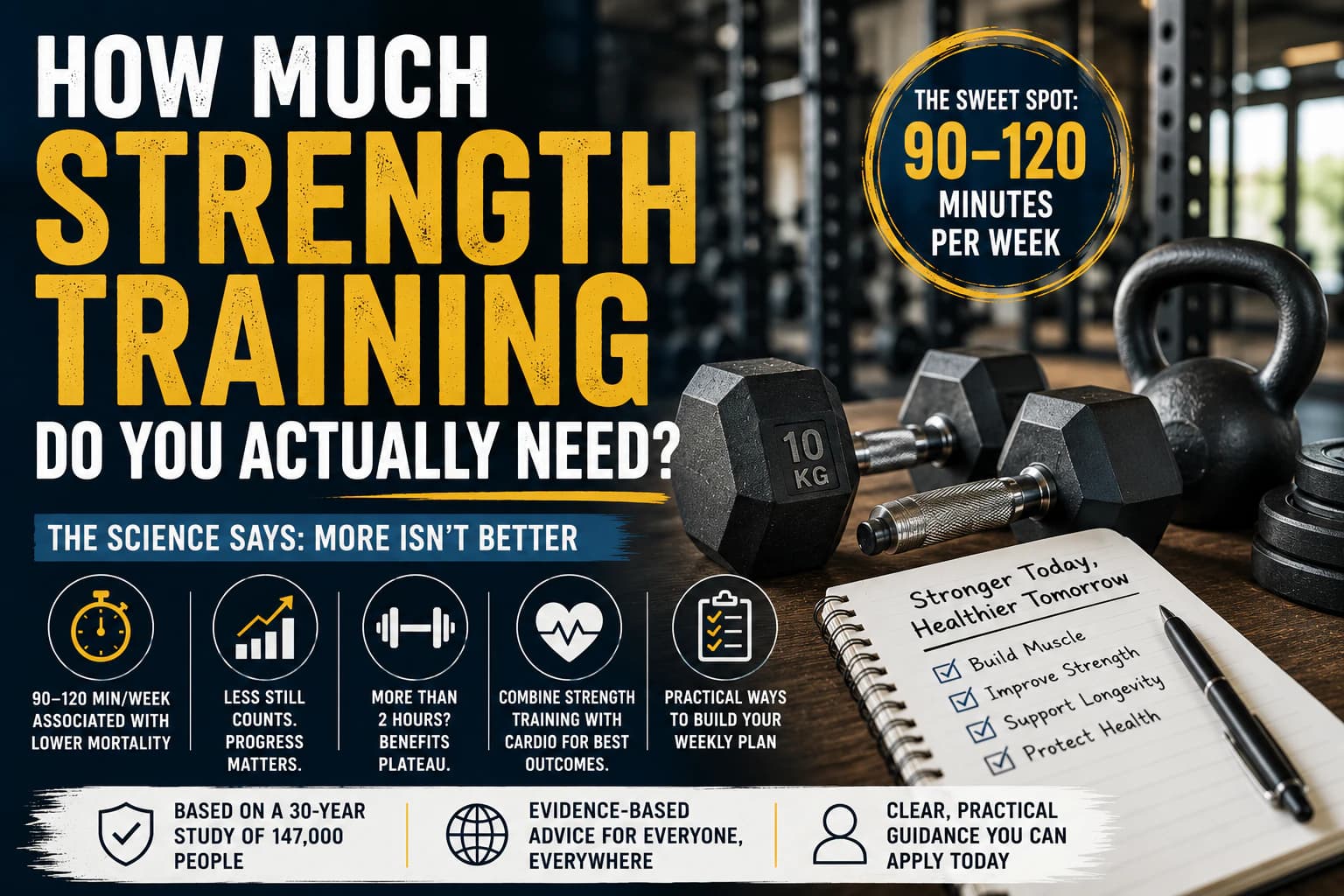
There is no universal number, but the best current evidence points at roughly 90 to 120 minutes of strength training a week as a sensible target for general health. Below that still counts. Above it, the health returns flatten, though training more can still serve strength and performance goals.
- The target: about 90 to 120 minutes a week, total, across two or more sessions
- Less still counts: lower amounts were associated with benefit too, just smaller
- The ceiling: no extra mortality benefit above roughly 120 minutes in this data
- Not a maximum: more training can still build strength, muscle and performance
- Pair it with cardio: the lowest risk appeared in people doing both
- Minutes are a planning tool: effort and progression decide what those minutes do
What the new research actually found
The study is Long-term resistance training with all-cause and cause-specific mortality, published in the British Journal of Sports Medicine in June 2026 by researchers at the Harvard T.H. Chan School of Public Health, working with colleagues at Yonsei University in South Korea, the Universidade Federal de São Paulo in Brazil and the Universidad Autónoma de Chile.
The design. It pooled three long-running prospective cohorts: the Health Professionals Follow-up Study (1992 to 2022), the Nurses' Health Study (2002 to 2021) and the Nurses' Health Study II (2003 to 2021). Weekly resistance training and aerobic exercise were reported through validated questionnaires at the start and then every two years afterward, which matters: this is repeated measurement over decades, not a single snapshot.
The scale. 147,374 participants, 31,540 men and 115,834 women, followed for up to 30 years, during which 35,798 deaths were recorded.
The main finding. Compared with people reporting no resistance training, those reporting 90 to 119 minutes a week had:
| Outcome | Association | Hazard ratio |
|---|---|---|
| All-cause mortality | 13% lower risk | 0.87 (95% CI 0.81 to 0.95) |
| Cardiovascular mortality | 19% lower risk | 0.81 (95% CI 0.67 to 0.97) |
| Neurological disease mortality | 27% lower risk | 0.73 (95% CI 0.58 to 0.92) |
Those figures were adjusted for aerobic activity, so they are not simply picking up the fact that people who lift also tend to run.
The ceiling. Above 120 minutes a week, no additional benefit was observed. The authors describe the lowest risks as plateauing at around 120 minutes a week or more, a point the journal's own publisher summarized as 90 to 120 weekly minutes being potentially optimal for lowering death risk.
Two findings most coverage skipped. First, the association with cancer mortality behaved differently from the others: it appeared only at the lower end, with a 9% lower risk at 1 to 29 minutes a week and 12% lower at 30 to 59 minutes, rather than growing with more training. Second, in the joint analysis combining both exercise types, the lowest mortality risk of all appeared among people doing both, with a hazard ratio of 0.55 for those getting 30 to under 45 MET-hours per week of aerobic activity alongside 60 to 119 minutes of resistance training. MET-hours combine how hard an activity is with how long it lasts, so they describe total aerobic load rather than time alone.
That combined figure is arguably the more important result. Harvard T.H. Chan's summary puts it plainly: participants doing both had among the lowest mortality risks, up to 45% lower than those doing neither.
What "associated with" is doing in those sentences
This is observational research. Nobody was assigned to lift weights. Researchers recorded what people said they did and tracked what happened over the following decades.
That design cannot establish cause. Healthier people may train more, and the relationship can run in both directions. The authors say so directly, and they flag reverse causation as a particular concern for the neurological findings, noting that physical activity tends to decline progressively long before dementia is diagnosed. Some of that striking 27% may reflect early disease reducing training rather than training protecting against disease.
None of this makes the study weak. Repeated measurement across 147,374 people over 30 years is about as good as observational evidence gets. It does mean the honest phrasing is "was associated with," not "will reduce your risk by 13%."
Why "twice a week" became the standard answer
The familiar guidance is not wrong, and it is worth understanding where it comes from.
Public health guidelines are written to be achievable at population scale. They set a floor that most people could reach, expressed in the simplest unit available: sessions per week. The World Health Organization frames global recommendations around at least 150 minutes of moderate-intensity physical activity per week, and states plainly that muscle strengthening benefits everyone.
Separately, the study cites the 2018 Physical Activity Guidelines, which set a more specific aerobic target of 150 to 300 minutes a week of moderate or 75 to 150 minutes of vigorous activity, expressed there as 7.5 to 15 MET-hours per week. Those same guidelines frame the muscle-strengthening advice as frequency rather than duration.
That gap is exactly what this research fills. "Twice a week" tells you how often. It does not tell you how much, and two sessions can mean 40 minutes or two hours depending on how they are structured.
So the two answers are not in conflict. Think of it this way: twice a week is the floor, roughly 90 to 120 minutes is a target worth aiming at, and the distance between them is where most people's actual decisions live.
The ceiling: what "more isn't better" does and doesn't mean
This finding is the easiest one to misread, so it is worth being precise.
What the study found: in this population, on this outcome, additional weekly minutes beyond about 120 were not associated with further reductions in mortality risk. The curve flattened.
What the study did not find:
- That training more than two hours a week is harmful
- That extra training is pointless
- That strength or muscle gains stop at 120 minutes
- That athletes should cap their training
- That everyone should train exactly 90 to 119 minutes
Mortality is one outcome. It is not the only reason people train, and it is a fairly blunt instrument for judging a training program. The study measured deaths over decades. It did not measure how much stronger anyone got, how much muscle they carried, how well they moved, how they felt, or how they performed.
Those things respond to training doses well beyond 120 minutes a week, and the research says nothing to contradict that. If you are training for a physique goal, a sport, or an event like a first HYROX race, your programming should be driven by that goal, not by a mortality curve.
The useful takeaway is narrower and more practical: if your only reason for strength training is general health, you can stop feeling guilty about not doing more. The point where extra time stops paying off in this particular currency arrives earlier than most people assume. That is genuinely freeing for anyone who has been treating training volume as an open-ended obligation.
What counts as strength training?
In everyday terms, strength training means loading your muscles against meaningful resistance and gradually increasing that demand. That includes free weights, machines, resistance bands, and bodyweight exercises hard enough to be challenging.
For reading this particular study, though, one detail matters a great deal.
The questionnaires used did not capture calisthenics or Pilates. The authors state this plainly as a limitation. So when the study reports on "resistance training," it is describing a narrower set of activities than the everyday meaning of the phrase.
This cuts both ways, and it is worth being careful:
- It does not mean calisthenics and Pilates fail to build strength. Plenty of other evidence says they can.
- It does not mean those activities carry the same mortality association. They were not measured, so the study is silent on them.
If you train mainly with bodyweight movements, the reasonable position is that you are almost certainly doing something worthwhile, and that this specific study cannot confirm it. Our 30-day beginner home workout plan uses that kind of training, and it remains a sensible starting point for anyone without equipment, with the honest caveat that the research above was measuring something different.
Turning weekly minutes into a real week
Here is where the number becomes usable. The examples below are practical illustrations, not prescriptions from the study, which measured only total weekly minutes and made no recommendations about session structure.
| Pattern | Sessions | Roughly | Suits |
|---|---|---|---|
| Two longer sessions | 2 × 50 min | 100 min | Busy weeks, gym access, full-body training |
| Three moderate sessions | 3 × 35 min | 105 min | Most people; easier recovery, more consistency |
| Four short sessions | 4 × 25 min | 100 min | Home training, tight schedules, split routines |
| Two plus a top-up | 2 × 40 + 1 × 20 | 100 min | Adding a short session around existing habits |
Every row lands in a similar weekly place. None is obviously superior, and the best one is the one you will still be doing in six months.
Why 90 minutes looks so different from person to person
Two people can both report 90 minutes and be doing very different things, because session time is dominated by variables the study never recorded:
- Rest periods. Resting three minutes between heavy sets instead of one triples the clock without tripling the work.
- Exercise count. Six exercises take longer than four, which is not the same as being better.
- Warm-up. Ten minutes of preparation counts toward your time but is not the training stimulus.
- Effort. Sets taken close to genuine difficulty produce far more adaptation per minute than comfortable ones.
- Structure. Supersets and circuits compress time. Straight sets with long rests expand it.
The authors acknowledge exactly this gap, noting they did not collect details such as the duration of active exercise or the time between sets. Minutes are a planning unit. They are not a measure of training quality.
Sets, frequency and effort: what minutes don't tell you
If minutes are the container, these are the contents. The study cannot speak to any of them, so what follows is general training principle rather than findings from this research.
Frequency. Training a muscle group across two or more sessions a week is a common approach and fits neatly with recovery. It also means a missed session costs you less.
Sets. Several hard sets per major muscle group per week is a reasonable working range for most people. Counting sets is only meaningful alongside effort. Ten easy sets do less than four hard ones.
Effort. This is the variable people most often underestimate. Adaptation is driven by sets taken close enough to genuine difficulty that the last repetitions are a real struggle. Comfortable training maintains. It rarely builds.
Progressive overload. The demand has to rise over time, through more weight, more repetitions, better control or harder variations. Without progression, a program becomes maintenance, which is a legitimate goal but a different one.
Exercise selection. Compound movements that train several muscle groups at once give you more per minute, which matters most when time is short.
Recovery. Adaptation happens between sessions, not during them. Sleep is the single largest lever here, and our 30-day guide to sleeping better covers it properly.
How to tell whether your minutes are working
Weekly minutes are easy to track and tell you almost nothing about whether training is doing its job. These signals do, and none requires equipment or testing:
- The same weight feels easier over several weeks. This is the clearest early sign, and it usually shows up before any visible change.
- You are adding something. A repetition, a small increase in load, a harder variation, better control. If nothing has moved in a month, the program has become maintenance.
- Everyday tasks change. Stairs, luggage, carrying shopping, getting off the floor. These are the outcomes that actually matter for most people, and they shift earlier than appearance does.
- You recover between sessions. Mild stiffness for a day or two is normal. Fatigue that carries into the next session, week after week, suggests the volume is ahead of your recovery.
- You are still doing it. Consistency over months is the variable that separates people who benefit from people who have an impressive first two weeks.
If none of these is moving, adding minutes is rarely the fix. Adding effort or progression usually is.
Strength training and longevity: what we can and cannot say
What the evidence supports: across a very large group followed for a very long time, people who did moderate amounts of resistance training tended to die less often over the follow-up period than people who did none, after accounting for aerobic activity. The pattern held across cardiovascular and neurological outcomes and appeared consistently rather than as a one-off result.
What it does not support: that strength training caused those differences, that a specific person will get a specific risk reduction, or that reaching 90 minutes a week produces a measurable personal benefit you could ever observe.
Population-level associations do not transfer cleanly to individuals. A 13% lower risk across 147,374 people is a statement about a group, not a promise to you.
The more useful framing may be the combined finding. The lowest mortality risk appeared among people doing both aerobic and resistance training, and the authors observed that while either alone was associated with lower risk, aerobic activity conferred the greater benefit. Strength training complements cardiovascular exercise. It does not substitute for it.
The combination beat either half
The joint analysis is worth sitting with, because it reframes the whole question.
Participants with both a solid aerobic load and moderate resistance training showed a hazard ratio of 0.55, meaning their mortality risk over the follow-up period was roughly 45% lower than the reference group doing neither. That is a substantially larger gap than the 13% attached to resistance training alone.
There is a second detail that complicates any simple "add weights" message. Among participants already reaching very high aerobic volumes, at or above 45 MET-hours per week, hazard ratios sat between 0.53 and 0.58 more or less regardless of how much resistance training they did. In that group, additional strength work was not associated with much further reduction in this outcome.
Read together, the pattern is not "lifting is the answer." It is closer to: doing very little of either is the real risk, the two together look better than either alone, and the aerobic side carries more of the weight than gym culture usually admits.
If your aerobic side is thin, our guide to how many steps a day you actually need covers that half of the equation, and rucking is one way to combine loaded carrying with walking volume.
Where the evidence is weaker
Taking a study seriously means being clear about its limits. The authors are candid about these in the full text, and they matter for how much weight to put on the numbers.
- It is observational. Participants chose their own training. Cause cannot be established, and the authors acknowledge reverse causation remains possible.
- Training was self-reported. People are imperfect at recalling and estimating exercise. The authors note measurement error was inevitable, while arguing that validated questionnaires and cumulative averages from repeated assessments likely reduced it.
- Some activities were not captured. Calisthenics and Pilates were outside the resistance training measure.
- No intensity or session detail. The study did not record the duration of active exercise or the time between sets, so it cannot distinguish hard training from easy training.
- The population was narrow. Participants were primarily white, middle-aged to elderly health professionals. That is a group with above-average health literacy and access to care, and the findings may not transfer identically to other populations worldwide.
- It cannot produce a program. Nothing in the design supports specific advice about sets, repetitions, exercises or loads.
None of this means ignore it. It means read it as a well-conducted study of one exposure and one outcome, in one kind of population, rather than as a training manual.
The cancer result shows why dose-response is not simple
There is one finding in this study that quietly undercuts any tidy "more training, better outcomes up to 120 minutes" story, and it deserves attention precisely because it is inconvenient.
For cancer mortality, the association did not follow the same shape at all. It appeared only at the lowest levels of resistance training and then faded, rather than strengthening with more. Small amounts were associated with modestly lower cancer mortality. Larger amounts were not.
Nobody should build a training plan around that. It may reflect confounding, chance across many analyzed subgroups, or something about who trains a little versus a lot. The point is what it demonstrates: different causes of death did not respond to the same exposure in the same way, which is a strong argument against treating any single weekly number as a universal health dial.
When a study's own results disagree with each other by outcome, that is a reason to hold the headline figure loosely.
Who should adjust the plan
General targets assume a healthy adult with no particular constraints. Several groups reasonably start somewhere different.
Complete beginners. Start below the target and build toward it. The study's senior author, Edward Giovannucci, made this point directly in the Harvard summary: for people who are less active, small amounts can still matter, and building a routine gradually may be more important than trying to do a lot at once. That is the single most useful sentence to take from this research if you are starting from zero.
Returning after a long break. Your tissues need more time than your enthusiasm suggests. Previous training history returns faster than most people expect, so there is little reason to rush the first few weeks.
Older adults. This age range is where the study population sits, so the evidence is most directly relevant. Maintaining strength matters for everyday function and independence, not only for long-term health markers.
People managing injuries. Working around an injury is normal and usually better than stopping entirely, but which movements are appropriate is specific to the injury. That is a question for a qualified professional, not a general guide.
People with cardiovascular, neurological or musculoskeletal conditions. Strength training is widely used in the management of many conditions, but the appropriate type and intensity varies enormously. Consider discussing your plan with a healthcare professional before starting, particularly if your condition or medication affects blood pressure, heart rate or balance.
This is not a reason for most people to seek clearance before picking up a weight. It is a reason to ask when there is something specific to ask about.
The bottom line
The realistic answer to how much strength training you need is: probably less than you feared, and more deliberately than you are currently doing it.
Roughly 90 to 120 minutes a week is a defensible target for general health, built on the largest and longest analysis of this question available. Two or three sessions gets you there comfortably. Less than that still counts, and starting small is explicitly supported by the researchers themselves.
The ceiling finding deserves a clear head. Extra minutes beyond about two hours did not buy more longevity signal in this data. They can still buy strength, muscle, capability and enjoyment, and if those are your goals, train for them.
What the numbers cannot tell you is whether your training is any good. Minutes are a container. Effort, progression and consistency are what fill it, and they are the part no study can do for you.
Related reads:
Frequently asked questions
Answers to the most common questions about this topic.
Yes, and for many people it is easier to sustain. Weekly totals are what the research tracked, not session length, so several shorter sessions across the week can accumulate the same minutes. Short sessions do need slightly tighter organization to make sure every major muscle group is trained across the week rather than repeating the same few exercises.
The same general target applies. Notably, women made up the large majority of this study population, with 115,834 women among 147,374 participants, so the findings are not drawn mainly from men as is often the case in exercise research. There is no evidence here for a separate weekly minute target by sex. Programming differences usually come down to goals, training history and preference rather than sex itself.
No. Resistance can come from free weights, bands, machines or your own body, and the principle is the same: load a muscle enough to challenge it, then gradually increase the demand. A gym mainly makes progressive loading easier because heavier options are already there. At home, progression usually comes from harder exercise variations, more reps, slower tempo or added load such as a backpack.
Maintaining takes considerably less work than building, which is useful during busy periods, travel or injury. Training each major muscle group with a small amount of hard work once or twice a week is generally enough to hold on to most of what you have built. This is practical guidance rather than a finding from the mortality study, which did not examine muscle mass.
Enough that each muscle group gets roughly a day or more before it is trained hard again, which most schedules handle naturally. Rest days are not lost time, since adaptation happens during recovery rather than during the session. Sleep matters more than most training variables here, and persistent fatigue, worsening performance or nagging joint pain usually mean recovery is short rather than effort is.
Thirty focused minutes is a genuinely useful session. Prioritize compound movements that train several muscle groups at once, keep the exercise count low, and accept fewer sets rather than rushing rest periods. Three such sessions land close to the 90 minute mark. Consistency at a smaller volume is worth more than an occasional long session.
For most people, no, and it is not necessary to reach a sensible weekly total. Daily training makes recovery harder to manage and offers no advantage in this research, which found no additional mortality benefit above roughly 120 minutes a week. If you prefer training daily, rotating muscle groups and varying intensity is the usual way to make it sustainable.
Before starting if you have a cardiovascular, neurological or musculoskeletal condition, are recovering from injury or surgery, are pregnant, or have been inactive for a long period. Also raise any new chest discomfort, unusual breathlessness, dizziness or joint pain that appears with training. General guidance cannot account for your history.
Filed under
Written by
We research travel, fitness and wellness, and publish what holds up. See our editorial policy.