Rucking for Beginners: How Much Weight and What It Burns
Rucking for beginners: how much weight to start with, a 4-week plan, and what the research says it really burns.
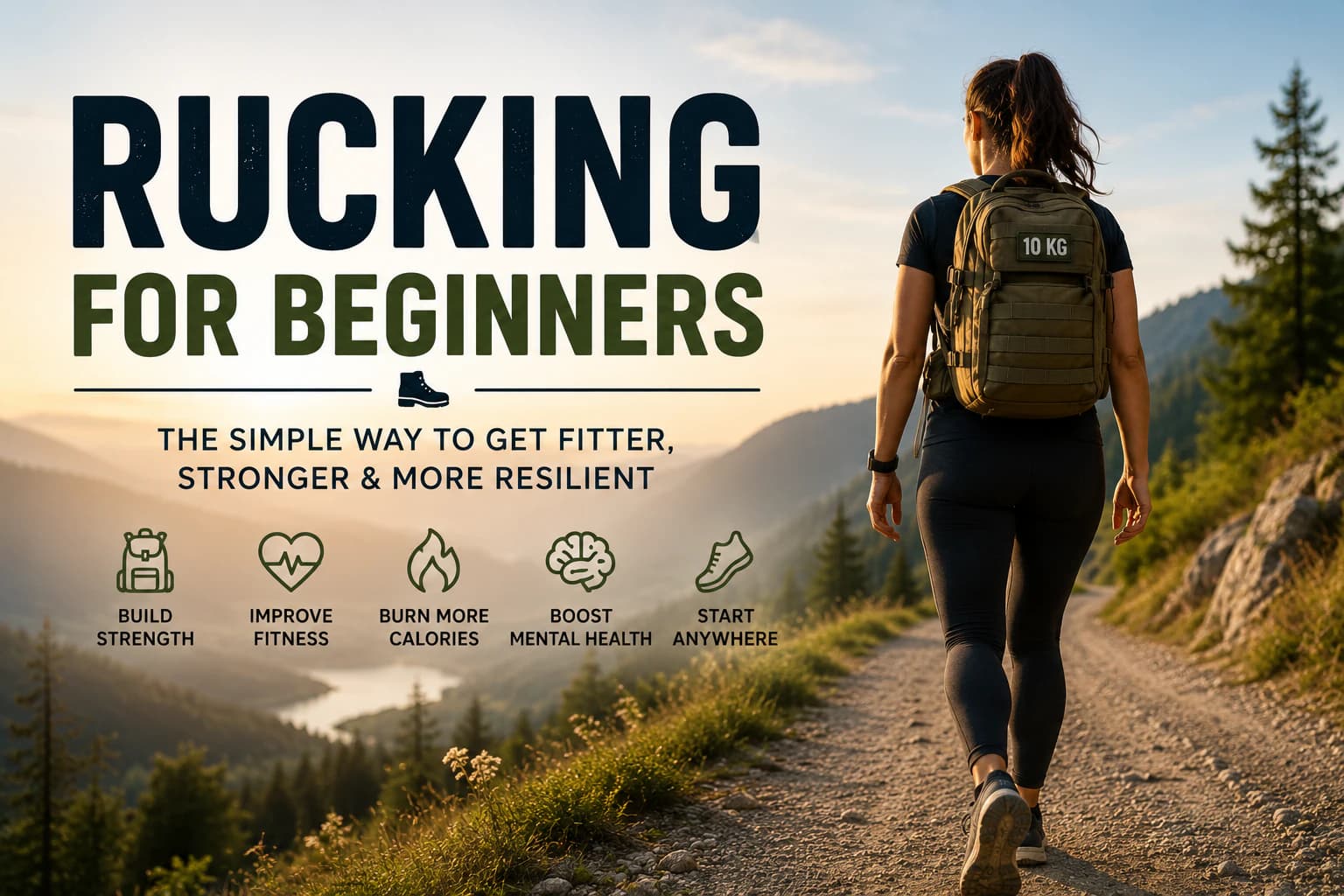
Rucking means walking with weight in a backpack. It has moved from military training into mainstream fitness over the past few years, and most guides to rucking for beginners repeat the same claim: that it burns two to three times the calories of walking.
That figure does not hold up. The measurements behind loaded-walking energy cost are well established, and they point to something considerably more modest at the weights a beginner would actually carry. Rucking is still worth doing. It is just worth doing for accurate reasons.
This guide covers how much weight to start with, what the research shows about calorie burn, a four-week progression, and where the joint-loading evidence suggests caution.
A note on health advice: This is general information, not medical advice. Adding load to walking changes the physical stress on your joints, feet and back. If you have an existing joint, back or cardiovascular condition, or have been inactive for a long period, discuss it with a clinician before starting.
The 30-second answer
Rucking is walking with weight in a backpack. Start lighter than you expect, around 2.3 kg (5 lb) for many people, walk 20-30 minutes twice a week, and add distance before you add load. It burns meaningfully more than walking, but not the two to three times the internet claims.
- Starting load: start light, near 2.3 kg (5 lb) for many, and build from there
- First sessions: 20-30 minutes, twice a week, on flat ground
- Progression: distance first, weight later, and only one change at a time
- Real calorie effect: roughly 10-25% above the same walk unloaded, at beginner loads
- The 2-3x claim: not supported at any load you would realistically carry
- What it will not do: build muscle size, or on current evidence, bone density
What is rucking?
Rucking is walking while carrying a weighted pack. The name comes from military foot marching, where covering ground under load is a core task rather than a training method.
As a civilian activity it requires no skill acquisition. If you can walk, you can ruck. The whole practice is: put weight in a bag, put the bag on your back, walk.
Its appeal is straightforward. It raises the effort of a walk without raising the impact the way running does, it needs almost no equipment, and it fits into walking you may already be doing. Cleveland Clinic's overview of rucking places it as a reasonable way to add intensity to walking for people who want more from it.
The strength of rucking is that it is a low-friction way to make an existing habit harder. Most of the exaggerated claims attached to it are unnecessary.
How many calories does rucking actually burn?
The honest answer is that it depends on your bodyweight, the load, your pace, the terrain and the duration, and that no guide can give you a reliable single number. What the research can give is the size of the effect that adding load produces.
The clearest measurement comes from a 2014 study in the Journal of Experimental Biology by Huang and Kuo. Eight adults walked on a treadmill at a fixed speed of 1.25 m/s (4.5 km/h, about 2.8 mph) on level ground, carrying backpack loads up to 40% of bodyweight, with energy expenditure measured by respirometry.
Two figures from that study matter:
- Unloaded gross metabolic rate was approximately 344 watts
- Metabolic rate rose approximately linearly, by about 7.62 watts for each additional kilogram carried
Those numbers let us work out what a given load actually adds, rather than guessing.
An illustrative table
The figures below apply the study's measurements to its own conditions. They are an illustration of the size of the effect, not a calorie prediction for your walk.
| Load | Approx. % of a 75 kg (165 lb) person | Metabolic rate | Increase vs unloaded |
|---|---|---|---|
| None | - | 344 W | - |
| 5 kg (11 lb) | ~7% | 382 W | +11% |
| 7 kg (15 lb) | ~9% | 397 W | +15% |
| 10 kg (22 lb) | ~13% | 420 W | +22% |
| 14 kg (31 lb) | ~19% | 451 W | +31% |
| 20 kg (44 lb) | ~27% | 496 W | +44% |
| 30 kg (66 lb) | ~40% | 573 W | +67% |
Why "2-3x more than walking" does not work
Doubling the gross figure of 344 W means adding another 344 W. At roughly 7.62 W per kilogram, that arithmetic points to somewhere near 45 kg (99 lb), and tripling it to around 90 kg (198 lb).
Treat those two numbers as arithmetic rather than physiology. Huang and Kuo tested loads only up to 40% of bodyweight, so both figures sit outside the range the study actually measured, and the 90 kg figure sits far outside it. The 2025 trial described below found the cost curve bending upward at heavier loads rather than continuing in a straight line, which means a simple linear projection is not a reliable prediction of what a 45 kg load would really cost.
The useful conclusion is not a precise doubling threshold. It is that the load needed to double gross energy expenditure is far heavier than anything a beginner would carry, and heavier than standard military marching loads for most people.
The 3x figure is not confined to fitness blogs. Cleveland Clinic's overview of rucking states that rucking burns "up to three times more calories than walking without a weighted pack." The wording is worth reading closely. "Up to" describes a ceiling under favourable conditions rather than a typical result, and controlled metabolic measurement is the better guide to what an ordinary loaded walk costs. Nothing here claims a threefold difference is impossible at extreme loads, gradients or paces. What is being corrected is the everyday reading: that putting on a beginner's pack will multiply your calorie burn two or three times.
There is one reading under which a doubling claim survives. The same study reported unloaded net metabolic rate, meaning energy above resting, of about 232 watts, and net rate roughly doubled across the tested load range up to 40% of bodyweight. Net energy expenditure is not what fitness trackers report and not what people mean by calories burned. The doubling applies to a different measure, at a military load.
The limitations, stated plainly
This is one study with eight participants, on a treadmill, on level ground, at a single fixed walking speed. It measures the energy cost of load carriage precisely under those conditions, and those conditions are narrow.
A separate 2025 study in Bioengineering enrolled 31 young men across three separate trials, of whom 11 took part in the load-mass trial that carried vest loads from 0 to 30 kg at 5 km/h. In that trial metabolic rate followed a quadratic rather than linear relationship with load, reaching statistical significance only at the 25 kg and 30 kg conditions. The two studies disagree on the exact shape of the curve. They agree that the effect at beginner loads is modest.
Real-world rucking also involves hills, variable pace and longer durations, all of which add to the total. Gradient is worth weighing alongside load: our guide to how many steps a day you actually need covers incline research in which walking uphill raised energy expenditure by around 58%. That figure comes from different conditions, at a faster pace on a steep treadmill gradient, so it is not a head-to-head test against the load figures above. The general point holds, though: adding gradient is an effective way to make a walk harder, and it costs nothing.
How much weight should a beginner start with?
Start with a load you can carry comfortably for the whole session, and start lighter than you think you need to. For many people that means something around 2.3 kg (5 lb) on a first walk, which is roughly where Cleveland Clinic's guidance points. If you already walk long distances regularly and carry a daypack without noticing it, more than that will be manageable from the start.
Percentage-of-bodyweight figures are more useful as a rough planning ceiling than as a starting prescription. Around 10% of bodyweight in the pack is a reasonable target to work toward over the first couple of months, rather than a number to begin at. No clinical trial has established an optimal beginner load, and anyone presenting a precise percentage as scientifically proven is overstating what is known.
Where the military figure comes from, and why not to copy it
US Army Field Manual 21-20, Physical Fitness Training, published in 1992, stated that soldiers could usually begin road-march training carrying a total load equal to 20% of their bodyweight, with beginning distances of 8-10 km (5-6 miles) at a pace of about 20 minutes per mile. That manual was superseded by TC 3-22.20 in 2010 and later by FM 7-22, so it is historical doctrine rather than current guidance.
Two details are routinely dropped when that figure is quoted:
- The 20% includes all clothing and equipment, not just what is in the pack. Boots, uniform and kit all count toward it. A civilian who puts 20% of bodyweight into a backpack is carrying more than the military standard, not the same amount.
- It applies to conditioned soldiers, in a training system with supervision and progression built around it.
Half that figure, in the pack alone, is the reasoning behind treating 10% as a planning ceiling rather than a place to start.
Starting load by bodyweight
| Your bodyweight | Suggested first load | ~10% as a planning ceiling |
|---|---|---|
| 55 kg (120 lb) | 2-3 kg (5-6 lb) | up to ~5.5 kg (12 lb) |
| 70 kg (155 lb) | 2-3 kg (5-6 lb) | up to ~7 kg (15 lb) |
| 85 kg (185 lb) | 2-4 kg (5-9 lb) | up to ~8.5 kg (19 lb) |
| 100 kg (220 lb) | 2-4 kg (5-9 lb) | up to ~10 kg (22 lb) |
The right-hand column is a ceiling to approach gradually, not a target for your first weeks. How long it takes to get there varies widely, and there is no evidence base setting a correct timeline.
If you are significantly deconditioned or carrying excess bodyweight, stay at the lighter end and build walking duration before adding much load at all. Your joints are already handling more during ordinary walking than a lighter person's are. Every percentage in this section, including the 10% ceiling, is a practical planning aid rather than an established clinical threshold.
A practical 4-week beginner rucking plan
This is a conservative framework rather than a prescription, and it assumes you can already walk 30 minutes comfortably without a pack. If you cannot, spend two to four weeks building that first.
| Week | Sessions | Duration | Load | Focus |
|---|---|---|---|---|
| 1 | 2 | 20 min | Your starting load | Getting used to the pack. Flat, even ground. |
| 2 | 2 | 30 min | Same | Same load, more time. Check for hot spots on the feet. |
| 3 | 2 | 40 min | Same | Same frequency and load. Build time on your feet. |
| 4 | 2 | 45-60 min | Same | Hold the load. Consistency is the goal, not overload. |
Notice that neither the load nor the frequency changes across the four weeks. That is intentional. Feet, shoulders and the postural muscles of the lower back adapt more slowly than your cardiovascular system does, and most beginner problems come from adding weight before those tissues are ready. A third weekly session belongs after this block rather than inside it.
When to increase the load
Add weight only when all of the following are true:
- You can complete 45-60 minutes at your current load
- Your breathing stays conversational throughout
- Your posture stays upright, with no forward lean to counterbalance the pack
- You have no joint soreness the following day
Then increase the load by a small increment and drop your duration back by about 10 minutes for the first session or two. Cleveland Clinic's guidance of raising a single variable by roughly 10% a week is a sensible general principle, which on a light beginner load means adding well under a kilogram at a time. On heavier loads a step of 1-2 kg (2-5 lb) is proportionate. The right increment depends on what you are already carrying, how the last few sessions felt, and whether anything is sore the next day.
When not to increase the load
Hold where you are if you are leaning forward, shortening your stride, feeling shoulder or neck pain during the walk, or noticing next-day soreness in the knees, hips or lower back. None of those improve by adding weight.
Change one variable at a time. Distance, load and pace should never increase in the same week.
Recovery
Leave at least one full day between rucking sessions in the first month. Unloaded walking on the days between is fine and generally helpful. If a session leaves you sore for more than 48 hours, the load or the duration was too much for where you currently are.
How often, how far and how fast should you ruck?
Frequency: two sessions a week to begin, moving to three once a month or two of consistent rucking has passed. Rucking daily is not a useful goal early on, because the tissues under repeated load need recovery time.
Distance: start with time rather than distance, since pace varies. Twenty to thirty minutes is roughly 1.5 to 2.5 km (1 to 1.5 miles) at an easy pace. Build to 45-60 minutes across the first month.
Pace: conversational. You should be able to speak in full sentences. That falls somewhere near 4.5 to 5.5 km/h (2.8 to 3.4 mph) for most people, though the number matters less than the ability to talk.
Pace is the last variable to increase, and there is a reason for that beyond comfort, covered next.
Is rucking bad for your knees or back?
Rucking is frequently described as joint-friendly, and at moderate loads and moderate pace that holds up reasonably well. The picture changes as load and speed rise, and the evidence on this is more specific than most guides acknowledge.
A study measuring tibiofemoral joint contact forces during load carriage, carried out with military body armour and kit, found that, compared with unloaded walking:
- A 15 kg (33 lb) load raised peak medial compartment contact force by about 10.1%
- A 30 kg (66 lb) load raised it by about 19.9%, with the second peak of total contact force about 28.3% higher
More usefully for pacing decisions, walking fast (1.81 m/s) while carrying 30 kg produced peak total forces of around five times bodyweight, approaching the range the authors associate with running. The researchers concluded that soldiers carrying loads above 15 kg for prolonged periods could be at greater risk of knee injury.
Two practical conclusions follow. Rucking's joint-loading advantage over running is real, but it belongs to moderate loads at moderate pace rather than to rucking as such. And load and speed compound: heavy and fast is a meaningfully different activity from moderate and steady.
That study modelled military loads and kit, and modelled forces are not the same as measured injury rates. It does not establish that rucking causes knee problems. It does give a reasonable basis for keeping beginner loads well below 15 kg and leaving pace increases until last.
For the back, the common issues are a pack that sits too low, a load that shifts while you walk, or weight added faster than the supporting muscles adapt. All three are addressable through pack fit and progression. Anyone with an existing back condition should get individual advice rather than working from a general guide.
For the feet, added load increases pressure through the sole and raises blister risk, which is the most common complaint in the first few weeks.
Does rucking build muscle or bone?
Both claims circulate widely. Both are weaker than they appear.
Muscle
Rucking does not build meaningful muscle size. Hypertrophy requires mechanical tension and training near the limit of what a muscle can produce, and loaded walking does not approach that threshold at any sustainable rucking weight.
What it does develop is muscular endurance in the legs, hips and postural muscles, along with general work capacity. That is a genuine adaptation and a useful one. It is simply a different adaptation from the one the word "muscle" usually implies.
If muscle size or maximal strength is the goal, rucking supplements resistance training rather than substituting for it. Our 30-day beginner home workout plan covers the resistance side without equipment.
Bone
The bone-density claim is the one worth examining carefully, because it is repeated with unusual confidence.
The INVEST in Bone Health randomised controlled trial followed 150 older adults with overweight or obesity, average age 66, over 12 months. Participants were randomised to dietary weight loss alone, weight loss plus a weighted vest, or weight loss plus resistance training. Vest wearers averaged 7.1 hours of wear a day.
According to the trial team at Wake Forest, neither the weighted vest group nor the resistance training group preserved bone mass better than dietary weight loss alone, with all three groups showing similar significant decreases in hip bone mineral density.
The limitations matter. INVEST tested passive vest wear during active weight loss in older adults, not loaded walking as a training stimulus in a general population. It does not prove that rucking has no skeletal benefit, and the trial team notes that weighted vests have been shown to help with strength and sit-to-stand performance.
Note also what the result does not say. INVEST asked whether added loading could protect bone while participants were actively losing weight, which is a narrower and more demanding question than whether resistance training builds bone in general. It does not overturn the standard recommendation that resistance work is what supports bone and strength.
What it does show is that the confident bone-density claims attached to weighted vests are running ahead of the best available trial evidence. "Rucking builds bone density" is not currently a supportable statement.
Rucking vs walking vs running
| Rucking | Walking | Running | |
|---|---|---|---|
| Energy cost | Moderately higher than walking | Baseline | Highest per minute |
| Joint impact | Low at moderate load, rises with load and pace | Lowest | Highest |
| Equipment | A pack and something dense | None | Shoes |
| Time efficiency | Moderate | Lowest | Highest |
| Barrier to starting | Low | Lowest | Higher for many |
Rucking vs walking is a question of whether you want the same walk to be harder. If your problem is that you do not walk enough, walking more is the simpler fix. If you already walk regularly and want more from the same 40 minutes, load is one way to get it, though as noted above, gradient is a stronger one and free.
Rucking vs running is largely a trade between time efficiency and impact. Running produces more per minute. Rucking spreads the same effort across a longer, gentler session, which suits people returning from a layoff or who find running uncomfortable.
For weight loss specifically, the contribution is real but modest. A 10-25% increase over a 45-minute walk is a useful addition rather than a transformation, and overall energy balance still does most of the work. Our guide on how long it takes to lose belly fat covers where the leverage actually sits.
Do you need a special rucking backpack?
Not to start. A normal daypack with a padded back panel and a chest strap is enough to find out whether you enjoy rucking before spending anything.
Two limitations show up once you are rucking regularly:
- Weight sags to the bottom. Ordinary packs are not designed to hold dense loads high against the spine, and a low load pulls you backwards, which you compensate for by leaning forward.
- Stitching is not built for it. Daypacks are designed for bulk, not for repeated dense loading, and seams and shoulder attachments are where they fail.
Purpose-built rucksacks address both, with a dedicated pocket that holds weight high and reinforced construction. Prices vary widely by brand and region, and there is a broad range from budget options to premium packs with lifetime warranties. Buy on fit rather than brand.
What to look for: a torso length that suits your height, a weight pocket positioned between the shoulder blades rather than at the base, shoulder straps wide enough to spread load without cutting in, and a sternum strap. A hip belt matters more as loads increase.
What to put in it: ruck plates are purpose-made and sit flat, but bagged rice, sand, water containers or wrapped books all work. The requirements are that the weight is dense, sits high, and cannot shift while you walk. Water has a practical advantage in that you can pour some away mid-walk if the load turns out to be too much.
Avoid filling a pack with light bulky material. That forces the weight low and away from your back, which is the position that causes most posture problems.
Shoes, hydration and other beginner gear
Shoes are the item that matters most, more than the pack. Added load increases pressure through the foot, so a shoe that fits acceptably when unloaded can cause blisters once you are carrying weight. Whatever you already walk comfortably in is usually the right starting point: trail or light hiking shoes for uneven ground, ordinary walking or running shoes for pavement. Heavy boots are not required and add weight at the far end of your legs, where it costs the most effort.
Socks cause more early problems than most people expect. Wool or synthetic blends manage moisture better than cotton, and blisters are usually a friction and moisture problem rather than a distance problem.
Water is worth carrying for anything over about 45 minutes, and more in heat. Any bottle works; a bladder is convenient but not necessary.
Everything else is optional. Rucking needs remarkably little, and the main risk in the gear phase is spending money on equipment before establishing whether the activity suits you. If you travel often, a pack you already own doubles as luggage, which our guide to staying fit while travelling covers alongside other equipment-light options.
Common beginner mistakes
- Starting too heavy. The most common error by a wide margin. The load that feels manageable for five minutes is often not the load that is manageable for forty.
- Adding weight and distance in the same week. Change one variable at a time or you will not know which caused a problem.
- Packing the weight low. Weight at the base of the pack pulls you backwards and you compensate by leaning forward, which loads the lower back.
- Ignoring hot spots. A hot spot at 20 minutes is a blister at 40. Stop and fix it.
- Expecting the advertised calorie burn. Working from a 2-3x figure and then judging results against it sets up disappointment for no reason.
- Wearing new footwear. Break shoes in unloaded before rucking in them.
- Rucking on consecutive days early on. The cardiovascular system recovers faster than feet, shoulders and lower back do.
- Treating it as strength training. Rucking does not replace resistance work, and substituting one for the other leaves a real gap. Our guide to strength-training volume covers how much to add.
Who should be more cautious before starting?
Rucking is a low-skill activity, but adding external load is a genuine change in physical stress rather than a neutral adjustment. It is worth getting individual advice first if any of the following apply:
- Existing knee, hip, ankle or back problems, or a previous injury to any of them
- Osteoporosis or diagnosed low bone density
- Joint replacements
- A history of falls or any balance impairment, since a pack raises your centre of mass slightly
- Cardiovascular conditions or uncontrolled blood pressure
- Pregnancy
- A long period of inactivity or significant deconditioning
None of these is automatically a reason not to ruck. They are reasons to have the conversation and to start lighter and shorter than a general guide would suggest.
If a session causes chest pain, unusual breathlessness, dizziness or joint pain that does not settle, stop and seek medical advice.
The bottom line
Rucking is a reasonable, low-friction way to make walking harder without making it longer or higher-impact. It requires almost no equipment, no technique, and it fits into activity you may already be doing.
What it is not is a shortcut that doubles your calorie burn. At the loads a beginner carries, the increase over the same walk unloaded is somewhere in the region of 10-25%, and reaching a genuine doubling of gross energy expenditure would take a load nobody should be carrying. The muscle and bone-density claims attached to it are similarly ahead of the evidence.
Start light, around 2.3 kg (5 lb) for many people, walk for 20 to 30 minutes twice a week, hold that load for a month, and add distance before you add weight. That is a slower start than most guides suggest, and it is the part most likely to keep you rucking in six months.
If you're rucking toward something specific rather than fitness in general, say a multi-day hike with a departure date already on the calendar, the progression above is a starting point rather than the whole plan. If that hike goes to altitude, it's worth checking the itinerary's ascent profile too, since how fast the trip climbs is a separate question from how well you've trained for it. The Multi-Day Hike Preparation System covers footwear, pack load and blister prevention for the hike itself, and The Trek-Ready Training System turns this kind of pack-carrying fitness into a 12-week program timed to that date.
Related reads:
Frequently asked questions
Answers to the most common questions about this topic.
Leaning forward noticeably to counterbalance the pack, shortening your stride, being unable to hold a conversation, shoulder or neck pain during the walk, and joint soreness that persists into the next day. Numbness or tingling in the arms usually means the shoulder straps are compressing nerves, which is a fit problem as often as a weight problem. Any of these is a reason to reduce load rather than push through.
Aerobic adaptations to consistent walking-based training generally become noticeable within several weeks, and the load itself will feel easier before any visible change occurs. Visible body composition change depends on overall energy balance rather than the activity alone, so it varies widely between individuals. A more useful early marker is that your usual route at your usual load starts to feel comfortably manageable.
Not at the start. Carrying load places repeated stress on the feet, shoulders and lower back, and those tissues adapt more slowly than the cardiovascular system does. Two sessions a week initially, moving toward three, gives enough stimulus while leaving recovery time. Daily unloaded walking alongside rucking is a reasonable pattern once you are established.
Often yes, though the calculation changes. Carrying additional bodyweight already raises the load your joints handle during ordinary walking, so adding external weight on top compounds it. Starting with unloaded walking, building duration first, and then adding only a light load is a more cautious route. Anyone with existing knee, hip or back problems should get individual advice first.
Age alone is not a barrier, and loaded walking is a manageable form of activity for many older adults. The sensible modifications are a lighter starting load, shorter initial sessions, flat and even terrain, and slower progression. Balance matters more with a pack on, since a load raises your centre of mass slightly. Anyone with osteoporosis, joint replacements or a history of falls should discuss it with a clinician before starting.
Either works, and they suit different preferences. A vest distributes weight closer to your centre of mass and around the torso, which some people find more comfortable over distance, but it usually carries less and has no room for water or layers. A rucksack holds more, doubles as ordinary luggage, and keeps the load in one place behind you. For rucking specifically, most people end up preferring a pack.
Filed under
Written by
We research travel, fitness and wellness, and publish what holds up. See our editorial policy.