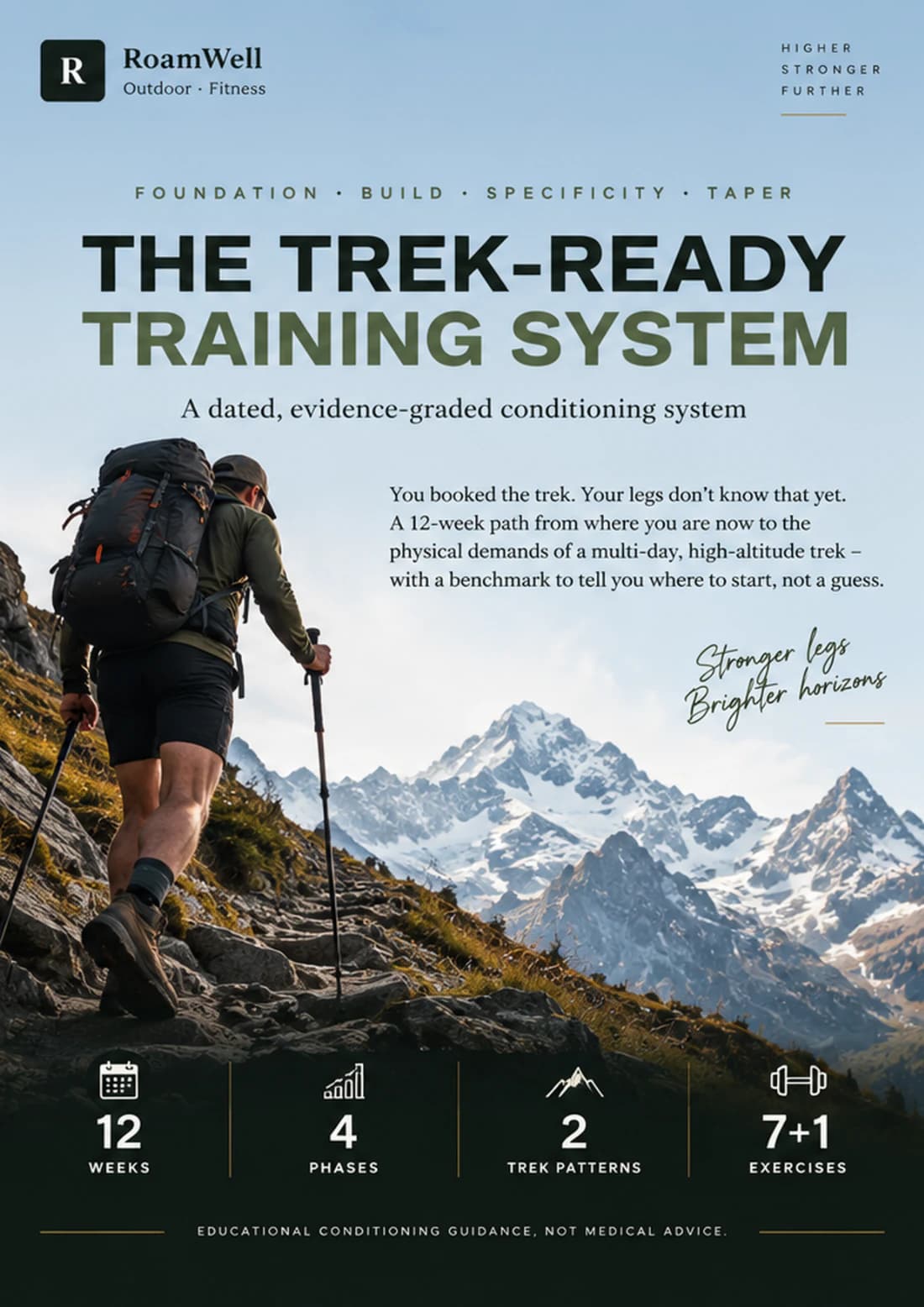
You booked the trek. Your legs don't know that yet.
No benchmark, just a guess
Most trek training advice picks a starting week for you without ever testing where you actually are.
One pattern, for every trek
A sustained multi-day teahouse trek and a single hard summit push load the body differently, but most programmes train them the same way.
Pack load, unproven method
Common advice trains pack-carrying against a percentage-of-bodyweight rule that no clinical trial has established as a safe starting point.
Fitness mistaken for altitude protection
Physical fitness doesn't prevent altitude illness, but that boundary rarely appears stated plainly in general trek training content.
02 · The promise
One benchmark, one pattern, twelve weeks to departure
Benchmark, choose, build, simulate, taper. A real test decides where you start, your itinerary decides which pattern you train, and the twelve weeks end at a taper timed to your departure date, not a guess.
Benchmark, then Choose, then Build, then Simulate, then Taper
01Benchmark
02Choose
03Build
04Simulate
05Taper
01Benchmark
02Choose
03Build
04Simulate
05Taper
Whether to start at Week 1, move slightly faster through it, or spend a few extra weeks first, decided by a real benchmark test rather than a guess
Which of two patterns your itinerary actually matches, Sustained Multi-Day or Single Big Push, and how that changes your final two weeks of training
How to progressively train your body to carry a loaded pack, using a fixed starting weight instead of an unproven bodyweight percentage
What to do if you have 6 weeks left instead of 12, or more than 12, without inventing a different programme
Where physical conditioning ends and altitude acclimatization begins, stated plainly and more than once
03 · How it works
9 chapters, run in order
Each chapter builds on the last one. You're never asked to guess at something an earlier chapter already covered.
01
Benchmark & entry point
A 3-minute step test and a loaded-comfort check decide your starting point, not a guess and not an invented readiness score.
02
Choosing your Trek Pattern
Two patterns, not a named-trek difficulty score: Sustained Multi-Day or Single Big Push, chosen from your own itinerary.
03
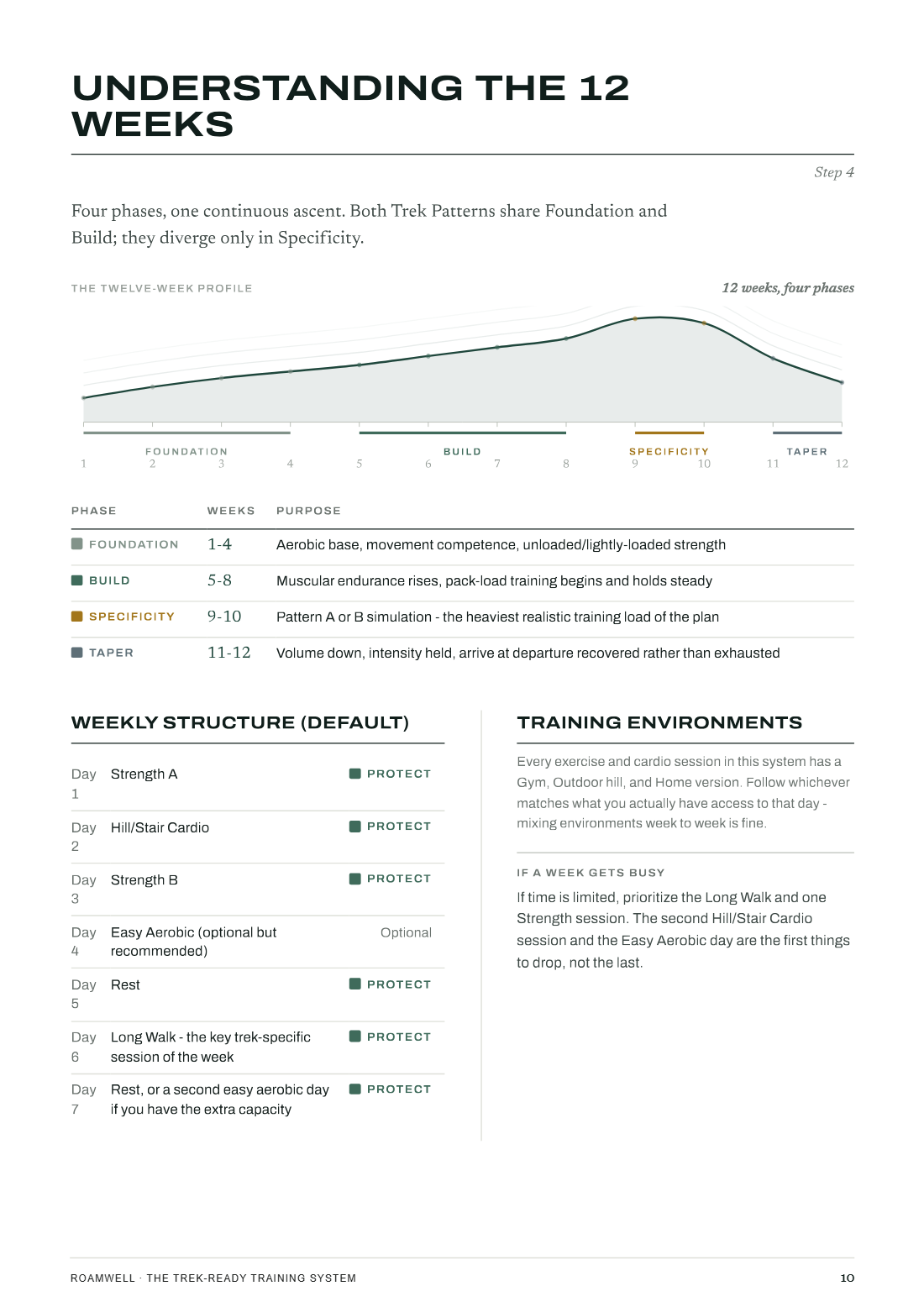
Foundation, Weeks 1-4
Aerobic base and learning to move well, kept easy and unloaded.
04
Build, Weeks 5-8
Pack-load training begins and holds steady while muscular endurance rises.
05
Specificity, Weeks 9-10
Your Pattern's simulation: the heaviest realistic training load in the plan.
06
Taper, Weeks 11-12
Volume down, intensity held, so you arrive at departure recovered rather than exhausted.
07
Exercise library
Seven strength movements and one cardio exercise, each with gym, outdoor-hill and home versions.
08
Pack-training progression
How to train your body to carry load, without duplicating the Hike Preparation System's own pack-weight research.
09
When plans change
Missed weeks, late starts, and shorter or longer timelines, each with its own clear rule, not a guess.
04 · What you get
Everything included
PDF in A4 and US Letter, plus a benchmark card, a printable log, an XLSX tracker, and a trek-day quick-reference card
30
Page PDF
The 12-week system in one document, run in order: benchmark, pattern, then four training phases.
2
Editions
A4 and US Letter, both included. Print either one without resizing anything.
1
Benchmark Test Card
The 3-minute step test and loaded-comfort check protocol, standalone so you can print it and test before reading the rest.
1
Weekly Training Log
A printable log for all 12 weeks, plus a digital XLSX version for tracking on a screen instead of paper.
1
Trek-Day Quick-Reference Card
Effort cues and stop-sign symptoms condensed to one page, built to be printed or screenshotted.
8
Exercise library
Seven strength movements and one cardio modality, each with a gym, outdoor-hill and home version.
2
Trek Patterns
Sustained Multi-Day or Single Big Push, chosen from your own itinerary rather than a named-trek difficulty score.
05 · Inside
See the actual pages
Six pages from the plan, shown in full. Open any one to see it at full size.
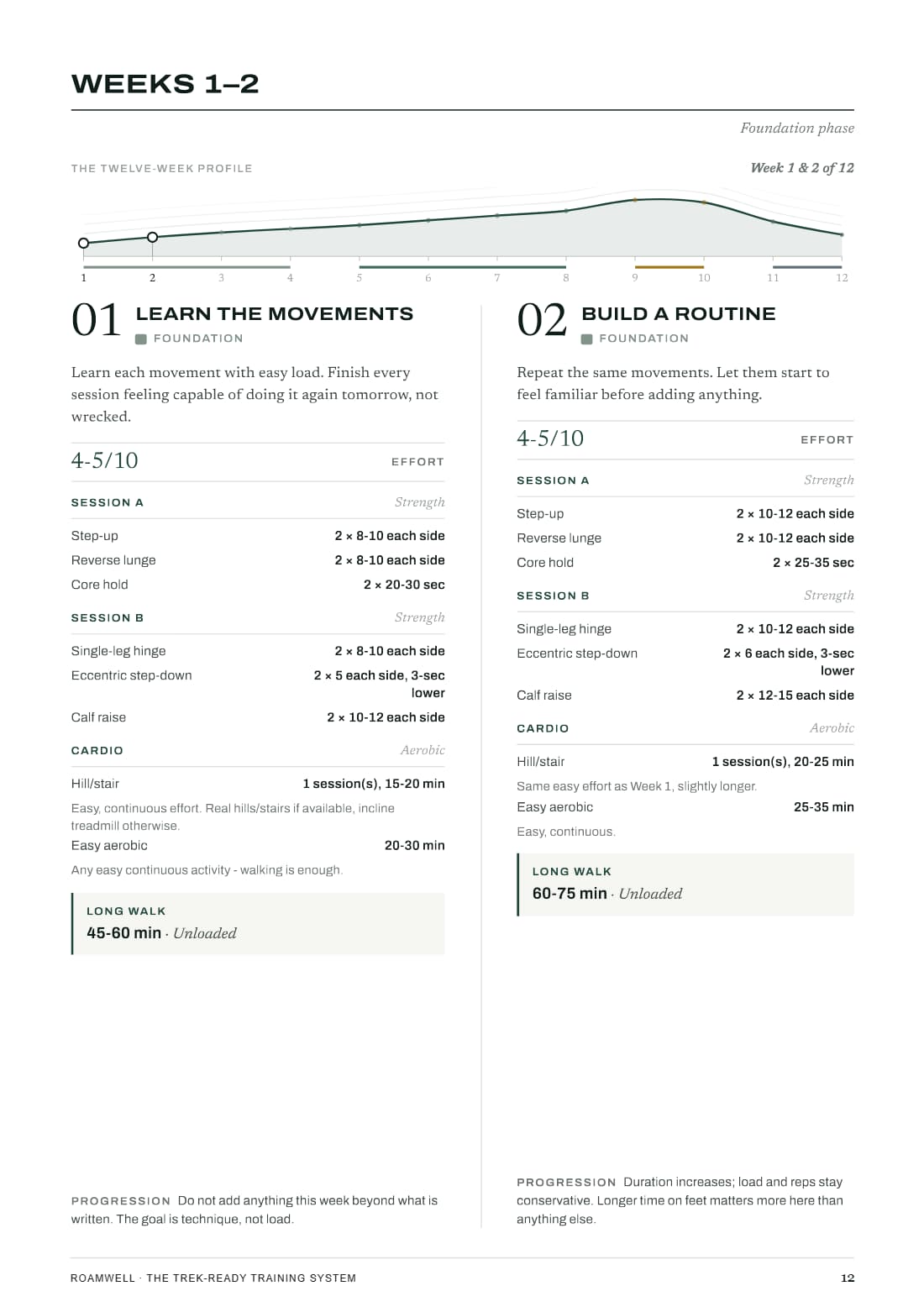
Every week fully specified: sessions, sets, reps, effort, and progression notes
The whole twelve weeks at a glance: four phases, one continuous progression
Benchmark interpretation: three outcomes, no invented readiness score
Choosing your Trek Pattern from your own itinerary, not a named-trek list
The exercise library: seven movements, each with gym, outdoor-hill and home versions
No gym, no hills? Every exercise has a gym, outdoor-hill and home version
06 · Evidence
Why this holds up
The evidence is graded, not asserted
Every claim that matters carries a confidence label, the same system used across RoamWell's guides.
A real benchmark, honestly limited
A validated step test decides your starting point. It's not a medical assessment, and it doesn't predict your trek.
Two patterns, not a fake trek score
Sustained Multi-Day or Single Big Push, read from your own itinerary. Neither is an invented difficulty rating.
Pack training that knows its boundary
Trains your body to carry load without re-answering what your actual trek pack should weigh. That question already has an answer, in a different system.
Fitness and altitude, kept separate
States plainly, more than once, that conditioning doesn't prevent altitude illness.
A small library, on purpose
Seven strength movements and one cardio exercise are the whole library, not a preview of a longer one. Less is deliberate here: a short list of compound movements beats a long one you'll never fully use.
Why this isn't a fitness ebook
The Multi-Day Hike Preparation System covers feet, footwear, load and friction, and says plainly that it isn't a fitness programme. The Ascent Profile Audit reads your itinerary's altitude risk, and says plainly that it isn't about fitness either. Both of those lines were already live before this system existed. This is the answer to them.
What a benchmark can and can't tell you
A 3-minute step test and a loaded-comfort check decide where you start: standard pace, a slightly faster pace through Foundation, or a short block of extra preparation first. That's genuinely useful, and it's also the limit of what it does. It's not a medical fitness assessment, it doesn't predict whether you'll complete your trek, and there's no invented single "readiness score" behind it, on purpose.
Two patterns, read from your itinerary
Some treks are many similar days in a row. Others are mostly ordinary days with one dramatically harder push. Weeks 9 and 10 train for whichever one your itinerary actually is, chosen from two questions about your own day-by-day schedule, not from a list of named destinations pretending to be a difficulty score.
07 · Worked example
From start to finish, one full example
Leo: booked a 14-day Everest Base Camp trek, 11 weeks out
01Benchmark
Completes the full 3-minute step test at an effort of 7/10, and the loaded-comfort check feels manageable but noticeably effortful. Result: "Completed, moderate-to-hard effort" - starts at Week 1 of Foundation, standard pace.
02Pattern
The itinerary is many similar teahouse days with no single dominant hard day. Answer to the pattern questions: Pattern A, Sustained Multi-Day.
03Timeline
Only 11 weeks are available, not 12. Using the Short-Timeline Pathway (8-11 weeks): Foundation compresses to 3 weeks instead of 4; Build, Specificity and Taper run at full length.
04Week 1
Session A and B as written for Week 1, one hill/stair cardio session, one easy aerobic session, one unloaded long walk (45-60 min), two rest days. Effort throughout: 4-5/10.
05Week 9
Follows Pattern A's back-to-back weekend: a long walk on Saturday, a shorter loaded walk on Sunday, deliberately on tired legs. (Renumbered Week 8 on Leo's compressed schedule.)
Example only. Leo is fictional. The figures illustrate how the benchmark, pattern choice and short-timeline pathway are meant to be used, not a claim about any specific outcome.
08 · Fit
Who it's for, and who it's not
The second list matters just as much as the first. If you're on it, this isn't the thing to buy.
Built for
You've booked a specific non-technical, high-altitude, multi-day trek. Everest Base Camp, Kilimanjaro, Annapurna-style routes: these are examples, not a closed list
You're reasonably active, but not a dedicated athlete
You've got anywhere from under 3 weeks to several months before departure. Shorter and longer timelines each have their own pathway
You want a dated, structured path rather than researching training advice yourself
Not built for
Technical mountaineering: ropes, glacier travel, crampon technique, or expedition-level training
Injury rehabilitation or post-surgery return to exercise
Diagnosed cardiac, respiratory, joint, or balance conditions without prior medical clearance
Altitude-illness prevention, diagnosis, or treatment
Figuring out your actual trek pack weight. The Multi-Day Hike Preparation System already covers that
A guarantee of completing your trek, reaching a summit, or avoiding injury or illness
09 · Anywhere
Works wherever you are
Page size
A4 · US Letter
Step height
cm · in
Pack load
kg · lb
Weeks
12
Step height, cadence and pack-training loads given in metric and imperial: cm and in, kg and lb
A4 and US Letter editions, both included
No country-specific rules, permits, healthcare systems or insurance
No named-trek database and no brand or retailer dependency
Your Trek Pattern is chosen from your own itinerary, not assumed from a destination
What this is, and what it is not
This system is for generally healthy adults preparing for a non-technical, high-altitude, multi-day trek. It's fitness guidance, not medical advice — not a diagnosis, treatment, rehab program, or a prescription written for your body. If you have a medical condition, an injury, ongoing pain, symptoms you can't explain, you've recently had surgery or a major health event, you're pregnant or recently gave birth, or you're just not sure exercise is a good idea for you right now, talk to a doctor before you start.
10 · Questions
Before you decide
Is 12 weeks mandatory?
No. It's the reference length this system is built around: it matches a real trek training plan already sold commercially for the same kind of trek. Shorter and longer timelines have their own pathways built in.
I'm already quite fit. Can I skip ahead?
Not past Foundation entirely. Foundation teaches the movement patterns safely, including the eccentric step-down, which is worth practising unloaded even if your cardio fitness is already strong. The benchmark can move you faster through Foundation, never past it.
What if I have no access to hills, stairs, or a gym at all?
Every exercise and cardio session in this system has a genuine home/no-equipment version. A staircase, a chair, and something to hold for load cover the entire system.
Does completing this system mean I'll be ready for altitude?
No. This system gets your body ready for the physical work of trekking. It has no effect on altitude-illness risk, and says so more than once.
Can I use this for a technical mountaineering objective?
No. This system is scoped to non-technical, high-altitude trekking. Technical mountaineering (ropes, crampon technique, glacier travel) has different demands this system doesn't train for.
What do I receive?
A 12-week training system as a PDF in both A4 and US Letter, a standalone Benchmark Test Card, a printable Weekly Training Log plus a digital XLSX version, and a Trek-Day Quick-Reference Card. All six files work completely offline.
Can I get a refund?
Once a digital product has been delivered, we generally don't offer refunds just because you changed your mind or didn't get around to using it, which is why this page goes into so much detail about what the system does, what it doesn't, and who it's not for. That is subject to the law that applies to you, and it is not a promise that every request will be refused. If a charge was made twice, a file is corrupted or you can't open it, something the page promised is missing, or the product is materially different from its description, contact us and we'll try to put it right first, and give any remedy the law requires if we can't. We also look into unauthorised payments and payment disputes. The full policy is on our refund page.
What happens after I buy?
You pay through Razorpay, a third-party payment gateway, in a secure checkout window. Once your payment is verified, the Thank You page shows a download button for a ZIP file with all six documents: the training system as a PDF in A4 and US Letter, the Benchmark Test Card, the Weekly Training Log as a PDF and as an XLSX, and the Trek-Day Quick-Reference Card. Where checkout asks you to sign in with your email, the purchase is linked to that account, and you can download again whenever you sign in to it. Otherwise, access is valid for 30 days, in the same browser you paid from, so keep that browser for your download. Purchases made before sign-in checkout opened keep that 30-day, same-browser access. The full details are on our refund page.