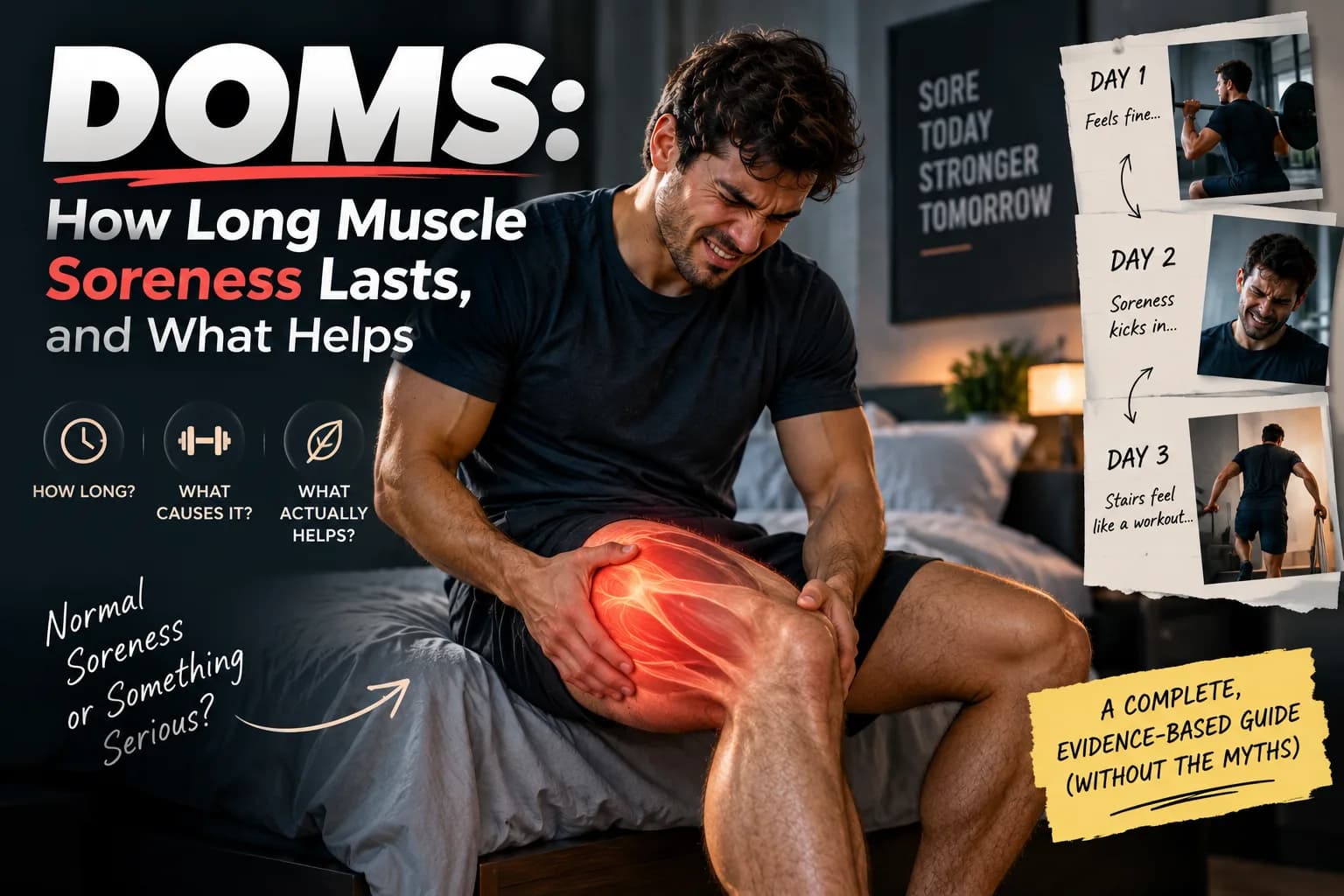
DOMS: How Long Muscle Soreness Lasts, and What Helps
How long DOMS actually lasts, and which recovery methods the evidence really supports.
You finish a hard leg day feeling fine. The next morning, sitting down on the toilet requires planning. By the following afternoon, stairs have become a genuine obstacle. Somewhere in there, a familiar thought shows up: this must have been a really good workout.
That instinct is worth questioning. Soreness is real, common, and usually nothing to worry about, but it is not a scoreboard, and treating it like one leads people to chase soreness for its own sake or to panic when a solid workout leaves them barely sore at all. This piece works through what delayed onset muscle soreness actually is, how long it tends to last, what the current evidence says genuinely helps, and where popular advice runs ahead of what's actually been shown.
A note on health information: This is general information about a common training response, not medical advice. If your symptoms don't fit the ordinary pattern described here, or you're unsure whether what you're feeling is normal, talk to a healthcare professional rather than self-diagnosing from an article.
Why "No Pain, No Gain" Isn't the Right Way to Think About Soreness
"No pain, no gain" survives because it captures something true at a low resolution: Training creates a reason for the body to adapt, but soreness is neither the goal nor the proof of that adaptation. But it gets misapplied constantly, turning soreness itself into the goal rather than a side effect that sometimes shows up and sometimes doesn't.
The research on delayed onset muscle soreness, usually shortened to DOMS, has moved a long way past the old explanations most people still repeat. It isn't caused by lactic acid. It isn't a reliable measure of how much muscle you built. And several of the recovery methods sold hardest to fix it have thinner evidence behind them than their marketing suggests, while a few quieter, less-hyped options hold up better than expected. Working through the evidence properly, rather than repeating what everyone already assumes, is the point of what follows.
The 30-Second Answer
DOMS is the soreness and stiffness that follows unfamiliar or unusually demanding exercise, especially movements with a lot of eccentric, lengthening-under-load work. It typically starts within a day, peaks a few days in, and clears within about a week. A handful of interventions have real, modest evidence behind them; several popular claims are weaker than advertised.
- Onset: usually within 12 to 24 hours after the workout
- Peak: commonly somewhere between 24 and 72 hours
- Resolution: usually within a week, sometimes sooner
- What helps: compression garments, cold water immersion, foam rolling, and light active recovery all have real, modest supporting evidence
- Weaker than claimed: static stretching, electrical stimulation, and tart cherry juice's effect on soreness specifically
- When it's more than DOMS: severe swelling, dark urine, extreme weakness, or worsening pain are not ordinary DOMS and deserve medical attention
What DOMS Actually Is
It's Not Lactic Acid
If you learned one thing about muscle soreness growing up, it was probably that lactic acid builds up during exercise and causes the ache the next day. That explanation is outdated and doesn't match how the body actually works. Lactate produced during exercise clears from the muscle within roughly an hour of finishing, long before soreness even begins. Researchers studying DOMS have moved on from this idea for decades; it just never fully left popular fitness culture, likely because it's a tidy, easy-to-repeat story compared with what's actually going on underneath.
Unfamiliar and Eccentric Exercise
One of the stronger factors behind soreness is the type of muscle action involved, especially eccentric loading, along with how unfamiliar the movement is to you. Eccentric contractions, where a muscle lengthens while under tension, such as lowering into a squat, controlling a dumbbell on the way down from a curl, or running downhill, place more mechanical stress on muscle fibers and their surrounding connective tissue than concentric, shortening contractions do. Doing something your muscles aren't used to compounds this further. A seasoned lifter trying a completely new machine, or a runner who normally sticks to flat ground taking on a steep downhill trail, is far more likely to wake up sore than someone doing familiar training at a similar intensity. This is also why a session that combines running with weighted lunges and sled work, like HYROX, can produce substantial soreness, especially when those movements are new to you.
The Accepted, More Complicated Explanation
There isn't one single, tidy mechanism that fully explains DOMS, and it's worth being honest about that rather than swapping one oversimplified story for another. A 2025 scoping review in the Journal of Functional Morphology and Kinesiology describes DOMS as arising from a combination of factors: disruption to muscle fibers and the surrounding connective tissue during unfamiliar or eccentric loading, an inflammatory response that follows that disruption, and sensitization of the nerve endings that detect pain, which makes the area more reactive to pressure and movement than it normally would be.
A separate line of research goes further, proposing that at least part of what we feel as DOMS may originate in the nerve endings themselves rather than in the muscle fibers. A 2020 paper in Antioxidants argues that repeated mechanical compression of nerve endings within the muscle spindle during eccentric loading produces a kind of microscopic nerve injury, and that this neural component may be doing more of the work in producing soreness than muscle fiber damage itself. This idea hasn't replaced the broader explanation above; it's a genuinely debated piece of an unresolved puzzle, cited here because the field is more actively worked out than most consumer content lets on, not because any single group has settled it.
What's fair to say with confidence: DOMS involves real, if temporary, mechanical stress to muscle tissue, a genuine inflammatory response, and a nervous system that becomes more sensitive to the affected area for a few days. For typical DOMS, these changes are temporary and resolve on their own.
How Long DOMS Lasts
Onset: Roughly 12 to 24 Hours
DOMS earns its name through the delay. Unlike an acute strain, which usually hurts the moment it happens, soreness from unfamiliar or eccentric-heavy exercise typically doesn't show up until somewhere in the first 12 to 24 hours afterward. This is exactly why it catches people off guard the day after leg day rather than during the workout itself.
Peak: Commonly 24 to 72 Hours
Soreness generally intensifies over the following day or two, most commonly peaking somewhere in the 24 to 72 hour window, with a lot of people landing close to the 48-hour mark. This is a general pattern rather than a fixed schedule. The exact timing shifts depending on which muscle group was worked, how much eccentric loading was involved, and how conditioned you already are to that specific movement.
Resolution: Days, Sometimes About a Week
From there, soreness typically fades gradually rather than disappearing all at once. Most cases resolve within about a week, and many clear up faster than that, especially after moderate training. A genuinely hard, unfamiliar session, particularly one heavy on eccentric loading, can push resolution closer to the full week. If soreness from a single session is still present and unchanged well beyond that, or getting worse rather than better at any point, that's worth paying closer attention to rather than assuming it will simply run its course.
Why Your Timeline Might Differ: The Repeated-Bout Effect
One of the more useful, underappreciated findings in this area is the repeated-bout effect: your first exposure to a new or eccentric-heavy movement often produces the most soreness you'll experience from that movement, with later sessions usually causing much less, even without any other changes to your training. This is measurable within a single training cycle and can persist for weeks to months after the initial exposure.
Practically, this means a beginner starting any new program, and an experienced lifter trying a genuinely new exercise, should both expect their worst soreness in the first one or two sessions, with a real and fairly quick improvement after that as the body adapts to the specific demand. It also means comparing your soreness to someone else's isn't especially useful. Someone who's been doing a particular movement for months has a trained, adapted response to it that a newcomer simply doesn't have yet, independent of how hard either of you is actually working.
Does Soreness Mean You Had a Good Workout?
Not reliably. This is one of the more persistent myths in fitness, and it's worth separating out carefully because it shapes how people actually train.
Soreness is a signal that a muscle experienced an unfamiliar or eccentric-heavy stress, not a direct measurement of training quality or effectiveness. A well-designed, genuinely productive workout using familiar movements at an appropriate intensity can leave you with very little soreness, particularly once your body has adapted to that style of training. Meanwhile, a poorly planned session that simply throws an unfamiliar exercise at you can leave you wrecked the next day without necessarily being a better use of your time.
The same logic applies to muscle growth specifically. It's tempting to treat soreness as proof that muscle is being built, but the two processes overlap without being the same thing. Studies tracking people through repeated training blocks have found meaningful strength and size gains occurring in people who report little to no soreness, especially as they become accustomed to their program. Chasing soreness as a goal in itself tends to backfire: it pushes people toward constantly switching exercises to stay "fresh" and sore, which actually works against the progressive, familiar loading that builds strength and size most reliably over time.
The honest takeaway: notice soreness, don't fear it, but stop using it to grade your workouts. Progress in strength, how a lift feels, and consistency over weeks and months tell you far more about whether training is working than how badly your legs hurt the next day, which is also the more useful lens for thinking about how much strength training you actually need in a given week.
What Actually Helps DOMS
This is the part most coverage of DOMS gets wrong, usually by treating every popular recovery method as either clearly proven or dismissing all of them equally. The real picture is more textured: some options have genuinely solid support, some have real but modest effects, and a couple of widely recommended ones don't hold up well under scrutiny.
An important distinction runs through the table below. Several interventions have been studied for more than one outcome: how sore you feel, how quickly your strength comes back, and blood markers of inflammation or muscle damage. These are related but different things, and an intervention that moves one doesn't automatically move the others. That distinction gets its own section right after this table, because it matters enough to explain properly.
| Intervention | What the evidence says | Confidence | Outcome it affects | Practical takeaway |
|---|---|---|---|---|
| Cold water immersion | Several recent meta-analyses find it reduces soreness; a moderate-duration, moderate-temperature protocol (roughly 10-15 minutes, 11-15°C) ranked highest in one 2025 network meta-analysis, though a separate 2026 review found the exact temperature made less statistical difference than expected | Some evidence | Subjective soreness | Reasonable to use if accessible; don't over-optimize for one exact temperature |
| Foam rolling | A 2024 meta-analysis of 16 studies and over 500 participants found a small-to-moderate reduction in soreness, most noticeable in the first 48 hours | Some evidence | Subjective soreness | Worth doing; expect a modest, not dramatic, effect |
| Percussion massage | A 2025 randomized trial found reduced soreness and better range of motion versus stretching after a squat-induced soreness protocol, with longer sessions outperforming shorter ones | Some evidence | Soreness and range of motion | Reasonable to try; not yet tested against doing nothing |
| Compression garments | A meta-analysis of 12 studies (n=205) found a real, statistically significant, moderate reduction in DOMS severity, alongside smaller gains in strength, power and blood markers of muscle damage | Better-supported | Subjective soreness plus strength/power | One of the more solidly backed options here |
| Active recovery / light movement | Light activity reliably reduces how sore you feel while you're doing it | Better-supported | Subjective soreness, in the moment | Low-cost and easy to justify |
| Tart cherry juice | A 2026 review of 19 trials found consistent, meaningful improvement in strength recovery and some inflammation markers, but no significant effect on soreness itself in the overall pooled data; a small reduction appeared only in a subgroup of whole-body-exercise studies at 48 hours | Uncertain for soreness; some evidence for strength recovery | Strength recovery and inflammation markers, not soreness reliably | Don't expect it to make you feel less sore; it may help strength bounce back faster |
| Heat / sauna | A 2025 systematic review of 14 studies found genuinely mixed results for DOMS and recovery overall; infrared sauna specifically showed a more promising signal in a handful of studies | Uncertain | Mixed, unclear | Not established; reasonable to use if you enjoy it, not a proven fix |
| Electrical stimulation | Trials versus placebo have generally failed to show a meaningful benefit for DOMS specifically | Little or no convincing benefit | Subjective soreness | Evidence does not support it as a strong DOMS-specific option |
| Static stretching | No meaningful evidence it prevents or reduces DOMS | Little or no convincing benefit | N/A | Stretch for other reasons, not to head off soreness |
A few of these deserve a second look before moving on. The cold-water immersion figures above come from a 2025 network meta-analysis in Frontiers in Physiology, which has real, replicated support behind it, but "most effective protocol" claims should be read as that analysis's best estimate among the options it compared, not a settled, universal recommendation. A separate 2026 review tested the temperature question directly and found the difference between roughly 11 and 15 degrees Celsius wasn't statistically significant, even though both beat colder water numerically, so the broad approach looks more solid than any single precise number.
Compression garments come out looking better than their reputation as a niche recovery gadget suggests. The meta-analysis behind that row pooled 12 studies and 205 participants and found a real effect size, not a borderline one. Foam rolling's evidence comes from a 2024 meta-analysis of 16 studies and over 500 participants, a reasonably solid base for a small-to-moderate effect. Percussion massage is promising but new enough that it hasn't been tested against a true do-nothing control, only against stretching in the 2025 trial behind that row, so treat "better than stretching" and "better than rest" as different claims. And the heat and sauna row draws on a 2025 systematic review of 14 studies that found genuinely mixed results overall, which is a more honest summary than either "sauna helps recovery" or "sauna does nothing" would be on its own.
What Probably Doesn't Live Up to the Hype
A few widely repeated ideas about soreness don't survive contact with the evidence.
The lactic acid explanation. Covered above, but worth restating plainly here because it's still the most common thing people say when asked why they're sore: lactate clears the muscle within about an hour of exercise ending, long before soreness starts. Whatever is causing the ache two days later, it isn't lactic acid sitting in your muscles.
"No pain, no gain." As a blanket rule, this doesn't hold up. Plenty of highly effective training produces little soreness, particularly once you're used to a movement, and soreness itself doesn't reliably track how hard or well-designed a session was.
More soreness means a better workout. Soreness reflects unfamiliarity and eccentric loading more than it reflects training quality. Chasing it by constantly switching exercises can actively work against the consistent, progressive training that builds strength and muscle most effectively.
Soreness proves your muscles grew. Growth and soreness are related processes that don't move in lockstep. People training consistently and successfully often report less and less soreness over time as they adapt, without that meaning their training has stopped working.
Stretching reliably prevents DOMS. Static stretching, whether done before or after training, hasn't held up as a meaningful soreness-prevention tool in the research. It's fine to stretch for flexibility or comfort, just don't count on it to head off next-day soreness.
None of these are strawman claims picked because they're easy to knock down. They're some of the most commonly repeated pieces of fitness folklore, which is exactly why they're worth checking against what the evidence actually shows.
Less Soreness vs. Faster Recovery: Why They're Not the Same Thing
This distinction does a lot of quiet work throughout the table above, and it deserves to be spelled out directly.
"Feeling less sore" is a subjective report: how much discomfort you notice, usually measured on a simple pain scale. "Recovering faster" usually means something more objective, like how quickly your strength or jump height returns to baseline, or how quickly a blood marker of muscle damage drops back down. These are genuinely different outcomes, measured differently, and an intervention can move one without clearly moving the other.
Tart cherry juice is the clearest example in the table above. A 2026 systematic review of 19 trials found a consistent, meaningful benefit for strength recovery, real evidence that your muscles are functionally bouncing back faster, alongside improvements in some inflammation markers. But its effect on how sore people actually reported feeling was much weaker: across all 19 trials pooled together, the result on soreness wasn't statistically significant at any timepoint tested. The one place a small reduction did show up was in a subgroup of studies using whole-body exercise, at the 48-hour mark specifically, not across the evidence as a whole. If tart cherry juice worked simply by "reducing DOMS," you'd expect both outcomes to move together. They didn't, which is exactly the kind of nuance a simple "does it work?" framing erases.
Compression garments show a version of this pattern too, just in the other direction: they produced a real, statistically significant improvement in both subjective soreness and functional recovery measures like strength and power in the same pooled analysis, which is a more complete picture than either outcome alone would suggest.
The practical upshot: when you read a claim that something "helps with DOMS," it's worth asking which outcome that claim is actually about. Something that makes you feel more comfortable isn't necessarily the same as something that gets you back to full strength faster, and a recovery method chosen for a competition or a training block where performance matters most might be worth picking differently than one chosen purely for comfort.
DOMS vs. Something That Needs Attention
Ordinary DOMS follows a fairly predictable shape: it's spread across a broad area of the muscle rather than pinpointed to one spot, it builds gradually over about a day, and from there it improves steadily rather than getting worse. Most of the time, that pattern is all you need to know it's normal soreness and nothing more.
Occasionally, symptoms fall outside that pattern, and it's worth knowing what those look like without turning this into a diagnostic checklist. The first three signs below come from guidance published by the CDC's National Institute for Occupational Safety and Health; the last two come from Cleveland Clinic. Together, they're signs that go beyond typical muscle soreness and warrant medical evaluation:
- Muscle weakness that's out of proportion to normal fatigue, or an inability to complete tasks you were previously able to do
- Dark, tea- or cola-colored urine
- Pain that is extreme, or that keeps getting worse instead of gradually improving
- Noticeable swelling in the affected muscle, beyond ordinary post-workout puffiness
- Weakness severe enough that you can't use the muscle the way you normally would
Any one of these, especially the urine color and the severe weakness, is a reason to see a doctor rather than wait it out or try to treat it yourself at home. Symptoms like these can sometimes develop hours or even days after an intense bout of exercise, particularly one that was much harder or much longer than what your body is used to, so a delay before symptoms appear doesn't rule anything out. None of this is a tool for diagnosing yourself; it's a guide for knowing when ordinary soreness has stopped looking ordinary, and a professional evaluation is the right next step.
What to Do at Your Next Workout
Soreness from a previous session doesn't automatically mean you need to skip your next one. If your strength and range of motion feel close to normal and the soreness is mild to moderate, light-to-moderate training through it is common and generally fine, and for some people, gentle movement even makes the soreness itself feel a bit more manageable.
What matters more than a fixed rule is paying attention to function rather than assuming pain always has to be pushed through. If a specific movement is sharply limited, or if trying to train through it changes your form in a way that shifts stress somewhere it shouldn't go, that's a reasonable moment to scale back the load, swap the exercise, or take an extra rest day, rather than grinding through out of habit. A lower-impact session, like the interval pattern in Japanese walking, is a reasonable way to stay active on a day when your legs are too sore for another hard training session but you'd still rather move than sit still.
If you're newer to structured training and want a starting point built around exactly this kind of gradual, adaptive approach, our 30-day home workout plan is deliberately paced to ease you into consistent training rather than front-loading the hardest sessions first. And if you're coming back to lifting after a long layoff, expect the repeated-bout effect described earlier to apply in full force: your first week or two back can bring some of your strongest soreness for a while, with the response often easing as your body re-adapts. Our Back to Fitness 6-week plan is built specifically around that return-to-training curve, if that's the situation you're in.
Bottom Line
DOMS is common, temporary, and mostly self-resolving. Time does most of the actual work: soreness from a typical hard workout follows a fairly predictable path, starting within a day, peaking somewhere in the next two to three, and clearing within about a week.
A handful of interventions have real, modest evidence behind them, compression garments and cold water immersion look like the better-supported options, foam rolling and percussion massage have genuine if smaller effects, and light movement reliably eases how sore you feel in the moment. Several popular claims don't hold up nearly as well: stretching as prevention, electrical stimulation, and tart cherry juice's effect on soreness specifically are all weaker than their reputations suggest.
Soreness itself is not a quality score for a workout, and it never was one. It's a normal response to something your muscles haven't fully adapted to yet, worth understanding, not worth chasing.
Related reads:
Frequently asked questions
Answers to the most common questions about this topic.
Traditional manual massage has long been used for this and has some supportive evidence, though the research base is thinner and more mixed than for some newer tools like percussion devices. It is a reasonable option if you enjoy it and have access to it, without strong evidence that it clearly outperforms simpler options like foam rolling.
The evidence is still unsettled. A 2025 systematic review covering 14 studies on post-exercise heat exposure found results that pulled in different directions depending on the study, some showed a benefit, some showed none, and one even showed a downside. Infrared sauna specifically stood out with a more encouraging signal in a handful of studies, but it has not been established as a reliable DOMS treatment yet.
DOMS is associated with the stress of unfamiliar or eccentric exercise, but soreness itself is not a measure of how much tissue damage occurred. The discomfort is part of a broader response involving muscle and connective tissue, inflammation, and changes in how the nervous system responds to the area. That is different from an injury, and typical DOMS is temporary and resolves on its own.
Not reliably, no single strategy eliminates it. What does reduce it substantially over time is repeated exposure to the same movement: your first hard session with a new exercise is almost always the worst for soreness, and later sessions doing the same thing tend to produce noticeably less, even without changing much else.
DOMS is diffuse, affects a broad muscle area, builds gradually over a day or so, and improves steadily from there. An injury tends to feel sharper, more localized to one specific spot, often shows up immediately during the activity rather than a day later, and doesn't follow that same steady improvement. If pain is one-sided, sharp, tied to a specific joint or tendon, or getting worse instead of better, treat it as a possible injury rather than ordinary soreness.
If soreness comes with severe swelling, unusual weakness well beyond normal fatigue, dark or cola-colored urine, pain that is extreme or steadily worsening rather than improving, or an inability to use the muscle normally, that combination goes beyond typical DOMS and is worth getting checked by a healthcare professional rather than waiting it out.
Filed under
Written by
We research travel, fitness and wellness, and publish what holds up. See our editorial policy.