Back to Fitness: A 6-Week Plan After a Long Break
Old workouts feel too hard now. Beginner plans feel too easy. This one sits in between.
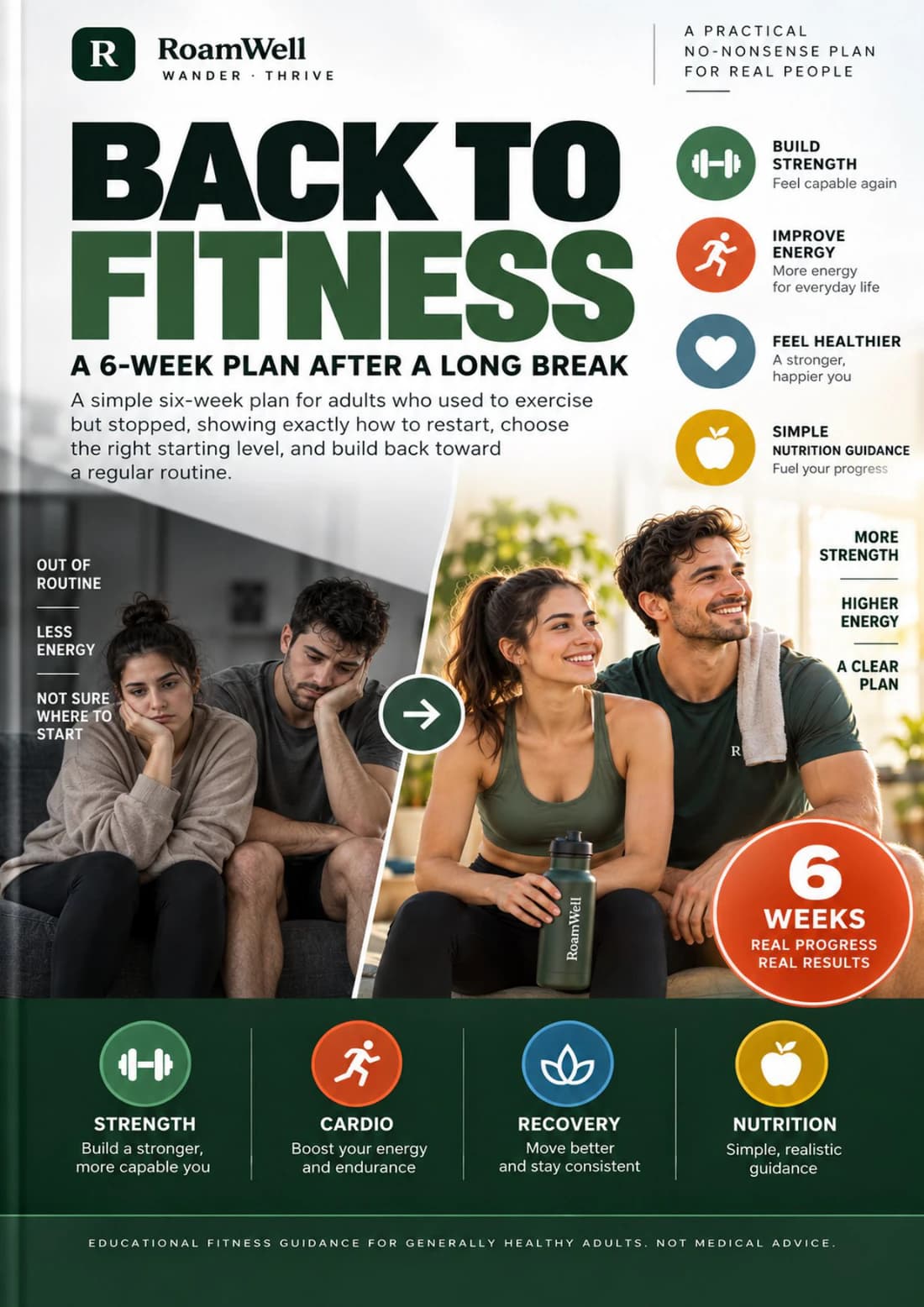
A 6-week plan for getting back into exercise after a break. Pick your starting level, then follow it week by week.
- A4 and US Letter, both included
- Works with a gym, home dumbbells, or nothing at all
- No app, no account, no subscription
Old workouts feel too hard. Beginner plans feel too easy.
- Old workouts
- Feel too hard now, because they're built for a fitness level you don't have anymore.
- Beginner plans
- Feel too easy, because they're written for someone who's never trained before, and that's not you.
- Effort
- Without a clear rule, how hard to push is just a guess, and guessing wrong is how a restart turns into an injury or a burnout.
- One missed session
- Is usually what actually ends a restart, not the workouts themselves. Most plans have nothing to say about what to do next.
Six weeks, and every one ends with a decision
Reintroduce, establish, build, progress, consolidate, finish. Every week gives you a session schedule and a check-in, and the check-in always lands on the same three options: keep going, repeat the week, or ease off.
- Reintroduce, then Establish, then Build, then Progress, then Consolidate, then Finish
- 01Reintroduce
- 02Establish
- 03Build
- 04Progress
- 05Consolidate
- 06Finish
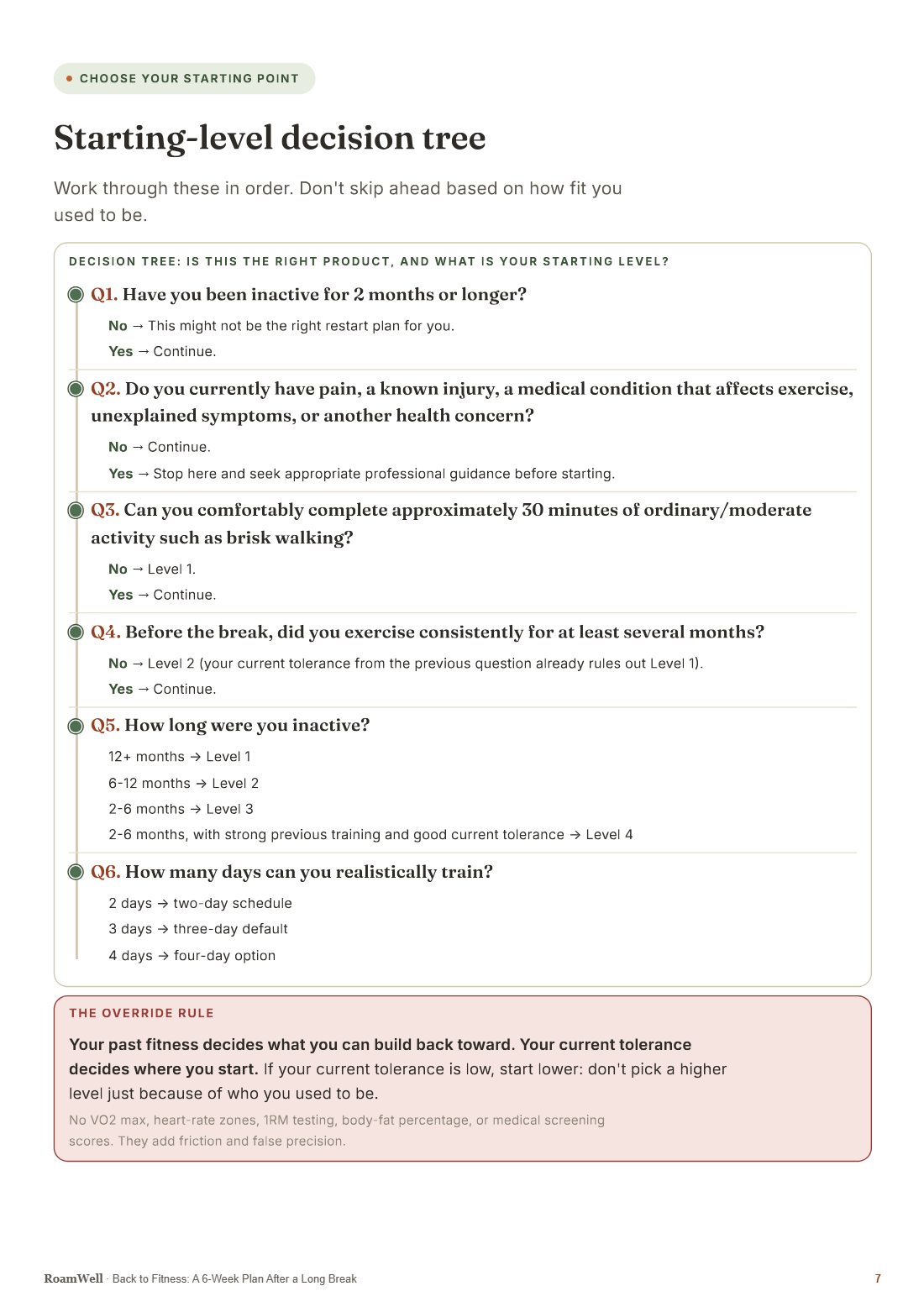
- Which of the four starting levels actually fits you, based on how you feel now, not how fit you used to be
- Exactly what today's session is: the exercises, the sets, the reps, and how hard it should feel
- What to do the second a session feels too easy or too hard, decided ahead of time instead of guessed mid-set
- What to do the moment you miss a workout, or a whole week, so one bad stretch doesn't turn into quitting
- How to swap any exercise between gym, home dumbbells, and no equipment at all, without throwing off the plan
- A quick goal check that points you to the right focus, inside the same six-week plan
10 chapters, run in order
Each chapter builds on the last one. You're never asked to guess at something an earlier chapter already covered.
Start here
What this plan is, who it's for, and the safety guidance worth reading before your first session.
Choose your starting point
Six quick questions sort you into one of four starting levels, based on how you feel now, not how fit you used to be.
Choose your schedule and equipment
Pick 2, 3 or 4 days a week, and a gym, home or no-equipment path for every move. Same plan either way.
How to train
How hard each set should feel, when to push harder, and what to do the moment a session's too easy or too hard.
Exercise reference
Ten movement patterns, each with five versions: the main one, a beginner one, a home one, an easier one and a harder one.
The six-week plan
Reintroduce, Establish, Build, Progress, Consolidate, Finish. A session schedule and a check-in for every single week.
When things go wrong
What to do if you miss a workout, miss a whole week, miss two weeks, or keep falling off.
Supporting habits
Eating while you restart, the basics of recovery, and a minimum week to fall back on when things get genuinely hard.
Finish and continue
A six-week review, a straight answer on what to do next, and a one-page card you can keep using.
Sources
Every guideline and study this plan is built on, named, so nothing here is just asserted without backing.
Everything included
PDF in A4 and US Letter
- 38
Page PDF
The full six-week restart plan in one document, made to work through, not just skim.
- 2
Editions
A4 and US Letter, both included. Print either one, no resizing needed.
- 4
Starting levels
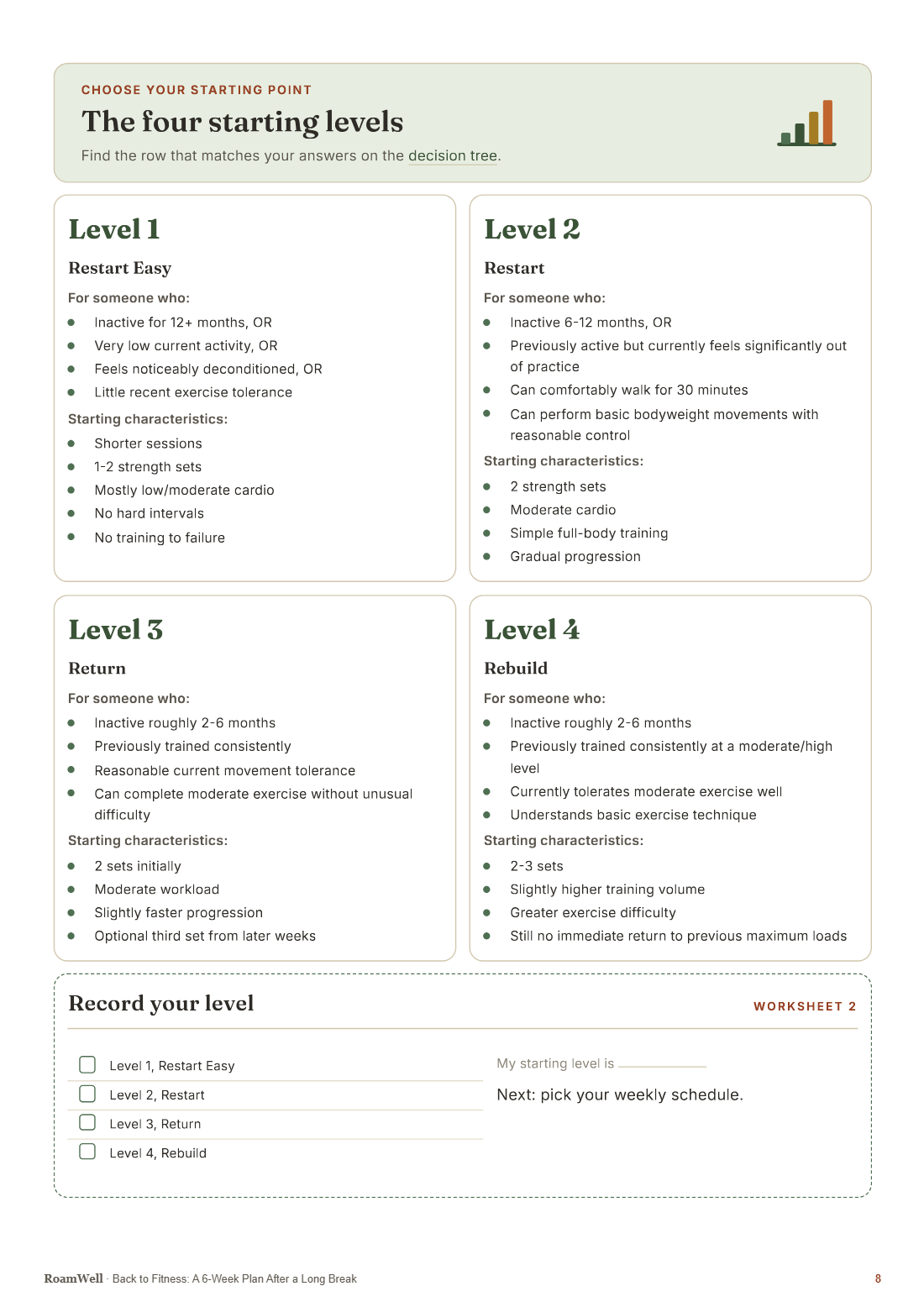
Restart Easy, Restart, Return and Rebuild, sorted by six quick questions, and how you feel today can bump you into a different one.
- 3
Weekly schedules
2, 3 or 4 days a week, all built from the same ten movement patterns. 3 days is the default.
- 10
Movement patterns
Each one with a main version, a beginner version, a home version, an easier version and a harder version, plus cues and the most common mistake.
- 6
Week + check-in pages
A session schedule and an end-of-week check-in for every single week, each one ending in a decision.
- 1
Bonus: Exercise substitution sheet
Every gym, home, no-equipment, easier and harder swap, all on one page.
- 1
Quick reference card
Effort, progression and missed-workout rules, all on one page you can print or screenshot.
See the actual pages
Six pages from the plan, shown in full. Open any one to see it at full size.
Why this holds up
Goes by how you feel now, not how fit you used to be
If your current tolerance is lower than it used to be, the starting-level test listens to that. Most restart advice gets this backwards.
One plan, three ways to do it
Every move has a gym version, a home version and a no-equipment version, so changing where you train doesn't mean starting over.
A plan for when things don't go to plan
Too easy, too hard, sore, tired, missed a session, missed a week, missed two weeks. Each one has a clear next step, no guilt trip attached.
Never asks you to max out
No 1-rep max tests, no training to failure, no brutal final week. Effort sits around 5-7 out of 10 the whole way through.
A short exercise list, not a library
Ten movement patterns cover the whole plan. You spend your time training, not scrolling through options.
Every week tells you what to do next
The weekly check-in isn't a journal entry. It gives you one answer: keep going, repeat the week, or ease off.
From start to finish, one full example
Priya: trained regularly for years, 4 months inactive, restarting on a 3-day schedule
- Snapshot
Off training for 4 months. Used to train consistently. Can walk 30 minutes without a problem. Has 3 days a week to train.
- Decision tree
No pain, no health concerns. Handles 30 minutes of moderate activity fine. Trained consistently for months before stopping. Inactive for 2-6 months with good current tolerance. Result: Level 4, Rebuild.
- Schedule
Goes with the 3-day default: Day 1, 2 and 3, each a full-body session using the same ten movement patterns.
- Week 1
2 strength sessions at 1-2 sets of 6-10 reps, plus 2 easy cardio sessions. Every set stops with reps still left in the tank.
- Week 4 check-in
Got through every session, and it felt manageable at a 6/10. Decision: bump up one thing, a harder version of the horizontal push.
This is just an example — Priya isn't real. It's here to show how the decision tree and check-in actually work, not to promise a specific outcome.
Who it's for, and who it's not
The second list matters just as much as the first. If you're on it, this isn't the thing to buy.
Built for
- You used to work out regularly (or semi-regularly), and it's been about 2 months or more since you stopped
- You want to get back into it without spending weeks putting a plan together yourself
- You've got a gym, some dumbbells at home, resistance bands, or nothing at all — any of those work
- You can do normal daily activities without any exercise-limiting medical problem getting in the way
- You want something simple to follow, not a full course on fitness
Not built for
- Rehab from an injury, or getting back to exercise after surgery
- Anyone dealing with sharp pain, unexplained chest pain, fainting, or serious shortness of breath
- A diagnosed medical condition that needs your exercise adjusted for it
- Pregnancy or postpartum exercise programs, cardiac rehab, or neurological rehab
- Competitive athletes who need sport-specific training, or anyone who needs a medically supervised program
Works wherever you are
- Doesn't depend on any country, brand or gym chain: every exercise is described by the movement, not a named machine
- A4 and US Letter editions, both included
- Works with a full gym, a pair of dumbbells at home, or nothing at all
- No app, no account, no subscription, no login
What this is, and what it is not
This plan is for generally healthy adults getting back into exercise after time off. It's fitness guidance, not medical advice — not a diagnosis, a treatment, a rehab program, or a prescription written for your body. If you have a medical condition, an injury, ongoing pain, symptoms you can't explain, you've recently had surgery or a major health event, you're pregnant or recently gave birth, or you're just not sure exercise is a good idea for you right now, talk to a doctor before you start.
Before you decide
Who is this for?
A generally healthy adult who used to train regularly (or semi-regularly) and has been off it for about 2 months or more. Works whether you trained seriously and lost your conditioning, or just exercised casually and now feel like you're starting from scratch.
Is this a rehabilitation or medical program?
No. It's fitness guidance for generally healthy adults, not medical advice, a diagnosis, a treatment or rehab. If you have an injury, a diagnosed medical condition, or any symptom that worries you, check with a doctor first.
How is this different from a free workout PDF?
Most free PDFs just hand you a workout. This also tells you where to start, what to do when something goes wrong, and how to progress week by week, not just what to do on day one.
Do I need a gym?
No. Every move has a gym version, a home dumbbell version, and a no-equipment version. The plan stays the same; you just pick the column that matches what you've got.
What if I miss a workout, or a whole week?
There's a clear answer for each situation. Miss one session: just pick up with the next one. Miss a few: keep going, don't try to cram in what you missed. Miss a whole week: repeat it. Miss two weeks: repeat your last full week at a lower effort and check your starting level again.
Does this include a nutrition or calorie plan?
No, and that's on purpose. There's one short section on the basics — balanced meals, getting enough protein, staying hydrated — but no calorie targets, macros, meal plans or supplements. What you actually need is personal, and a fixed plan can't work that out for you responsibly.
How many exercises are in it?
Ten movement patterns, each with five versions: the main one, a beginner one, a home one, an easier one and a harder one. It's kept small on purpose, not a 100-exercise encyclopedia you'll never fully use.
Will I lose weight or build muscle?
This plan doesn't promise weight loss, muscle gain, or any specific change to how you look. What it's built to do is get you back into a consistent routine that's actually hard enough to matter. What that leads to for you depends on a lot this plan can't control.
Can I print it?
Yes. It's built to print fine in black and white, the worksheets have real space to write on, and it comes in both A4 and US Letter.
Can I get a refund?
Once a digital product has been delivered, we generally don't offer refunds just because you changed your mind or didn't get around to using it, which is why this page goes into so much detail about what the plan does, what it doesn't, and who it's not for. That is subject to the law that applies to you, and it is not a promise that every request will be refused. If a charge was made twice, a file is corrupted or you can't open it, something the page promised is missing, or the product is materially different from its description, contact us and we'll try to put it right first, and give any remedy the law requires if we can't. We also look into unauthorised payments and payment disputes. The full policy is on our refund page.
What happens after I buy?
You pay through Razorpay, a third-party payment gateway, in a secure checkout window. Once your payment is verified, the Thank You page shows a download button for the PDF. Where checkout asks you to sign in with your email, the purchase is linked to that account, and you can download again whenever you sign in to it. Otherwise, access is valid for 30 days, in the same browser you paid from, so keep that browser for your download. Purchases made before sign-in checkout opened keep that 30-day, same-browser access. The full details are on our refund page.
Back to Fitness: A 6-Week Plan After a Long Break
What to do and how hard to push, mapped out week by week
- Weeks
- 6
- Starting levels
- 4
- Schedules
- 2 / 3 / 4-day
- Movement patterns
- 10
We research travel, fitness and wellness, and publish what holds up. See our editorial policy.
Last updated September 2, 2026
Related articles
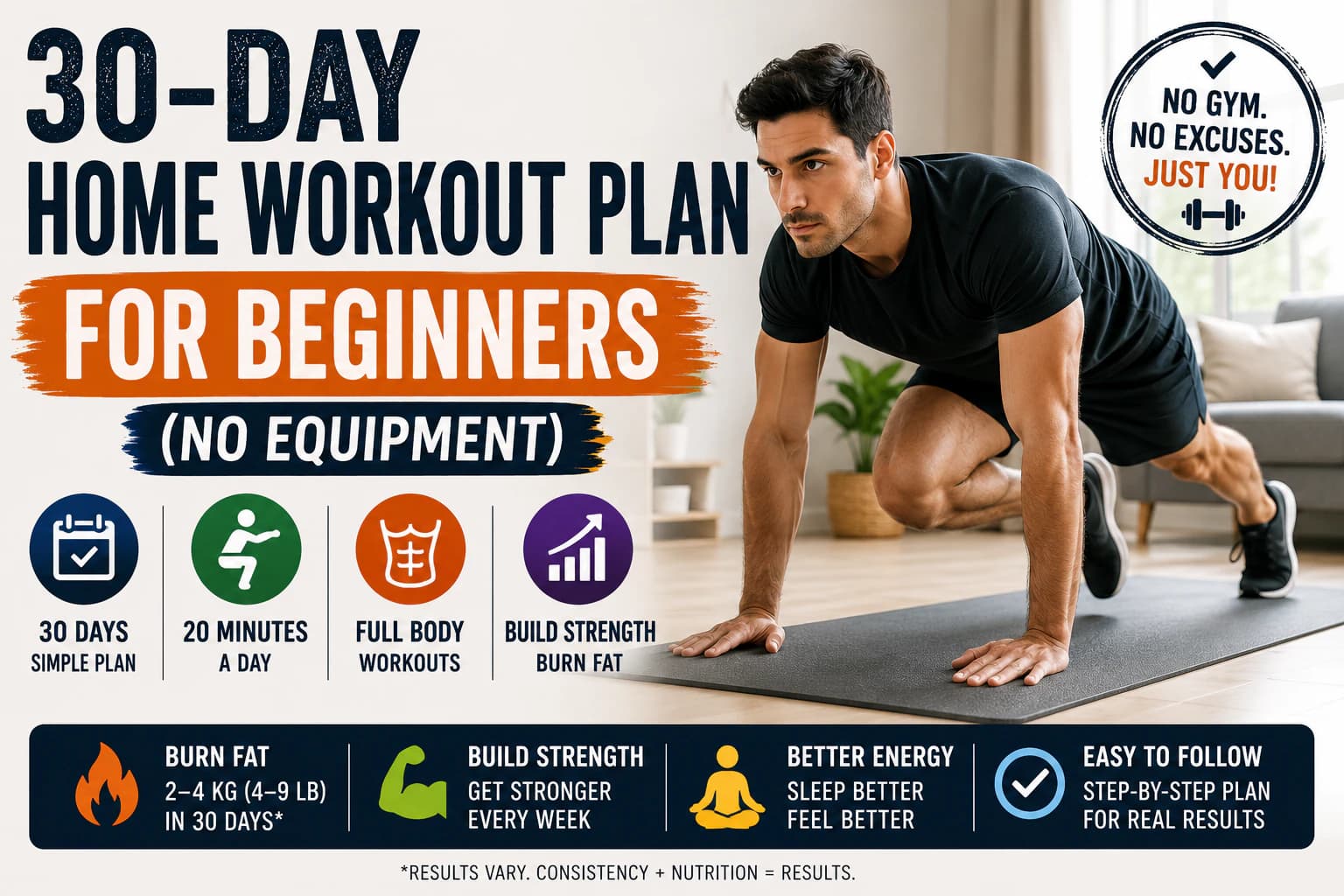
30-Day Home Workout Plan for Beginners (No Equipment)
A 30 day home workout plan for beginners: day-by-day calendar, form cues, injury prevention and a real results timeline.
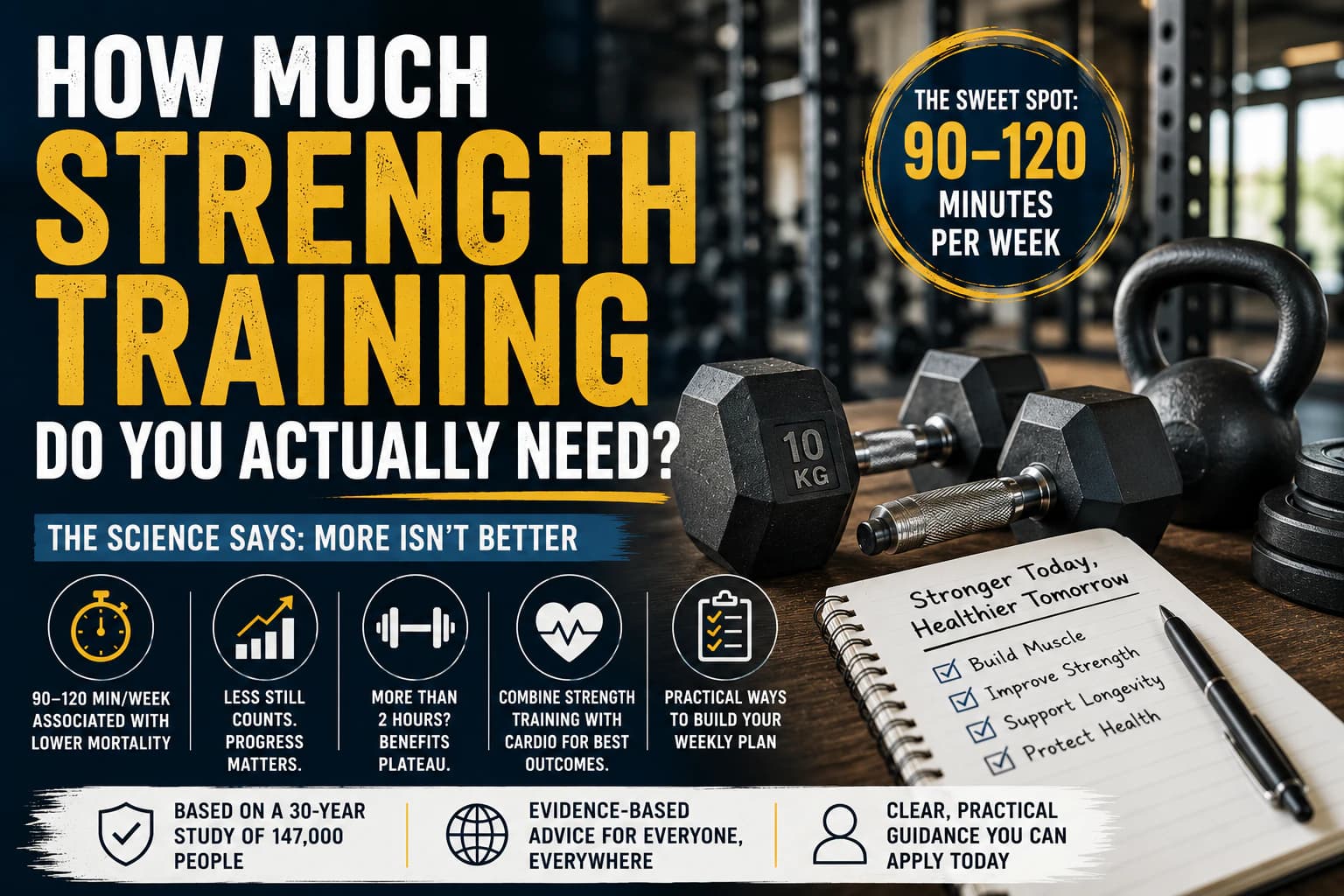
How Much Strength Training Do You Actually Need?
How much strength training per week? What a 30-year study of 147,000 people found, and why more than 2 hours adds nothing.
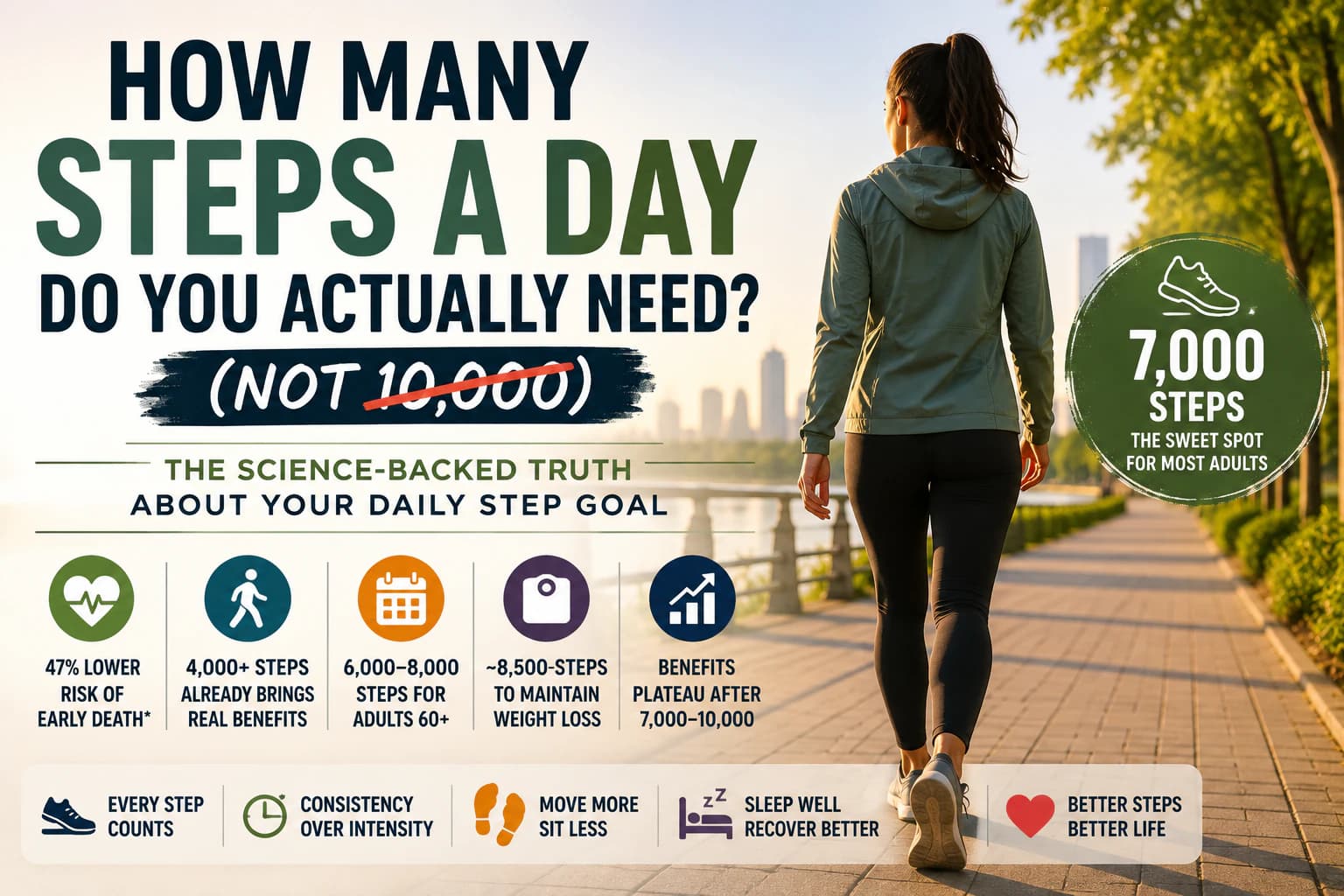
How Many Steps a Day Do You Actually Need? (Not 10,000)
How many steps a day you actually need: research points to 7,000, not 10,000, and less after 60. Your target by age.