30-Day Home Workout Plan for Beginners (No Equipment)
A 30 day home workout plan for beginners: day-by-day calendar, form cues, injury prevention and a real results timeline.
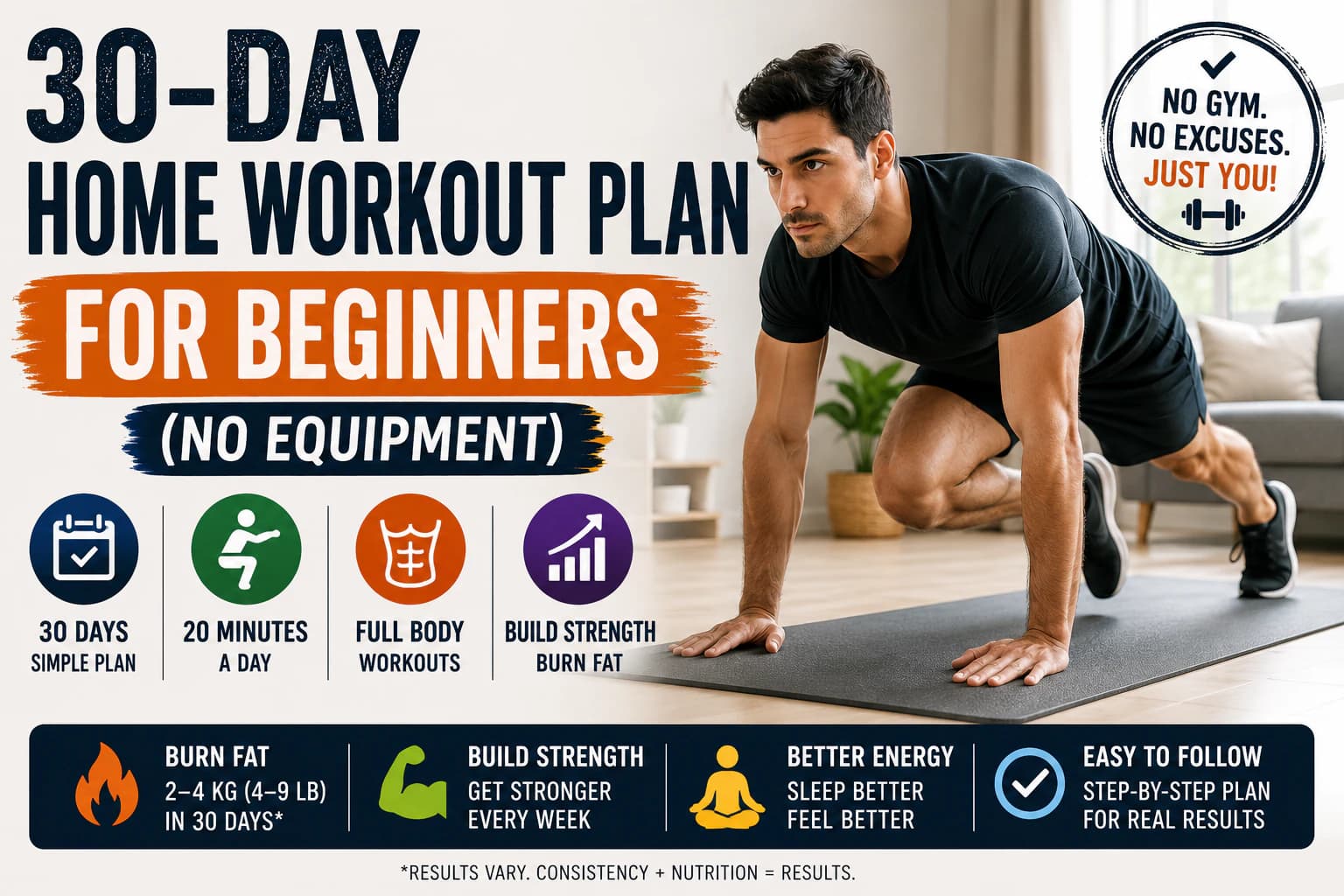
Most people who start a 30 day home workout plan stop within the first couple of weeks. The reason isn't laziness. Most home workout plans throw you into 60-minute HIIT sessions on day one, then wonder why you never come back.
What follows is deliberately unambitious: twenty minutes a day, difficulty that creeps up slowly, and rest days that are actually scheduled rather than earned. It assumes you haven't exercised in years, or ever.
If that's not quite you, and you trained seriously before and are coming back after months off rather than starting from zero, Back to Fitness: A 6-Week Plan After a Long Break starts from a different baseline than this plan does.
The structure draws on progressive-overload research, the habit-formation work of BJ Fogg and of Lally et al. (2010), and injury data from Texas Health. The pacing reflects what the research on sticking with a plan consistently shows about where beginners drop out.
A note on equipment prices: Resistance bands and dumbbells vary in price by brand and retailer, and prices shift over time. Check current listings before buying rather than relying on the figures below.
A note on health advice: This is general information, not medical advice. People with significant health conditions, substantial inactivity, mobility limitations or safety concerns should consider discussing a new exercise program with a clinician first.
The 30-second answer
This 30 day home workout plan runs five workout days and two rest days a week, at 20 minutes a session: a 3-minute warm-up, a 15-minute full-body circuit and a 2-minute cool-down. No equipment is needed. With consistent training and appropriate nutrition, some people may see changes in fitness, strength, body composition, or scale weight over 30 days, but results vary considerably.
- Weekly structure: 5 workout days, 2 scheduled rest days
- Session length: 20 minutes: 3 warm-up, 15 circuit, 2 cool-down
- Focus: full body every session, not a split
- Progression: weeks 1-2 foundations, 3-4 strength, 5+ habit
- The one rule: never skip two days in a row
- By day 30: a real exercise habit, measurable strength gains, and possible changes in body composition and energy, though the specifics vary by person
Before you start
Equipment needed: None. A yoga mat helps but isn't required.
Space needed: 2m × 2m. Your bedroom floor works.
Time per day: 15-25 minutes.
Days off: Two per week (yes, really, recovery supports the adaptation and muscle growth that training stimulates).
What you need: The ability to walk. That's it.
The critical injury prevention truth
55% of exercise-related injuries occur within the first three months of a new workout program, according to Texas Health. That figure comes from fitness industry data rather than a clinical trial, so treat it as a strong signal about when beginners get hurt rather than a precise number. Two main causes:
- Overloading (too much, too soon)
- Poor form on compound movements (squats, lunges, planks)
This plan is built to reduce both risks by starting slow (Week 1 is deliberately easy) and putting form ahead of quantity. No program can rule out injury, but the form cues on every exercise below are the part worth following closely.
The three principles
- Consistency over intensity. A missed workout is worse than an easy one.
- Progressive overload. Every week gets slightly harder, but never more than 10% jump per week.
- Full body, always. No "leg day" nonsense at this stage.
Master the 5 foundational exercises (form first)
These 5 movements make up 80% of the plan. Master the form or risk injury.
Bodyweight Squat
Setup:
- Feet shoulder-width apart
- Toes pointed slightly outward (15 degrees)
- Keep pressure through the whole foot, with the heel and midfoot firmly grounded
- Chest lifted, gaze forward
Movement:
- Hips move back FIRST (as if sitting into a chair)
- Then knees bend to lower body
- Descend until thighs parallel to floor (or as low as comfort allows)
- Knees track OVER toes (not caving inward)
- Drive up through heels
Breathing: Inhale on descent, exhale on drive up.
Common mistakes:
- Knees caving inward (a common form issue worth fixing)
- Heels lifting off floor
- Rounded lower back
- Rushing through, squats should be controlled
Modifications:
- Beginner: Squat to a chair (touch, don't sit)
- Injured knees: Partial squat only (¼ range)
- Balance issues: Hold a wall or chair
Push-up
Setup:
- Hands slightly wider than shoulders
- Fingers pointed forward
- Body in straight line from head to heels
- Core engaged (belly button pulled toward spine)
Movement:
- Elbows go BACK at 45-degree angle (NOT flared out to sides)
- Lower until chest almost touches floor
- Push up powerfully
- Full range of motion
Breathing: Inhale on descent, exhale on push.
Common mistakes:
- Hunched shoulders / arched neck
- Sagging hip (usually from weak core)
- Butt in the air
- Elbows flaring 90 degrees (shoulder injury risk)
Progressions (easy to hard):
- Wall push-up (standing, hands on wall)
- Incline push-up (hands on couch/desk)
- Knee push-up
- Standard push-up (full plank position)
- Decline push-up (feet elevated)
Lunge
Setup:
- Stand tall, feet hip-width apart
- Step one foot forward (or backward for reverse lunge)
- Torso upright
Movement:
- Both knees bend to 90 degrees
- Keep the front knee controlled and aligned comfortably with the foot; some forward knee movement is normal
- Back knee drops toward floor (doesn't touch)
- Weight distributed 60% front leg, 40% back
- Push through front heel to return
Breathing: Inhale on descent, exhale on push up.
Common mistakes:
- Front knee moving with no control (allowing it to move forward isn't inherently dangerous, but keep the movement controlled and pain-free)
- Torso leaning too far forward
- Feet too close together (balance loss)
- Not going deep enough
Modifications:
- Hold a wall for balance
- Reverse lunge (easier on knees than forward)
- Static split squat (no step, just lower)
Plank
Setup:
- Elbows directly under shoulders (forearm plank) OR palms directly under shoulders (high plank)
- Body in straight line from head to heels
- Feet hip-width apart
Engagement:
- Squeeze glutes tight
- Pull belly button toward spine
- Pull shoulder blades back and down (away from ears)
- Look at floor (neutral neck)
Breathing: Slow, controlled breaths. Never hold breath.
Common mistakes:
- Sagging hip (weak core)
- Butt in air (safer but easier)
- Neck strain from looking forward
- Holding breath
Modifications:
- Beginner: Knee plank (knees on floor)
- Wrist issues: Forearm plank
- Progression: Side plank, plank with leg lift
Glute Bridge
Setup:
- Lie on back
- Knees bent, feet flat on floor
- Feet hip-width apart, close to butt
- Arms at sides
Movement:
- Squeeze glutes and drive hips up
- Body forms straight line from knees to shoulders
- Hold 2 seconds at top
- Lower slowly
Breathing: Exhale on lift, inhale on lower.
Common mistakes:
- Overarching lower back
- Not squeezing glutes at top
- Feet too far from butt
The 30 day home workout plan calendar
Week 1: Getting your body used to movement
Each workout: 3 rounds. Rest 45 seconds between rounds.
Day 1: Foundations
- 10 wall push-ups
- 10 chair-supported squats
- 10 knee raises (standing)
- 20-second knee plank
Day 2: Rest
Day 3: Bodyweight Basics
- 10 wall push-ups
- 12 bodyweight squats
- 10 alternating reverse lunges (5 each leg)
- 25-second knee plank
Day 4: Movement Flow
- 15 marching in place (high knees, slow)
- 12 squats
- 10 glute bridges
- 30-second knee plank
Day 5: Rest
Day 6: Full Body
- 10 incline push-ups (hands on couch)
- 15 squats
- 10 walking lunges (5 each leg)
- 15-second side plank each side
Day 7: Active Recovery
- 20-minute walk outside
- 5 minutes gentle stretching
Week 1 focus: Building the habit. Don't push hard. Master form.
On recovery days the walk is the workout, and it does more than it looks like it does. Our daily step guide covers what target the research actually supports, which is lower than the number you have probably been given.
Week 2: Building strength
Each workout: 3 rounds. Rest 40 seconds.
Day 8: Push & Squat
- 12 incline push-ups
- 15 squats
- 10 reverse lunges (5 each)
- 30-second plank (knee or full)
Day 9: Cardio Intro
- 30 seconds marching
- 15 squats
- 20 mountain climbers (slow)
- 30-second plank
Day 10: Rest
Day 11: Strength Focus
- 15 incline push-ups
- 18 squats
- 12 lunges (6 each)
- 35-second plank
Day 12: Movement Flow
- 20 jumping jacks
- 15 squats
- 12 glute bridges
- 15 mountain climbers
Day 13: Rest
Day 14: Full Body Test
- 15 push-ups (incline if needed, floor if strong)
- 20 squats
- 15 lunges (total)
- 45-second plank
Week 2 focus: DOMS decreases. Body adapting. Energy up.
Week 3: Adding intensity
Each workout: 4 rounds. Rest 40 seconds.
Day 15: Push Emphasis
- 12 floor push-ups (or 15 incline)
- 20 squats
- 10 lunges each side
- 40-second plank
Day 16: Cardio Push
- 30 jumping jacks
- 20 squats
- 20 mountain climbers
- 30-second plank
Day 17: Rest
Day 18: Legs
- 25 squats
- 15 lunges each side
- 15 glute bridges
- 40-second wall sit
Day 19: Full Body
- 15 push-ups
- 20 squats
- 15 lunges each
- 45-second plank
Day 20: Rest
Day 21: Endurance Test Do without stopping (rest as needed within):
- 20 push-ups
- 30 squats
- 20 lunges (total)
- 60-second plank
Time yourself. When you repeat this on Day 30, you'll shave 2+ minutes.
Week 3 focus: Habit forming (see the 66-day research below). Sleep may be improving for some people. Strength gains at this stage likely involve a mix of neural adaptation and early muscle-level changes.
Week 4: Locking in the habit
Each workout: 4 rounds. Rest 30 seconds.
Day 22: Strength Circuit
- 15 push-ups
- 20 squats
- 15 lunges each
- 45-second plank
Day 23: HIIT-Lite
- 40 sec jumping jacks / 20 sec rest
- 40 sec squats / 20 sec rest
- 40 sec mountain climbers / 20 sec rest
- 40 sec plank / 20 sec rest
- Repeat 4 rounds.
Day 24: Rest
Day 25: Push Focus
- 20 push-ups (do sets if needed)
- 20 squats
- 20 lunges (total)
- 50-second plank
Day 26: Legs Focus
- 30 squats
- 20 lunges each
- 20 glute bridges
- 45-second wall sit
Day 27: Rest
Day 28: Full Test Same as Day 21. Compare your time.
Day 29: Active Recovery 20-minute walk + 10 minutes stretching.
Day 30: Graduation Workout
- 25 push-ups
- 30 squats
- 20 lunges each side
- 60-second plank
- Repeat 4 rounds.
Completing the plan gives you a foundation for progressing beyond beginner-level routines.
Warm-up protocol (3 minutes, do every workout)
A brief warm-up can help you gradually raise body temperature, rehearse the movements, and prepare for the session.
30 seconds jumping jacks: raises heart rate + core temperature 20 arm circles: 10 forward, 10 backward (shoulders) 15 bodyweight squats: activates hips + knees 10 leg swings each leg: hip mobility 10 torso twists: spine mobility 10 knee raises marching: hip flexors
Worth doing every session, not an optional extra.
Cool-down protocol (2-3 minutes, do every workout)
Static stretching after warm muscles can help maintain or improve flexibility, but it has little effect on post-exercise soreness.
Quad stretch: hold ankle behind you, 20 sec each side Hamstring stretch: bend forward, reach for toes, 20 sec Hip flexor stretch: lunge position, 20 sec each side Chest stretch: hands behind back, lift arms, 20 sec Shoulder stretch: arm across body, 15 sec each Cat-cow: 10 slow rounds
Hold each stretch 15-30 seconds. Never bounce.
The results timeline (what to expect week by week)
Here is roughly what the adaptation curve looks like, and when each change tends to show up:
Days 1-3
- Feel: Many beginners feel sore, widely, as muscles adapt to unfamiliar movement.
- Body: DOMS is a normal response to unfamiliar exercise, not muscle damage.
- Push through: If soreness is mild, gentle movement at lower intensity may be fine. If it's severe, give yourself more recovery time.
Week 1 (Days 4-7)
- Feel: Some people notice energy improving mid-day.
- Body: Neural adaptation is thought to begin early (the nervous system getting more efficient at the movements).
- Weight loss: Highly variable; early scale changes are often influenced heavily by water weight shifts rather than fat specifically.
Week 2 (Days 8-14)
- Feel: Some people notice sleep quality or mood improving.
- Body: Sore recovery time often drops compared with Week 1.
- Strength: Strength gains in beginners can involve multiple factors, including neural adaptations and early changes in muscle capacity, not neural adaptation alone.
Week 3 (Days 15-21)
- Feel: Habit forming for many people. Some crave movement on rest days.
- Body: Muscle adaptation processes continue.
- Visible: Some people notice slight tone showing in arms and legs, results vary.
- Clothes: May fit slightly differently for some people.
Week 4 (Days 22-30)
- Feel: Often more automatic by this point.
- Body: Muscle adaptation continues to build on earlier weeks.
- Visible: Photos may show a difference from Day 1 for many people.
- Weight: Change varies considerably and depends heavily on diet, not just training.
After Day 30 (weeks 5-12)
- Weeks 5-8: Some people notice more visible muscle definition, results vary.
- Weeks 9-12: Some people notice more visible fat loss, largely diet-dependent.
- Week 12+: Longer-term body composition change is possible with continued consistency, but isn't guaranteed on any fixed timeline.
Reality check: Scale weight can be misleading in week 1. You may lose water fast then plateau. Muscle also weighs more than fat by volume. Trust the mirror + measurements + photos over scale.
Track progress properly (not just the scale)
Weekly measurements
- Waist (at belly button)
- Hip (widest point)
- Chest
- Thigh (mid-thigh)
- Weight (same day, morning, after washroom)
Photos every 2 weeks
- Front + side view
- Same lighting, time, clothes
- The mirror lies. Photos don't.
Performance metrics
- Push-ups you can do (unbroken)
- Squats in 60 seconds
- Plank hold time
- 20-minute walking pace
All should improve week over week.
Sleep + energy tracking
- Sleep hours + quality (1-10 scale)
- Morning energy (1-10 scale)
- These often improve BEFORE physical changes are visible
Common beginner mistakes (avoid these)
1. Skipping warm-ups
A brief warm-up helps prepare your body for the session. 3 minutes is worth protecting.
2. Poor form for reps
5 perfect push-ups > 15 sloppy ones. Progress form before reps.
3. Doing too much too soon
Following an "advanced" plan on Day 1. Beginners are especially vulnerable to injury in the first three months of a new program, and overloading too fast is one of the main reasons why.
4. Not resting enough
Training provides the stimulus; recovery supports the adaptation. Working out 7 days a week without rest can increase fatigue and raise the risk of overtraining, poor sleep and injury.
5. Working out through significant illness
Fever, chest symptoms, body aches, or feeling systemically unwell are reasons to rest instead. Return gradually when you feel well enough, easing back into intensity.
6. Comparing to Instagram
Their videos are lit, angled, filtered, and often supplemented by anabolics. Yours isn't. Compare only to your Week 1 self.
7. Quitting when soreness peaks
Week 1 is hardest. Push through to Week 2 and it gets easier.
8. All-or-nothing mentality
Missed a day? Do 5 push-ups. Never let a miss become a spiral.
9. Neglecting sleep + nutrition
Workouts alone won't work if sleep is 5 hours and diet is fast food.
10. Cardio-only mindset
Aerobic training and resistance training emphasize different adaptations; resistance training is the more direct way to stimulate muscle growth. Resistance training can help build or preserve muscle, which can contribute to changes in body composition and appearance. Our guide to how often to strength train covers the weekly amount worth aiming at.
Modifications for common limitations
Bad knees
- Skip: Jump squats, deep lunges
- Do: Wall sits, glute bridges, chair squats, partial ranges
- Add: Isometric quad holds
Bad shoulders / wrists
- Skip: Regular push-ups, planks
- Do: Wall push-ups, forearm planks, standing exercises
- Add: Rotator cuff strengthening
Back pain
- Skip: Sit-ups, weighted flexion
- Do: Bird-dog, dead-bug, glute bridges, planks
- Rule: Any sharp pain = stop and see doctor
Larger bodies / higher body weight
- Start: Wall push-ups, chair squats, walking
- Add: 20-30 minutes daily walking
- Focus: First 2 weeks on movement quality, not quantity
- Note: People with significant health conditions, substantial inactivity, mobility limitations, or safety concerns should consider discussing a new program with a clinician first
Over 60
- Consult doctor first
- Chair-based variations for all exercises
- Balance work priority (single-leg stands)
- Add: Mobility work, tai chi, gentle yoga
Pregnancy
- Consult obstetrician or a qualified prenatal exercise professional first, recommendations depend on your individual health, pregnancy, and symptoms
- Second/third trimester: General cautions some clinicians raise include lying-on-back exercises, jumping, and fall-risk movements, confirm what applies to you
- Prenatal-specific programs designed by qualified professionals are generally preferable to adapting a general program
- Walking, Kegels, and prenatal yoga are commonly well-tolerated, but check with your own care team rather than assuming any exercise is universally safe
Nutrition to boost results (simple version)
Full nutrition is beyond this post (see our belly fat guide). For this 30-day plan:
3 simple habits worth prioritizing
- Protein at every meal (eggs, chicken, fish, lentils, beans, tofu, paneer, yoghurt)
- Drink enough fluid to stay hydrated, needs vary by body size, climate, activity, diet, and medical conditions
- Cut sugary drinks completely (soft drinks, fruit juice, sweetened tea or coffee)
That's it. These are simple habits that can support overall nutrition and make your training easier to sustain, without needing to follow strict diet rules.
If you also want fat loss
- A modest calorie deficit can support fat loss for people trying to lose weight, but the appropriate intake varies by person (see belly fat guide)
- Add regular walking or other low-intensity activity that fits your current fitness level
- Sleep 7+ hours (see sleep guide)
Weight change over 30 days with all of the above varies considerably by person and isn't a fixed, guaranteed number.
How to stay consistent (habit science)
Motivation is a myth. Systems win.
The 5 habit-forming tactics
- Same time daily: before excuses build up
- Layout clothes night before: reduces friction
- Track visually: printed calendar with X-marks (childish but works)
- Habit stack: workout right after existing habit (e.g., after brushing teeth)
- Public accountability: post progress on social media OR tell a friend to check in
How long habits actually take
The 66-day figure everyone quotes comes from one study: Lally and colleagues (2010) followed 96 people taking up a daily habit over 12 weeks. Time to reach near-automatic behaviour ranged from 18 days to 254 days, and 66 was the median, not a typical duration. The spread is the useful part. Some habits stick in three weeks, some take most of a year, and where you land says nothing about your discipline. If you can survive Week 3, Week 4 gets easier. Focus on getting to Day 21: everything after gets easier.
If you miss more than 2 days
Don't restart. Don't beat yourself up. Just show up today with 50% intensity. Missing days is normal. Quitting is the problem.
After Day 30: the roadmap
Congratulations. You're now capable of harder training. Three paths:
Path 1: Level up bodyweight training
- Same plan, harder variations (jump squats, decline push-ups, pistol squat progressions)
- Add 5 reps per week
- Try Athlean-X Zero, MadFit HIIT programs
Path 2: Add weights
- Buy 5-10 kg (10-20 lb) dumbbells (USD 31-52, Rs 3,000-5,000)
- Or resistance band set (USD 8, Rs 800)
- Learn goblet squats, dumbbell rows, overhead press
USD figures here are approximate reference conversions at about Rs 95.5 to the dollar as of August 2026; exchange rates move.
Path 3: Sport-specific
- Running program (Couch to 5K)
- Rucking, walking with a weighted pack, lower impact than running and built from walks you already do
- Swimming (best full-body if pool access)
- Cycling
- Group classes (yoga, boxing, dance)
The one thing NOT to do
Rest for a week thinking "I earned a break." An unplanned week off is where most people quietly stop for good. Continue directly into Month 2 at higher intensity, or a deload week where you show up but at 50%.
Common questions from beginners
"I don't have time"
15 minutes exists in your day. It exists during Instagram scrolling, TV watching, or dead office moments. The problem is priority, not time.
"I don't feel motivated"
Motivation follows action, not the other way around. Start the workout. Motivation shows up 5 minutes in.
"I look silly at home"
No one is watching. This is one of the great benefits of home workouts.
"What if I injure myself?"
Follow form cues religiously. Warm up. Never work through sharp pain. See a doctor for any pain lasting 3+ days.
"I'm too old / too fat / too weak"
This plan is specifically designed for beginners. Modifications exist for every limitation. The riskiest thing is NOT moving.
The final rule
30 days is not a magic transformation. It's the foundation.
If you complete 30 days, you've achieved the hardest part of fitness: building the identity of "someone who exercises."
Everything after gets easier. But you have to get to Day 30 first.
Start day one tomorrow. Not next Monday. Not "when work slows down." Tomorrow.
Related reads:
Frequently asked questions
Answers to the most common questions about this topic.
Do what you can. If the plan says 15 push-ups and you can do 5, do 5. Add 1 more the next session. Consistency at your level beats trying to match a plan and quitting. The plan is a target; your effort is the metric.
Yes, with modifications. Focus on chair-supported variations (wall push-ups instead of floor, chair squats instead of full squats). Consult a doctor if you have joint issues, cardiovascular conditions, or haven't exercised in 5+ years. Regular movement can support mobility, strength, balance, and overall health, while prolonged inactivity has important health risks.
Don't obsess over diet in month 1. Just: protein at every meal, drink enough fluid to stay hydrated (needs vary by body size, climate and activity), cut sugary drinks. These are simple habits that can support overall nutrition and make your training easier to sustain, without needing to follow strict diet rules. Detailed nutrition can wait until month 2. See our belly fat loss guide for the full nutrition protocol.
DOMS (Delayed Onset Muscle Soreness) is muscle pain 24-72 hours after new exercise. It's a normal response to unfamiliar or strenuous exercise and involves multiple processes, including changes in the muscle and surrounding tissues, not simply 'tears.' Peaks day 2-3 post-workout. Manage with: gentle movement (walking), light stretching, hydration, protein. If soreness is mild, gentle movement may be fine; if soreness is severe or affects normal movement, take additional recovery time and reduce the next session rather than pushing through. DOMS tends to drop a lot after week 3 as the body adapts.
Many beginners do in week 1-2. As you adapt (week 3-4), soreness tends to decrease. Absence of soreness doesn't mean you're not making progress. Extreme soreness (can't walk, DOMS lasting 4+ days) suggests you overdid it, scale back. Mild soreness (feel it, can still function) is generally a reasonable sign. Sharp or persistent pain is a reason to stop and seek appropriate evaluation.
For most beginners: yes, for roughly the first 6-12 months. Muscle grows in response to progressive overload, and beginners can generate meaningful overload from bodyweight training fairly easily. After that period, adding external resistance (dumbbells, resistance bands, weighted vest) tends to help continued progress for most people. Advanced calisthenics practitioners maintain strong physiques on pure bodyweight training, showing what's possible without external load.
Yes, this plan is designed to be appropriate. Start with modifications: chair squats instead of full squats, wall push-ups instead of floor, walking instead of jumping. Focus on WEEK 1 movements for first 2 weeks to build joint tolerance. Add 20-30 minutes daily walking. Weight change with clean eating varies by person and isn't guaranteed on a fixed timeline. People with significant health conditions, substantial inactivity, mobility limitations, or concerns about exercise safety, including a high BMI or cardiovascular conditions, should consider discussing a new exercise program with a clinician first.
Yes, 2-3 minutes minimum. Static stretching after workouts (when muscles are warm) can help maintain or improve flexibility. It will not spare you the soreness though: a Cochrane review of stretching and muscle soreness found it reduced soreness by about one point on a 100-point scale, which is too small to notice. Focus on major muscle groups worked: quads, hamstrings, hip flexors, chest, shoulders. Hold each stretch 15-20 seconds. Use controlled movements and avoid forcing a stretch into pain, rather than bouncing. Cool-down also helps heart rate return to normal.
Consult your obstetrician first, this is not a program designed for pregnancy. Pregnancy exercise recommendations depend on the individual's health, pregnancy, symptoms, and clinician guidance, there's no universal answer. General cautions some clinicians raise for later pregnancy include lying-on-back exercises (planks, glute bridges after 20 weeks), jumping, and exercises with a fall risk, but confirm what applies to you with your own care team. For pregnancy-specific modifications, follow guidance from an obstetric clinician or a qualified prenatal exercise professional rather than adapting a general program on your own.
Partially, and diet tends to do a lot of the work alongside training. The oft-quoted 80/20 split is not a real research finding, but the direction it points at is well established: exercise and nutrition both matter for body composition, and it's hard to out-train a poor diet. Training can strengthen the core, but visible definition depends partly on overall body composition. Each session burns some additional energy, with the amount varying substantially by body size, exercise selection, intensity, and duration. Combined with a calorie deficit sized appropriately for you and regular walking, weight change is possible over 30 days, but the amount varies considerably by person. See belly fat guide for the nutrition side.
Filed under
Written by
We research travel, fitness and wellness, and publish what holds up. See our editorial policy.