Does Alcohol Help You Sleep? What 27 Studies Found
Does alcohol help you sleep? What a 2025 review of 27 studies found about REM sleep, falling asleep and dose.
Plenty of people pour a drink in the evening because they believe it helps them sleep. The belief is not baseless: alcohol is a sedative, and it can make you feel drowsy. But feeling drowsy and sleeping well are different outcomes, and laboratory studies have measured the second one.
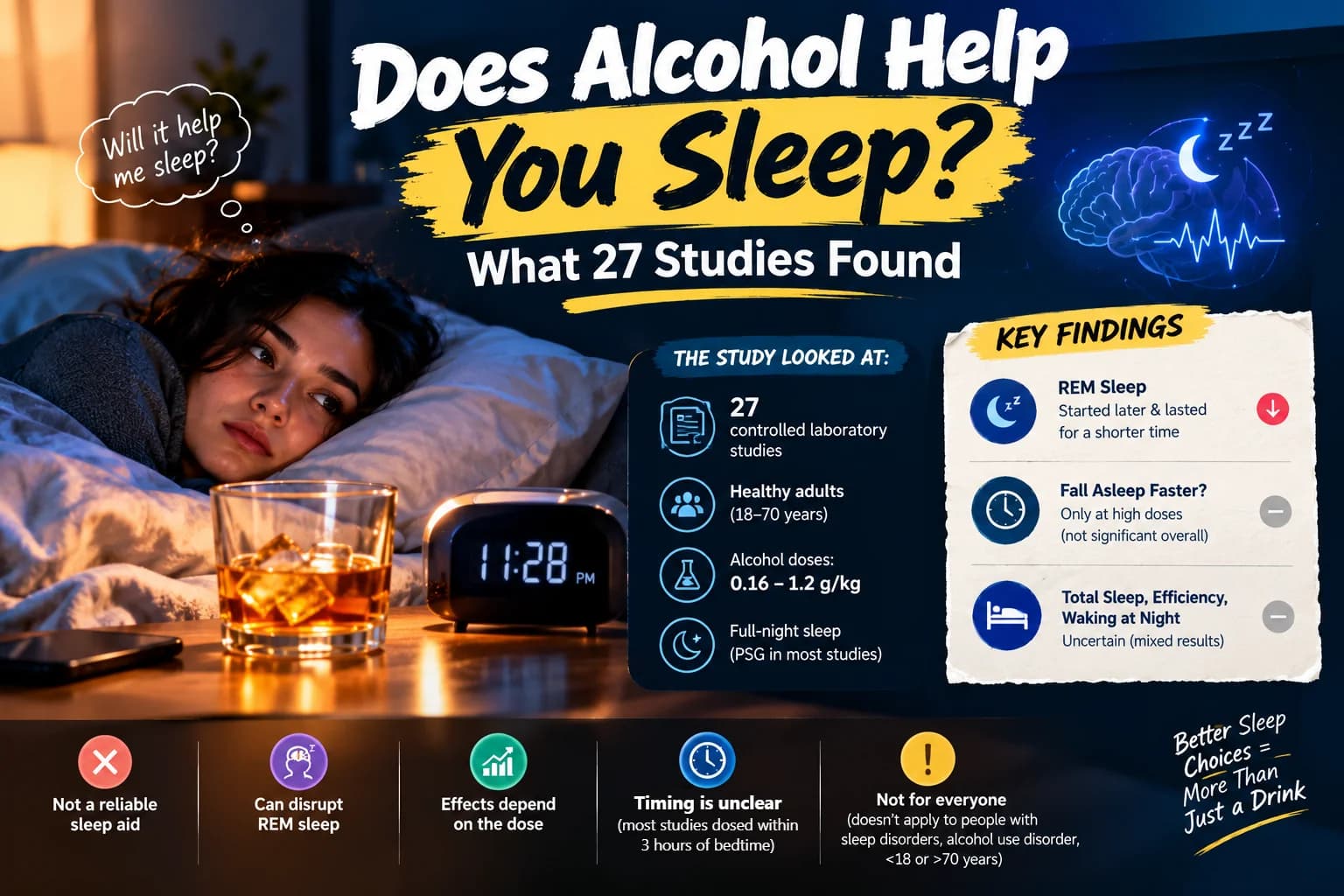
A 2025 systematic review and meta-analysis pooled 27 controlled laboratory studies, all in healthy adults. Its authors cite research putting the share of people who use alcohol as a sleep aid at roughly 10 to 28 percent, but those samples are not necessarily representative of the general population. This article walks through what it found, in the order a reader would ask: what happens to REM sleep, whether alcohol really helps you fall asleep faster, what the dose findings mean, and where the evidence runs out. It also explains why "how many drinks" is a harder question than it sounds, because a drink is not the same amount of alcohol everywhere.
A note on health information: This is general information, not medical advice. The review describes average effects in groups of healthy adults in a laboratory, and cannot predict how alcohol will affect your sleep. If you rely on alcohol to sleep, or you are worried about your drinking, a healthcare professional can help.
The 30-Second Answer
In a 2025 meta-analysis of 27 controlled laboratory studies in healthy adults, alcohol was not a reliable way to improve sleep. The overall change in time to fall asleep was not statistically significant, and a shorter time showed up only at high doses. REM sleep, on the other hand, was reduced, and the disruption grew with the dose. Effects on total sleep time, sleep efficiency and waking during the night could not be pinned down. The authors concluded that using alcohol as a sleep aid is not an appropriate strategy.
- REM sleep: it started later and lasted for a shorter time. A delay in REM onset became detectable at about 0.35 grams of alcohol per kilogram of body weight, and a shorter REM duration at about 0.50 g/kg
- Falling asleep: faster sleep onset appeared only around 0.85 g/kg and above, and the overall pooled effect was not statistically significant
- Total sleep, efficiency, waking at night: uncertain, with wide ranges that include both less and more sleep
- Timing: the review cannot say how many hours before bed a drink should be finished, because most studies gave alcohol within about three hours of bedtime
- Who it covers: healthy adults aged 18 to 70, tested in sleep laboratories, not people with alcohol use disorder (a clinical condition involving problematic alcohol use), sleep disorders, adolescents or adults over 70
What the Research Actually Tested
The paper is Gardiner and colleagues, published in Sleep Medicine Reviews in 2025, and it is open access through a university repository record. It follows the standard reporting guidelines for systematic reviews and was registered in advance.
To be included, a study had to meet four conditions: healthy adults aged 18 to 70, a controlled experimental design, a measured dose of alcohol, and sleep assessed across a full night. Studies where alcohol was given after sleep began, or where the sleep period was under 90 minutes, were excluded.
That gave 27 studies, and 25 of them were crossover designs, in which the same people sleep once after alcohol and once without it, which is a strong way to compare. Objective sleep was recorded with polysomnography (the lab standard that measures brain activity directly) in most studies. Across the studies, 37 alcohol conditions were tested, and doses ran from roughly 0.16 to 1.2 grams of alcohol per kilogram of body weight. The reviewers grouped them as low (up to 0.50 g/kg), moderate (above 0.50 and below 0.75) and high (0.75 and above). Almost all gave a single dose on the evening of the measured night, though four repeated it across two to nine nights.
Not every study measured every outcome: REM onset was reported in 14 studies, time to fall asleep in 19, total sleep time in 18, REM duration in 10, sleep efficiency in 14, wake after sleep onset in eight, and latency to N3 in six.
Two features of that design shape everything below:
- Timing was largely fixed. Alcohol was given within about three hours of bedtime in most studies.
- Study quality was uneven. The reviewers found risk-of-bias concerns in 21 of the 27 studies. Common reasons were that people did not get the conditions in randomized order, some studies had no washout period (a gap between drinking conditions so that one does not carry over into the next), and some lacked a clear analysis plan.
What Happens to REM Sleep
In this review, alcohol delayed REM onset and reduced REM duration. REM, or rapid eye movement sleep, is one of the sleep stages that lab recordings identify, and it is the clearest signal in the results. Two measurements point the same way.
REM onset. Pooled across 14 studies, REM sleep started about 18 minutes later after alcohol than without it (95% confidence interval: from about 9 to 27 minutes later). The reviewers also modeled how each outcome changes as the alcohol dose rises. In that dose-response model, the delay grew by about 30 minutes for every additional g/kg. For a 62 kg adult, 1 g/kg represents 62 g of alcohol, so that is a large step. The delay became statistically detectable at about 0.35 g/kg.
REM duration. Pooled across 10 studies, REM sleep lasted about 11 minutes less (confidence interval: from about 2 to 21 minutes less). The share of the night spent in REM fell by about 2.8 percentage points. In the dose-response model, the loss grew by about 40 minutes for every additional g/kg, and became detectable at about 0.50 g/kg. That model rests on 10 effect estimates from 64 participants, which is a small base for a threshold.
Two things are worth keeping straight. First, this was measured in a lab, in the hours after a single dose. Second, the review mostly measured sleep stages and timing. A few studies also collected people's own ratings of their sleep, but the review did not examine how people functioned the next day. Its discussion mentions possible links between REM disruption and memory and emotion, citing other work, but these studies did not test that.
REM was the outcome with the clearest dose-related conclusion, and, in the dose-response model, the only one that showed effects at lower doses. Its authors put it plainly: even a low dose appears to reduce REM sleep, and larger doses reduce it more. In this review, "low dose" meant up to 0.50 g/kg, or about 31 g of alcohol for a 62 kg adult. This describes the study's dose category, not a recommended amount or a safety threshold.
Does Alcohol Help You Fall Asleep Faster?
Not reliably. The overall pooled change in time to fall asleep was not statistically significant, although the high-dose part of the dose-response model found a shorter time. This is the belief that keeps the nightcap (a drink taken shortly before bed) alive, so the details matter.
Pooled across 19 studies, people fell asleep about 2 minutes sooner after alcohol, and that was not statistically significant (confidence interval: from about 4 minutes sooner to 0.2 minutes later). When the reviewers modeled dose, time to fall asleep shortened by about 6 minutes for every additional g/kg, and the effect became statistically detectable only at about 0.85 g/kg, a high dose.
One point of context from the paper helps: most people in these studies already fell asleep quickly. About 82 percent of the times to fall asleep on comparison nights were under 20 minutes, which leaves little room to improve. Among five studies that did find faster sleep onset, three had times to fall asleep on comparison nights above 20 minutes. The authors suggest alcohol may have more effect on people who are slow to fall asleep, though this review did not test that directly.
Across six studies, the time to reach deep sleep (N3) was about three minutes shorter overall, with a detectable dose effect at around 0.95 g/kg. A shorter time to deep sleep is not the same as more deep sleep: the review found no significant change in total N3 duration, and the durations of lighter N1 and N2 sleep were not significantly different either. The latency result was sensitive to an assumption the reviewers had to make about how each person's alcohol night and comparison night relate, so it is a weaker finding than the REM results.
Perceived effects are less clear. Subjective measures, such as how long people thought it took to fall asleep and how they rated sleep quality, were too varied to combine. Some studies found people felt they fell asleep faster, and the quality ratings pointed in different directions across studies.
The authors' reading is that the high dose needed to shorten sleep onset also brings more REM disruption, so any benefit is likely outweighed by it.
What the Dose Findings Mean, and What They Do Not
The review states dose in grams of alcohol per kilogram of body weight, which is more precise than counting drinks. Here are the modeled thresholds:
| Outcome | Approximate dose where the dose-response model found a statistically detectable effect |
|---|---|
| Later REM onset | about 0.35 g/kg |
| Shorter REM duration | about 0.50 g/kg |
| Faster sleep onset (high-dose model result only; overall pooled change not significant) | about 0.85 g/kg |
| Shorter time to N3 sleep | about 0.95 g/kg |
Four cautions apply to every row.
A threshold is not a safe amount, or a danger line. It marks where an average effect became large enough to detect in a statistical model. It does not show that a smaller amount has no effect, and it does not show that a larger amount affects you the same way it affects the study groups.
Detectable is not the same as important. The review's authors note that the thresholds rest on statistical significance and assume the changes are meaningful for sleep. The review did not establish how much REM loss matters for health or how someone feels.
Body weight changes the numbers. At the same dose per kilogram, the total amount of alcohol is higher for a person with a higher body weight and lower for a person with a lower body weight. The conversions in the next section assume one body weight.
Individual differences are large. The authors point to variation in how people process alcohol, including genetics, whether they have eaten, how fast they drink and what else they take. A group average describes the group.
Why "How Many Drinks" Does Not Travel Across Countries
The review gives approximate standard-drink equivalents alongside its g/kg figures, using an assumed 62 kg adult and 10 g per drink. That is the paper's assumption, not a universal definition.
Official definitions differ. In the United States, a standard drink contains 14 grams of pure alcohol. The US National Institute on Alcohol Abuse and Alcoholism illustrates one US standard drink as a 12 ounce regular beer at 5% alcohol by volume (ABV), a 5 ounce glass of wine at 12% ABV, or a 1.5 ounce shot of spirits at 40% ABV. Converted to metric (our conversion, not NIAAA's), that is about 355 mL, 148 mL and 44 mL. These examples each contain approximately 14 g of pure alcohol. In the United Kingdom, one unit is 8 grams, and a UK unit is not the same thing as a US standard drink. A 175 mL glass of wine at 12% ABV is about 2.1 UK units, for example. Other countries use other values.
Here is the same set of modeled thresholds converted for a 62 kg adult. The conversions in this table are our arithmetic from the paper's g/kg figures. The paper itself gives only rounded, approximate drink equivalents.
| Modeled threshold | Grams of alcohol (62 kg adult) | US standard drinks (14 g) | UK units (8 g) | Drinks of 10 g (the paper's assumption) |
|---|---|---|---|---|
| Later REM onset, about 0.35 g/kg | 22 | 1.6 | 2.7 | 2.2 |
| Shorter REM duration, about 0.50 g/kg | 31 | 2.2 | 3.9 | 3.1 |
| Faster sleep onset (high-dose model result only†), about 0.85 g/kg | 53 | 3.8 | 6.6 | 5.3 |
| Shorter time to N3 sleep, about 0.95 g/kg | 59 | 4.2 | 7.4 | 5.9 |
† The overall pooled change in time to fall asleep was not statistically significant. This row reflects the dose-response model at high doses only.
These conversions shift with body weight, and a different drink definition changes the count even when the grams stay the same. The thresholds mark where a model detected an effect, not an amount to aim for or stay under.
You may see the review summarized as "about two drinks disrupts REM sleep." The paper's abstract describes its low-dose band that way, but its own conversions elsewhere put the REM duration threshold nearer three drinks of 10 grams. Two drinks matches the first row, the REM onset result. It is not the threshold for every outcome, and it is not the same amount of alcohol in every country. If you want to check an actual drink, the useful number is the grams of alcohol it contains, which labels and national guidance often give.
What the Evidence Cannot Tell You
A review is as useful for what it admits as for what it shows. These are the outcomes it could not settle.
Total sleep time. Pooled across studies, people slept about 10 minutes less with alcohol, but the result was not statistically significant, and the range was very wide. The 95 percent prediction interval, which describes where a future study's result might fall, ran from about 71 minutes less to 51 minutes more. Five studies reported statistically significant reductions in total sleep time, while two reported statistically significant increases. Many did not equalize time in bed across conditions, which makes this outcome hard to read. In that sense the review finds no clear answer, which is different from finding no effect.
Sleep efficiency and waking at night. Sleep efficiency, the share of time in bed spent asleep, was about 0.7 percentage points lower, and time awake after falling asleep was about 4 minutes longer. Neither was statistically significant, and both had wide ranges. These findings could not be pinned down, and they do not show that waking is unaffected.
Timing. The review set out to test whether drinking earlier or later matters. Its timing meta-regressions did not establish an effect of drinking earlier versus later, and the authors note that their ability to detect one was limited because most studies gave alcohol within about three hours of bedtime. No study tested the same dose at different times. That means it cannot support a rule such as "stop drinking a set number of hours before bed," and this article does not offer one. The authors list better timing studies as a research priority.
Sex differences. Twelve studies had only male participants, four had only female participants and eleven had both. Only one study tested sex differences directly, so the review could not determine whether men and women respond differently.
Repeated use. Almost all the evidence concerns one evening's dose. It does not describe what happens after weeks of nightly drinking, or when someone stops.
People outside the studies. The review excluded or did not cover people with alcohol use disorder or sleep disorders, adolescents and adults over 70. The authors say the results may not generalize to them.
If You Use Alcohol to Fall Asleep
The review does not suggest an alternative, and it did not test one. What it supports is narrower: its authors conclude that alcohol is not an appropriate sleep aid, because any gain in falling asleep at high doses comes with more REM disruption.
If you reach for a drink most nights to settle down, there is nothing in this review that says how your own sleep would change without it. That is a pattern worth noticing, and the reason behind it is worth understanding. If it is stress or worry, our guide to calming anxiety covers that side. Our general sleep guide covers habits that do not involve alcohol. Our melatonin guide asks a similar question about another common sleep aid.
When to Get Support
Two situations deserve a conversation with a healthcare professional, and neither is something an article can assess.
Persistent sleep trouble. If poor sleep keeps happening or is affecting your daily life, a clinician can look for the cause. For adults with chronic insomnia, the American College of Physicians' 2016 guideline recommends cognitive behavioral therapy for insomnia (CBT-I) as the first-line treatment. A clinician can advise whether CBT-I is appropriate and how to access it.
Regular reliance on alcohol. If you are worried about your drinking, want help to stop drinking, or experience withdrawal symptoms such as anxiety, difficulty sleeping or sweating when you reduce or stop drinking, the UK's National Health Service (NHS) advises speaking to a doctor or an alcohol support service. Severe symptoms, such as visible shaking, confusion or seizures, need urgent medical care. The NHS also warns that stopping suddenly can be very dangerous for someone who is dependent on alcohol, and says to get medical help before trying. This article cannot tell you whether you might be dependent, and it does not suggest how to cut back. If you might be, the safe first step is a conversation with a doctor, not a change made on your own.
Bottom Line
Alcohol can make you feel sleepy, but in a review of 27 laboratory studies in healthy adults it was not a reliable way to improve sleep. The overall change in time to fall asleep was not statistically significant, a shorter time appeared only at high doses, and REM sleep was reduced from lower modeled doses, with more disruption as the dose rose. The review could not settle total sleep time, sleep efficiency, waking at night, timing or sex differences, and its results come from healthy adults after a single evening's dose. Its authors conclude that alcohol is not an appropriate sleep aid, and those findings describe groups, not you. A drink is also not the same amount everywhere, so grams of alcohol and body weight are the more precise way to think about dose.
Related reads:
Frequently asked questions
Answers to the most common questions about this topic.
The 2025 meta-analysis of laboratory studies in healthy adults cannot give a yes or no for one drink. The included conditions went as low as about 0.16 g/kg, or roughly 10 g of alcohol for a 62 kg adult. The first statistically detectable REM change in its dose model came at about 0.35 g/kg, around 22 grams for that adult. Those are group averages from mostly small studies. They do not show that a smaller amount has no effect on you, or that a larger one will.
The authors of a 2025 meta-analysis of 27 controlled laboratory studies in healthy adults concluded that using alcohol as a sleep aid is not an appropriate strategy. Falling asleep faster showed up only at high doses in the dose model, and the same high doses were linked to more REM disruption. The overall pooled change in time to fall asleep was not statistically significant.
The 2025 meta-analysis of laboratory studies could not say. Most of its included studies gave alcohol within about three hours of bedtime, and none tested the same dose at different clock times, so it offers no cut-off time. A rule such as stopping a set number of hours before bed would need evidence this meta-analysis does not contain.
The 2025 meta-analysis of 27 laboratory studies in healthy adults could not determine whether alcohol affects sleep differently in men and women. Twelve of them enrolled only men, four only women and eleven both, but only one tested sex differences directly, and the pooled analysis found no moderating effect of sex. One study is not enough to establish a difference either way.
In the 2025 meta-analysis of laboratory studies in healthy adults, five studies reported statistically significant reductions in total sleep time with alcohol and two reported statistically significant increases, and many did not hold time in bed equal between the alcohol and comparison nights, which makes total sleep time hard to compare. The pooled estimate was not statistically significant, with a wide range from about 71 minutes less to 51 minutes more.
Written by
We research travel, fitness and wellness, and publish what holds up. See our editorial policy.