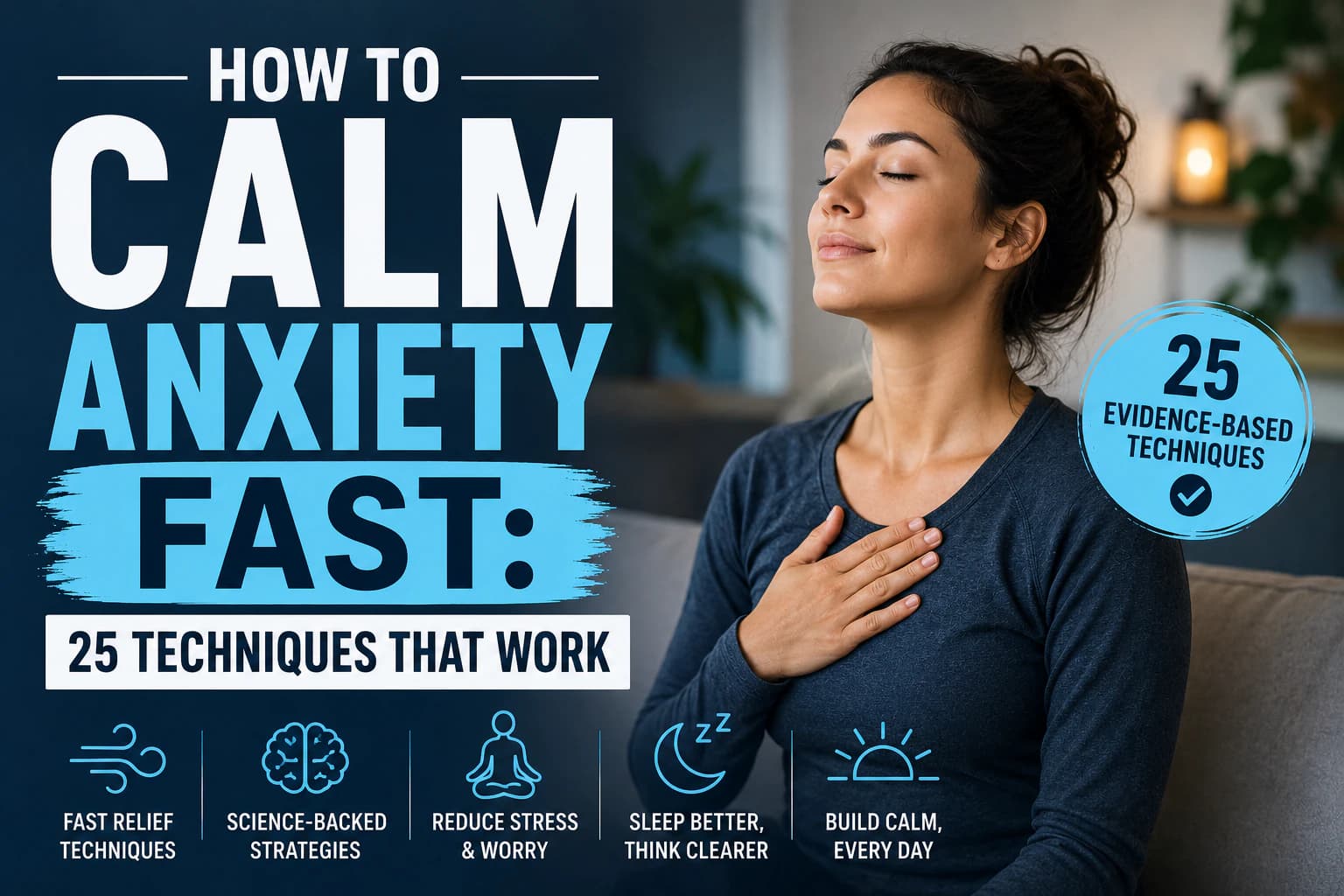
How to Calm Anxiety Fast: 25 Techniques That Work
How to calm anxiety fast: 25 evidence-based techniques, a panic attack protocol, and CBT explained honestly.
Search how to calm anxiety fast and most of what you find is either useless ("just meditate!") or dangerous ("pop this pill"). What follows sits between those two poles, because that is where the evidence actually is.
Sources are linked at the claims they support rather than listed up front. Many of the techniques below have real clinical or research evidence behind them, and we've flagged where that evidence is strong, mixed, or mostly anecdotal.
Many people who consistently practice the first five techniques for a few weeks report a meaningful drop in day-to-day anxiety. These are the ones with the strongest clinical evidence behind them, though how much they help varies a lot from person to person.
A note on costs: Therapy session fees and app subscription prices vary by provider and change over time. Confirm current rates directly with the therapist or platform before booking.
A note on health advice: This is general information, not medical advice. These techniques help, but they don't replace professional care for severe cases; coming off an SSRI is something to plan with the prescribing clinician rather than do on your own.
Critical note first
If your anxiety is severe: panic attacks multiple times per week, unable to function, thoughts of self-harm, using substances to cope, please see a therapist and consider medical evaluation. These techniques help, but they don't replace professional care for severe cases.
If you are in immediate danger or having thoughts of self-harm, contact your local emergency services or get urgent in-person help. For crisis support, Find A Helpline lists verified crisis services by country, so you can reach one where you actually are.
Everything below is for the person with manageable-but-real anxiety who wants a real toolkit.
The 30-second answer
How to calm anxiety fast comes down to three techniques with near-immediate effect: the physiological sigh (two short inhales, one long exhale, three cycles), 30 seconds of cold water on the face, and 5-4-3-2-1 grounding. Any of them can interrupt a spiral within about two minutes.
- Physiological sigh: two short inhales through the nose, one long exhale, 3 cycles
- Cold water: 30 seconds on the face triggers the dive reflex
- 5-4-3-2-1 grounding: name 5 things you see, 4 you feel, 3 you hear, 2 you smell, 1 you taste
- Daily baseline: a 20-minute walk, 10 minutes of meditation, 7+ hours of sleep
- Cut: caffeine, which mimics and amplifies anxiety symptoms
- Long-term: CBT is the gold standard; for severe anxiety, CBT plus SSRIs is often more effective than either alone
Anxiety by the numbers
- India: national diagnosis rates run far below the US figures below, which reflects how few people reach a clinician rather than how few are affected
- US: 19.1% of adults had an anxiety disorder in the past year, per NIMH
- Panic disorder: 2.7% of US adults in the past year and 4.7% at some point in life
- Women: roughly twice as likely as men to have panic disorder, 3.8% against 1.6%
- Genetics: twin-study meta-analysis puts the heritable component of anxiety disorders at roughly a third, with the rest down to environment and individual experience
Anxiety is not weakness. It's a medical condition affecting hundreds of millions worldwide.
Anxiety vs. stress vs. panic: understanding the difference
These are often used interchangeably but they're distinct experiences requiring different responses.
Stress
A response to external pressure. Has a trigger (deadline, exam, conflict). Goes away when the trigger passes.
Feels like: Overwhelm, tension, irritability. Duration: Hours to days. Treatment: Address the trigger + relaxation.
Anxiety
Persistent worry, often without a specific trigger. About future possibilities. Can exist without any real stressor present.
Feels like: Chronic apprehension, physical tension, difficulty concentrating. Duration: Weeks to months. Treatment: CBT, lifestyle changes, possibly medication.
Panic attack
Sudden intense episodes of terror + physical symptoms. Peak within 10 minutes.
Feels like: Racing heart, chest tightness, feeling of doom, derealization, feeling of dying. Duration: 10-30 minutes peak, up to an hour. Treatment: Cognitive restructuring + breathing + sometimes medication.
Understand what anxiety is (physiologically)
Anxiety is your brain's threat detection system misfiring. It evolved to keep you alive in the face of real dangers: predators, dark caves, hostile tribes. It hasn't adapted to modern life where "threat" means overdue email or embarrassing yourself at a wedding.
Physiologically, anxiety involves:
- Amygdala hyperactivation (threat detection)
- Prefrontal cortex shuts down (clear thinking fades)
- Sympathetic nervous system activation (fight-or-flight)
- Cortisol + adrenaline spike
- Reduced blood flow to digestion (butterflies)
- Elevated heart rate + breathing
The digestion one runs both ways. The vagus nerve carries signals from gut to brain as well as brain to gut, which is why anxiety reliably disturbs digestion, and why a handful of fibre and probiotic trials have reported modest anxiety reductions. Our guide to what the gut-brain evidence actually shows sets out where it holds and where the popular version overstates the case considerably.
Most of the techniques below work, in some way, by either calming amygdala activity or re-engaging the prefrontal cortex, though the full picture of why any given technique helps is more complex than a two-part model can capture.
Types of anxiety disorders (a quick overview)
Different anxiety types tend to respond to different approaches. This is educational background, not a diagnostic tool, only a clinician can actually diagnose an anxiety disorder, but recognizing roughly which pattern feels closest to your experience can make it easier to figure out what kind of help to look for.
Generalized Anxiety Disorder (GAD)
Constant low-grade worry about work, family, money, health. Never fully turns off. Not about specific triggers.
- How common: 2.7% of US adults in the past year, per NIMH
- What works best: Daily meditation + CBT + eliminating caffeine + fixed sleep + SSRIs if needed
Panic Disorder
Recurrent, unexpected panic attacks, followed by persistent worry about having another one, and then changes to how you live in order to avoid the triggers.
- How common: 2.7% of US adults in the past year, and roughly twice as common in women as men, 3.8% against 1.6%
- What works best: CBT specifically for panic (interoceptive exposure) + SSRIs
Social Anxiety Disorder
Fear of judgment, embarrassment, being noticed. Avoidance of social situations. Not just shyness.
- How common: 7.1% of US adults in the past year
- What works best: Exposure therapy + CBT + sometimes propranolol for physical symptoms
Specific Phobia
Intense fear of specific objects/situations (heights, spiders, flying, needles, closed spaces).
- How common: 9.1% of US adults in the past year, and 12.5% at some point in life
- What works best: Gradual exposure therapy, the best-established treatment for specific phobia
Health Anxiety (Hypochondriasis)
Persistent worry about serious illness despite medical reassurance. Constant symptom-checking.
- How common: genuinely uncertain, because estimates swing widely depending on how it is defined
- What works best: Therapy for health anxiety + limits on medical Google + specific protocols to break reassurance-seeking
Post-Traumatic Stress Disorder (PTSD)
Anxiety triggered by trauma cues. Flashbacks, hypervigilance, nightmares, avoidance.
- How common: 6.8% of US adults at some point in life, and 3.6% in the past year
- What works best: Trauma-focused therapy (EMDR, CPT, TF-CBT). Do not attempt to self-treat.
Obsessive-Compulsive Disorder (OCD)
Intrusive thoughts driven by anxiety, and compulsive behaviors performed to bring that anxiety back down.
- How common: 2.3% of US adults at some point in life, and 1.2% in the past year
- What works best: ERP (Exposure and Response Prevention) therapy + SSRIs
How to calm anxiety fast: the 25 techniques, by speed of effect
For immediate relief (under 2 minutes)
The first technique here has better evidence behind it than almost anything else on this list. A 2023 randomised controlled trial in Cell Reports Medicine, run by Stanford's Huberman and Spiegel labs, compared three five-minute daily breathing practices against mindfulness meditation over a month. Cyclic sighing, the exhale-focused pattern below, produced the largest improvement in positive affect and the biggest drop in resting respiratory rate, outperforming the meditation arm. Five minutes a day, no equipment, no cost.
1. Physiological sigh (30 seconds)
Two quick inhales through the nose (short-short). One long exhale through the mouth. Repeat 3 times.
In the Stanford trial, 114 people were randomised to five minutes a day of one of three breathing patterns or mindfulness meditation, and cyclic sighing beat the other three on mood improvement and on lowering respiratory rate. Worth being precise: that is best of four conditions in one month-long study, not "the best breathing technique in existence". The mechanism is the long exhale, which shifts you toward parasympathetic activity.
Do this before difficult conversations, before public speaking, or when you feel anxiety rising.
2. Cold water on your face (60 seconds)
Splash very cold water on your face. Hold your breath 20 seconds.
Triggers the mammalian dive reflex, a real physiological response in which heart rate tends to slow and blood shifts toward the core. Many people find this genuinely helps interrupt a spiral, though it isn't guaranteed to work every time or for everyone.
One of the go-to options when spiraling in a bathroom.
3. Box breathing (2 minutes)
Inhale 4 seconds. Hold 4. Exhale 4. Hold 4. Repeat for 2 minutes.
Used by Navy SEALs and ER doctors as a way to stay steady under high stress. The even rhythm gives you something to hold on to when your breathing has gone shallow and fast.
4. Extended exhale (4-7-8 method)
Inhale 4 seconds. Hold 7 seconds. Exhale slowly for 8 seconds. The long exhale matters most.
Longer exhales are thought to help engage the vagus nerve, which is associated with calming. Many people find 8-10 rounds brings noticeable relief fairly quickly, though this varies.
5. 5-4-3-2-1 grounding (90 seconds)
Anxiety pulls you into future/past. Grounding pulls you back to now.
- 5 things you can see
- 4 things you can touch (physically touch them)
- 3 things you can hear
- 2 things you can smell
- 1 thing you can taste
Can help interrupt the anxiety loop by pulling attention back to the present. Many people find it useful even during moderate panic attacks, though it doesn't work the same way for everyone.
6. Ice cube in hand
Hold an ice cube for as long as you can. The intense sensation can help pull your attention into the present moment, making it much harder to stay lost in rumination while your hand is stinging.
Used in DBT (Dialectical Behavior Therapy) for high-intensity emotional overwhelm.
7. Naming the emotion out loud
Say: "I'm feeling anxious right now."
Sounds too simple. Isn't. UCLA research (Matthew Lieberman) found verbally naming an emotion activates the prefrontal cortex and is associated with reduced amygdala activity in brain-imaging studies. Called "affect labeling."
Say the sentence. Out loud if you're alone.
8. Change your language (unique technique)
Speak or read in a secondary language you know for 5 minutes.
Some research on the "foreign language effect" suggests processing things in a non-native language can feel less emotionally loaded, which may be part of why some bilingual people report feeling calmer speaking a less-dominant language under stress. This is a smaller and more speculative area of evidence than most other techniques on this list.
Try: watch a show in a different language, read a book, or simply narrate what you see.
For medium-term (5-30 minutes)
9. Movement: any kind
Anxiety is trapped energy. It needs an outlet.
5-minute walk. 20 push-ups. Dance to one song. Anything.
Movement is often more effective at working off anxious energy than sitting and trying to "calm down." Even 10-15 minutes is linked to a temporary drop in anxiety for many people.
10. Write it out (specific method)
Sit down. Set a 5-minute timer. Write everything in your head. No structure. No editing.
Then, on a second sheet, answer three questions:
- What am I actually worried will happen?
- How likely is it, honestly (0-100%)?
- If it did happen, what would I do?
Many worries feel smaller once you've actually worked through this kind of questioning. Cognitive Behavioral Therapy (CBT) uses this exact structure.
11. Progressive muscle relaxation
Lying down, tense a muscle group for 5 seconds, release. Move through the body:
- Feet, calves, thighs, glutes, belly, chest, hands, arms, shoulders, face
By the end, many people feel noticeably heavier and more relaxed. Often used for bedtime anxiety.
12. Music (specific type)
Not just "any calming music." Some research and common recommendations point to:
- 60-80 BPM (bpm matches slow heart rate)
- Instrumental (lyrics engage cognition)
- Familiar or brand-new, not "somewhat familiar"
Commonly recommended pieces: Weightless by Marconi Union, Clair de Lune, ambient nature sounds. The widely quoted claim that Weightless cuts anxiety by a specific percentage traces to a study commissioned by a bath-products brand rather than independent peer-reviewed work, so treat it as a pleasant suggestion rather than a clinical one.
13. Create a "safe playlist"
Compile 20-30 songs from different periods of your life that made you feel safe or happy. Save for anxiety emergencies.
Music tied to positive memories may feel more calming for some people than unfamiliar "calming" music, though this hasn't been rigorously quantified.
14. Guided imagery
Close eyes. Visualize a place you feel completely safe (real or imagined). Add sensory details:
- What do you see?
- What sounds are around?
- What do you smell?
- Temperature on your skin?
- What can you touch?
5 minutes. Visualization can produce a real physiological response for some people, similar in kind, though not necessarily in degree, to actual experience.
15. Yoga (specific poses)
These gentle poses are often recommended for relaxation:
- Child's pose: 2 minutes
- Legs up the wall: 5 minutes
- Cat-cow: 10 rounds
There's no strong evidence that these specific poses activate the parasympathetic system meaningfully faster than other gentle yoga, but gentle yoga in general has reasonable support for easing tension.
For long-term reduction
16. Reduce caffeine (huge lever)
You cannot out-technique 6 cups of coffee.
Anxious people often self-medicate with caffeine because it "wakes them up." For many people it's also raising everyday anxiety levels, caffeine activates some of the same neural pathways as fear, though sensitivity to this varies a lot between individuals.
Rule: Max 1 cup, before 11 AM. Cut off entirely for a 2-week test, many people notice a difference within days, though this varies.
17. Sleep (foundational)
One sleepless night raised next-day anxiety by around 30% in Ben Simon and Walker's 2019 work at UC Berkeley, published in Nature Human Behaviour. Their scans showed the medial prefrontal cortex, the region that normally keeps anxiety in check, going quiet after sleep loss while deeper emotional centres ran hot. Small study, 18 participants, but the direction matches what most people already suspect about themselves.
If you're chronically anxious and consistently under-sleeping, improving sleep is one of the more important things to address, it's hard to make progress on anxiety while running on too little sleep. See our complete sleep guide.
18. Regular exercise
30 minutes, 5 days/week. Any kind.
This is among the best-evidenced items on the list. A 2021 review of the meta-analytic evidence for exercise in anxiety disorders found a consistent anxiolytic effect across trials, in the small-to-moderate range, the same magnitude bracket as most psychological interventions, and reached without a prescription.
What the trials suggest about dosing: aerobic exercise at least three times a week, sessions under an hour, works as well as more. More is not better here, which is convenient, because "more" is what stops people starting.
Start with our 30-day home workout plan.
19. Sunlight (morning specifically)
Morning light exposure is one of the stronger cues for keeping your daily cortisol rhythm on a healthy schedule, peaking earlier in the day rather than staying elevated into the evening, which many people find is linked to feeling calmer at night. For where the popular version of this claim overstates the science, see does a cortisol detox work.
One of the simplest, lowest-cost things worth trying.
20. Reduce social media (specific method)
Not "delete Instagram forever." That's fantasy for most.
Instead:
- Delete Instagram/X from home screen
- Move them to a "Distraction" folder on page 3
- No social media before 10 AM
- No social media within 60 minutes of bed
Friction plus timing cuts scroll time substantially for most people who try it. Cutting back is worth two weeks of honest effort before you judge whether it helps.
21. Journaling (with specific prompts)
Not "dear diary." Specific prompts:
- What am I avoiding that's making this worse?
- What did today's version of me do that I'm proud of?
- If a friend was feeling this, what would I say to them?
Prompted journaling processes anxiety. Unprompted often rehashes it.
22. Meditation (daily 10 min)
Doesn't eliminate anxiety. Builds a small gap between how you feel and how you react.
Some studies link around 8 weeks of consistent daily practice to measurable reductions in anxiety intensity for many people, though results vary. See our morning meditation guide to start.
23. Reduce alcohol
Alcohol commonly raises next-day anxiety, sometimes called "hangxiety", for many people, though not everyone experiences it the same way or to the same degree. Stopping completely for 4 weeks is linked to a measurable anxiety reduction for many people, though individual response varies.
24. Nutrition
- Omega-3s (fatty fish, walnuts, flaxseed), reduce anxiety in some studies
- Magnesium (spinach, almonds, dark chocolate), deficiency linked to anxiety
- B vitamins (whole grains, eggs), support nervous system
- Probiotics (dahi, kimchi), some trials report reduced anxiety, though results vary
- Avoid: refined sugar, ultra-processed foods, too much caffeine
25. Therapy (highest effect)
One of the most effective steps, especially for anything beyond mild or situational anxiety.
You don't need to be in crisis. You don't need a "diagnosis." Regular therapy in high-functioning people is the most under-utilized wellness tool available.
Cost varies widely by country, provider, insurance and health system: in India (2026) expect roughly Rs 1,500-3,000 per session, while elsewhere it may be covered, subsidised or considerably more expensive. Online options (BetterHelp, Amaha, Lyf) are accessible in many countries.
Panic attack protocol (dedicated section)
Panic attacks deserve their own protocol. What to do during one:
Understand what's happening
Symptoms: Racing heart, chest tightness, dizziness, sweating, trembling, feeling of doom, derealization, nausea, tingling in hands/feet, choking sensation, feeling like you're dying or going crazy.
Duration: Peak within 10 minutes. Usually gone within 20-30 minutes.
Truth: A typical panic attack is frightening but not dangerous, and it will end. That said, panic symptoms can genuinely overlap with medical emergencies. If this is a first episode, the symptoms feel different from your usual pattern, or you have chest pain plus risk factors for heart problems, get it checked out rather than assuming it's anxiety. If you already know from experience that this is a panic attack: you're very unlikely to "go crazy" or lose control, and it will pass.
The 5-step in-the-moment protocol
Step 1: Name it: "This is a panic attack. It will pass in 20 minutes."
Step 2: Slow breathing: 4-7-8 breathing. Longer exhales than inhales. Continue for 3-5 cycles.
Step 3: Ground yourself: 5-4-3-2-1 sensory technique.
Step 4: Move if possible: Walk slowly. Movement can help work off some of the physical activation that builds up during a panic attack.
Step 5: Don't fight it: Fighting a panic attack often makes it feel worse. Accepting ("okay, this is happening, it will pass") makes it easier to get through for many people.
After the attack
- Don't ruminate on "why did that happen"
- Continue normal activities
- Note trigger if identifiable (caffeine? poor sleep? specific situation?)
- If frequency increases → see a doctor
Preventing future panic attacks
- Reduce caffeine to zero for 4 weeks (huge trigger)
- Consistent sleep schedule
- Regular exercise
- Learn to sit with mild anxiety without escalating it
- CBT for panic disorder specifically (interoceptive exposure), the best-evidenced option
When panic attacks need medical attention
- More than once a week
- Occurring in specific situations you now avoid
- Followed by big changes in behavior
- Interfering with work or relationships
- Combined with depression or suicidal thoughts
CBT: the gold standard treatment (deep dive)
CBT (Cognitive Behavioral Therapy) is the most evidence-backed treatment for anxiety. A meta-analysis of CBT trials for adult anxiety disorders found a mean remission rate of about 51%, meaning roughly half of people no longer met diagnostic criteria afterwards. Its effects often hold up better after treatment ends than medication alone in follow-up studies, though direct comparisons vary by study and condition.
What CBT actually does
Three core techniques:
1. Cognitive restructuring: Identify and challenge anxious thoughts.
Common cognitive distortions in anxiety:
- Catastrophizing: "What if I fail the interview and never find a job and become homeless?"
- Mind reading: "They think I'm stupid"
- All-or-nothing: "If it's not perfect it's a failure"
- Fortune telling: "This is going to be a disaster"
- Emotional reasoning: "I feel anxious so something must be wrong"
Challenge each with evidence:
- "What's the actual probability?"
- "What's the worst case? How would I cope?"
- "What would I tell a friend thinking this?"
- "What's the more balanced thought?"
2. Exposure therapy: Gradually face what you fear in incremental steps, usually paced by a therapist. The example below is illustrative of how a therapist might structure this, not a self-directed program to run on your own.
For social anxiety:
- Session 1: Imagine social situations
- Session 3: Small talk with cashier
- Session 6: Extended conversation with acquaintance
- Session 10: Speaking up in group setting
- Session 15: Public presentation
3. Behavioral experiments: Test anxious predictions in real life.
- Prediction: "I'll definitely embarrass myself if I speak"
- Experiment: speak in low-stakes setting
- Result: probably fine
- Update belief
How to access CBT
Availability and cost vary a lot by country and health system. In some places CBT is funded and the barrier is a waiting list; in others you pay per session and the barrier is price. Start with whichever route below matches where you live.
Finding a local therapist:
- Search through your country's health service, your insurer, or a national psychology or psychotherapy register
- Ask for someone specifically trained in CBT rather than counselling in general
- 12-20 sessions is a typical course
Online options:
- Amaha (Indian, Rs 1,500-2,500/session)
- BetterHelp (international, around $65-90/week on US plans, and pricing varies by country)
- Talkspace (international, subscription)
- Lyf (Indian, group + individual)
In India specifically:
- Rs 1,500-3,000 per session
- Look for CBT-trained clinical psychologists
- Fortis, Apollo and Manipal have psychiatric departments
Self-guided workbooks:
- "Mind Over Mood" by Dennis Greenberger
- "Feeling Good" by David Burns (for anxiety + depression)
- "The Anxiety and Phobia Workbook" by Edmund Bourne
Medications for anxiety (honest guide)
Medication is NOT a crutch. For moderate-severe anxiety, medication combined with therapy tends to outperform therapy alone in many studies.
First-line: SSRIs (Selective Serotonin Reuptake Inhibitors)
Among those commonly prescribed are escitalopram (Lexapro), sertraline (Zoloft), fluoxetine (Prozac) and paroxetine (Paxil). They differ in how long they stay in the body and in which side effects are more common, and which one suits a particular person is an individual decision made with a prescriber rather than something to choose from a list.
How they work: They act on serotonin signalling in the brain. Exactly how that translates into reduced anxiety is not fully settled, and the older "chemical imbalance" framing is now widely regarded as an oversimplification, so treat this as the mechanism they target rather than a complete explanation.
Timeline: these are not immediate. Early side effects such as nausea, headache or sleep changes are commonly reported in the first weeks, often before any benefit is noticeable, and improvement tends to build gradually after that. How long it takes varies between people and between drugs, so treat this as a general shape rather than a schedule.
How well it works: many people respond, but not everyone, and finding the right drug can take more than one try
Duration: how long someone stays on an SSRI varies a great deal, depending on the condition, the response and the treatment plan agreed with their prescriber. It is usually measured in months rather than weeks, but there is no standard course that applies to everyone.
Not addictive. Not habit-forming.
Discontinuation: stopping abruptly can cause discontinuation symptoms, so coming off an SSRI is something to plan with the prescribing clinician rather than do on your own. They can set a pace appropriate for the drug and for you.
Second-line: SNRIs (Serotonin-Norepinephrine Reuptake Inhibitors)
Venlafaxine (Effexor) and duloxetine (Cymbalta) are the ones most often mentioned in this class. Similar timeline to SSRIs, and a prescriber may consider them depending on the person's situation, including when an SSRI has not worked well.
Non-first-line: Benzodiazepines
- Alprazolam (Xanax)
- Lorazepam (Ativan)
- Clonazepam (Klonopin)
- Diazepam (Valium)
Work fast: within 30 minutes. Feel like relief.
Problems:
- Physical dependence can develop with sustained daily use, and sooner than many people expect
- Tolerance builds (need higher doses over time)
- Withdrawal is dangerous (seizures possible)
- Cognitive impairment with long-term use
- Increased fall risk in elderly
Use case: Short-term (under 4 weeks) during crisis, or occasional as-needed use for specific events (flights, medical procedures).
Not for daily long-term use.
Other options
Beyond the classes above, there are further medications a clinician may raise depending on the person, the diagnosis and what has already been tried. Buspirone, propranolol, hydroxyzine, pregabalin and gabapentin all appear in this conversation in different circumstances. Which, if any, is appropriate is a prescribing decision, not a menu to choose from, and worth asking about rather than assuming.
Important reality about medication
- Not weakness: anxiety is medical
- Not personality change: you'll feel like you, just less anxious
- Not necessarily permanent: for many people it is a period of treatment rather than something they stay on indefinitely, though how long varies by person
- Combines with therapy: best outcomes
- Try one, adjust, try another if needed: first medication doesn't always work
- Consider a psychiatrist: a psychiatrist typically has more specialized experience with dosing and drug selection than a GP, which can help if the first medication doesn't work well
Rule out medical causes first
Before assuming psychological anxiety, rule out these physical causes:
Thyroid dysfunction
Hyperthyroidism can cause anxiety-like symptoms. A TSH blood test helps rule it out.
- Test: TSH, a routine blood test (roughly Rs 400-800 in India; often covered by the health system elsewhere)
- Signs: anxiety + weight loss + heat intolerance + rapid pulse + tremor
Cardiac issues
Some arrhythmias mimic panic attacks.
- Signs: anxiety only during physical exertion, family history of heart disease, chest pain without other panic symptoms
- Test: ECG, Holter monitor
Adrenal issues
Rare but pheochromocytoma (adrenal tumor) causes panic-like episodes.
- Signs: anxiety with severe blood pressure spikes, sweating, headaches
Vitamin deficiencies
- B12 deficiency: causes anxiety-like symptoms
- Vitamin D deficiency: common in many populations and associated with anxiety symptoms, though the direction of that link is unsettled. Worth testing alongside the rest if you are getting blood work done
Blood sugar issues
Hypoglycemia (low blood sugar) can closely mimic anxiety symptoms.
- Signs: anxiety spike when hungry, goes away after eating
Perimenopause/menopause
Hormonal fluctuations during this transition are linked to new-onset anxiety in some women in their 40s-50s.
- Signs: anxiety plus hot flashes, irregular periods, mood swings
Get full blood work done: TSH, HbA1c, Vitamin D, Vitamin B12, complete blood count, cortisol if severe. Roughly Rs 2,500-4,000 in India; cost and coverage differ everywhere else. Ruling out significant physical causes is a reasonable step, especially if your symptoms don't fit the usual anxiety pattern, though it doesn't need to delay starting therapy.
Anxiety across life stages
Anxiety in children (about 11% of 3-17 year olds have a current diagnosis)
Signs:
- Too much worry about school/friends
- Sleep resistance
- Physical complaints (stomachaches, headaches) without medical cause
- Refusal to attend school
- Clinginess beyond age-appropriate
- Perfectionism
Treatment: Family therapy + child CBT + parent training. Medication for severe cases only.
Early treatment is linked to better long-term outcomes.
Anxiety in teens (commonly cited estimates run somewhat higher than in younger children)
Signs:
- Social withdrawal
- Academic performance drops
- Sleep disturbance
- Substance experimentation
- Physical symptoms
- Self-harm behaviors
Treatment: CBT + family involvement + school coordination. SSRIs may be used for moderate-severe cases under psychiatric supervision; prescribers typically monitor closely for mood or suicidality changes, especially in the first weeks, which is standard practice at this age.
Postpartum anxiety (about 15% report symptoms, about 10% meet criteria)
Signs:
- Too much worry about the baby's safety
- Intrusive thoughts (sometimes disturbing)
- Insomnia beyond baby-waking
- Physical tension
- Panic attacks
- Difficulty leaving baby with others
Treatment: Therapy + support groups + SSRIs if needed (sertraline is generally considered a preferred option during breastfeeding, per common clinical guidance, though this is a decision to make with your doctor). Don't suffer in silence.
Anxiety in older adults (9.0% past-year prevalence in the 60+ group, often missed)
Signs:
- Preoccupation with health
- Fear of falling/losing independence
- Sleep disruption
- Physical complaints
- Isolation
Treatment: Therapy adapted for older adults + careful medication (many drugs interact + benzos cause falls). SSRIs at lower doses.
What to build first (starting today)
Don't try to do all 25 at once. Pick these three tonight:
- Morning sunlight + physiological sigh (foundation + emergency tool)
- Caffeine cut-off at 11 AM + no phones before bed (removes triggers)
- 10-minute walk when anxiety spikes (release valve)
Do these for 2 weeks. Add more once these are automatic.
What NOT to do
- Alcohol as anxiety relief: backfires next morning, extends anxiety
- Avoiding everything that triggers anxiety: grows the anxiety
- Too much reading about anxiety at 2 AM: reading r/anxiety at night is not helpful
- Beating yourself up for having anxiety: adds shame, compounds it
- Waiting for anxiety to "go away" before living your life: it won't. You learn to function alongside it
- Daily benzos for months: creates dependence that's harder than the anxiety
- Skipping the doctor visit because "it's just anxiety", could be medical
The uncomfortable truth
Anxiety is not something you cure. It's something you learn to live with skillfully.
The people you know who "have their life together" often have anxiety too. They've just built a toolkit: CBT skills, movement, sleep discipline, sometimes medication, that keeps it manageable.
Build your toolkit. Start with three tools. Add more slowly.
You likely won't eliminate anxiety completely. Most people who put in the work can meaningfully reduce it. And you can build a self that isn't as scared of it anymore.
That's the whole game.
Related reads:
Frequently asked questions
Answers to the most common questions about this topic.
The 3-3-3 rule is a grounding technique: name 3 things you see, 3 things you hear, and move 3 parts of your body. It interrupts the anxiety loop by pulling attention to the present. Similar to the 5-4-3-2-1 method (5 see, 4 touch, 3 hear, 2 smell, 1 taste). Both are commonly taught by therapists as options for interrupting a spiral, though no single grounding technique works the same way for everyone.
Yes, significantly. Common physical symptoms: racing heart, chest tightness, dizziness, nausea, digestive issues (IBS is often anxiety-linked), headaches, muscle tension, sweating, tremors, breathing difficulty, and pins-and-needles. Chronic anxiety has also been linked to weight fluctuations, insomnia, immune changes, and elevated blood pressure. These are real physiological effects, not 'in your head.'
Mild situational anxiety usually goes away within days to weeks once the stressor passes. But if anxiety persists longer than 6 months, affects daily functioning, or includes panic attacks: it usually won't go away on its own without help (therapy, medication, or big lifestyle changes). Chronic anxiety tends to strengthen the neural patterns that maintain it. Early help is much easier than late help.
Common sudden triggers: caffeine (huge one), poor sleep, blood sugar drops, alcohol withdrawal, stimulant medications, hormonal fluctuations, specific phobia exposure, or unresolved trauma cues. Attacks that feel random often turn out to have a trigger once you track them in a journal for a couple of weeks.
Evidence is mixed. Some studies show benefit for social anxiety and mild general anxiety at 300-600mg doses. Effects modest and not universal. Legal status varies. Not a replacement for therapy or medication for moderate-severe anxiety. If you try it, buy from reputable sources, the supplement market is largely unregulated.
There is a real connection, but the popular explanation of it is wrong. You will often read that about 90% of the body's serotonin is produced in the gut, implying that is what lifts mood. The figure is accurate, but gut-derived serotonin does not cross the blood-brain barrier, so it does not supply the serotonin your brain uses, it regulates gut motility and digestive reflexes instead. The better-supported pathway is the vagus nerve, which carries two-way signals between gut and brain; animal studies show some gut-driven behavioural effects disappear when it is cut. Some trials of probiotics and fiber-rich diets report anxiety reductions, though effect sizes and study quality vary considerably. Any effect is gradual rather than immediate. See our gut health guide for what the evidence actually supports.
Don't say 'just relax' or 'it's all in your head', invalidates and worsens shame. Instead: ask 'what would help right now?' Sometimes it's presence, sometimes space, sometimes distraction, sometimes talking. Learn their triggers over time. Encourage professional help without pushing. Take care of yourself, supporting someone with anxiety is emotionally taxing.
See a therapist if: anxiety persists 2+ weeks despite self-help, panic attacks more than once a week, sleep disrupted 3+ nights/week, avoiding situations, using substances to cope, thoughts of self-harm, or family/friends are concerned. If you are having thoughts of self-harm right now, contact local emergency services or find a verified crisis line for your country through Find A Helpline, rather than waiting for an appointment. Costs vary widely by country and health system: in India (2026) that is roughly Rs 1,500-3,000 per session, and elsewhere it may be covered or cost considerably more. Online options (BetterHelp, Amaha, Lyf) are legitimate and effective.
Yes. About 11% of US children aged 3 to 17 have a current, diagnosed anxiety disorder, per CDC survey data. Signs: too much worry about school/friends, sleep resistance, physical complaints (stomachaches, headaches) without medical cause, refusal to attend school or social events, clinginess beyond age-appropriate, perfectionism. Treatment: family therapy + child CBT + parent training. Medication for severe cases only. Early treatment is linked to better long-term outcomes.
Anxiety that develops within a year of childbirth. A meta-analysis of 102 studies covering 221,974 women found about 15% of women report anxiety symptoms after birth, and about 10% meet criteria for an anxiety disorder. Symptoms: too much worry about the baby's safety, intrusive thoughts, insomnia (beyond baby waking), physical tension, panic attacks. More common than postpartum depression but less recognized. Treatment: therapy + support groups + SSRIs if needed (sertraline is generally considered a preferred option during breastfeeding, per common clinical guidance, though this is a decision to make with your doctor). Speak to your doctor without shame.
Typical CBT for anxiety: 12-20 sessions over 3-5 months. Improvement often begins by session 4-6. Completing the full protocol is linked to more lasting change, and dropping out early is a common reason people don't see that benefit. Deeper therapy (for trauma, personality patterns) may take 1-2 years. Some people benefit from occasional 'booster' sessions afterward. CBT has the strongest evidence base specifically for anxiety, and is generally a better-supported starting point than open-ended talk therapy for this particular concern, though what works best can still vary by person.
Yes, closely connected. A large share of people with an anxiety disorder also experience depression at some point. They share some overlapping neurobiology, though the older idea of a simple serotonin or norepinephrine 'imbalance' explaining either condition is now considered an oversimplification by many researchers. Chronic anxiety often leads to depression as exhaustion sets in. Treatment overlaps a lot, SSRIs are used for both, CBT works for both. If you have one, it's worth being screened for the other.
The 'worry window' technique: schedule 15 minutes earlier in the day to write down every worry. When worries hit at night, tell yourself 'I've already handled those at 5 PM.' Combined with the parking lot method (write worries on paper by bed, put in a drawer), nighttime overthinking eases for many people within a couple of weeks. Some people also try magnesium (often cited around 400mg) before bed, though the evidence for anxiety specifically is limited, and it's not a substitute for addressing the racing thoughts directly. Check with a doctor or pharmacist before adding a supplement if you're on other medication.
Filed under
Written by
We research travel, fitness and wellness, and publish what holds up. See our editorial policy.