How to Sleep Better at Night Naturally: A 30-Day Reset
How to sleep better at night naturally, a 30-day reset, the 10-3-2-1-0 rule, the military method and CBT-I.
You've read every list of how to sleep better at night naturally. Cool room. No phone. Chamomile tea. And yet you're still lying in bed at 1 AM watching the ceiling and wondering why sleep won't come.
Bad sleep isn't a willpower problem. It's a signals problem: your body receives contradictory signals throughout the day and can't figure out when to sleep. Fix the signals, fix the sleep.
Sources are linked at the claims they support rather than listed up front. There is no pill-pushing and no shopping list of gadgets, largely because the sleep researchers themselves don't rely on either.
The 30-day reset below targets the causes behind most common sleep complaints, and for many people that is enough. If you have chronic insomnia, there is a dedicated CBT-I section further down. The American College of Physicians recommends CBT-I as first-line treatment for chronic insomnia in adults, a strong recommendation on moderate-quality evidence. Worth being precise about what that does and does not mean: the ACP found insufficient evidence to compare CBT-I directly against medication head to head. What it did find is that CBT-I likely carries fewer harms, and that its benefits persist after treatment ends, where sleep aids only work while you keep taking them.
A note on costs: Therapy session fees, supplement prices and sleep-clinic costs vary by provider and location, and change over time. Confirm current rates before booking or buying.
A note on health advice: This is general information, not medical advice. Chronic insomnia is a different problem from ordinary poor sleep, and persistent symptoms such as loud snoring, gasping awake or heavy daytime sleepiness are worth raising with a doctor rather than self-managing.
The 30-second answer
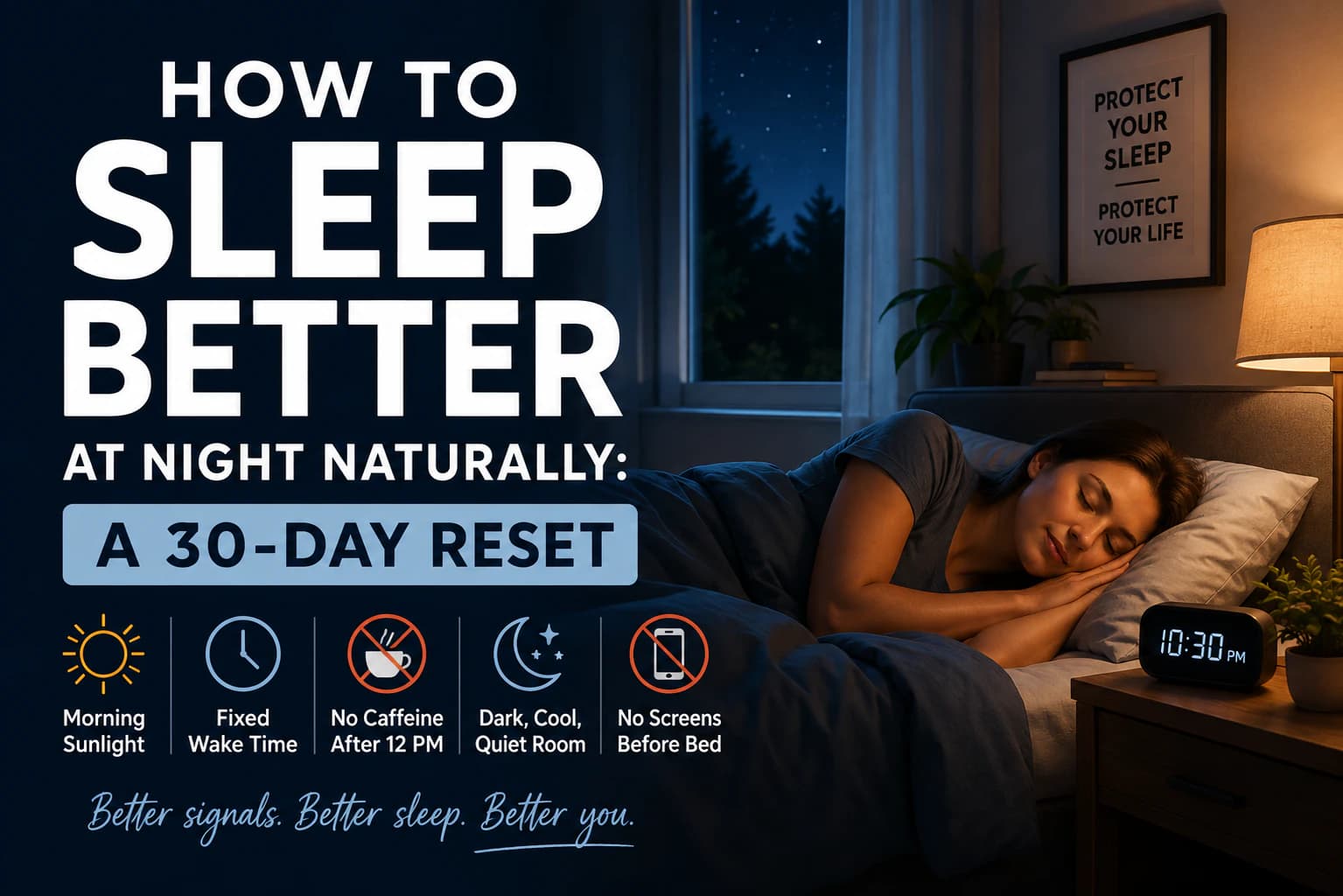
30-second sleep reset: if you want the shortest version, make your bedroom dark and comfortable, put your phone away, slow your breathing, and commit to the same wake time tomorrow. A 30-second routine cannot literally reset chronic insomnia; the goal is to start a set of habits that consistently strengthens your sleep-wake signals. The fuller version comes down to fixing those signals, in order: 10 minutes of morning sunlight within half an hour of waking, a fixed wake time every day, no caffeine after midday, and no screens for 45 minutes before bed. Give these changes a few consistent weeks before judging whether they are helping. If sleep problems persist or interfere with daytime life, consider talking with a healthcare professional.
- Morning light: 10 min within 30 min of waking, one of the most useful single habits
- Fixed wake time: every day, weekends included
- Caffeine cutoff: midday, not evening
- Bedroom: 18-20°C (64-68°F), dark and quiet
- Screens: none for 45 min before bed, plus a fixed 30-min wind-down
- If it persists: CBT-I is the recommended first-line treatment, ahead of medication
The 10-3-2-1-0 rule (memorize this)
The simplest framework for sleep hygiene, popularized recently but based on decades of research:
- 10 hours before bed: No more caffeine
- 3 hours before bed: No more food or alcohol
- 2 hours before bed: No more work
- 1 hour before bed: No more screens
- 0 times: Hit snooze in the morning
Follow just this, every day, and give it a couple of weeks before you judge whether it is working.
Understanding sleep (the science first)
Sleep is not a switch. It's a cascade of hormones: melatonin, cortisol, adenosine, growth hormone, that build and release across 24 hours based on three environmental inputs:
Cortisol in particular is widely misunderstood online, and the cortisol detox trend gets the direction of cause and effect backwards.
- Light (one of the most influential signals)
- Movement
- Eating patterns
If those signals are wrong, no amount of "trying to sleep" will fix it. This is why willpower fails and why the same person can sleep instantly on vacation but struggle at home.
The sleep stages (why 6 hours ≠ 8 hours)
You cycle through 4 stages every 90-120 minutes, and a healthy adult night breaks down roughly like this:
- Stage 1 (5%), drowsy transition, easy to wake
- Stage 2 (45%), light sleep, body preparing for deep sleep
- Stage 3 (25%): DEEP sleep (physical recovery, immune function, growth hormone release)
- REM (25%): dreams, memory consolidation, emotional processing
Critical insight: Deep sleep happens mostly in the first half of the night. REM happens mostly in the last half of the night.
Six hours is less sleep than most adults need, and consistently cutting sleep short can reduce the amount of later-night REM sleep you get, which is part of why sleep-deprived people become more emotionally reactive and forgetful.
Sleep pressure vs. tired (understand the difference)
You can be tired without being sleepy. Tired = physically fatigued. Sleepy = adenosine has built up enough that your brain is ready to shut down.
Caffeine blocks adenosine receptors. That's why afternoon caffeine can still interfere with nighttime sleep: as it wears off, adenosine that had been blocked can flood back in.
Practical rule: Don't get in bed unless you're actually sleepy. Not just tired. Sleepy. If you lie in bed tired-but-wired, you train your brain to associate bed with wakefulness. This is called "conditioned arousal", a top cause of chronic insomnia.
How to sleep better at night naturally: the 12 highest-impact fixes
1. Morning sunlight within 30 minutes of waking (start here)
What to do: Getting outdoor light soon after waking can help reinforce your body's circadian timing. A practical starting point is 10-20 minutes outdoors within 30 minutes of waking, without sunglasses, though the exact amount and timing that works best varies with season, latitude, weather, and your own sleep schedule.
Overcast day? Fine. Outdoor light on a cloudy day is still much brighter than indoor light.
Why it works: Light hitting your retina helps set your circadian clock, signalling to your brain that day has started, which in turn shapes when melatonin is released later that night.
This is one of the more useful habits on this list, but it works alongside the others, not instead of them.
2. Same wake time every day, even weekends
Your body cannot have a sleep schedule if wake time floats 3 hours between weekdays and weekends.
Rule: Pick a wake time. Hold it within 30 minutes, seven days a week.
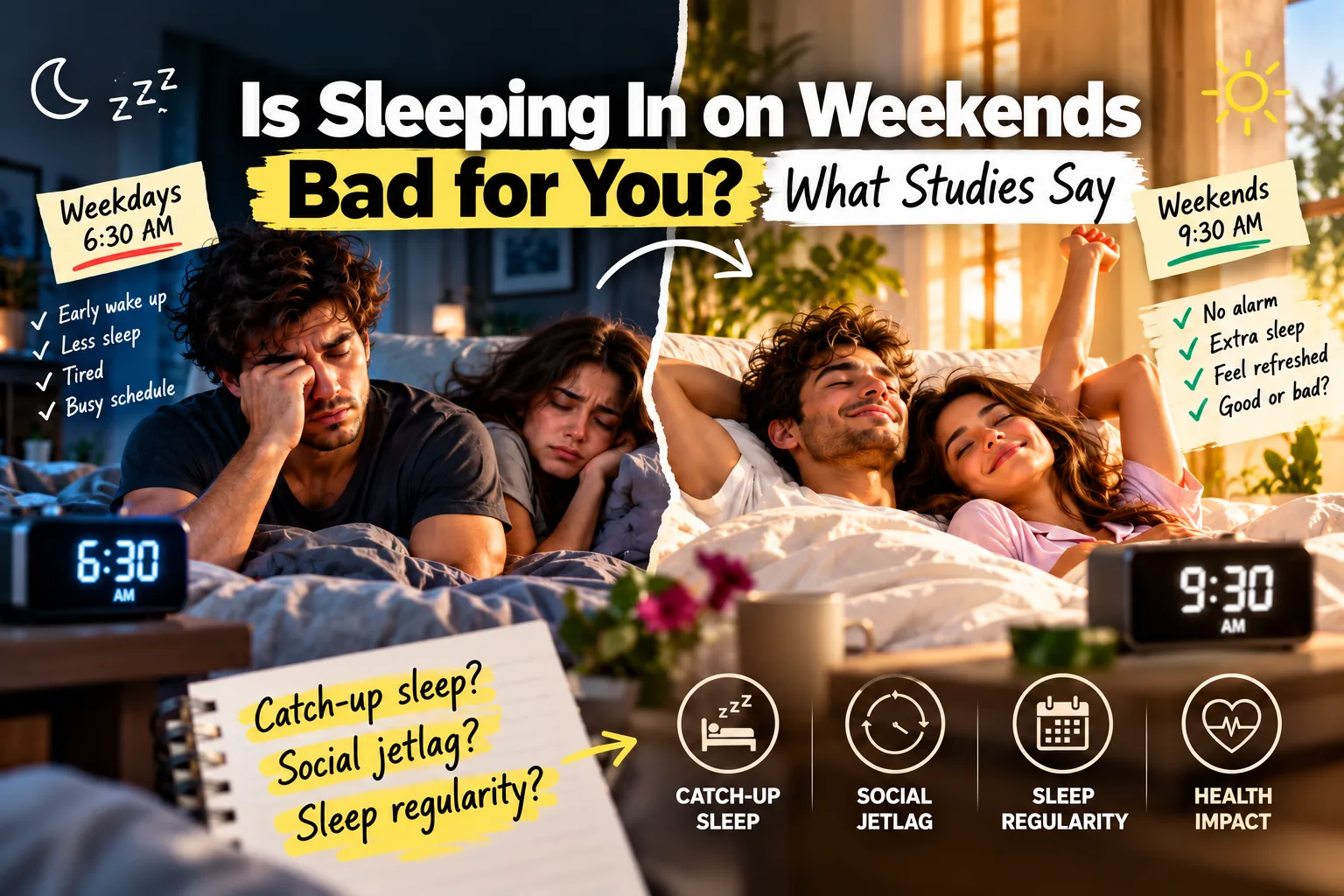
Saturday feels sacred. Sleep quality matters more. Nap later if tired, but wake up on schedule. This one habit alone can substantially reduce the "Sunday night insomnia" most people accept as normal. For a closer look at the evidence, see what the research says about sleeping in on days off.
3. No caffeine after 12 PM
Caffeine's half-life averages 5-6 hours, so a 2 PM coffee still has a meaningful share of its dose circulating at 8 PM. The often-cited experiment here gave people 400 mg at bedtime, three hours before, and six hours before: even the six-hours-before dose measurably cut total sleep time and reduced slow-wave sleep, and the participants largely did not notice it had. That last part is the important bit: "caffeine doesn't affect my sleep" is not evidence that it doesn't. See the Sleep Foundation's summary of caffeine and sleep.
Problem: Even if you fall asleep, caffeine consumed earlier in the day can fragment deep sleep for many people. You might wake unrested and blame stress, when caffeine could be the more likely culprit.
Cut off: A practical starting point is to stop caffeine around midday, especially if you are sensitive to it or have trouble sleeping.
Exception: Some genetic "fast metabolizers" handle caffeine later. If you don't know your genotype, assume you're not one of them.
4. Cold room (18-20°C / 64-68°F)
Your body sleeps deepest when slightly cool. Body wakes when warm.
Set AC/fan to 18-20°C (64-68°F). If partner disagrees, blankets are a compromise (one hot, one cold with different bedding).
The Sleep Foundation puts the optimal range at roughly 18-20°C (64-68°F), and the mechanism is thermoregulation: core body temperature starts dropping about two hours before sleep, alongside melatonin release, and a cool room helps that happen. Being too hot disrupts sleep more than being too cold, cutting into REM and slow-wave stages specifically.
One caveat the usual advice misses: this is not universal. Older adults tend to sleep better somewhat warmer, closer to 20-25°C (68-77°F). If 18°C (64°F) leaves you awake and cold, you are not doing it wrong.
5. Complete darkness
Any light leak: street lamp, phone charger LED, alarm clock, can reduce melatonin (see the FAQ on sleeping with lights on below).
What to do:
- Blackout curtains (about USD 16, Rs 1,500)
- Cover LEDs with electrical tape
- Sleep mask if renting/traveling
- Phone completely out of bedroom
Bedroom should be dark enough that you can't see your hand in front of your face.
6. Zero screens 45 minutes before bed
Evening light exposure and stimulating screen content can both interfere with sleep. Reducing screen use before bed also removes the mental stimulation of scrolling, messaging and work.
What to do: 45 minutes before bed, phone goes on a different room's charger. Not bedside table. Not airplane mode nearby. Different room.
Read paperback. Journal. Talk to someone. Anything but screen.
Blue light filters and glasses? Worth a try, not a substitute for putting the phone down. Randomised trials do suggest evening blue-blocking glasses can shorten how long it takes to fall asleep, but the effect is modest and the trials are small. They also do nothing about the dopamine loop of scrolling. Content is the real problem, not just light.
7. Consistent wind-down routine (30 minutes)
Your brain learns patterns. A consistent pre-sleep routine gives your brain repeated cues that bedtime is approaching and can make it easier to transition into sleep.
Example routine:
- 10 min: warm shower (drops core temperature after)
- 10 min: read paperback (fiction, not thriller)
- 5 min: journal (one sentence: what went well, one worry offloaded)
- 5 min: gentle stretching in bed
Same order. Same time. Every night. Boring is the point. Boredom is the pathway to sleep.
8. Exercise, but timing matters
Regular exercise tends to improve sleep for most people. But intense exercise within 3 hours of bed raises core temperature and cortisol, bad for falling asleep.
Best: Morning workout Good: Afternoon workout Fine: Evening workout before 7 PM Bad: Late-night intense workout
Even 20-minute daily walks can noticeably improve sleep within a couple of weeks. See our 30-day home workout plan for the starter routine.
9. Alcohol makes sleep worse (yes, even one drink)
Yes, it "helps you sleep."
Alcohol can make you fall asleep faster while making sleep lighter and more fragmented later in the night. It's also linked to reduced REM sleep, early wakeups, and dehydration.
Not saying never drink. Don't blame bad sleep the day after drinking.
10. Dinner 3+ hours before bed
Late dinners can raise core body temperature. Sleep requires temperature drop. If you eat at 10 PM and try to sleep at 11 PM, your body is still digesting and deep sleep can suffer.
If you eat late socially, walk 30 minutes after. Can help accelerate digestion.
11. Stimulus control (bed = sleep only)
Your brain associates places with activities. If you scroll, work, eat, and watch TV in bed, your brain associates bed with wakefulness.
Rules:
- Bed for sleep and sex only
- Feel tired but not sleepy? Sit in another room
- Awake in bed 20+ minutes? Get up
- No phone in bedroom (put charger in another room)
This is a core CBT-I technique. Extremely powerful for chronic insomnia.
12. Sleep restriction (sounds wrong, but it works)
This one seems wrong but is a core CBT-I technique for insomnia, not a general sleep-hygiene tip: temporarily limiting time in bed to roughly match your actual sleep time, then gradually expanding it, which concentrates sleep, increases sleep efficiency, and rebuilds sleep drive.
Illustrative example (not a prescription for everyone): someone in bed 10 PM - 7 AM but sleeping poorly might work with a clinician or app toward a tighter window such as 12 AM - 6:30 AM, expanding by 15 minutes once they're sleeping through more than 85% of that window consistently for a week.
Sleep restriction is best done with guidance from a trained clinician or validated CBT-I program, particularly if you have significant daytime sleepiness, bipolar disorder, epilepsy, or another condition for which sleep loss could be unsafe. Available in CBT-I apps like SHUTi and Sleepio.
How to fall asleep in 2 minutes: The Military Sleep Method
The best-known technique for learning to fall asleep faster. Developed by US Navy Pre-Flight School in the 1940s and used by combat pilots to sleep in tanks and trenches. The figure everyone quotes, 96% of trainees asleep within two minutes after six weeks, comes from Bud Winter's 1981 book "Relax and Win", describing the Del Monte Naval Pre-Flight School. It is a book report rather than a study: the method as a whole has never been tested in peer-reviewed research.
The exact steps
Step 1: Face relaxation
- Relax all facial muscles including forehead, eyes, cheeks
- Unclench your jaw
- Let your tongue sit loosely in your mouth (not touching teeth)
Step 2: Drop your shoulders and arms
- Let shoulders fall as low as they can toward the mattress
- Relax dominant arm first: upper arm, forearm, hand, fingers
- Repeat with other arm
Step 3: Breathe out slowly
- Take deep breath, exhale very slowly
- Focus only on lungs and chest
- Feel chest sink deeper into mattress
Step 4: Relax legs
- Right thigh, then calf, ankle, foot
- Left thigh, calf, ankle, foot
Step 5: Clear your mind for 10 seconds
Two visualization options:
- Option A: Imagine lying in a canoe on a calm lake, blue sky above
- Option B: Imagine lying in a black velvet hammock in a completely dark room
- Option C: Silently repeat "don't think, don't think, don't think" for 10 seconds
With practice, many people find this helps them fall asleep faster, though the "2 minutes" figure is a training anecdote, not a guarantee. If distracting thoughts arise: return to visualization.
Realistic expectations
Don't expect 2-minute sleep on night 1. It's a skill that takes practice, and there's no reliable data on how long that typically takes. Some people combine it with box breathing (4-4-4-4), though the two haven't been tested together as a combination.
Critical rule: Only try when actually sleepy. This is not a "force sleep" technique. It's a relaxation protocol that helps you fall asleep when your body is READY to sleep.
When it's chronic: CBT-I (the recommended first-line treatment)
If you've had insomnia 3+ nights per week for 3+ months, you have chronic insomnia. Sleep hygiene alone often isn't enough.
CBT-I (Cognitive Behavioral Therapy for Insomnia) is the gold-standard treatment. Clinical guidelines recommend it ahead of sleep medication for chronic insomnia, and its benefits persist after treatment ends. Around 70-80% of people who complete a full course respond, and roughly 40% reach remission.
The 5 CBT-I components
1. Stimulus control (bed = sleep only) See tip 11 above.
2. Sleep restriction See tip 12 above.
3. Cognitive restructuring Challenge unhelpful thoughts:
- "I need 8 hours or I'll be useless tomorrow" → Reality: you'll be tired but functional
- "If I don't fall asleep now, I'll never sleep" → Reality: sleep pressure will build eventually
- "I'll fail the meeting because I didn't sleep" → Reality: most tasks proceed fine on 5-6 hours
4. Sleep hygiene All the fixes above.
5. Relaxation training Military method, box breathing, progressive muscle relaxation, meditation.
How to access CBT-I
Online (self-paced):
- SHUTi: original research-backed program, around USD 150
- Sleepio: NHS-recommended, subscription
- Somryst: FDA-cleared prescription digital therapeutic
Finding an in-person provider:
- Search for "CBT-I therapist", or a clinical psychologist or sleep specialist with CBT-I training
- 4-8 sessions typically needed
- Availability varies a lot by country. Some health systems cover CBT-I; in others trained providers are scarce and waits are long
- Cost varies just as much, depending on the provider and whether your health system or insurance covers it
In India specifically:
- Around Rs 2,000-4,000 per session
- Fortis, Apollo and Manipal hospitals often have sleep clinics
Free options:
- CBT-I Coach app (VA-developed, free)
- Sleep Reset app (freemium)
What supplements actually help (evidence-ranked)
Most sleep supplements are marketing. Evidence for magnesium and other sleep supplements is mixed and depends on the person and the underlying sleep problem. If you are considering any of these, check the dose, possible interactions and whether it is appropriate for you with a pharmacist or clinician, none of them is a proven cure for insomnia.
Better-studied options
Magnesium glycinate (200-400 mg): Commonly taken around 30 min before bed. Some evidence supports a role in relaxation and sleep quality, alongside possible benefit for restless legs and anxiety, though study quality varies. Cost: about USD 4-8 (Rs 400-800) a month.
Glycine (3g): Some studies, mostly from Japanese sleep research, report improved subjective sleep quality and reduced daytime fatigue. Cost: about USD 5 (Rs 500) a month.
USD figures for these supplements are approximate reference conversions at about Rs 95.5 to the dollar as of August 2026; exchange rates move.
Circadian timing
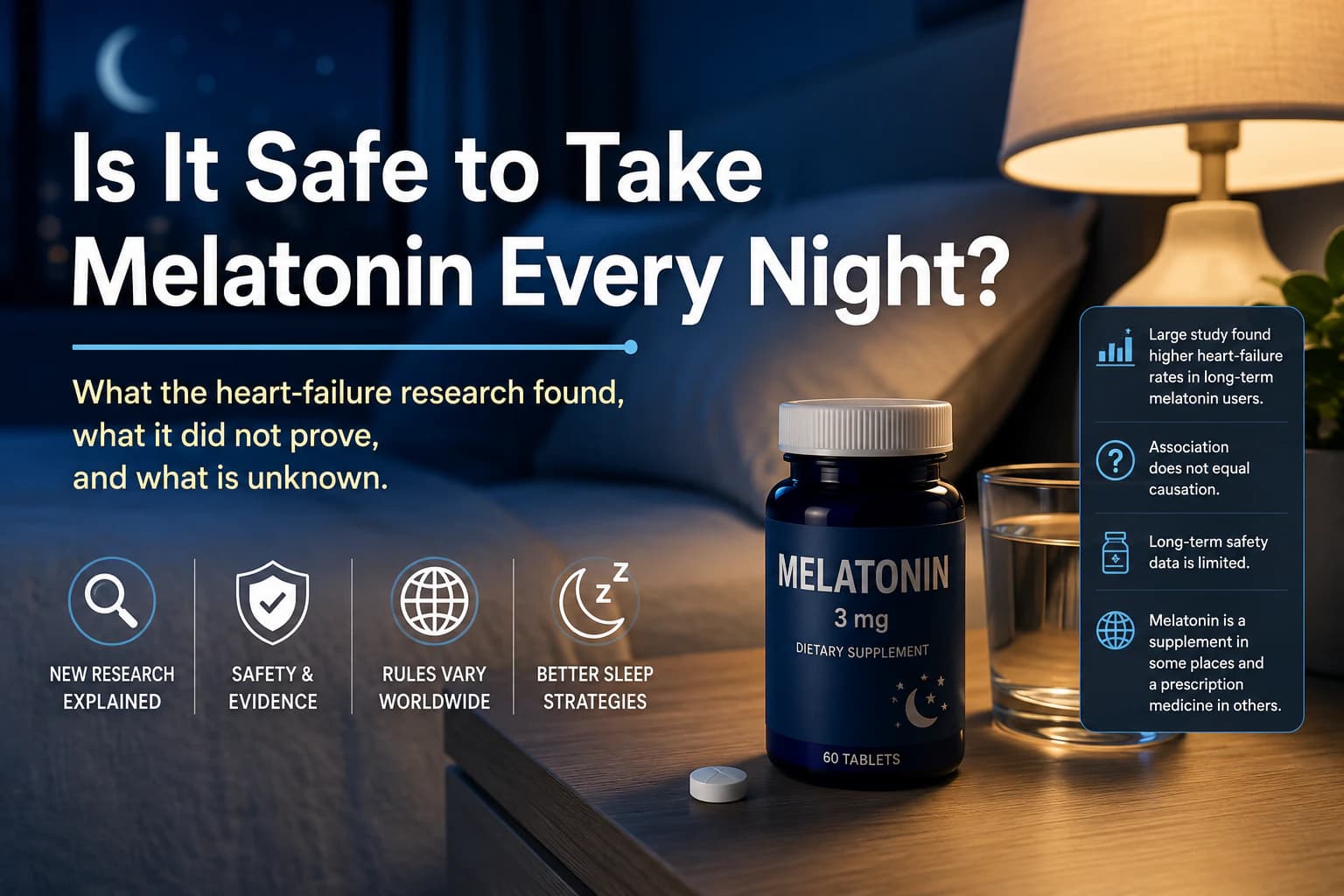
Melatonin (0.3-1 mg is the researched range): Can be helpful for circadian timing issues like jet lag or shifting schedules; it is not a proven treatment for chronic insomnia itself. Where it is sold over the counter, including the US and India, 5-10 mg tablets are the norm, well above the doses most studied. Elsewhere it is controlled: the UK makes it prescription only. Check what applies where you live, and note that higher doses aren't established as more effective and may carry more side effects like next-day grogginess. If you already take it every night, our guide to taking melatonin long term covers what the evidence does and does not show.
Take 30-60 minutes before target bedtime.
L-theanine (200 mg): May help reduce racing thoughts before bed for some people. Generally well-tolerated. Naturally in green tea (small amounts).
Ashwagandha (300-600 mg): Sometimes used for stress-related insomnia, taken at night. If you try it, give it 3-4 weeks before judging whether it's helping. Skip if you have thyroid issues.
Weak/mixed evidence
Valerian root: Mixed studies. Some show effect, others show none. Try if other options fail.
Chamomile tea: Mild effect, mostly placebo + ritual value.
Passionflower: Some evidence for anxiety-related insomnia.
Skip these (mostly marketing)
- Sleep sprays
- Lavender pillows (nice but not magic)
- Weighted blankets (fine for anxiety but not a sleep cure)
- CBD (mostly overhyped, some evidence for anxiety-related insomnia only)
The prescription question
When to consider: Severe acute insomnia (bereavement, major stress) for short-term use only.
What NOT to use long-term:
- Ambien / Zolpidem, dependence risk, memory issues
- Benzodiazepines (Xanax, Ativan), highly addictive
- Antihistamines (Benadryl), daytime grogginess, cognitive issues in elderly
Sometimes discussed as an alternative: Trazodone is sometimes prescribed off-label for sleep, but whether it is appropriate depends on the individual. Discuss its risks, benefits and alternatives with a clinician.
The 3 AM problem (waking mid-sleep)
Very common. Protocol:
If you wake at 3 AM and can't fall back asleep
- Don't check the phone. Checking the clock can spike alertness and anxiety right when you're trying to fall back asleep.
- Don't lie there trying for more than 20 minutes. Get up.
- Go to another room. Dim light only.
- Read a boring paperback book. Not exciting. Boring.
- No food, no screens.
- Return to bed only when actually sleepy.
This retrains your brain to associate bed with sleep, not insomnia.
Why does this happen anyway?
- Cortisol spike: Chronic stress can contribute to an early-morning cortisol surge
- Alcohol: Metabolism spike 3-4 hours after drinking
- Blood sugar: Late dinner + refined carbs can contribute to a 2 AM sugar dip and adrenaline response
- Room temperature: Warms up naturally around 3 AM
- Age: Sleep stages change after 40
- Sleep apnea: If accompanied by snoring, gasping
The 30-day sleep reset protocol
If your sleep is broken, here's a practical structure to work through:
Days 1-3: Foundation
- Fixed wake time (say 6:30 AM). No matter how late you slept.
- 10 min sunlight within 30 min of waking
- No caffeine after 12 PM
- No screens 45 min before bed
- Bedroom at 18-20°C (64-68°F), blackout curtains
Possible early effects: some fatigue as your schedule adjusts, with sleep quality often starting to improve within the first few days for many people, though timelines vary.
Days 4-7: Add wind-down routine
- Same 30-minute pre-sleep sequence every night
- Read paperback fiction only
- Journal one sentence: what went well
- Optional: magnesium (200-400 mg, see supplements section) 30 min before bed, if you choose to try it
- Same bedtime target (8 hours sleep opportunity)
Possible effects for many people: falling asleep somewhat faster, fewer wakeups, though this varies by person.
Days 8-14: Lock in schedule
- Continue everything
- Same wake time even weekends
- Add 20-min morning walk
- No alcohol at all
- Start military method or box breathing before sleep
Possible effects some people notice by this point: waking naturally before the alarm, energy feeling more stable.
Days 15-30: Fine-tune
- Continue everything
- Still waking at 3 AM? Reduce dinner size, move earlier
- Still tired at 3 PM? Bedroom might be too warm
- Track sleep quality on 1-10 scale each morning
By day 30, you should have enough information to see whether your sleep consistency, sleep quality and daytime energy are improving.
Signs you should see a doctor
Not every sleep issue is fixable with tips. See a doctor if:
- Snoring loud enough to hear through walls (possible sleep apnea)
- You gasp/choke awake at night (possible sleep apnea)
- Very sleepy during the day despite 7-8 hours in bed
- Chronic insomnia 3+ months despite all fixes
- Vivid nightmares waking you regularly
- Sleep walking or eating
- Restless legs preventing sleep
- Sleep issues starting alongside anxiety/depression symptoms
Sleep clinics do overnight polysomnography to diagnose sleep apnea, narcolepsy and REM sleep behavior disorder, all treatable. What it costs you varies enormously: in some countries it is fully covered by the health system or insurance, in others it is a significant out-of-pocket expense. In India it typically runs Rs 8,000-15,000.
Orthosomnia: the sleep tracker trap
New syndrome first named by researchers around 2017.
Orthosomnia = obsessive focus on optimizing sleep that paradoxically causes insomnia. If you're:
- Checking Fitbit/Oura score 5× per day
- Stressed if you don't hit 8 hours
- Refusing to go out because "I need to sleep well"
- Anxious before bed about tomorrow's score
...that IS the problem.
Fix: 2-week complete tracker break. A short break may reduce sleep-related anxiety for some people. Then reintroduce tracker for weekly trend analysis only. Never nightly obsession.
Trackers are useful tools. Not judges of your worth.
Sleep across life stages
Sleep in your 20s
Most flexible sleep pattern. Can bounce back from bad nights easier. Don't waste it. Habits you build now can meaningfully shape your sleep quality for years to come.
Sleep in your 30s
Kids, career stress, later bedtimes create "sleep debt" most 30-somethings accept as normal. Protect fixed wake time: the anchor that keeps everything workable.
Sleep in your 40s
Deep sleep declines naturally. Focus on quality over quantity. Cut alcohol harder. Morning sunlight becomes more important as circadian rhythm weakens. Perimenopause starts affecting women's sleep.
Sleep during menopause (women 45-55)
Estrogen decline causes:
- Hot flashes (waking hot)
- Night sweats
- Mood changes
- Reduced sleep quality overall
- Progesterone (natural sedative) drops too
Solutions:
- Colder bedroom (16-18°C / 61-64°F)
- Moisture-wicking sheets
- HRT if severe. Discuss with doctor
- Magnesium + glycine supplementation may help some women (see supplements section)
- Around half of postmenopausal women report sleep disruption, with estimates across studies ranging roughly 35-60%
Sleep after 60
Sleep patterns change a lot. More wakeups are normal, not a medical problem. Take short naps if needed. Focus on total 24-hour sleep, not consolidated night sleep.
Shift work protocol
Rotating shift schedules can increase the risk of shift work disorder and make it harder to maintain consistent sleep.
Strategies:
- Blackout curtains + earplugs during day sleep
- Bright light therapy during "wake" hours
- Melatonin 0.3-1 mg before day sleep
- Strict caffeine cut-off 8 hours before intended sleep
- Maintain same shift as long as possible, rotating shifts tend to be hardest
- If shift work is causing persistent sleep problems or excessive daytime sleepiness, discuss strategies with a healthcare professional
Sleep and mental health
Sleep is bidirectionally linked with mental health:
- Depression: Insomnia AND sleeping too much are both signs
- Anxiety: Racing thoughts, difficulty falling asleep, 3 AM wake-ups
- Bipolar disorder: Sleep disruption often triggers episodes
- PTSD: Nightmares, hypervigilance preventing sleep
- ADHD: Delayed sleep phase syndrome (can't fall asleep till 3 AM)
Important: Improving sleep can support mental health, while treating anxiety, depression and other conditions can also improve sleep. Combining CBT-I with therapy for the underlying condition is often more effective than either alone.
See our anxiety relief guide for the mental health component.
Sleep and other wellness pillars
Sleep is foundational. Fix sleep first and everything else gets easier:
- Weight loss: See our belly fat guide, sleep deprivation can increase appetite and make higher-calorie food choices more likely
- Anxiety: See our anxiety relief guide, sleep and anxiety feed each other
- Meditation: See our morning meditation guide, meditation before bed may help reduce stress and make it easier to wind down
- Fitness: See our 30-day workout plan, exercise is a sleep multiplier
- Gut health: See our gut health guide, severe sleep restriction measurably cut microbial richness in one human trial
Partner sleep issues (the honest section)
If you share a bed, sleep is a two-person problem.
Common issues
Snoring: #1 relationship-affecting sleep issue. Solutions in order:
- Side-sleeping (sew tennis ball into back of pajama)
- Nasal strips
- Mouth guard
- See doctor for sleep apnea evaluation
- CPAP machine if apnea confirmed
Temperature disagreement: Different bedding on same bed. Two duvets. Fan on one side.
Restless movement: Consider bigger mattress. Or "sleep divorce" (see below).
Different schedules: Blackout curtains for early bird sleeping in. Eye masks. Quiet routines for night owl.
Sleep divorce (worth considering)
Sleep divorce = sleeping in separate rooms.
Increasingly common. In a 2023 AASM survey of 2,005 US adults, 35% said they occasionally or consistently sleep in a separate room from their partner. That is how many do it, not how many benefit: a separate 2023 Sleep Foundation survey found 52.9% of those sleeping apart said their sleep quality improved, by an average of 37 minutes a night. Whether it helps the relationship is down to the couple.
Not a sign of relationship failure. Sign of prioritizing well-being.
If separate rooms not possible:
- Twin beds pushed together
- Different bedding (weighted blanket for one, cool sheets for other)
- Different pillows
- Different mattresses (side-by-side compatible)
Socially loaded in most places, and often limited by how many bedrooms you actually have. Practically: excellent sleep decision.
The final rule
Sleep is not something you fix in one night. It's something you build across weeks.
If you do half of this, tomorrow's sleep barely changes. If you do all of it consistently for a month, most people notice a real difference.
Pick three tonight. Sunlight tomorrow morning. No phone at bedside tonight. Cool room by tomorrow. Master those. Add more later.
Sleep is the foundation of everything: fitness, mood, career, relationships. Get it right and the rest gets easier.
Bookmark this. Read every 6 months. Your future self will thank you.
Related reads:
Frequently asked questions
Answers to the most common questions about this topic.
National Sleep Foundation recommends 7-9 hours for adults 18-64, and 7-8 hours for adults 65+. Individual needs vary, some genuinely thrive on 7 hours, others need 9. Fewer than 6 hours consistently increases risk of cardiovascular disease, diabetes, and cognitive decline. If you need caffeine to function or feel groggy through mornings, you're likely under-sleeping.
Melatonin is a circadian rhythm signal, not a sedative. Works for shifting your clock (jet lag, shift work) but largely useless for chronic insomnia. Availability differs by country: the US treats it as a dietary supplement sold without a prescription, while in the UK it is prescription only, and other countries apply their own controls, so check your local rules and ask a pharmacist or doctor. Where it is sold freely, including India, 5-10 mg tablets are the norm, well above the roughly 0.3-1 mg range most studied. Higher doses aren't established as more effective and can cause morning grogginess. Take 30-60 minutes before target sleep time, not right before bed.
For the small number of people who carry a genuine short-sleep gene variant, yes. True genetic short sleep is rare, though: the best-known variant is estimated at roughly 1 in 1,000 and the others are rarer still, so assume it is not you. For everyone else, 6 hours accumulates a sleep debt that impacts cognition, immunity, and metabolism. If you're consistently getting 6 hours and 'feeling fine,' you're likely operating at reduced capacity, studies show people underestimate their own sleep deprivation.
Foods with tryptophan and magnesium support sleep: eggs, dairy (dahi, milk), bananas, almonds, walnuts, oats, cherries, turkey. Warm milk before bed is a popular remedy, though the evidence that the small amount of tryptophan in a glass of milk meaningfully affects sleep is weak, the warmth and ritual may matter as much as the biochemistry. Avoid heavy, spicy, or high-sugar meals within 3 hours of bed. Kiwi fruit specifically shown to improve sleep quality in some studies.
Yes. In a study of 116 adults, ordinary room light during the usual hours of sleep suppressed melatonin by more than 50% in 85% of trials, measured against a dim-light control. Light at night has also been linked to weight gain, insulin resistance and depression, though those are associations rather than established cause. Includes phone screens, LED chargers, streetlight through curtains. Aiming for a very dark room is one of the more well-supported sleep hygiene habits.
For a moderate shift (1-2 hours), expect roughly 3-7 days of consistent effort. For bigger circadian shifts like jet lag or shift work, 3-4 weeks of consistent morning sunlight and a fixed wake time is a reasonable timeframe to expect real adaptation, though it varies by person. Chronic insomnia is a different problem, schedule changes alone often aren't enough, see the CBT-I section for a more complete approach. Biggest mistake: 'catching up' on weekends, this undoes progress every week.
Excellent if done right: 20 minutes maximum (avoid deep sleep and grogginess), before 3 PM (avoids interfering with nighttime sleep), only when needed. Longer or later naps can worsen insomnia by reducing sleep pressure at bedtime. A short nap can help take the edge off daytime sleepiness after a poor night, though it's not a precise substitute for the sleep you missed.
'Sleep drunkenness' after oversleeping happens when you wake mid-way through a deep sleep cycle. Also, sleeping 10+ hours consistently is often a sign of poor sleep quality (fragmented sleep, sleep apnea) rather than genuine rest need. If you regularly sleep 9+ hours and still feel tired, get evaluated for sleep apnea.
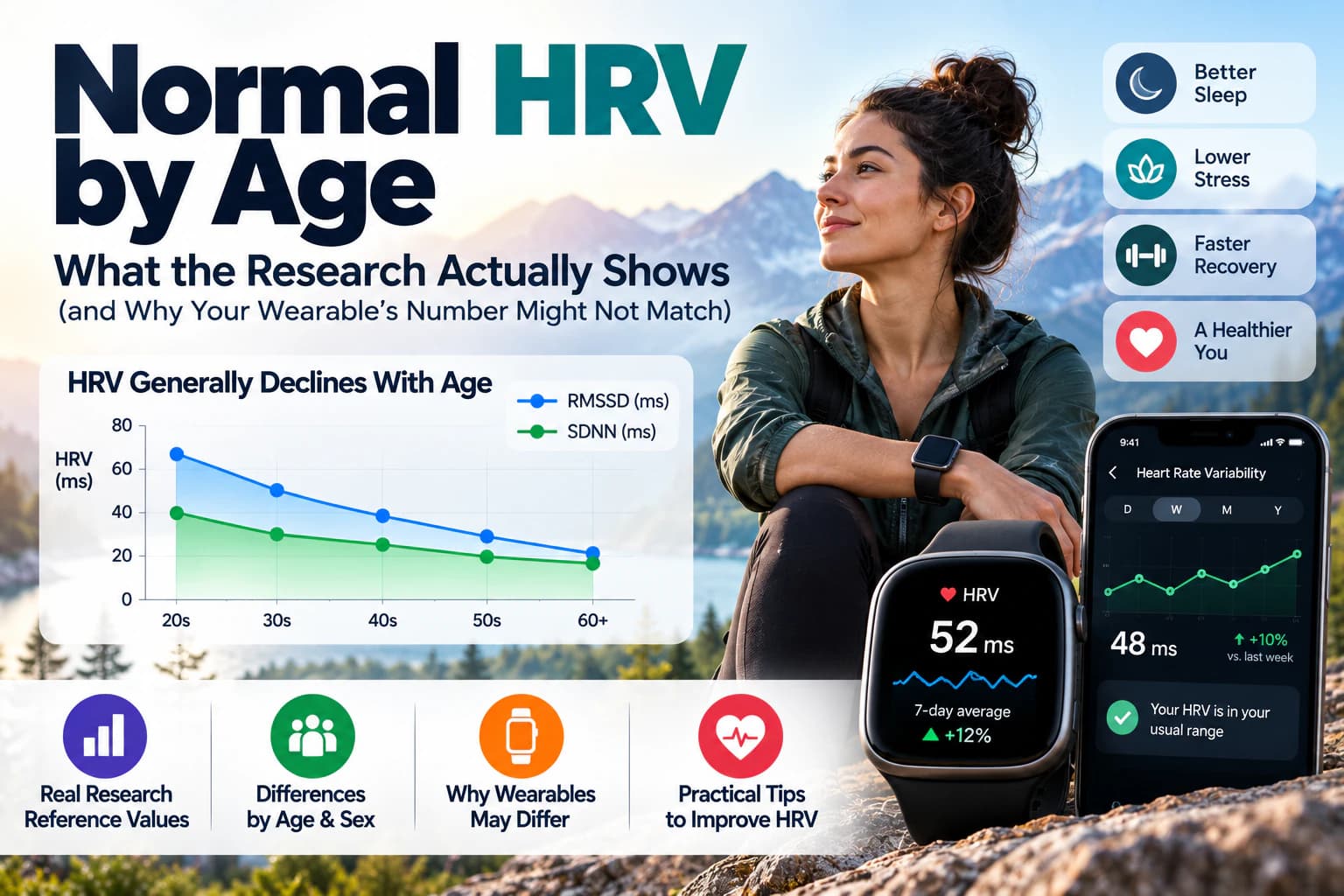
Useful for detecting weekly patterns but not for nightly obsessing. Consumer devices estimate sleep stages rather than measure them, and how well they manage it varies a lot by device: one validation study against polysomnography reported stage sensitivities from 50.5% to 86.1% across three popular devices, depending on which device and which stage. The same caveat applies to a tracker's HRV reading, which varies by device and metric more than most dashboards suggest. For context, this is hard even for people: in the AASM inter-scorer reliability programme, human technicians scoring the same records agreed on sleep stage 82.6% of the time, so nothing here is going to be exact. If your tracker stresses you out (orthosomnia), skip it. Use them for trend analysis: 'my sleep got worse when I drank', actionable insight. Not for '85 vs 92 sleep score anxiety.'
Often, yes. The techniques below are the core of CBT-I and you can apply them yourself. One caveat: the widely quoted 70-80% response rate comes from full clinician-delivered courses, and self-guided versions help many people but should not be assumed to match it. The techniques: (1) fixed wake time, (2) stimulus control (bed only for sleep: no phone, TV, work), (3) sleep restriction (temporarily reduce time in bed to build sleep pressure), (4) cognitive restructuring (challenge 'I'll never sleep' thoughts), (5) morning sunlight. Give 4-6 weeks of consistency. If no improvement, see a sleep specialist.
Filed under
Written by
We research travel, fitness and wellness, and publish what holds up. See our editorial policy.