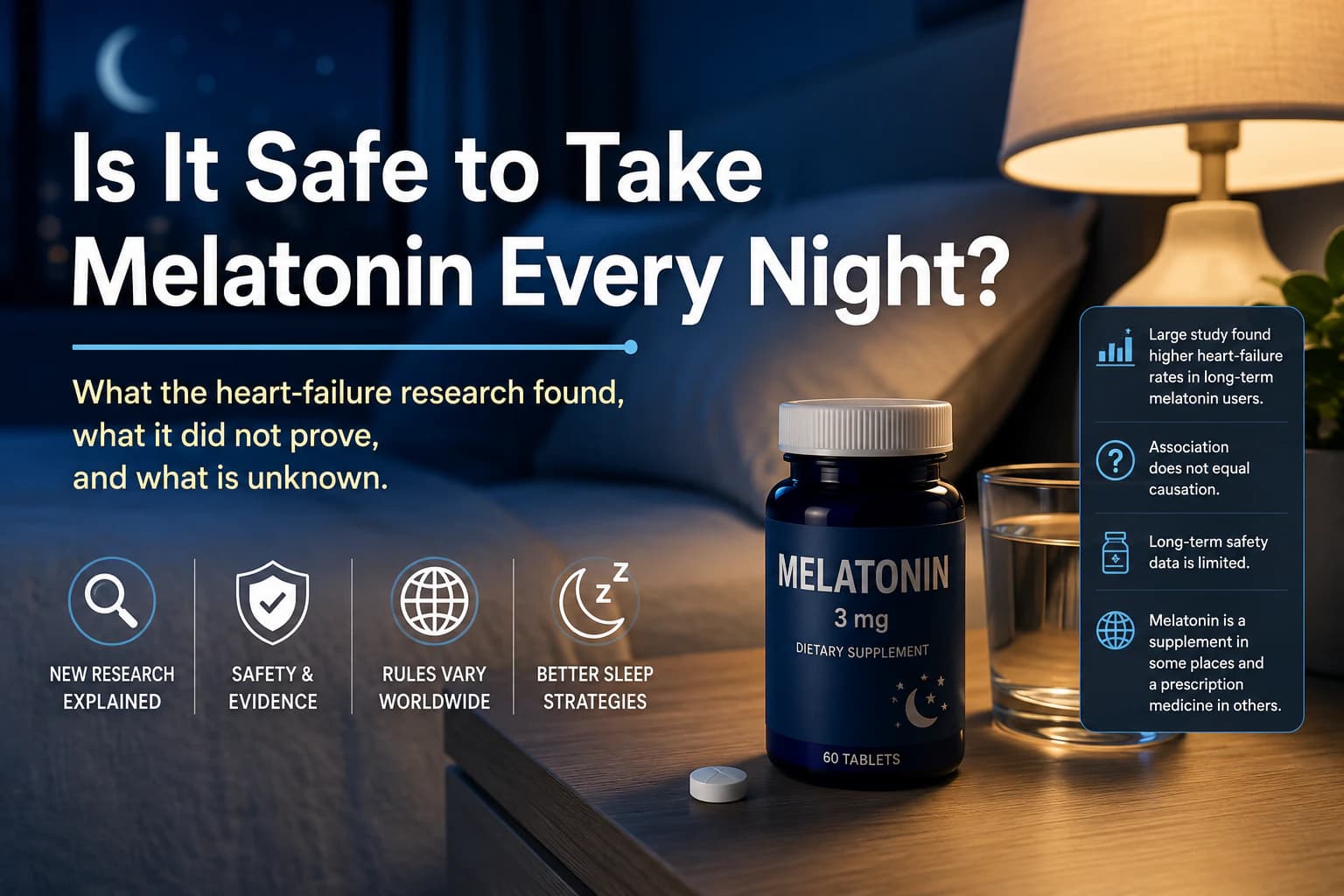
Is It Safe to Take Melatonin Every Night?
Is it safe to take melatonin every night? What the heart-failure research found, what it did not prove, and what is unknown.
If you have been swallowing the same tablet at 10pm for the past two years, you have probably wondered at some point whether that is fine. The question of whether it is safe to take melatonin every night has become harder to ignore since headlines linked long-term use to heart failure.
The short version is that the headlines overstate what the research showed, and the more interesting problem is a quieter one. Nightly indefinite melatonin use has not really been studied, which is a different thing from being studied and found safe.
A note on health advice: This is general information, not medical advice. Melatonin is a prescription medicine in some countries and a supplement in others, and the right approach depends on your circumstances. Nothing here is a reason to stop or change something a clinician has prescribed. If you have ongoing sleep problems, take regular medication, or are considering melatonin for a child, speak to a healthcare professional.
The 30-second answer
Short-term use is well established. Nightly, indefinite use is not, and that is the honest answer. A large observational study found higher rates of heart failure among long-term users, but it cannot show melatonin caused them. The bigger practical issue may be that nobody has studied years of use.
- The study is real but preliminary: a conference abstract, not a peer-reviewed paper
- Association, not causation: it observed a difference, it did not explain it
- The honest gap: long-term safety data barely exists in either direction
- Melatonin shifts timing: it is a body-clock signal, not a sedative
- Labels are unreliable: tested products often contained far more or less than stated
- Rules differ by country: a supplement in some places, a prescription medicine in others
What melatonin actually does
Melatonin is a hormone your body already makes. Production rises in the evening as light fades and falls toward morning, which is how your body signals internally that it is night.
That mechanism matters more than most coverage suggests, because it explains what melatonin is good at and what it is not.
It is a timing signal, not a sedative. Many sleeping medications work by altering brain activity to promote sleep. Melatonin works by telling your body what time it thinks it is. If your sleep problem is that your internal clock has drifted out of step with your schedule, that signal can help. If your sleep problem is stress, pain, an irregular routine, or an untreated condition, a timing signal does not address it.
This distinction predicts where the evidence is strongest. The National Center for Complementary and Integrative Health, part of the US National Institutes of Health, notes that research suggests melatonin supplements may help with jet lag, with results varying by direction of travel. For chronic insomnia, the same source is notably more reserved, stating that sleep medicine guidance has found there is not enough strong evidence on the effectiveness or safety of melatonin supplementation for chronic insomnia to recommend its use.
Read those two positions together and a pattern appears. Melatonin has reasonable support for a short, specific, timing-related job. It has much weaker support for the thing most nightly users are actually doing with it.
What it is and is not designed to address
Holding this distinction clearly makes the rest of the evidence much easier to interpret.
| Sleep problem | Is melatonin plausibly relevant? |
|---|---|
| Body clock shifted by travel across time zones | Yes, this is the timing problem it addresses |
| Body clock shifted by night or rotating shift work | Sometimes, though the schedule itself is the larger factor |
| Naturally late sleep timing that clashes with an early start | Sometimes, as a timing signal alongside light exposure |
| Racing thoughts, worry or stress at bedtime | Not directly, the cause is not timing |
| Pain, reflux or another physical condition disturbing sleep | No, the underlying condition is the issue |
| Breathing interruptions during sleep | No, and this warrants medical assessment |
| Caffeine, alcohol or an irregular schedule | No, these are behavioral and reversible |
For many people taking melatonin nightly for years, the underlying sleep problem may sit somewhere in the lower half of that table. That is the mismatch at the center of this whole question, and it exists independently of any safety finding.
How people end up taking it every night
Many people don't set out to take melatonin indefinitely. They start by taking it for a week.
The usual pattern is recognizable. Something disrupts sleep: a stressful period, a trip, a new baby, a schedule change, an illness. Melatonin gets added because it is easy to obtain where you live and seems low-risk. Sleep improves, or at least the disruption passes. The tablet stays.
Months later, the original reason has gone but the habit has not. At that point melatonin is no longer being used to solve the problem it was introduced for. It has become part of the bedtime routine, and stopping feels like removing a load-bearing piece of it, which is uncomfortable enough that most people simply do not test whether it is still doing anything.
This matters for two reasons. The first is that the safety question people are actually asking is about this drift, not about the week they originally planned. The second is that the drift makes it hard to know whether melatonin is still helping, because nobody runs the comparison. If you have taken something nightly for three years, you have no recent experience of sleeping without it to compare against.
None of this is an argument that the habit is harmful. It is an argument that it is worth examining rather than continuing on autopilot.
Why "is it safe to take melatonin every night" is harder than it looks
Most safety questions can be answered by pointing at evidence. This one runs into a gap instead.
The overwhelming majority of melatonin research involves short-term use. NCCIH describes the available studies as short-term and states plainly that information on the long-term safety of supplementing with melatonin is lacking, and that possible long-term side effects are unclear.
That phrasing deserves care, because it is easy to read in two opposite and equally wrong ways:
- It does not mean melatonin has been shown to be harmful over the long term.
- It does not mean melatonin has been shown to be safe over the long term.
It means the studies that would answer the question have largely not been done. Someone taking melatonin nightly for five years is doing something the research base has not characterized well, in either direction.
That is the honest foundation for everything below. The heart-failure story sits on top of this gap rather than filling it.
What the recent heart-failure research found
In late 2025, researchers presented an analysis that drew a great deal of attention, and it is worth walking through carefully because the headline version lost most of the important detail.
What the researchers compared
According to the American Heart Association's summary, the team used a large international health-records network to study adults diagnosed with insomnia.
They identified 65,414 adults who had melatonin documented in their records for at least a year, and matched them against 65,414 adults who also had insomnia but no recorded melatonin use, for a total of 130,828 people. The two groups were matched on 40 factors, then followed for five years.
Matching on 40 factors is a genuine methodological strength. It is an attempt to compare people who resemble each other on the things that might otherwise explain a difference.
What the numbers show
| Outcome over 5 years | Long-term melatonin group | Matched comparison group |
|---|---|---|
| Developed heart failure | 4.6% | 2.7% |
| Hospitalized for heart failure | 19.0% | 6.6% |
| Died from any cause | 7.8% | 4.3% |
Those are the observed rates in each group. It is worth looking at them in absolute terms rather than only as a ratio, because the difference in the first row is roughly two people in every hundred over five years, which is a smaller picture than "90 percent higher" conveys even though both describe the same numbers.
These figures describe what happened in these two groups. They are not a personal risk calculation, and they should not be read as one.
What the research cannot tell us
This is the part that most coverage compressed into a single sentence, and it carries more weight than the numbers.
It was observational. Nobody was assigned to take melatonin. Researchers looked at what people already did and recorded what happened afterward. That design can identify an association. It cannot establish that melatonin caused the difference.
It was presented as a conference abstract. Abstracts presented at scientific meetings are short summaries that have not been through the full peer-review process a journal applies, and findings are treated as preliminary until published as a complete manuscript.
The exposure classification has a real weakness, and the researchers said so. The AHA summary notes that the database includes countries that require a prescription for melatonin and countries that do not. Where melatonin is bought without a prescription, use frequently leaves no trace in medical records. Some people counted as non-users may have been taking melatonin. If that happened at scale, the comparison between the two groups becomes less reliable.
Other differences may not have been captured. The researchers noted they lacked information on the severity of insomnia and on the presence of other psychiatric conditions. Severe, long-standing insomnia is itself associated with cardiovascular problems. People whose insomnia is bad enough to warrant a year or more of treatment may differ from people whose insomnia is not, in ways that matching cannot fully resolve.
Independent specialists made similar points. In expert commentary collected by the Science Media Centre, Carlos Egea, president of the Spanish Federation of Sleep Medicine Societies, noted that observational studies of this kind show association rather than causality, that the abstract had not been through independent review, and that because melatonin does not require a prescription in the US, the comparison group may have included people taking it without that appearing in their records. He described the appropriate response as highlighting the need for a prospective trial to clarify the safety profile.
Does melatonin cause heart failure?
On this evidence, that question cannot be answered, and it is important to say so plainly rather than hedge.
What the research establishes is that in this dataset, people with long-term recorded melatonin use experienced higher rates of these outcomes than matched people without it. What it does not establish is why.
At least three explanations remain open, and the study cannot distinguish between them:
- Melatonin contributes to these outcomes in some way.
- The underlying insomnia, or its severity, contributes to these outcomes, and melatonin use is simply a marker of having worse insomnia.
- The groups differed in ways the data could not capture, including the misclassification problem described above.
Reasonable specialists currently regard the second and third as very much live possibilities. That is why the responsible framing is that this finding justifies further research and a conversation with your clinician if you are a long-term user, not that melatonin damages hearts.
A note on the counterargument. The Council for Responsible Nutrition, a supplement-industry trade association, publicly urged caution in interpreting the findings. Their scientific point about preliminary non-peer-reviewed data is fair on its face, but they are not an independent medical authority and they represent the sector that sells the product. Their position is worth knowing and worth weighting accordingly.
A more recent analysis points the other way
In May 2026, an analysis published in Open Heart revisited this question using different data. It is not a new prospective study but a fresh look at existing national survey data, and it deserves attention because it cuts against the earlier signal without settling the matter.
Researchers at Vanderbilt examined melatonin and cardiovascular risk using NHANES, a nationally representative US health survey, covering 1999 to 2018. In updated survey-weighted models, they reported that recent melatonin use was not significantly associated with prevalent composite cardiovascular disease or heart failure.
That sounds like an all-clear. It is not, and three details explain why.
It measured a different exposure. The earlier analysis looked at people with at least a year of documented melatonin use. This one looked at recent use. Those are not the same thing, so the two results are not directly comparable, and the absence of a signal for recent use says little about years of nightly use.
It looked at prevalent disease. It examined conditions already present rather than following people forward to see who went on to develop heart failure. That design cannot establish which came first.
It carries the same observational vulnerabilities. The authors note that melatonin users differed markedly from non-users at baseline, particularly for sleep disturbance and depression, and that associations in this area are unusually vulnerable to confounding by indication, reverse causality and exposure misclassification, because melatonin use often reflects insomnia severity, mood symptoms and how much healthcare someone accesses.
The authors are unusually direct about how much weight to place on their own work. They describe the findings as a hypothesis-generating contextual counterpoint to recent alarm signals rather than causal evidence of benefit or harm, and conclude that available observational data do not support strong claims of cardiovascular benefit and do not establish definitive cardiovascular harm or safety.
That is the most accurate summary available of where this stands. One dataset produced a signal. Another, measuring something different in a different way, did not. Neither was designed to establish cause, and what the question needs is prospective research rather than another observational read.
The supplement-label problem
There is a separate issue with nightly melatonin that has nothing to do with heart failure, and for many people it is the more immediately relevant one.
You may not be taking what you think you are taking.
An analysis of commercially available melatonin products, summarized by the American Academy of Sleep Medicine, found that melatonin content did not fall within a 10 percent margin of the label claim in more than 71 percent of the supplements tested. Actual content ranged from 83 percent less to 478 percent more than the concentration declared on the label. Lot-to-lot variability within a single product varied by as much as 465 percent.
The same analysis found serotonin, a much more strictly controlled substance, in 26 percent of tested supplements, unlisted on the label. The authors raised this as a safety concern, since an unlabeled active substance can interact with medication and cannot be accounted for by the person taking it.
What this does and does not mean. This was a specific sample of products analyzed in one study. It does not establish that 71 percent of every melatonin product sold worldwide is mislabeled, and it does not mean supplements are inherently unsafe. What it demonstrates is that label accuracy is a legitimate thing to think about rather than assume, particularly for something taken every night for years.
The concern extends to products aimed at children. NCCIH notes that 22 out of 25 over-the-counter melatonin gummy products were inaccurately labeled, with melatonin levels ranging from 74 to 347 percent of labeled amounts.
Where melatonin is regulated as a medicine rather than a supplement, manufacturing is subject to the controls medicines face, which is one practical difference between the two regulatory approaches.
Short-term use versus nightly use
These are different situations and the evidence treats them differently, which is easy to miss when both involve the same tablet.
Short-term, timing-focused use is the scenario with the most support. Crossing several time zones leaves your internal clock misaligned with local time, and melatonin can help nudge it. That is a defined problem, a defined duration, and a mechanism melatonin actually addresses. Our science-backed jet lag protocol covers how timing and light exposure work together for travel, which matters more than the supplement itself.
Nightly ongoing use is a different proposition. Here melatonin is usually being asked to solve a problem that is not primarily about timing, over a duration nobody has studied properly, often with a product whose contents are uncertain.
That is not an argument that nightly users are doing something dangerous. It is an argument that the confidence attached to the practice runs ahead of the evidence supporting it.
Why the evidence does not transfer between the two
It is tempting to reason that if a few days of melatonin are fine, a few years must be fine at a slower rate. That reasoning does not hold, and it is worth being explicit about why.
A short course tests one thing: what happens when you nudge your body clock a few times. Extended nightly use asks entirely different questions. Does taking an external hormone signal every night for years affect how your body produces or responds to its own? Does the answer change with age, or alongside medication, or in people with other conditions? Those questions are not smaller versions of the short-term question. They are separate questions, and short-term trials were never designed to answer them.
This is why "melatonin is well tolerated" is a true statement that does less work than it appears to. It is well tolerated over the timeframes it has been studied. Extending that reassurance to a decade of nightly use is an assumption, not a finding.
What about months or years of use?
This is where most nightly users actually sit, and where the evidence is thinnest.
On whether it keeps working. A common report is that melatonin feels less effective over time. This has not been settled by strong evidence, and there are at least two explanations that do not require any change in how your body responds. The first is that it may never have been addressing the real cause, so the initial improvement reflected the disruption passing rather than the tablet working. The second is that expectation plays a genuine role in sleep, and novelty fades.
The unhelpful response to diminishing benefit is to take more. Larger amounts are not reliably more effective, and given how variable product content can be, increasing the amount compounds the uncertainty about what you are actually taking.
On what long-term use does. Here the honest answer is that the research does not say. The bigger unanswered question is long-term melatonin safety, because most research has not followed people taking it indefinitely. NCCIH's position that long-term safety information is lacking and that possible long-term side effects are unclear is not a hedge. It is an accurate description of a gap.
On what to do with that gap. Uncertainty is not evidence of harm, and treating it as such would be its own error. But uncertainty does change how a decision should be made. A short course of something well studied over that timeframe is a low-stakes decision. An indefinite nightly habit in a space where long-term data barely exists is a decision worth revisiting occasionally with someone who knows your history, rather than one to make once and never review.
Melatonin is not regulated the same way everywhere
This is one of the most consequential things to understand, and it is routinely missed by health coverage written for a single country.
In the United States, NCCIH states that melatonin is considered a dietary supplement, which means it is regulated less strictly by the Food and Drug Administration than a prescription or over-the-counter drug would be.
In the United Kingdom, the NHS states that melatonin is available on prescription only. It is mainly used to treat short-term sleep problems in people aged 55 and over, and can sometimes be prescribed by specialists for longer-term sleep problems in some children and adults. The NHS notes that people usually take melatonin for up to 13 weeks, though some may need it for longer.
Elsewhere, the position varies considerably. Some countries treat melatonin as a medicine requiring a prescription or pharmacist involvement, some permit limited amounts as a supplement, and the rules change over time. We are deliberately not listing specific rules for other countries here, because regulatory status is exactly the kind of detail that should be checked against your own national regulator rather than taken from an article.
Two practical consequences follow. First, guidance written in one country may not describe your situation at all. Second, the difference between these systems is precisely what made the heart-failure study's exposure data unreliable, which is an unusually direct link between a regulatory quirk and a research limitation.
There is a third consequence that catches travelers out. Something you bought freely at home may be a regulated medicine at your destination, which can affect whether you are permitted to carry it and in what quantity. If you travel with melatonin, it is worth checking the rules of the country you are entering rather than assuming your own country's classification applies. This is the same principle that governs many routine medications, and it is easy to overlook precisely because melatonin does not feel like a drug in places where it sits on a supermarket shelf.
Who should speak to a healthcare professional first
General information cannot account for your circumstances. These situations particularly warrant individual advice:
- Pregnancy or breastfeeding
- Children and adolescents, where melatonin is usually a specialist decision and product quality is a specific concern
- Anyone taking regular medication, particularly affecting blood clotting, blood pressure, blood sugar, immune function or the central nervous system
- Existing cardiovascular, neurological or psychiatric conditions
- Sleep problems lasting more than a few weeks, which usually have a cause worth identifying
- Loud snoring or breathing pauses during sleep reported by someone else, which can point to a condition melatonin does not treat
If melatonin was prescribed to you, do not stop it based on a general article. Raise it at your next appointment.
What to consider if you take melatonin every night
None of this means a nightly user should panic. It does suggest a few reasonable things to think about.
- Ask what problem it is solving. If it was started for a temporary reason that has passed, the habit may have outlived the reason.
- Consider whether the underlying issue was ever addressed. Melatonin does not treat stress, pain, an irregular schedule or a breathing disorder. If sleep is still poor, something else is going on. Our 30-day guide to sleeping better naturally works through the habits with the strongest evidence, and if stress is the driver, what a cortisol detox actually does covers why that framing is usually wrong.
- Do not assume more is better. Larger amounts are not reliably more effective, and given label variability you may already be taking more than the package states.
- Pay attention to product quality where melatonin is sold as a supplement, including any third-party verification the manufacturer offers.
- Raise long-term use at a routine appointment. Not as an emergency, but as a reasonable thing to review, particularly if you have taken it nightly for months or years.
- Treat behavioral approaches as the main route for ongoing sleep difficulty. Structured programs such as cognitive behavioral therapy for insomnia are generally positioned as first-line for chronic insomnia, and if anxiety is keeping you awake, our guide to calming anxiety quickly covers techniques that address the cause rather than the symptom.
The bottom line
Is it safe to take melatonin every night? The accurate answer is that it has not been established either way, and anyone telling you confidently in either direction is going beyond the evidence.
The heart-failure research is worth paying attention to. It is also observational, preliminary, and hampered by a data problem the researchers themselves flagged. It raises a question rather than answering one, and treating it as proof that melatonin damages hearts misrepresents what was actually found.
The more durable point is the one that was true before the study and remains true after it. Melatonin is a timing signal with evidence for some short-term uses, taken indefinitely by a great many people for problems that are usually not about timing, in products whose contents are frequently not what the label says.
If you sleep well and take it occasionally for travel, there is little here that should worry you. If you have taken it every night for years without ever establishing why your sleep is poor, the useful response is not fear. It is a conversation with someone who can look at your actual situation.
Related reads:
Frequently asked questions
Answers to the most common questions about this topic.
Melatonin is not considered addictive in the way that term is normally used, and it is not associated with the dependence pattern seen with some sedative medications. People can still become psychologically reliant on a bedtime routine that includes it, which is a different issue worth raising with a healthcare professional.
Melatonin is not generally associated with the withdrawal pattern seen with many sedative medications. Sleep may temporarily feel worse, partly because the underlying difficulty is still there and partly because expectation plays a real role in sleep. If you have taken it nightly for a long time, or it was prescribed to you, discuss stopping with a clinician rather than doing it abruptly.
The commonly reported short-term side effects are mild. The National Center for Complementary and Integrative Health lists headache, dizziness, nausea and sleepiness. Daytime grogginess is a frequent complaint, particularly with larger amounts taken late. The bigger gap is long-term: the same source describes possible effects of extended use as unclear.
There is no single number that applies to everyone. Appropriate amounts depend on why it is being used, your age and, where it is a regulated medicine, the licensed product and local guidance. A widespread misconception is that larger amounts work better. Because product content can differ substantially from the label, what you actually take may not match the packaging. Follow the product guidance and a healthcare professional's advice.
Older adults are the group for whom melatonin is most often formally licensed where it is a prescription medicine, which suggests regulators consider it appropriate in defined circumstances. That said, older adults are more likely to take other medications and have conditions affecting how a supplement fits in. Individual advice is more useful here than general guidance.
It can, one reason some countries regulate it as a medicine. Anyone taking regular medication, particularly anything affecting blood clotting, blood pressure, blood sugar, immune function or the central nervous system, should check with a pharmacist or clinician before adding melatonin. The unlabeled serotonin found in some tested products adds a further reason to raise it rather than assume a supplement is interaction-free.
For ongoing sleep problems, the approaches with the strongest evidence are behavioral rather than supplemental: a consistent wake time (see what the research says about sleeping in on days off), morning light exposure, a cool and dark room, limiting caffeine and alcohol, and structured programs such as cognitive behavioral therapy for insomnia, which sleep guidance generally positions as the first-line approach for chronic insomnia. These are less convenient than a tablet and considerably better supported for long-term sleep difficulty.
Filed under
Written by
We research travel, fitness and wellness, and publish what holds up. See our editorial policy.