Shoulder Season Travel: Find the Right Time to Go
How to find the shoulder season window for any destination, using climate and demand, with real RoamWell case studies.
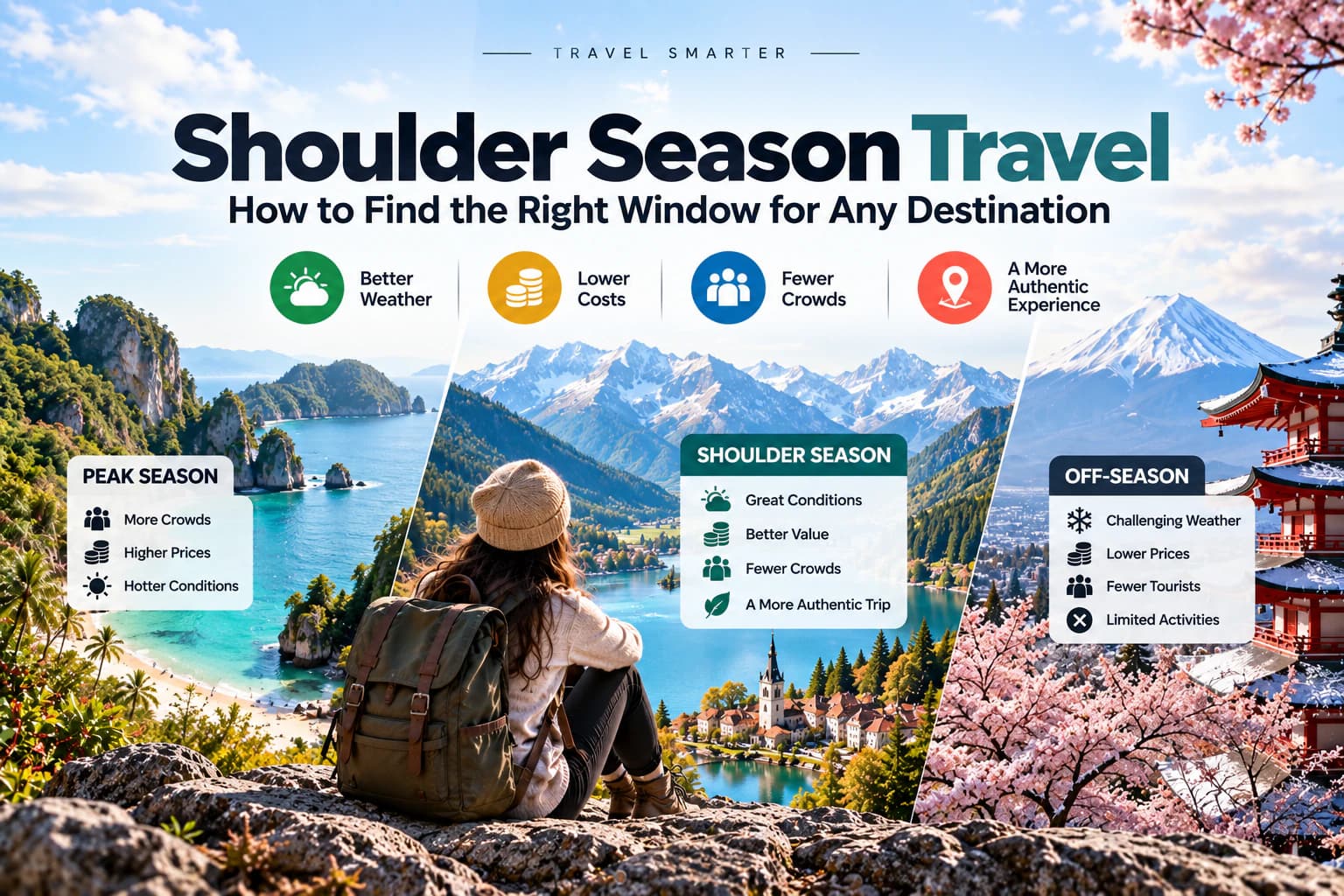
Most shoulder season advice collapses into one line: travel in spring or fall. That works reasonably well if your trip is a city circuit through Western Europe in April. It falls apart the moment your destination runs on a monsoon instead of a temperature swing, sits at 3,200 meters where snow reliability is the whole question, or turns out to be three different climates sharing one country's name on a map.
Shoulder season is a real, useful planning concept, and it is worth building a trip around. But its dates shift with the destination, so there's nothing to memorize once and reuse everywhere. It is the point where a destination's conditions become workable (or genuinely good) and where demand for it softens, and those two things do not always move together. This guide treats shoulder season as a method rather than a date range: what actually drives it, how to work it out for a specific destination, and six real RoamWell case studies where that method produces six different, occasionally uncomfortable, answers.
The 30-second answer
Shoulder season is the window between a destination's peak season and its off-season, where conditions are usually more workable than off-season and demand is usually softer than peak, but "usually" is doing real work in that sentence. It is set by two separate things: the climate driving conditions on the ground, and the calendar driving how many other travelers show up. Sometimes those two align cleanly. Sometimes they don't, and pretending they do is worse than admitting a destination has no clean shoulder window at all.
- It isn't one fixed season. "Spring and fall" works for the Northern Hemisphere's temperate climates. Plenty of destinations run on a completely different calendar.
- Two separate drivers, not one. Climate (temperature, monsoon, snow reliability, storm timing) and demand (school holidays, festivals, booking cycles) can move together or apart.
- Flights and hotels don't move the same amount, and don't always move down. Hopper and Expedia data reported by CNBC found 2026 shoulder-season flight and hotel prices flat to higher than summer in aggregate, even as some individual routes still showed real, if shrinking, year-over-year savings.
- Some destinations simply don't have a clean shoulder window. Rishikesh's best weather overlaps its busiest booking period; that's a real finding, not a gap in the research.
What shoulder season actually means
Shoulder season is the travel-industry term for the period between peak (or high) season and off (or low) season. It is used to describe a destination where conditions have moved past their least favorable point but haven't yet reached full peak demand, or have moved past peak demand while conditions are still reasonable. Travel professionals generally use the term this way: a transition period between a destination's busier peak period and quieter off-peak period, with the exact timing and trade-offs varying by destination and trip type.
That caveat matters more than the definition itself. A ski trip's shoulder season is not a spring trip, because a ski trip needs snow. A beach trip's shoulder season is not a winter trip, because a beach trip needs heat. The term describes a relationship between peak and off-season for a given destination and activity, not a specific set of months that travel writing can hand you once and reuse everywhere.
It is also not an official or regulated term. No single body sets shoulder-season dates the way an airline sets a fare class. It is descriptive shorthand the travel industry uses for a real, recurring pattern, applied destination by destination.
The two axes that decide the window
Most shoulder-season advice treats the concept as a weather question alone: conditions improve or moderate, so book then. That's only half the picture, and the missing half is the reason a clean, comfortable shoulder window doesn't exist everywhere.
Axis one: climate and conditions. This is what most people mean by "shoulder season" instinctively. It covers a temperature transition in a temperate destination, a wet-dry transition in a monsoon or tropical destination, snow reliability and access in a mountain or ski destination, and storm or typhoon timing in destinations exposed to seasonal weather systems. Tropical climates in particular don't run on a spring/fall temperature swing at all; large parts of the tropics shift instead around the seasonal rain belt, which sits roughly over the Northern Hemisphere tropics from around May to September and over the Southern Hemisphere tropics from around November to March, driving opposite dry seasons on either side of the equator during those windows (Wikipedia: Dry season).
Axis two: demand and the calendar. This is the half that gets left out. Peak demand for a destination doesn't only come from good weather. School holidays, national or religious festivals, recurring seasonal draws (a training season, a sporting event, a harvest or wildlife window) and simple booking-cycle momentum can hold demand high on dates that have nothing to do with the destination's climate. A destination's busiest, most expensive period can be its best-weather period rather than a separate peak, which means there's no softer-demand window sitting next to it waiting to be found.
The shoulder season a traveler actually wants sits where these two axes overlap: conditions that are workable, alongside demand that has softened. Where they overlap cleanly, you get a genuine value window, RoamWell's Bali, Kerala backwaters and Western/Central Europe case studies below all work this way. Where they don't overlap, and RoamWell's own Rishikesh guide is direct evidence of this, the destination simply doesn't have that clean shoulder window, no matter how good the weather looks on a chart.
Here's the catch: even where shoulder season genuinely lowers cost, it doesn't lower every cost the same way, and sometimes it doesn't lower cost at all. Recent 2026 pricing data show why you shouldn't assume shoulder-season discounts will appear equally in flights and hotels. CNBC reported Hopper route-level data showing that flight savings versus peak periods had narrowed sharply in several regions, while Expedia's aggregate 2026 comparison found international flights 3.2% more expensive in fall than summer, U.S. top-10-destination hotels 20% higher, and international top-10-destination hotels 0.7% higher (CNBC, August 2026). In other words, shoulder-season value remains destination- and route-specific rather than a universal flight-or-hotel discount. That reporting reflects overall pricing data presented by a U.S.-focused outlet for one specific year, not a single global benchmark, but the underlying point holds generally: flights and accommodation respond to softer demand differently, and treating "shoulder season" as one uniform discount across an entire trip overstates what it actually delivers.
Both axes also depend on where in the world a destination actually sits. There's no single default calendar. A Northern Hemisphere spring-to-fall pattern does not describe the whole planet. Southern Hemisphere destinations run their seasons in reverse, so a temperature-driven shoulder window there tends to fall roughly March to May and September to November instead of April-May and September-October. Destinations near the equator often don't have a meaningful temperature season at all, and shift instead around the wet-dry boundary described above. And demand itself can split by traveler origin: a destination can be in low season for international arrivals while a domestic school holiday or a local festival keeps it busy and priced accordingly for everyone else. None of RoamWell's current destination guides sit in the Southern Hemisphere, so that reversal is described here as a general climate pattern rather than backed by a RoamWell-specific case study, and it's worth treating it that way rather than as a claim this guide has tested directly.
How to find shoulder season for any destination
A repeatable way to work this out for a specific trip, rather than guessing from a generic spring/fall rule:
- Identify the climate transition. Is the destination driven by temperature (a temperate climate), by a wet-dry boundary (a monsoon or tropical climate), by snow reliability and access (a mountain or ski destination), or by a storm or typhoon season (many coastal and tropical regions)? This sets the range of dates where conditions are realistically workable.
- Identify what actually drives peak demand there. Don't assume it's the weather. Check for school-holiday periods (which vary by country and don't share a single global calendar), major festivals or religious observances, and recurring seasonal draws specific to that destination, a training season, a wildlife migration, a sporting or cultural event.
- Check whether the two line up. If the climate-favorable window and the low-demand window overlap, that overlap is your shoulder season. If they don't overlap, the destination may simply not have one, and that's a legitimate finding to plan around rather than something to force.
- Compare flight-price and hotel-price trends separately for your route. Don't assume they move by the same amount or on the same schedule; recent aggregate data suggests they often don't.
- Check local operating schedules for the specific window you're considering. Some attractions, boat operators or tour companies run reduced hours, or suspend service entirely, outside their main season, independent of whether the weather looks fine on paper.
- Weigh the specific trade-off honestly. "A bit more rain than peak season" and "the snow might not be there at all" are both technically shoulder-season trade-offs, but they carry very different risk. Match your tolerance to the actual trade-off, not to the general reputation of the term.
- If there's no real overlap, decide what matters most to you. Cheaper, quieter and better-conditions don't always arrive together. Some trips are worth planning around softer demand even if conditions are a notch below peak; others genuinely need the peak-condition window regardless of the crowd.
Six real trips, six different answers
Applying that method to six real RoamWell destination guides produces six different results, not one pattern repeated six times. Two are clean shoulder-season case studies. One is a useful counter-example showing why an entire country can't get one answer. One shows shoulder season as a genuine gamble rather than a discount. One shows a destination with no clean shoulder window at all. And one shows the classic spring/fall pattern, deliberately scoped to the specific itinerary it actually describes, rather than generalized to an entire continent.
| Destination (RoamWell guide) | Shoulder-type window | Primary driver | Demand pattern | Real trade-off |
|---|---|---|---|---|
| Bali | April, October, November | Wet-dry monsoon transition | Softer than the July-August peak | Occasional showers; less reliably dry than the interior dry-season months |
| Kerala backwaters | October, March | Pre/post-peak transition around the Nov-Feb window | Explicitly the "value" period in the destination's own guide | Slightly less lush than peak, but real, direct price relief |
| Central Vietnam | February to May | Regional weather window ahead of typhoon season | The guide doesn't establish a low-demand window here; treat this as a climate finding only | Doesn't extend to the whole country; North and South run different calendars entirely |
| Almaty | Roughly late February into March for comfort; November and April are riskier edge months | Snow reliability and access | Outside-peak dates can be cheaper, per the destination's own guide, though the savings come with less certainty | Genuine unpredictability, a bigger risk than a simple downgrade from peak |
| Rishikesh | No clean shoulder window | Best-weather months coincide with peak Yoga Teacher Training demand | Demand stays high right through the best-weather period | The opposite of cheaper and quieter; booking 6+ months ahead applies in its best months |
| Western/Central Europe city circuit | April-May, September-October | Temperature transition plus school-holiday calendar | Softer than the June-August peak, specific to this itinerary | Scoped to this circuit; a Mediterranean beach trip or a ski trip elsewhere in Europe runs on a different calendar |
Bali: a clean monsoon-driven shoulder
Bali runs on two seasons rather than four: a dry season from roughly April through October, and a wet season from roughly November through March. RoamWell's Bali guide names April, October and November specifically as shoulder months, transitional weather, better deals than the July-August peak. That's distinct from the dry season's own interior sweet spot (May, June and September in the same guide), which sits inside the dry season proper rather than at its edges. The shoulder months are the transition zone itself, and the honest trade-off there is occasional showers rather than the more reliably dry weather deeper into the dry season.
Kerala backwaters: where the guide says the money actually is
Kerala's backwaters run on a clear peak (November to February, when the water is high and the weather is at its best) and an explicit off-season monsoon (June to September, when rates drop the most but operators can suspend service in bad weather). Between those two sits the case RoamWell's own Kerala backwaters guide makes directly: October and March are named as "the value months," weather still largely on your side, prices dropping noticeably from the peak, more room to negotiate. It's one of the cleanest shoulder-season examples in RoamWell's own destination coverage, stated in those terms by the guide itself rather than inferred from a general date range.
Central Vietnam: the case that breaks the "one country, one season" habit
Vietnam is the destination that proves shoulder season can't be assigned at the country level. RoamWell's Vietnam travel guide lays out three regions running on different, partly conflicting calendars: the north's best months sit around March-April and September-November, the centre's best months run February through May while August through November brings its typhoon season, and the south follows its own separate dry-season pattern. Central Vietnam's February-to-May window is a real, climate-driven finding, a period ahead of the region's typhoon season, but the guide doesn't establish a corresponding low-demand shoulder for it, so this case study is used here for what it actually demonstrates: that "Vietnam" is too broad a unit for a single shoulder-season answer, not as a template to copy onto the rest of the country.
Almaty: shoulder season as a risk, not a discount
Almaty's winter season is built entirely around snow reliability, and its own guide is unusually direct about what that means at the edges. January and February hold the most reliable snowpack; November and April are flagged as variable or unreliable, dependent entirely on that specific year's snowfall and temperatures, according to RoamWell's Almaty winter guide. The closest thing to a comfortable shoulder sits in late February into March, when daylight lengthens and cold eases while the base is, in the guide's own words, "still-workable." That's a trade-off between depth and comfort rather than a straightforward discount. November and April are a genuine gamble on conditions that may not show up at all.
Rishikesh: when weather and demand refuse to separate
Rishikesh is the case that disproves the assumption baked into most shoulder-season advice, that good weather and low demand travel together. RoamWell's Rishikesh yoga guide names February through May and September through November as the town's best-weather stretches, and also names those same windows as peak Yoga Teacher Training season, when bookings need to go in six or more months ahead. There is no separate, quieter window sitting next to the good weather here; the good weather is the busy season. Treating Rishikesh as a "cheap and quiet" shoulder-season destination because a chart says the temperature is pleasant would be a real, avoidable planning mistake.
The Western/Central Europe city circuit: the classic pattern, correctly scoped
This is the destination that actually matches the familiar "spring and fall" advice, though the reason is more specific than that phrase suggests. RoamWell's Europe trip from India guide covers a specific multi-city circuit through Western and Central European capitals, and names April-May and September-October as its shoulder window: milder than the June-August peak, with meaningfully fewer crowds and lower prices, driven by both the seasonal temperature swing and the school-holiday calendar that concentrates family travel into summer. That pattern is real for this specific circuit. It is not a stand-in for "Europe" as a whole; a Mediterranean beach trip, a Nordic summer trip or an Alpine ski trip elsewhere on the same continent runs on an entirely different calendar, driven by different conditions and different demand.
When shoulder season is actually a good deal
The pattern in those three cases is the same: workable conditions plus measurably softer demand, which is the version of shoulder season most generic travel advice is actually describing. Bali, Kerala backwaters and the Western/Central Europe circuit all combine a real, if partial, easing of conditions with lower demand and typically lower prices. These are the destinations where the standard "travel in shoulder season" advice actually holds up once you check it against the destination's own specifics.
When "shoulder season" is not the deal it sounds like
Three failure patterns show up repeatedly, and RoamWell's own destination coverage happens to have a clean example of each. First, a destination where the calendar-driven demand doesn't soften even though conditions improve: Rishikesh's overlapping best-weather and peak-booking window. Second, a destination where the "shoulder" edge is a real risk rather than a mild compromise: Almaty's November and April, where the trade is a coin flip on whether the core activity works at all. Third, a destination broad enough that no single shoulder-season answer applies to it: Vietnam, where a north-to-south trip needs three separate calendars rather than one compromise date range. None of these are reasons to avoid the destinations; they're reasons to check the specific pattern before assuming the general advice applies.
What you actually give up
Depending on which type of shoulder season a destination has, the honest cost side looks different:
- Weather variability. More likely rain, less predictable conditions, or a shorter window of good light and temperature than peak season offers.
- Reduced operating hours or fewer operators running. Some tours, boats and attractions scale back or pause outside their main season, independent of how the weather actually looks on a given day.
- Thinner service in tourist-dependent businesses. Some restaurants, guides and smaller operators reduce staffing or availability once demand drops.
- Genuine unpredictability in condition-dependent trips. Skiing, wildlife viewing, and other activities tied tightly to specific conditions can swing from excellent to unusable within the same nominal "shoulder" window, Almaty's edge months being the clearest example in this guide.
- Occasional closures. Some attractions run maintenance or seasonal closures specifically during lower-demand periods, since that's when closing costs the operator the least revenue.
None of these are reasons to avoid shoulder-season travel. They're the actual price of the lower demand and, often, lower flight cost, and worth weighing against them honestly rather than assuming shoulder season is a pure upgrade with no downside.
Shoulder season vs off-season
The distinction that actually matters for planning: off-season sits further from what most travelers would choose, usually because conditions are at or near their least favorable (heaviest rain, thinnest or least reliable snow, most extreme heat, the highest chance of a specific route or activity being unavailable). Pricing there is typically at its lowest, and that's the honest trade for the least favorable conditions.
Kerala backwaters' own guide makes this distinction concretely: June through September is described as the genuine monsoon off-season, the landscape at its most dramatic and rates at their lowest, but with rougher water and a real chance that operators suspend service in bad weather, a different and larger trade-off than October and March's shoulder-season dip in price. Shoulder season sits between peak and off-season on both axes: usually more workable than off-season, usually less crowded and less expensive than peak, without pushing all the way to either extreme.
A short note on packing
Shoulder-season trips tend to reward flexible layering over a single seasonal wardrobe, since conditions at the edges of a season are, by definition, less predictable than deep in either peak or off-season. A shoulder-season trip to a wet-dry climate like Bali benefits from packing for occasional rain even on a mostly dry-season itinerary; a shoulder-edge trip to a snow destination like Almaty benefits from treating the forecast as provisional rather than settled. This isn't a packing guide on its own, just a reminder that "shoulder season" conditions are, almost by definition, the least fixed part of the year to pack for.
The bottom line
Shoulder season is a genuinely useful way to plan a trip, but it's a method, not a memorized date range. Work out what drives a destination's conditions, work out what drives its demand, and check whether the two overlap before assuming they do. Where they overlap, as in Bali, Kerala backwaters and the Western/Central Europe circuit, that overlap is worth planning a trip around. Where they don't, as in Rishikesh, Almaty or Vietnam, the honest answer is that a clean shoulder window simply isn't there, and pretending otherwise is worse advice than admitting it plainly.
Related reads:
- Kerala Backwaters 2026: Houseboat Guide, Prices & Tips
- 10-Day Bali Itinerary 2026: Route, Real Costs & Visa
- Vietnam Travel Guide 2026: Timing, Visa, Costs, Routes
- Almaty in Winter 2026: Guide, Costs and Itineraries
- Rishikesh Yoga Ashrams 2026: 7 Best, Prices & Aarti
- Europe Trip from India 2026: Budget, Visa & 15-Day Plan
- Is Your Trek Itinerary Too Fast? How to Read an Ascent Profile
Frequently asked questions
Answers to the most common questions about this topic.
Sometimes, but not as one regional answer. Bali has a fairly clean wet-dry shoulder (April, October, November). Vietnam does not have a single national shoulder season at all: its north, centre and south run on different, partly conflicting climate calendars, which is exactly why "Southeast Asia" is too broad a unit to plan around.
In some destinations, yes; it's not a universal rule. April sits in Bali's shoulder window (dry season starting, fewer crowds than peak) and in the RoamWell Europe circuit's spring shoulder window. In Rishikesh, April sits inside the best-weather period that is also peak Yoga Teacher Training demand, so it isn't a quiet month there at all.
Often, in destinations with a Northern Hemisphere autumn transition or a monsoon retreating around that time. It's one of Bali's named shoulder months, one of Kerala backwaters' explicit "value months," and part of the RoamWell Europe circuit's autumn shoulder window. It is not automatically true everywhere; check the specific destination's own pattern rather than assuming October works globally.
It depends on which type of shoulder you're in. A ski destination's shoulder edge can mean unreliable snow rather than a safe discount, as Almaty's own guide flags for its November and April edge months. A hiking or beach trip's shoulder window is usually a milder, more comfortable trade-off. Match the question to the specific activity's actual dependency on conditions.
Decide which one actually matters more for this specific trip before you look at a calendar. A trip built around a specific activity (skiing, a festival, wildlife) should prioritize the climate/access window even if demand stays high. A trip built around a relaxed pace and lower cost can prioritize the demand-soft window even if conditions are a notch below peak.
Filed under
Written by
We research travel, fitness and wellness, and publish what holds up. See our editorial policy.