Europe Trip from India 2026: Budget, Visa & 15-Day Plan
A Europe trip from India on a real budget: Schengen visa costs, a 15-day four-country itinerary, and what to skip.
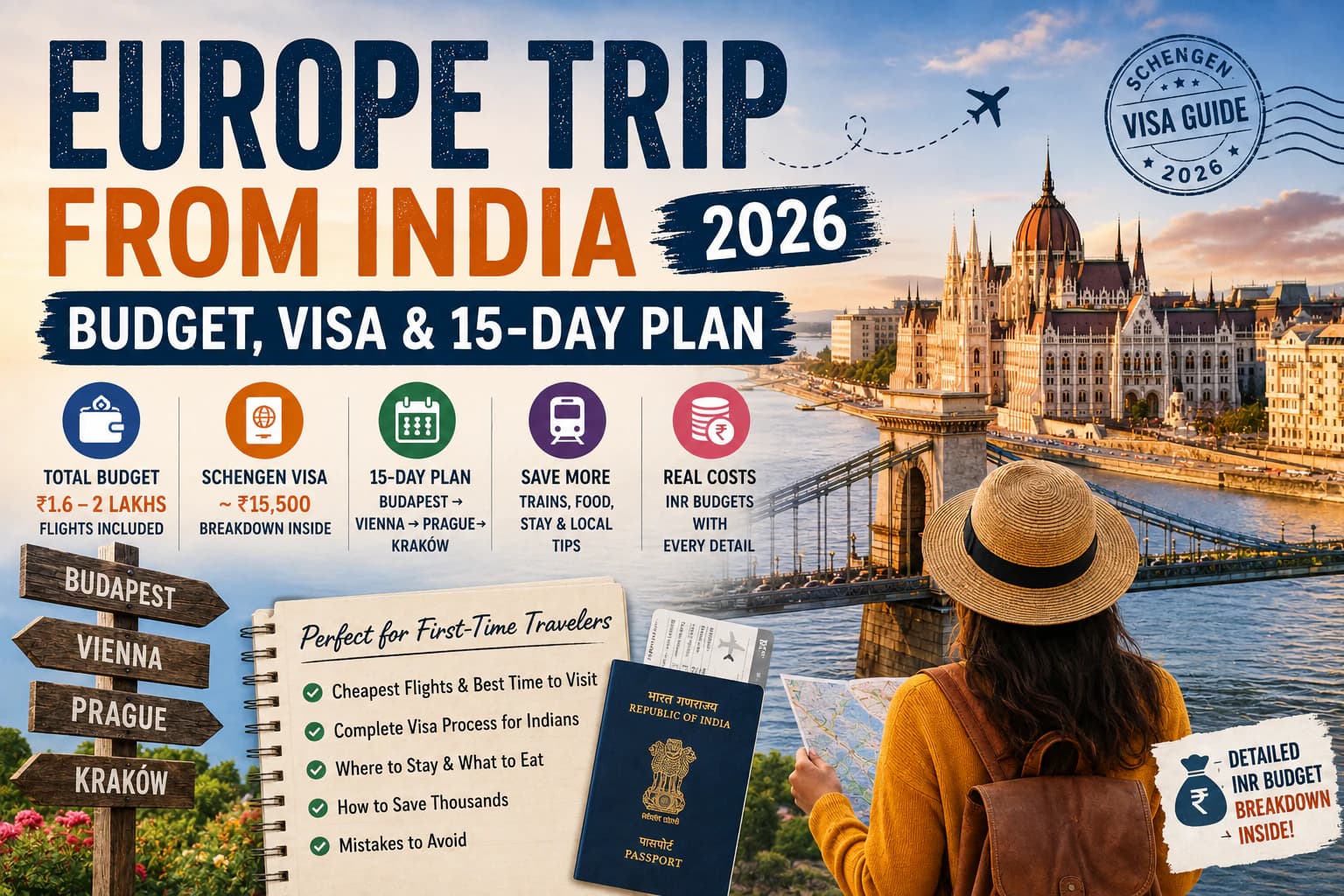
"Europe is too expensive" is the single biggest myth about a Europe trip from India. It isn't true. You can do a legitimate 15-day, four-country trip for under Rs 2 lakhs (about USD 2,400) with flights included, if you know what you're doing.
Here's exactly how, using 2026 Schengen visa costs, realistic INR budgets, and the mistakes that cost Indian travelers thousands.
A note on prices: Flights, accommodation and the Schengen visa fee move with the season, the airline and the exchange rate. Confirm current figures with the airline and your country's VFS centre before booking.
The 30-second answer
A 15-day Europe trip from India costs Rs 1.6-2 lakhs (about USD 1,900-2,400) on a backpacker budget, including flights. Fly into a cheap gateway like Budapest, Prague or Krakow rather than Paris or London, travel in April-May or September-October, and budget around Rs 15,500 for the Schengen visa.
- Backpacker: Rs 1.6-2 lakhs / USD 1,900-2,400 for 15 days, flights included
- Mid-range: Rs 2.5-3.5 lakhs / USD 3,000-4,200
- Visa total: about Rs 15,500: Schengen fee Rs 9,000, VFS Rs 1,500, insurance Rs 5,000
- Cheap gateways: Budapest, Prague, Krakow, not Paris, Amsterdam or London
- Best months: April-May and September-October
- First trip: Central and Eastern Europe stretches the budget furthest
The Schengen visa process (don't skip this)
Schengen visa breakdown (2026)
- Adult fee (18+): €90 (roughly Rs 9,000-9,500). The fee rose from €80 to €90 on 11 June 2024, and the Commission reviews it every three years, so the next review falls due in 2027
- Children 6-12: €45
- Under 6: FREE
- VFS service charge: Rs 1,000-1,500 per application (non-refundable)
- Travel insurance (mandatory): Rs 3,000-5,000
- Total realistic cost: around Rs 13,000-16,000 per person
Note: The consular fee itself is the same across all Schengen states. What varies is the VFS or TLScontact service charge, appointment availability and processing time, so the total you pay differs by which country you apply through.
The 29 Schengen countries (2026)
Austria, Belgium, Bulgaria (added 2025), Croatia, Czech Republic, Denmark, Estonia, Finland, France, Germany, Greece, Hungary, Iceland, Italy, Latvia, Liechtenstein, Lithuania, Luxembourg, Malta, Netherlands, Norway, Poland, Portugal, Romania (added 2025), Slovakia, Slovenia, Spain, Sweden, Switzerland.
NOT Schengen: UK, Ireland, Cyprus (require separate visas).
One visa, 29 countries
A valid Schengen visa generally allows travel within the Schengen area during the visa's validity, subject to its number of entries, validity dates and any territorial limitations shown on the visa sticker. Routine passport checks at internal Schengen borders are generally abolished, but member states can and occasionally do reintroduce temporary border controls (for security events, migration pressure, and similar reasons), so carry your passport when crossing borders regardless. Your visa's own conditions, validity dates, number of entries permitted, and any territorial limitations, still apply, check these on the visa sticker itself.
The 90/180 day rule (critical to understand)
You can stay in Schengen for maximum 90 days within any rolling 180-day period.
Not calendar year, a rolling window.
Example: If you were in Europe January 1-30 (30 days), you can stay only 60 more days between January 30 and July 30.
Overstay consequences: these are decided case by case by the member state that catches it, not by a fixed tariff.
- An entry ban. Under the EU Return Directive, its length is set with regard to the circumstances of the individual case and should not normally exceed five years, though it can run longer for someone considered a serious threat to public policy or national security
- A fine
- Removal from the Schengen area
- A record that will show at your next visa application
No published schedule maps a given overstay to a given ban length, so treat any guide quoting exact durations with caution.
Business travelers with multiple annual trips must track this carefully.
Complete document checklist
Mandatory documents
- Passport: valid for the required period beyond your intended departure, with at least 2 blank pages; check your destination country's current requirements before applying
- 2 passport photos: 35×45mm, white background, no smiling, taken within 6 months
- Visa application form: Signed, complete, honest
- Round-trip flight bookings: Confirmed with PNR (not tickets, but bookings)
- Hotel bookings: For every night of your stay
- Bank statements: Last 6 months, showing a consistent balance and income pattern, there's no single official minimum (see the FAQ on bank balance below)
- ITR (Income Tax Returns): Last 2 years
- Employer NOC: Detailing leave dates + salary slips (last 3 months)
- Travel insurance: Minimum €30,000 medical coverage
- Cover letter: Explaining purpose of visit, itinerary, personal introduction
- VFS appointment receipt
Additional (based on country)
- Marriage certificate (if spouse traveling)
- Property documents (proof of ties to India)
- Business documents (if self-employed)
- Invitation letter (if visiting friends/family)
Cheapest flight strategy
Realistic Delhi/Mumbai to Europe return fares in 2026 range from about Rs 32,000-45,000 to the cheapest Eastern European gateways, up to Rs 55,000-75,000 for Paris or London. The cheapest stretches to fly are late September to early November and February to April.
Booking rules
- Ignore the "best day to book" advice. Fares update continuously, and the day of the week you book makes almost no difference. What moves the price is how far ahead you book and which airport you fly into.
- Fly into cheap gateways. Budapest, Warsaw, Krakow, Lisbon, 30-40% cheaper than Paris/London.
- Use Skyscanner "Everywhere" search. Type city → destination "Everywhere" → sort by price.
- Return via different city. "Multi-city" bookings on Skyscanner often beat two one-ways.
- Best months to fly: Late September to early November, February to April.
- Middle Eastern carriers: Emirates, Qatar, Etihad often good deals via Doha/Dubai.
- 8-12 weeks advance booking. Sweet spot.
Indicative 2026 fares (verify at booking time)
- Delhi → Budapest return: Rs 32,000-45,000
- Mumbai → Lisbon return: Rs 40,000-55,000
- Delhi → Prague return: Rs 38,000-50,000
- Delhi → Paris/London return: Rs 55,000-75,000
Europe trip from India: total 15-day budget breakdown
Budget backpacker (Rs 1,60,000)
- Flights: Rs 40,000
- Trains (Eurail): Rs 25,000
- Accommodation (14 nights hostels): Rs 35,000
- Food (Rs 1,000/day): Rs 15,000
- Activities: Rs 15,000
- Local transport: Rs 8,000
- Visa + insurance: Rs 13,000
- Buffer: Rs 9,000
Mid-range (Rs 2,50,000-3,50,000)
- Flights: Rs 55,000
- Trains + budget flights: Rs 30,000
- Accommodation (mid-range hotels/Airbnb): Rs 90,000
- Food (Rs 2,000/day): Rs 30,000
- Activities: Rs 30,000
- Local transport: Rs 12,000
- Visa + insurance: Rs 15,000
- Buffer: Rs 15,000
Luxury (Rs 5,00,000+)
- Business/premium flights: Rs 1,80,000+
- Luxury hotels: Rs 1,50,000+
- Fine dining: Rs 60,000+
- Private tours: Rs 40,000+
- Everything else: Rs 70,000+
Solo vs traveling as a couple
The figures above are per person. Traveling as a couple typically brings the per-person cost down somewhat, since accommodation, some local transport, and many activities are priced per room or per booking rather than per head. Solo travelers pay the full per-person rate on those shared costs, though hostels price by the bed rather than the room, which keeps solo backpacking relatively affordable. If you're comparing solo pricing on organised tours or cruises specifically, see avoiding the single supplement for how that works.
The 15-day Central Europe itinerary (recommended)
The magic combo: Budapest → Vienna → Prague → Krakow. Central Europe. Cheap. Beautiful. Underrated.
Days 1-4: Budapest
Fly into Budapest (BUD). Cheapest gateway to Europe from Delhi/Mumbai.
Day 1: Arrive. Chill. Ruin bar crawl at night (Szimpla Kert Rs 300 entry).
Day 2: Fisherman's Bastion + Buda Castle + Chain Bridge walk. Rs 500 total.
Day 3: Szechenyi thermal baths (Rs 2,500 for full day). Central Market Hall lunch.
Day 4: Free walking tour + Danube sunset cruise (Rs 1,500). Palinka tasting.
Stay: Wombat's Hostel (Rs 2,000/night private) or Vitae Hostel (Rs 800/night dorm).
Days 5-7: Vienna
3-hour train from Budapest (Rs 2,500 booked ahead).
Day 5: Schönbrunn Palace grounds (free) + Naschmarkt street food.
Day 6: MuseumsQuartier + Belvedere for Klimt's "The Kiss" (Rs 1,800).
Day 7: Coffee house crawl. Central Cafe, Cafe Sacher, Cafe Landtmann.
Stay: Wombat's Vienna (Rs 2,500/night private) or MEININGER Wien (Rs 3,500).
Days 8-11: Prague
4-hour train from Vienna (Rs 3,000).
Day 8: Old Town Square + Astronomical Clock + Charles Bridge sunset.
Day 9: Prague Castle (Rs 800) + Vltava River boat.
Day 10: Day trip to Kutna Hora (bone church, Rs 1,500 return).
Day 11: Vintage shopping + Vysehrad hill.
Stay: Hostel One Home (Rs 900/night) or Miss Sophie's (Rs 2,000).
Days 12-15: Krakow
7-hour train from Prague (Rs 3,500) or Rs 3,000 flight.
Day 12: Main Square + Wawel Castle.
Day 13: Auschwitz-Birkenau day trip (Rs 3,500). Emotionally heavy but essential.
Day 14: Wieliczka Salt Mine (Rs 2,500).
Day 15: Kazimierz Jewish Quarter + fly out.
Stay: Greg & Tom Hostel (Rs 700/night) or Cracow Central Aparthotel (Rs 2,500).
Four cities in 15 days is a full schedule, three to four days per stop with a travel day between each. If that pace feels like too much packing and too little time in any one place, our guide to slower travel planning covers how to decide how many bases a trip this length can actually support.
Where to save (real strategies)
Accommodation
Hostels aren't just for 20-year-olds. Modern private hostel rooms Rs 1,500-2,500/night, cleaner than hotels, have communities you actually meet. If you are traveling alone, it is worth understanding solo accommodation pricing before you book.
Best hostel chains in Central Europe:
- Wombat's (Vienna, Budapest, Munich)
- MEININGER (Berlin, Vienna)
- Hostel One (Prague)
- Generator (Berlin, Barcelona)
Food
- One meal at hostel kitchen (cook your own): saves Rs 800 daily
- Street food lunch: Rs 300-500 (langos, kolache, pierogi)
- One restaurant dinner: Rs 800-1,200 (splurge)
- Never eat 3 restaurant meals daily: doubles budget
Trains vs flights
Central European trains often cheaper than budget flights once you factor luggage. And they drop you in the city center.
Sample train fares:
- Budapest-Vienna: Rs 2,500 (booked ahead)
- Vienna-Prague: Rs 3,000
- Prague-Krakow: Rs 3,500
Free walking tours
Every major European city has them. Tip Rs 500 at the end. You'll learn more in 3 hours than from any museum.
Best free tour companies:
- Sandeman's New Europe
- Guru Walk
- Free Tour Vienna
Museum days
Most museums are free on first Sunday of the month. Time your itinerary. Also: student discounts if under 26 with ID.
Cards worth comparing before you leave
A plain Indian debit or credit card usually carries a forex markup of roughly 3-3.5%, plus a separate ATM withdrawal fee, this adds up over 15 days. Multi-currency travel cards like Wise and Niyo Global are popular alternatives among Indian travelers, built around lower markups and exchange rates closer to the real mid-market rate. Exact fees, free-withdrawal limits and any "zero markup" claims change over time and by transaction type, so verify current terms directly on the provider's site before you commit.
What to actually compare:
- Forex markup: the percentage added on top of the real exchange rate
- ATM withdrawal fees and limits: how many free withdrawals per month, and any cap on amount
- Exchange rate used: real mid-market rate vs a marked-up one
- Card availability: whether it's accepted reliably in every country on your route
- Backup-card requirement: carry at least one second card in case the first is blocked or unsupported somewhere
| Card type | Typical forex markup | ATM fees | Notes |
|---|---|---|---|
| Multi-currency cards (Wise, Niyo Global and similar) | Usually lower, often close to the real exchange rate | Often free up to a monthly limit, then a fee | Verify current terms before travel |
| Standard Indian debit/credit card | Roughly 3-3.5% | Bank + forex fee per withdrawal | Works everywhere but costs more |
Setting up a multi-currency card:
- Sign up online and complete KYC
- Load INR from your Indian bank account
- Get the physical or virtual Euro card (may carry a small one-time issuance fee)
- Withdraw or spend in euros at the card's exchange rate
Getting around Europe
Trains
Central Europe intercity trains:
- Book on national websites: oebb.at (Austria), ceskedrahy.cz (Czech), mavcsoport.hu (Hungary)
- Book 2-4 weeks ahead for cheapest tickets
- Interrail/Eurail passes worth it for 4+ countries in 7-15 days (Rs 25,000-35,000)
Budget airlines
Best European budget carriers:
- Ryanair: cheapest, strict baggage
- Wizz Air: Eastern Europe focus
- EasyJet: Western Europe
- Vueling: Spain focus
Warnings:
- Check baggage limits carefully (Ryanair penalties Rs 5,000+)
- Fly from smaller airports (often distant from city)
- Print boarding pass (Ryanair charges Rs 2,500 to print at gate)
Buses
FlixBus: Cheapest way across Europe. Overnight buses save hotel cost.
- Rs 2,000-4,000 for cross-country routes
- Comfortable seats
- Wi-Fi + power outlets
- Book on flixbus.com
Within cities
- Metro/tram day passes (Rs 500-1,000)
- Google Maps works well everywhere
- Uber not always available; use local apps (Bolt in Eastern Europe)
What actually goes wrong
Missed trains
Book flexible tickets or leave 30-minute buffers.
Pickpockets
Real problem in Rome, Barcelona, Paris, Prague tourist areas. Use money belt in crowds. Never keep phone in back pocket.
Menu-of-the-day scams
In tourist areas, ask for the local price menu, not the tourist one. Some restaurants have separate menus.
Weekend closures
Many restaurants close Sundays and Mondays (especially in smaller cities). Check ahead.
Airport surprises
- Ryanair from distant airports (Ciampino not Fiumicino in Rome)
- Boarding pass printing required
- Strict baggage weight/dimensions
Common visa rejection reasons
Consulates assess your application as a whole. No single missing item guarantees a rejection on its own, but weaknesses across several of these tend to add up:
- Financial documentation that doesn't clearly show sufficient funds for your trip and return, there's no universal minimum balance, but consistency matters
- Inconsistent income or large, unexplained deposits shortly before applying
- Weak ties to India (no clear job, property or family commitments supporting your intent to return)
- Missing or inadequate documentation, this can contribute to a refusal, especially alongside other weak points
- Previous visa violations on record
- Incorrect or inconsistent information on the application form
- Falsified documents, treated as a serious matter by consulates, with lasting consequences for future applications
- Unemployment or unclear income source, without other evidence of financial means
- An itinerary or supporting documents that don't clearly establish your purpose of travel and intention to leave at the end of the trip
- Vague travel plans, a clear day-by-day itinerary genuinely helps
If rejected
- The fee is non-refundable
- There's no official mandatory waiting period before reapplying, but address the specific reasons given in your refusal first
- Consider an experienced visa agent (roughly Rs 3,000-8,000) for a second set of eyes on your reapplication
- Apply through the embassy that matches your actual main destination or first entry point, not whichever one you've heard is "easier", there's no reliable evidence that switching embassies improves your odds
Packing rules
One carry-on backpack (40L max). No checked luggage, saves Rs 12,000+ in Ryanair/Wizz fees.
Clothes
- Layers not sweaters (merino base + light jacket + waterproof shell)
- 5-7 sets basics
- 2 pairs shoes (walking + one nice)
- 1 formal outfit
- Weather-appropriate outerwear
- Modest options for churches (covered shoulders/knees)
Tech
- Universal adapter (Type C/F for continental Europe, Type G for UK)
- Phone charger + fast charger
- Power bank
- E-book reader or paperback
Documents
- Passport + copies (in different bags)
- Visa printout
- Insurance policy
- Hotel bookings printed
- Emergency contacts
- Some INR cash for arrival home
Skip
- Multiple outfits per day
- Heavy books
- Expensive jewelry
- Full-size toiletries
- Umbrellas (buy locally if needed)
The unpopular opinion
Skip Paris and London on your first Europe trip.
Everyone wants them, understandably. But they're the most expensive cities in Europe by 40%, and 90% of what makes Europe special, the medieval towns, affordable cafes, ease of walking, is easier to find in Central Europe or Portugal.
Do Central Europe first. Save Paris for when you have more money and less agenda.
Alternative itineraries
Almaty in Winter (5-7 days)
Not Europe, but it competes for the same budget and skips the Schengen application entirely, Kazakhstan's entry requirements depend on nationality and can change, so check the current official requirements for your passport before booking. Lift passes at Shymbulak run roughly a third of Alpine prices, and it is 3.5 hours from Delhi.
Best for: Snow without the visa queue, or a first winter trip on a tight budget. Full costs and itineraries in the Almaty winter guide.
The Portugal Loop (7-10 days)
Lisbon → Porto → Douro Valley → Sintra. Rs 90,000-1,20,000 all-in.
Best for: Wine lovers, moderate budget, first-timers who want less-touristy.
The Balkan Route (10-14 days)
Croatia → Slovenia → Bosnia → Montenegro (some outside Schengen). Rs 1,20,000-1,60,000.
Best for: Adventure travelers, off-beat, budget-conscious.
The Nordic Splurge (10 days)
Copenhagen → Stockholm → Oslo → Bergen. Rs 3-4 lakhs.
Best for: Bucket-list, second-time Europe travelers, luxury.
Italy Deep-Dive (10 days)
Rome → Florence → Venice → Amalfi. Rs 1,80,000-2,50,000.
Best for: History lovers, food obsessed, couples.
Final rule
Book Europe now. Not "when you save more." The Rs 30,000 fare you're waiting for may not stay available, especially as your travel date approaches. The visa waits for no one.
The most common thing Indian travelers say after finally making the trip they spent years planning: they should have gone five years earlier.
Go this year.
If the Schengen visa or the budget is the blocker this year, our Vietnam travel guide covers a trip at roughly a third of the cost, with an e-visa instead of an embassy appointment.
Related reads:
Frequently asked questions
Answers to the most common questions about this topic.
Steps: (1) Choose country of majority stay for application, (2) Book VFS/BLS appointment 3-4 weeks before travel, (3) Complete online form on embassy portal, (4) Gather documents (passport, photos, itinerary, hotel bookings, flight bookings, bank statements 6 months, ITR 2 years, employer NOC, travel insurance, cover letter), (5) Attend appointment with biometrics, (6) Wait 15-30 working days for decision. Total processing: 3-6 weeks. Apply 6+ weeks before travel.
Sweet spots: April-May (mild spring, moderate crowds) and September-October (autumn, still warm, fewer tourists). Peak season June-August: highest prices, most crowds. Winter (November-February): Christmas markets December, but many attractions closed. Budget-conscious travelers: shoulder season Sept-Oct offers 30-40% savings on flights and hotels.
First-time visitors: minimum 10 days. Sweet spot 15 days across 3-4 countries. 21+ days for 5-6 countries with proper exploration. Under 7 days = too rushed, feels wasted given flight cost. Central Europe (Prague, Budapest, Vienna, Krakow) can be seen in 10-12 days. Western Europe (Paris, Amsterdam, Rome) needs 12-15 days minimum.
Eastern Europe is 30-50% cheaper than Western Europe. Cheapest: Bulgaria, Romania (2025 Schengen entry). Very cheap: Poland (Warsaw, Krakow), Hungary (Budapest), Czech Republic (Prague). Moderate: Portugal (Lisbon, Porto), Greece. Most expensive: Switzerland, Norway, Sweden, Denmark. Skip Paris/Amsterdam/London for first trip if budget-conscious.
There's no single official minimum that applies to every Schengen country. Consulates assess whether you can demonstrate sufficient funds to cover your planned stay and return, taking your itinerary and circumstances into account. The amount you need can therefore vary by destination, trip length and individual circumstances. A consistent financial history and clear source of funds are more useful than trying to hit an arbitrary number. Check your main destination country's current official visa guidance before applying.
Yes for a short 7-8 day trip focused on Eastern Europe. Budget breakdown: Flights Rs 45,000, visa+insurance Rs 12,000, hostels Rs 15,000, food Rs 12,000, transport Rs 8,000, activities Rs 8,000 = Rs 1,00,000 total. Skip: Western Europe expensive countries. Include: Budapest, Krakow, Prague. Book flights 8+ weeks ahead. Use hostels.
Yes, mandatory for Schengen visa. Minimum €30,000 medical coverage required. Cost: Rs 3,000-5,000 for 15 days. Best providers for Indians: TATA AIG, ICICI Lombard, Bajaj Allianz, HDFC ERGO. Compare features: cabin baggage loss, trip cancellation, adventure sports coverage (if hiking/skiing). Don't skip, one hospital day in Europe = Rs 1-2 lakhs. Buy online same-day.
Generally very safe. Main risks: (1) Pickpocketing in tourist areas (Rome, Barcelona, Paris). Use money belt, keep phone secure, (2) Scam artists at popular attractions. Don't sign petitions or accept 'free' bracelets, (3) Menu scams in tourist areas: ask for local price menu, (4) Late-night in isolated areas. Use common sense. Solo female Indian travelers: Europe very safe, huge nomad community especially in Prague, Berlin, Lisbon.
Extensions rare and only for exceptional circumstances (medical emergency, force majeure). Apply at local immigration BEFORE visa expires. Regular tourism = no extension possible. Overstaying brings a fine, removal, and an entry ban set case by case, which under the EU Return Directive should not normally exceed five years. If you want more time: apply for multi-year multiple-entry visa (available after 2-3 successful single-entry uses).
No. UK is NOT part of Schengen. Requires a separate UK visa (Standard Visitor: £135 for six months, roughly Rs 15,000). Apply separately at VFS Global. Processing time: 3 weeks. Documents mostly overlap with Schengen. UK visa allows 6-month stay. Can combine both. Do Schengen countries first, then fly to UK, then home. Ireland also separate visa (though EU member).
Cash: Rs 15,000-20,000 worth of euros for first 3-4 days (accommodation deposits, small purchases). Rest on cards. Total daily budget in Europe: Backpacker Rs 4,000-5,000, Mid-range Rs 7,000-10,000, Luxury Rs 15,000+. Emergency cash Rs 5,000 hidden separately. Don't carry more than Rs 30,000 in cash total, theft risk + declaration limits.
No. A Schengen short-stay tourist visa doesn't authorize employment or paid work in the Schengen area. If you plan to work remotely for a non-European employer while traveling, or want to work in Europe itself, check the specific immigration rules of the country involved rather than assuming a tourist visa covers it, rules and enforcement vary by country and change over time. Portugal and Spain both offer dedicated digital-nomad visas as a legal route for longer working stays. Working without the right visa carries real risk, refusal of entry, deportation and complications with future visas are all possible, but the specific consequence depends on the country and circumstances, so don't rely on a single guaranteed figure.
Filed under
Written by
We research travel, fitness and wellness, and publish what holds up. See our editorial policy.