10-Day Bali Itinerary 2026: Route, Real Costs & Visa
A practical 10 day Bali itinerary: Canggu, Ubud, Nusa Penida and Uluwatu, with real costs, visa rules and best months.
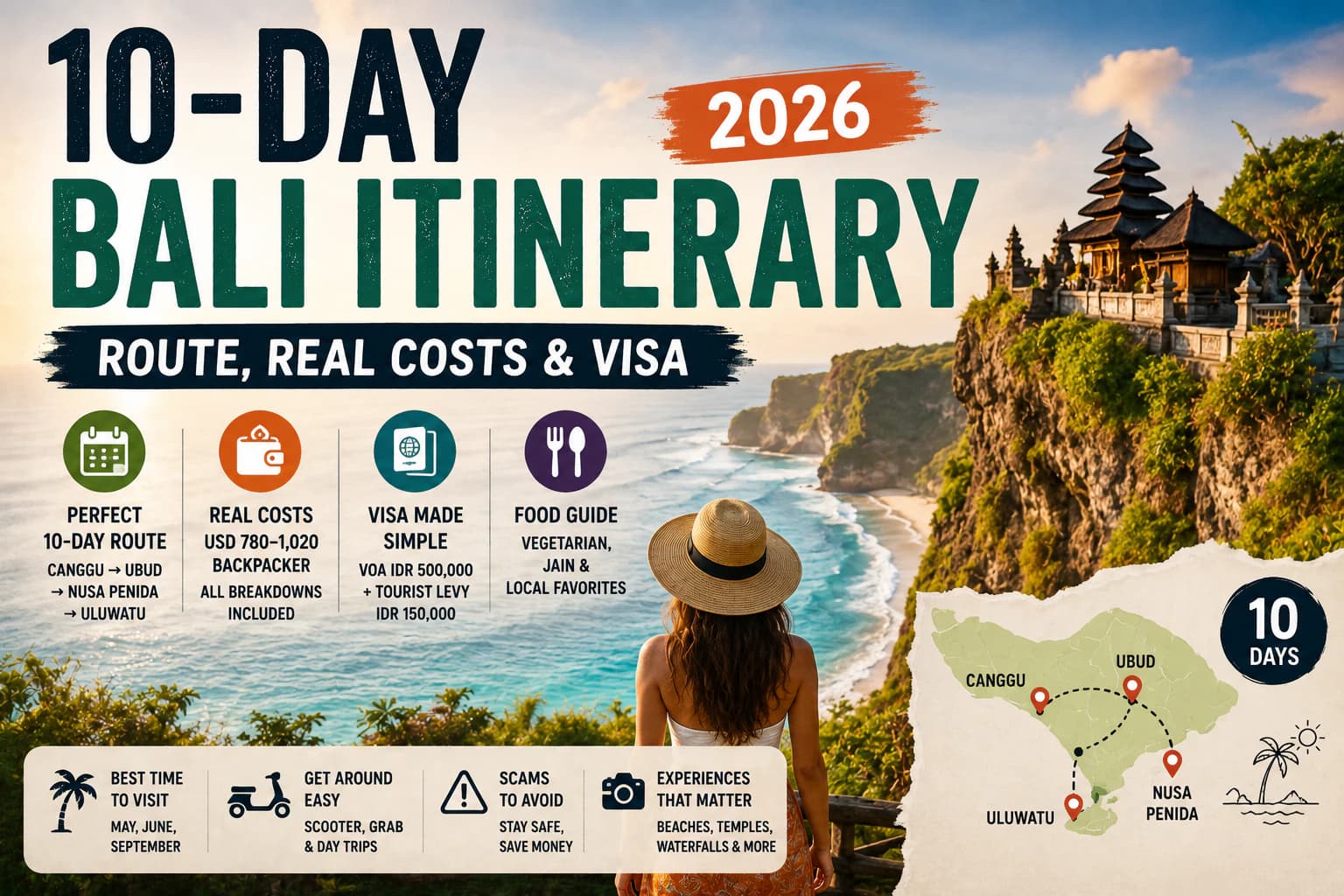
A good 10 day Bali itinerary is harder to find than it should be. Bali is affordable, visa-on-arrival for most nationalities, the food is excellent, and it delivers everything from beach parties to mountain-quiet retreats within a two-hour drive.
What this guide tries to do is set out the whole trip in one place: a day-by-day route across Canggu, Ubud, Nusa Penida and Uluwatu, costed at three budget levels, with the visa and tourist-levy rules, vegetarian and Jain food notes, the scams worth knowing about, and the mistakes that cost people money.
This guide draws on published travel data, official Indonesian entry requirements and current operator pricing. It is researched rather than experiential.
A note on prices and rules: Every price in this guide, flights, accommodation, food, activities, transport, scooter rental, the visa and tourist-levy fees, is an indicative planning figure that moves with season, demand and the exchange rate, not a quote. Visa, extension, overstay and entry rules can also change. Confirm current figures and requirements with the airline, your accommodation, the relevant operator, and Indonesian immigration before booking.
The 30-second answer
The best 10 day Bali itinerary runs Canggu for surf and cafes, Ubud for yoga and culture, Nusa Penida for the island day, then Uluwatu for cliffs and beaches. Budget roughly USD 820-1,020 backpacker or USD 1,200-1,800 mid-range, including return flights from India. Visit in May, June or September.
- Route: Canggu → Ubud → Nusa Penida → Uluwatu (2-3 nights each)
- Budget: USD 820-1,020 (Rs 78,000-97,000) backpacker; USD 1,200-1,800 (Rs 1.15-1.7 lakh) mid-range
- Best months: May, June and September, dry, and before peak crowds
- Entry: visa on arrival ~USD 35 plus ~USD 10 tourist levy
- Getting around: scooter rental, or Grab for longer hops
- Money: a multi-currency travel card beats airport exchange
The essentials first: visa, money and entry
Visa breakdown
- Who needs it: visa on arrival covers around 90 nationalities, including the US, UK, most of Europe, Australia, New Zealand, Canada, Japan, South Korea, China and India. Check the official eligibility list before booking, since it changes by regulation.
- Visa on Arrival (VOA): IDR 500,000 (about USD 33) at Denpasar airport
- e-VOA option: apply online 7-14 days before travel, same cost, faster immigration lane
- Bali Tourist Levy: IDR 150,000 (about USD 10), one-time, separate from the visa, payable through the official Love Bali portal
- Total entry cost: roughly USD 43 per person
- Valid: 30 days
- Extension: once, for another 30 days, at the same IDR 500,000 fee. Since 2025 this needs an in-person visit and biometrics.
Overstay warning
Overstay penalty: IDR 1,000,000 per day (USD 66-72). Adds up fast. Extend visa if you'll stay longer. Don't risk fines or deportation.
Documents required
- Passport with 6 months validity minimum
- 2 blank passport pages
- Return/onward flight ticket
- Hotel booking or Bali address
- Tourist levy receipt (QR code)
- Sometimes: proof of funds (~USD 2,000), travel insurance
Time zone
Bali runs on UTC+8, the same as Singapore, Malaysia and Manila. That is 2 hours 30 minutes ahead of India, so arrivals from South and Southeast Asia barely notice it. From Europe or the Americas, expect genuine jet lag.
Currency
Indonesian Rupiah (IDR). Roughly 15,000 IDR to the US dollar, or about 180 IDR to the Indian rupee.
Total 10-day budget (per person)
Figures below are in US dollars. Indian travellers can read them at roughly Rs 95.5 to the dollar as of August 2026, and the INR totals are in the cost FAQ at the end. Exchange rates move, so treat the rupee figures as approximate.
Budget backpacker (USD 820-1,020)
- Flights: from USD 420
- Accommodation (hostels): USD 145
- Food (warungs): USD 96
- Transport (scooter + Grab): USD 60
- Activities: USD 48
- Visa + misc: USD 48
Mid-range (USD 1,200-1,800)
- Flights: USD 458
- Accommodation (boutique + villas): USD 420
- Food (mix of warungs + cafes): USD 180
- Transport: USD 96
- Activities: USD 180
- Visa + misc: USD 60
Luxury (USD 3,000+)
- Business/premium flights: USD 965+
- Luxury villas: USD 1,085+
- Fine dining: USD 360+
- Private drivers + tours: USD 240+
- Spa + activities: USD 360+
If you are weighing Bali against a longer-haul trip, our Europe trip from India budget guide runs the same arithmetic for a 15-day Central Europe route, including the Schengen visa cost that Bali does not have.
Best time to visit Bali: month by month
Bali has two seasons: Dry (April-October) and Wet (November-March).
| Month | Season | Temp | Character |
|---|---|---|---|
| Jan | Wet | 30°C | Rainy but cheap. Jungle lush. Low crowds. |
| Feb | Wet | 30°C | Romantic, quiet, wellness-focused. |
| Mar | Wet→Dry | 31°C | Nyepi silence day. Prices rising. |
| Apr | Dry starts | 31°C | Clear skies begin. Fewer crowds. |
| May | Dry | 30°C | Sweet spot #1: usually excellent weather, moderate crowds |
| Jun | Dry | 29°C | Sweet spot #2: lovely weather, cultural festivals |
| Jul | Peak | 28°C | Crowded, expensive, world-class surf |
| Aug | Peak | 28°C | Peakest crowds, sunniest month |
| Sep | Dry | 28°C | Sweet spot #3: great weather, crowds thin, best value |
| Oct | Shoulder | 30°C | Transitional. Occasional showers. Good prices. |
| Nov | Wet begins | 31°C | Early rain, budget-friendly, peaceful |
| Dec | Wet/Peak | - | Expensive holiday madness Dec 15+ |
By activity
- Beach + surf: May-September (west coast)
- Diving + snorkeling: April-October (best visibility)
- Hiking (Mt Batur, Mt Agung): May-September
- Waterfalls: December-March (post-rain, dramatic flow)
- Cultural festivals: March-April (Nyepi + Galungan)
- Nightlife: Year-round
Rainy season truth
The rainy season isn't a washout. Rain typically falls 20-30 minutes in afternoon, then clears, though this varies and isn't guaranteed on any given day, check the forecast for your actual travel dates. Landscapes are lush. Prices are often meaningfully lower, sometimes by 30-40% versus peak season, depending on the property and how far ahead you book. Often a good fit for digital nomads and long stays.
If your dates are fixed to December-February and you would rather have snow than rain, the Almaty winter guide covers the opposite trip, visa-free for most nationalities, and cheaper per day than Bali once you are on the ground.
If you would rather stay in Southeast Asia but avoid the wet season entirely, southern Vietnam is dry from December to April. Our Vietnam travel guide covers the regional timing, which is more complicated than Bali's because the country's three regions do not share a season.
Skip: Peak monsoon January mid-day activities.
Nyepi Day: critical warning
Nyepi is Bali's Day of Silence (Hindu New Year). Falls in March or April.
24-hour complete shutdown:
- Airport closes (no flights in/out)
- All traffic stops
- All shops close
- Even lights must be dim
- No outdoor activity permitted
- Tourists must stay inside hotels
If your travel overlaps Nyepi:
- Book a hotel with restaurant service
- Stock snacks day before
- Plan indoor activities
- Nyepi Eve has spectacular Ogoh-Ogoh parades (see them!)
Nyepi 2026: March 19-20 (check exact date each year)
The 10 day Bali itinerary (detailed)
This is a practical route and pacing framework, not a fixed script. Travel times below are typical, but Bali traffic is unpredictable and can push journeys well past these estimates, especially around Canggu, Ubud and Seminyak. Activity availability, weather and your own pace may all mean adjusting the order, so treat the day-by-day breakdown as a starting point to adapt.
Days 1-3: Canggu (surf town)
Fly into Denpasar (DPS). Grab to Canggu, 45 min, USD 6.
Day 1: Recover from flight. Walk to Berawa Beach for sunset. Dinner at Warung Local (authentic warung, USD 2.50 meal).
Day 2: Surf lesson (USD 30 including board and instructor). Lunch at The Loft. Coconut water at La Brisa beach club. Sunset at Old Man's.
Day 3: Morning rice paddy walk. Coffee at Crate. Afternoon at KYND Community (vegan cafe famous globally). Sunset drinks at La Laguna.
Stay:
- Budget: Serenity Eco Guesthouse (USD 18/night)
- Mid: FRii Bali Echo Beach (USD 42/night)
- Luxury: The Lawn Canggu (USD 96/night)
Canggu vibe: Surf-cafe-digital nomad. Cool, casual, slightly gentrified. Best for young couples, solo travelers, digital nomads.
Days 4-6: Ubud (culture + wellness)
1.5-hour drive from Canggu. Private driver USD 10.
Day 4: Check in. Explore Ubud center. Sacred Monkey Forest (USD 5 entry). Sunset at Karsa Kafe overlooking rice fields.
Day 5: Tegallalang rice terraces at sunrise (USD 5). Yoga at The Yoga Barn (USD 10/class, iconic). Balinese massage in evening (USD 14 for 90 min). Dinner at Locavore or Sayuri Healing Food.
Day 6: Waterfall day, Tibumana + Kanto Lampo (private driver USD 18 for full day). Or Tegenungan closer to Ubud.
Stay:
- Budget: Ubud Aura Retreat (USD 22/night)
- Mid: Alaya Ubud (USD 54/night)
- Luxury: Bisma Eight (USD 145/night)
Ubud vibe: Spiritual, jungle, cafes, yoga, art. Best for wellness seekers, couples, solo introspection.
Alternative: Sidemen (if you want quieter)
Sidemen is 1 hour east of Ubud, jungle valley with almost no tourists. Ideal if Ubud feels too commercial. Beautiful rice paddies, misty mornings, tiny villages.
Best for: Deep introverts, digital detox, honeymooners wanting privacy.
Stay 1-2 nights here instead of extra Ubud days.
Days 7-8: Nusa Penida (day trip or overnight)
The island that broke Instagram. Kelingking Beach viewpoint is iconic for a reason.
Fast boat from Sanur: USD 14 return, 30-40 min journey.
Day 7: Full-day west tour (Kelingking + Broken Beach + Angel's Billabong): USD 36 with driver. Snorkeling at Crystal Bay: USD 24.
Day 8: East side less-crowded, Diamond Beach, Atuh Beach. Or day trip to Nusa Lembongan (smaller, calmer alternative to Penida).
Stay: If overnighting, Penida Bambu Green (USD 36/night) or Semabu Hills Hotel (USD 72/night).
Tip: Nusa Penida roads are rough. If you're not confident scooter riding, use a private driver.
Days 9-10: Uluwatu (beach cliffs)
Day 9: Padang Padang Beach morning (yes, from Eat Pray Love). Uluwatu Temple + Kecak Fire Dance at sunset (USD 10 entry). Dinner at Warung Local Uluwatu.
Day 10: Beach club (Ulu Cliffhouse or Karma Beach, USD 18 minimum spend). Fly out evening.
Stay:
- Budget: Ulu Nomad Villas (USD 36/night)
- Mid: Bingin Inn (USD 66/night)
- Luxury: The Anvaya Beach Resort (USD 145/night)
Uluwatu vibe: Cliff-side beaches, surf, sunset views, boho luxury. Best for beach lovers, honeymooners.
Areas of Bali: full comparison
| Area | Vibe | Best For | Skip If |
|---|---|---|---|
| Canggu | Surf/cafe/nomad | Young couples, nomads | You want quiet |
| Ubud | Culture/wellness | Wellness, yoga, first-timers | You need beach |
| Uluwatu | Cliffs/luxury/surf | Beach lovers, honeymoons | Party-focused |
| Seminyak | Upscale beach | Fine dining, beach clubs | Budget travel |
| Kuta | Party central | Nightlife, budget | Cultural travel |
| Nusa Dua | Family resort | Kids, luxury families | Backpackers |
| Sanur | Family beach | Older couples, kids | Nightlife seekers |
| Sidemen | Rural jungle | Deep escape, introverts | You want cafes |
| Nusa Penida | Untouched island | Adventure, Instagram | Full comfort |
| Amed | Diving | Divers, quiet | Surf/party |
| Munduk | Highland jungle | Off-beat, hikers | Beach seekers |
Getting around Bali
Scooter rental (best for freedom)
- Cost: roughly USD 5/day (around USD 60/month long-term), varies by shop and season
- License: an International Driving Permit is generally required under Indonesian law to ride legally. Many rental shops don't check for tourists in practice, but police spot checks happen, and going without one can mean a fine. Get an IDP from your own licensing authority before you travel, and check current requirements.
- Insurance: rental shops often include basic third-party cover, and offer fuller cover for an extra daily fee, but exactly what's covered varies by shop, so ask what's included and excluded, and check separately whether your travel insurance policy covers scooter accidents at all.
- Safety: Always wear a helmet. Bali roads have unpredictable traffic. Take it slow.
- Where to rent: Local shops charge USD 3.60/day. Bigger operators (like Bali Scooter Rentals) USD 6/day but safer.
Grab / GoJek (Bali's Uber)
- Cost: USD 0.70-3.60 for 10-30 km rides
- Safe, reliable, English interface
- Default option if you can't ride scooter
- Warning: Some areas (Uluwatu, Ubud center) restrict GoJek/Grab pickup, often due to pressure from local taxi and ojek operators competing for fares, so you may need to walk a few minutes to reach a pickup spot.
Private drivers (best for groups)
- Full day 8 hours: USD 48-60
- Includes: driver, car, fuel (not entry fees)
- Book: Hotel concierge or apps like MyBaliTrips
- Great for: Groups of 3-4 sharing cost, elderly, families
Blue Bird taxi (metered, reliable)
- Use meter always
- Book on the Bluebird app or call
- Cheaper than Grab for airport trips
Airport transfer
- Grab from airport: USD 6-14 depending on destination
- Pre-booked hotel transfer: USD 18-30 (more expensive but reliable)
- Warning: Unofficial touts at the exit often quote inflated fares, sometimes well above USD 30-48. Skip them and use Grab or your pre-booked transfer.
Food guide
Must-try Balinese foods
- Nasi Campur: mixed rice plate with 4-5 sides. USD 1.20-2.40 at warungs.
- Babi Guling: suckling pig (skip for veg). Ibu Oka Ubud is famous.
- Nasi Goreng: fried rice. Available everywhere, USD 1.20-3.60.
- Mie Goreng: fried noodles.
- Bebek Betutu: slow-roasted duck (non-veg).
- Sate Lilit: Balinese fish satay (non-veg).
- Gado-Gado: vegetable salad with peanut sauce (100% veg-friendly).
- Kopi Bali: the coffee is exceptional and cheap.
For vegetarians
Bali has huge veg cafe scene, especially Ubud + Canggu.
Ubud gems:
- Zest: vegan fine dining
- Sayuri Healing Food: Ayurvedic-inspired veg
- Alchemy: famous vegan raw food cafe
- Kismet: Buddha bowls, plant-based
Canggu gems:
- KYND Community: Instagram-famous vegan
- The Shady Shack: plant-based
- Peloton Supershop: cyclist-friendly veg
For Jain travelers (no onion/garlic)
Many Ubud wellness cafes cater to Jain principles. Communicate clearly: "Ayurvedic style, no onion, no garlic, no root vegetables." Zest and Sayuri accommodate. Avoid warungs (too spice-heavy without customization).
Indian food
- Om Wine Bar (Seminyak), decent North Indian
- Indian by Nature (Seminyak, Canggu), thali, biryani
- Ganesha (Sanur), South Indian
- Balinese kitchens happily make roti + dal on request in warungs
Skip
Overpriced beach clubs charging USD 10 for pasta or USD 7 for a smoothie. Warungs deliver better food for a tenth.
Money and cards
Best cards to bring
- Wise multi-currency card: real exchange rate, no ATM markup, available from most countries. Best overall.
- Revolut or an equivalent local travel card: similar benefits depending on where you bank.
- From India specifically: Niyo Global and IDFC Wealth both work well, with little to no forex markup.
- Backup: one additional card plus about USD 120 in cash for emergencies.
ATM strategy
- Use only bank ATMs (BCA, Mandiri, BNI, BRI)
- Avoid unmarked kiosks in tourist areas (skimming risk)
- Maximum single withdrawal: usually IDR 1,250,000-3,000,000
- Cover keypad when entering PIN
Money changers
- Use only official ones with clear signage
- Central Kuta Money Exchange: trusted chain
- BMC Money Changer: reliable
- Never trust street changers offering "best rate"
- Count money before leaving counter
- Get receipt
Common scam
Money changer promises great rate. Counts money in front of you. Then quickly re-counts and short-changes. Always count yourself twice before leaving.
Cultural etiquette
Bali is deeply Hindu and spiritual. Respecting culture goes a long way.
Temple visits
- Wear a sarong (rent USD 0.25 at temple entry)
- Cover shoulders and knees
- Do not enter sacred inner sanctums
- Never touch offerings on the ground (canang sari)
- Menstruating women traditionally avoid temples (own choice)
- Enter with right foot first
Daily observances
- Canang sari: small offerings on ground in front of shops/homes. Never step on them. Walk around.
- Head touching: head is sacred. Never touch someone's head casually.
- Feet: feet are lowest chakra. Never point feet at religious objects or people.
- Right hand for giving/receiving (left is considered unclean).
Photography
- Ask permission before photographing locals, especially in temple contexts
- Some ceremonies restricted, respect signs
- Don't stand higher than a priest during ceremonies
Bali scams: protect yourself
1. Scooter damage scam
Rent scooter. Return it. Owner claims "hidden damage": charges USD 60-180.
Prevention: Photograph/video every angle of scooter BEFORE leaving. Point out any existing scratches to owner. Get written confirmation.
2. Fake taxi at airport
Guys in "official-looking" uniforms offering rides. Charge 3-5× normal rate.
Prevention: Use Grab app or pre-booked hotel transfer only.
3. Money changer short-change
See above.
4. Boat operator fee creep
Advertise "Nusa Penida day trip USD 24." On arrival: "But entry fee is USD 18 extra. Beach fee USD 6. Guide fee USD 10."
Prevention: Book through reputable operators (Bali Booking, Klook). Get all-inclusive quote in writing.
5. Massage extras
Cheap massage advertised. During service: "For extra USD 6 I do special massage."
Prevention: Go to established spas (Bodyworks, The Nest). Not roadside "massage."
6. ATM skimming
Card skimmed at ATM. Money withdrawn later.
Prevention: Only use bank ATMs. Cover PIN. Check ATM for suspicious attachments.
7. Sunbed rental
Beach club chairs "free" but require USD 10 "minimum food/drink." Enter, they present bill for USD 30 anyway.
Prevention: Confirm minimum spend before sitting down.
For solo travelers
Solo female travelers
- Bali is a popular destination for solo female travellers, with normal travel precautions still worth taking
- Ubud has huge international female nomad community
- Yoga studios are natural meeting places
- Hostels (Roam, Tribal Bali) offer female-only dorms
- Skip: Kuta night clubs alone after 2 AM
- Wear "modest but comfortable", Bali is chill
- Grab is generally a safer choice than an unmarked taxi at night
Solo male travelers
- Canggu is nomad-heavy, you'll meet people
- Hostels + surf classes = instant friends
- Uluwatu quieter, better for reflection
- Ubud yoga = friendly community
Best solo activities
- Yoga retreats (2-7 day)
- Surf schools (group classes)
- Cooking classes
- Bali temple tours
- Volcano hikes (Mt Batur sunrise trek)
For families
Best areas
- Sanur: calm beach, family resorts, medical facilities
- Nusa Dua: luxury family resorts, safe beaches
- Ubud: culture + jungle activities
Activities that work with kids
- Bali Zoo, Bali Bird Park
- Waterbom Bali (Kuta), water park
- Rice paddy walks
- Cooking classes (kid-friendly)
- Elephant sanctuary Ubud (marketed as ethical/no-rides, worth checking current practices and reviews before booking)
Skip with kids
- Uluwatu (steep cliffs, dangerous currents)
- Kuta nightlife areas
- Nusa Penida (rough boat, difficult roads)
Family budget
USD 2,400-4,800 for family of 4, 10 days, mid-range comfort.
For honeymoons
Best combinations
Ubud (3-4 nights jungle romance) + Uluwatu (3-4 nights cliff-top luxury).
Splurges worth it
- Private pool villa in Ubud (USD 96-300/night)
- Rock Bar or Sundara sunset dinner (USD 48-96)
- Couples spa at Como Shambhala (USD 96)
- Private beach dinner at Uluwatu resort
- Bali cooking class for two
Budget honeymoon
USD 1,800-3,000 per couple all-inclusive for 7-10 days. Doable and romantic.
Health and safety
Medical facilities
- BIMC Hospital (Kuta, Nusa Dua), well-regarded, English-speaking
- Siloam Hospital (Denpasar), one of the larger hospitals, broad range of services
- Roughly USD 180-360 per day inpatient as an indicative range, actual cost depends on the facility and treatment
- Travel insurance is non-negotiable
Vaccinations recommended
- Hepatitis A and B (typhoid + tetanus routine)
- Japanese encephalitis if extended stay
- Rabies pre-exposure if visiting rural areas
- Consult travel medicine specialist 4-6 weeks before
Bali belly prevention
- Bottled water only (including brushing teeth)
- No ice in local warungs
- Peel your own fruits
- Freshly cooked hot food only
- Probiotics daily starting week before travel
- Imodium + ORS in kit
Volcanic activity
Mt Agung has had periods of volcanic activity in recent years. Monitor news before booking. Flights sometimes cancelled during eruptions. Many travel insurance policies cover volcanic-related delays, but check your specific policy's terms and exclusions rather than assuming.
Packing list
Essentials
- Passport (6 months validity)
- Visa/VOA receipt
- Tourist levy QR code
- Travel insurance policy
- Flight tickets (printed backup)
- Hotel bookings printed
- 2 credit/debit cards plus a multi-currency travel card
- IDP for scooter
- ID copy (leave passport in hotel safe)
Clothes
- Light cotton clothing (5-7 sets)
- 2-3 swimwear
- 1 light jacket (Ubud evenings)
- 1 sarong for temples
- Modest set for cultural sites
- Walking sandals + flip flops
- Yoga clothes if Ubud
- 1 formal outfit if fine dining
Toiletries
- Sunblock (expensive locally)
- Reef-safe sunscreen for snorkeling
- Insect repellent
- Basic first aid + Imodium + ORS + probiotics
- Own toothbrush (dry it in sun)
- Feminine hygiene (available but limited brands)
Tech
- Universal adapter (Type C/F)
- Phone charger
- Power bank
- eSIM (Airalo, activate before landing)
- Refillable water bottle
- Camera / GoPro if desired
Mistakes to avoid
- Overpacking Ubud: 2-3 nights max, gets same-y
- Booking villa without checking exact location: "Canggu" can be 20 min from anywhere useful
- Not renting scooter: doubles your freedom if comfortable
- Eating at Instagram cafes: overpriced, mediocre
- Skipping insurance: regrettable one accident away
- Trusting unofficial airport taxi touts
- Not photographing scooter before rental
- Ignoring Nyepi dates: get stuck without food/movement
- Exchanging money at shady changers
- Not respecting temple etiquette
- Drinking tap water even once
- Booking cheap boat trips with hidden fees
Final tips
Bali's charm is that USD 1,200 gets you a genuinely comfortable 10 days, and USD 2,400 stretches to something properly indulgent.
Book the boutique villa. Take the surfing lesson. Get the massage every third day. Say yes to the extra waterfall. In Bali, a little extra budget tends to go a long way.
Book flights well in advance where you can. Get travel insurance. Pack light. Learn "terima kasih." Photograph the scooter.
Go when it fits your calendar and budget.
Related reads:
Frequently asked questions
Answers to the most common questions about this topic.
For 10 days per person: budget backpacker Rs 78,000-97,000 (USD 820-1,020), mid-range Rs 1.15-1.7 lakh (USD 1,200-1,800), luxury villas Rs 2.9-5.7 lakh (USD 3,000-6,000+). Return flights from India run roughly Rs 40,000-63,000 (USD 420-660) depending on season. Daily on-ground costs are about USD 30 for a backpacker and USD 180+ at the luxury end.
Minimum 7 days for a genuine experience. 10 days is the sweet spot for first-timers (Canggu + Ubud + Nusa Penida + Uluwatu). 14+ days lets you add lesser-visited areas like Sidemen, Amed, or Munduk. Under 5 days feels rushed, Bali's charm requires slowing down.
Generally yes. Petty theft is rare and violent crime against visitors is uncommon. Scooter accidents are the biggest actual risk. Monkey theft at temples and food poisoning ('Bali belly') are real but avoidable. Solo female travellers consistently rate Bali among Asia's easier destinations, helped by the size of the digital nomad and wellness communities. Skip nightclubs alone after 2 AM as a general precaution.
Yes, though ATM withdrawals typically cost 3-5% once forex fees and bank charges are counted. A multi-currency travel card avoids most of that: Wise works from most countries at the real exchange rate with no ATM markup, and Indian travellers also have Niyo Global and IDFC Wealth. Over a ten-day trip the difference runs to roughly USD 60-96 against a standard debit card. Use BCA or Mandiri ATMs and avoid unmarked machines, which carry a skimming risk.
Traveler's diarrhea from bacteria in local food/water. Avoid: tap water (bottled only), ice in local warungs, uncooked salads/fruits you can't peel, street food not freshly cooked hot. Bring probiotics + Imodium + ORS in your kit. If it hits: hydrate, rest, and skip dairy for a day, mild cases often improve within a couple of days, though this varies by person and cause. If persistent (3+ days) or with fever/blood, see a doctor.
Yes, once, for another 30 days. Cost: IDR 500,000 (USD 33-36). Apply at least 7 days before expiry at Immigration office in Denpasar or Ubud, or hire a licensed agent (USD 48-60 fee handles paperwork). Requires biometrics and photo. Maximum total stay = 60 days per entry.
No. Never drink tap water. Always use bottled water, including for brushing teeth. Sealed bottled water costs USD 0.20-0.50 (10,000-20,000 IDR). Refillable water stations exist in cafes and yoga studios (bring your own bottle). Ice in tourist-oriented restaurants is usually filtered, safe. Ice from small warungs may not be. Check.
Strongly recommended. Scooter accidents happen. Bali belly can occasionally require IV drips. Volcanic activity can strand you. Providers travellers commonly consider include SafetyWing (roughly USD 42 for 10 days) and World Nomads (typically higher cost), but check each policy's current terms for what is and isn't covered, including scooter-accident exclusions, rather than assuming. Don't travel without some form of cover. Uninsured medical evacuation from Bali to Singapore can reportedly run to USD 48,000 or more, treat that as an indicative figure rather than a fixed price.
Bahasa Indonesian officially, Balinese locally. English is widely spoken in tourist areas. Learn 3 phrases: 'Terima kasih' (thank you), 'Permisi' (excuse me), 'Berapa harganya?' (how much?). Locals appreciate any Indonesian effort. Grab/GoJek apps have English interface. Menus in tourist areas are in English.
Bali offers several experiences in one trip: beach + surf, wellness + yoga (Ubud), luxury (Seminyak), adventure (Nusa Penida, Mt Batur), spirituality (temples). Comparable places: Phuket (more party-focused), Krabi (more beach-focused), Goa (India). Bali's mix of experiences within a compact island is a real differentiator. Prices are often noticeably lower than Thailand for a broadly comparable standard, though this varies by category, season and how you book.
Indonesian Rupiah (IDR), at roughly 15,000 IDR to the US dollar and about 180 IDR to the Indian rupee. Airport exchange counters give poor rates almost everywhere, so avoid changing large amounts before you fly. Best options: a multi-currency card such as Wise withdrawing at the real rate, or official money changers with clear signage (Central Kuta Money Exchange, BMC Money Changer). Avoid shops advertising a 'special rate', and never change more than you need for three or four days at once.
Filed under
Written by
We research travel, fitness and wellness, and publish what holds up. See our editorial policy.