Almaty in Winter 2026: Guide, Costs and Itineraries
Almaty in winter: Shymbulak lift passes from $31, month-by-month snow, real budgets and 5 & 7-day itineraries.
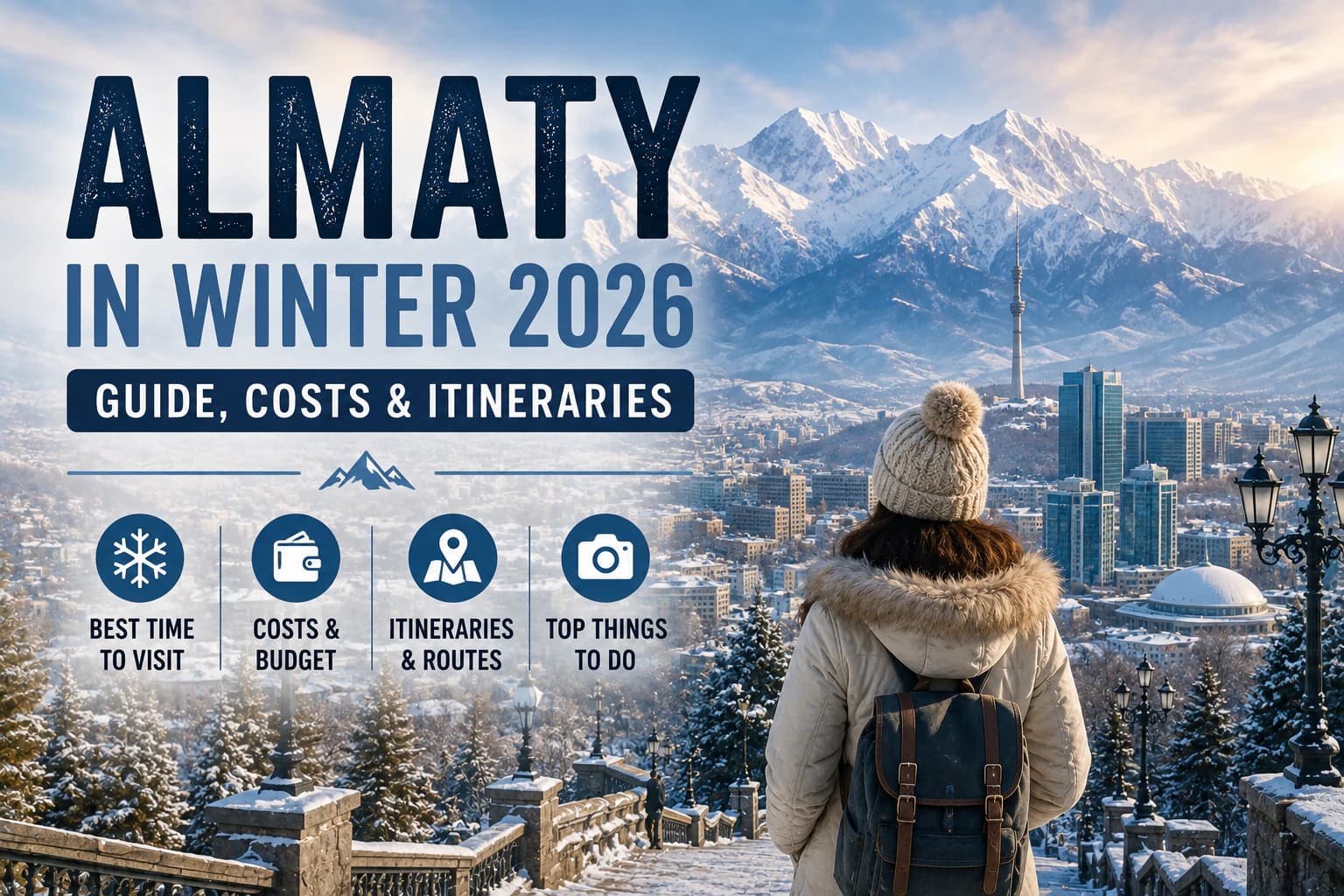
Almaty in winter is one of the more affordable ways to combine a major city with a serious mountain destination, and most travellers still have not registered that. Bookings to the city have surged as visa rules loosened and direct flights multiplied, yet the guides that rank for it are largely listicles and tour-package pages.
This guide covers the practical decisions instead: what a winter trip actually costs, which months hold snow, how the visa rules differ by nationality, what breaks when the temperature drops, and how to structure five or seven days without wasting one to weather.
A note on prices and rules: Costs, lift-pass rates, visa terms and transport fares change over time. Every figure here is sourced at the time of writing, but confirm current details with the official provider, the resort, the airline, or the Kazakhstan migration service, before booking.
The 30-second answer
Almaty in winter is at its best from January to February, when the snowpack is most reliable. Shymbulak day lift passes cost about USD 31-33: roughly a third of Alpine prices, and around 50 nationalities enter Kazakhstan visa-free. Budget USD 38-106 per day, plus USD 40-55 on each ski day.
- Best months: January and February for snow; late February onward for beginners and longer daylight
- Lift pass: ~USD 31-33 per day at Shymbulak, against EUR 48-108 across the Alps
- Visa: ~50 nationalities visa-free for 30 days (Indian passports: 14 days)
- Daily budget: USD 38 budget, USD 89-106 mid-range, USD 300+ luxury
- Trip length: 5 days for a first visit, 7 to add Charyn Canyon
- Pack for: -25 degrees C on the mountain, not the city forecast
Why Almaty in winter
The argument is mostly economic, and it holds up against real numbers.
| Resort | Country | Day lift pass |
|---|---|---|
| Shymbulak | Kazakhstan | ~USD 31-33 |
| Espace Diamant | France | EUR 47.50 |
| Austrian resorts (range) | Austria | EUR 48-78 |
| Niseko United | Japan | JPY 9,800 (regular season) |
| Swiss average | Switzerland | EUR 78.92 |
| Zermatt | Switzerland | EUR 108 |
Shymbulak is not a budget compromise resort, either. It is one of the largest and most developed ski resorts in Central Asia, sits at 3,200 m, and holds the longest season of any Kazakh resort. It is also about 30 minutes from a city of two million, which is unusual, most resorts at this standard require a transfer of several hours from the nearest major airport.
The second argument is access. Kazakhstan waives visas for roughly 50 nationalities. For eligible nationalities, visa-free entry removes the need for a visa application and its associated processing, which shapes trips to many comparable destinations.
The honest counterweight: international airfare. If you live within driving distance of the Alps, Almaty will not be cheaper overall. The saving is real for travellers flying long-haul regardless, or flying from the Gulf, South Asia or Central and Eastern Europe.
Who should visit Almaty in winter
- Skiers and snowboarders looking for a low cost per day on the mountain
- Travellers from India, the Gulf and Southeast Asia for whom this is one of the more accessible options for reliable snow, 3.5 hours from Delhi, 4 from Dubai, 6 from Singapore
- Anyone wanting a city-plus-mountain trip rather than an isolated resort, since Almaty offers museums, markets and restaurants alongside the slopes
- Beginners with a flexible schedule, provided they come in late February or March rather than deep January
- Travellers who value visa simplicity, particularly those tired of Schengen appointment queues
Who should skip it
Being direct about this saves people a wasted trip.
- Travellers whose main goal is the alpine lakes and hiking. Big Almaty Lake, the Kolsai Lakes and Charyn's trails are all better from spring to autumn. Winter access ranges from limited to genuinely difficult.
- Anyone who dislikes short days. January offers roughly 9 to 9.4 hours of daylight. Sightseeing time is compressed.
- Families with very young children. Mountain temperatures near -25 degrees C and an altitude of 3,200 m are a demanding combination for small children.
- Travellers with cardiovascular or respiratory conditions who have not discussed altitude with a doctor.
- Anyone on a tight three-day schedule hoping to see both the city and the far canyons. Winter road conditions do not reliably permit it.
Entry requirements: who needs a visa
Kazakhstan has operated a unilateral visa-free regime since January 2022 covering citizens of around 50 countries.
| Passport | Visa-free stay | Cap |
|---|---|---|
| USA, UK, Canada, Australia, Japan, Singapore, New Zealand, and most EU states | 30 days per entry | 90 days in any 180 |
| India | 14 days per entry | 42 days in any 180 |
Entry rules change more often than most travellers expect, and being turned back at the border is an expensive mistake. Confirm your own nationality's status on the official Kazakhstan migration service shortly before you travel rather than relying on any third-party list, including this one.
Getting there: flights
Almaty (ALA) is better connected than its reputation suggests, with direct service from several major hubs.
| From | Direct? | Notes |
|---|---|---|
| London | Yes | Air Astana, around 9h20 |
| Frankfurt | Yes | Air Astana and Lufthansa |
| Istanbul | Yes | Air Astana, year-round |
| Dubai / Sharjah | Yes | Air Arabia; Air Astana seasonal |
| Delhi | Yes | Around 3.5 hours |
For cities without a direct route, Istanbul and Frankfurt are the usual connecting points, with Turkish Airlines and Lufthansa both running frequent service. London has direct connections to Almaty, with schedules varying by season and airline. Schedules for the direct long-haul routes are published by Air Astana, which operates most of them.
Long-haul arrivals should plan for the time-zone shift rather than absorbing it on day one, a wasted first day is expensive on a five-day trip. Our jet lag protocol covers how to compress the adjustment.
Best time to visit Almaty: snow reliability month by month
The best time to visit Almaty for snow is January and February, when the snowpack is most reliable. March trades depth for warmer, longer days. Month by month:
| Month | Snow reliability | What to expect |
|---|---|---|
| November | Variable | Mountain snow usually arrives late October to early November. Resort opening depends on the year. |
| December | Good | Season generally underway. City averages about -5.8 degrees C. Around 11 snowfall days. |
| January | Best | Most reliable snowpack. Coldest month, city average about -7.3 degrees C, roughly 11 snowfall days, shortest daylight. |
| February | Best | Deep base plus lengthening days. City average about -4.5 degrees C. Charyn Canyon at its most photogenic under snow. |
| March | Declining but usable | Season generally runs to early March. City average about -1.1 degrees C. Warmer and more forgiving for beginners. |
| April | Unreliable | Depends entirely on that year's snowfall and temperatures. |
If snow certainty is the priority, book January or February. If comfort matters more than perfect conditions, late February into March gives longer daylight and less severe cold with a still-workable base.
Weather: what to actually expect
The single most important fact is the gap between city and mountain. The mountains run roughly 10-15 degrees C colder than Almaty, so a city forecast of -5 degrees C can mean -20 degrees C at the top of the lifts, and Shymbulak in January can reach -25 degrees C.
City averages through the winter:
- December: about -5.8 degrees C, ranging from -9.9 to -1.7
- January: about -7.3 degrees C, with daytime highs near 0.7 and lows around -8.4
- February: about -4.5 degrees C, ranging from -9.1 to +0.2
- March: about -1.1 degrees C
Daylight sits around 9 to 9.4 hours in deep winter. Plan excursions to start early; a 9 am departure for Charyn Canyon leaves less usable daylight than the same departure would in summer.
Shymbulak Ski Resort
The centrepiece of an Almaty winter trip, and the reason most visitors come.
The essentials
- Altitude: about 3,200 m
- Distance from the city: roughly 30 minutes, reachable by public transport
- Season: generally December to early March, sometimes opening in late November
- Standing: one of the largest and most developed ski resorts in Central Asia, with the longest season in Kazakhstan
Costs
| Item | Price (KZT) | Approx. USD |
|---|---|---|
| Adult day lift pass | 15,500-17,500 | 31-33 |
| Ski or snowboard rental, per day | 5,000-7,000 | 10-20 |
| Full service package | up to 30,000 | up to 62 |
| Season pass, adult | ~300,000 | ~600 |
| Season pass, ages 11-23 | ~220,000 | ~440 |
| Season pass, child | ~150,000 | ~300 |
A realistic all-in ski day, with pass and rental, lands around USD 40-55 before food and transport. Lessons are available on site for beginners. Current rates and lift status are published on the official Shymbulak site.
The altitude caveat. At 3,200 m, some visitors experience headaches, dizziness or breathlessness, especially when riding the cable car up on their first morning. Give yourself a city day first where possible, stay hydrated according to your needs, activity level and conditions, and go easy on alcohol the night before. If you are working on general conditioning before a ski trip, our guide to staying fit while travelling covers maintaining a routine without a gym.
Things to do in Almaty in winter beyond skiing
Medeu is an outdoor skating rink at about 1,691 m, widely described as the highest of its kind in the world, roughly 25 minutes from the centre. It sits on the same road as Shymbulak, so the two combine naturally into one day. Skate rental is available on site.
Other things to do in Almaty in winter that do not depend on snow conditions:
- Kok-Tobe: cable car to a hilltop with city views, particularly good after dark
- Green Bazaar: the central market; the best place to understand what people actually eat here
- Panfilov Park and the Ascension Cathedral: the wooden cathedral is among the city's defining buildings
- Republic Square: the civic centre of the city
- Almaty's cafe and restaurant scene: genuinely strong, and a reasonable way to spend the short winter afternoons
Day trips from Almaty in winter
Big Almaty Lake: the most practical mountain excursion in winter, doable as a half-day trip from the centre. The lake and its setting are striking under snow.
Charyn Canyon: a full-day trip, and worth it. In winter the red rock formations are dusted or fully blanketed with snow, and by February the contrast is at its strongest. Go with an organised tour or experienced driver, start early, and dress for far colder conditions than the city.
Kolsai Lakes: frozen and beautiful, but the most demanding option. Temperatures reach -15 degrees C and below, and the road can be rough. An experienced driver or organised group is strongly advised over self-driving. If your trip is short, choose Big Almaty Lake instead.
Where to stay
| Area | Best for | Character |
|---|---|---|
| Medeu District | First-time visitors | City centre extending into the foothills; near Republic Square, Panfilov Park, the Ascension Cathedral, and the road to Medeu and Shymbulak |
| Bostandyk | Comfort and dining | Leafy southern district with embassies, Esentai Mall, and much of the city's best food |
| Shymbulak / Medeu area | Dedicated skiers | Alpine-resort feel, first access to the slopes, but detached from the city in the evenings |
Nightly rates run roughly USD 10-15 for hostels and guesthouses, USD 25-40 for mid-range hotels, and USD 60-80 for boutique properties.
What things cost: daily budget
| Level | Per day | Includes |
|---|---|---|
| Budget | ~USD 38 | Hostel, local food, public transport |
| Comfortable | ~USD 106 | Mid-range hotel, mixed dining, taxis, activities |
| Mid-range (per person, common range) | USD 89-104 | Accommodation, food, local transport, activities |
| Luxury | USD 300+ | High-end hotels and private transport |
Component costs:
- Accommodation: USD 10-15 hostels, USD 25-40 mid-range hotels, USD 60-80 boutique or yurt stays
- Food: USD 5-10 per day eating where locals eat; USD 10-20 for mixed local restaurants and cafes
- Airport transfer: 2,500-4,000 KZT (USD 5-8) by Yandex Taxi, 25-40 minutes
- Skiing: add roughly USD 40-55 per day with pass and rental
Travel outside peak winter dates can be cheaper, but compare current accommodation and lift prices before booking, worth factoring into January and February plans.
Money: cards, cash and tenge
The currency is the Kazakhstani tenge (KZT).
- Cards work well in the city. Visa and Mastercard are widely accepted, and the metro takes contactless bank cards directly at the gates.
- Carry cash for the edges. Buses, small kiosks, mountain stops and excursion stops outside the city are far less card-friendly.
- Bus fares in cash are about 200 KZT paid directly to the driver.
Getting around Almaty
Yandex Taxi is the default for most visitors: app-based, cheap, and it removes fare negotiation. Set it up before you arrive.
The metro is small but efficient, and the simplest option for tourists because it accepts contactless bank cards at the gates.
Buses are where it gets awkward, and this is worth knowing in advance:
- Buses primarily use the Onay card system; a physical card costs about 400-500 KZT and is sold at the airport, train stations, metro ticket offices and some kiosks
- Tapping a foreign bank card on buses works inconsistently
- The Onay app requires a Kazakh phone number to register and has no English option
- Top-up terminals display only Russian and Kazakh
- Most visitors do best buying a physical card and topping it up with cash at Qiwi or Kassa24 terminals
Traffic is a real constraint. The higher southern areas have limited road access and peak-hour congestion is heavy. Leave earlier than seems necessary for mountain trips.
SIM cards and internet
- Where: Kcell and Beeline both have stores in the arrivals area at Almaty airport, just past customs and baggage claim. Vending machines for Kcell, Beeline and Tele2 are also in arrivals, with fewer plan choices.
- Cost: roughly USD 3-5 for a tourist SIM.
- eSIM: Airalo works across Kazakhstan if you would rather not swap physical SIMs.
- Coverage: solid 4G LTE in cities and along major highways. Coverage drops to 2G or nothing in canyons and mountain areas: download offline maps before any day trip.
Safety
Almaty is generally regarded as safe for visitors and is the country's most cosmopolitan city. In winter, the realistic hazards are environmental rather than criminal:
- Ice on pavements is a practical winter hazard, so footwear with good grip is useful. Boots with grip, or clip-on ice grips, are a genuinely worthwhile purchase.
- Cold exposure at altitude, particularly for anyone underdressed on the mountain.
- Mountain roads to Kolsai and Charyn in poor conditions. Use experienced drivers.
- Patchy phone coverage outside the city, which compounds all of the above.
Ordinary urban precautions still apply: watch belongings in the Green Bazaar and other crowded places, and use app-based taxis rather than unmarked cars. Kazakhstan is generally described as welcoming for solo female travellers, with the usual precautions; for a broader perspective on travelling alone, see our guide to solo travel and mental health. Check your own government's current travel advice before departure.
Packing checklist for -25 degrees C
Pack for the mountain, not the city.
Clothing
- Insulated, waterproof outer jacket
- Thermal base layers, top and bottom
- Fleece or down mid-layer
- Waterproof gloves, ideally with liner gloves underneath
- Warm hat covering the ears
- Neck gaiter or buff
- Thick wool or synthetic socks
- Insulated, waterproof boots with real grip
Often forgotten
- High-SPF sunscreen, snow glare at 3,200 m is stronger than most people expect
- Sunglasses or ski goggles
- Lip balm
- Clip-on ice grips for city pavements
- Power bank, cold drains phone batteries fast
- Offline maps and an offline Russian language pack
Almaty winter itinerary: 5 and 7 days
5-day Almaty winter itinerary
| Day | Plan |
|---|---|
| 1 | Arrive, collect SIM at the airport, settle into the city. Light walking only: Panfilov Park, the Ascension Cathedral, Republic Square. Deliberately low altitude and low exertion. |
| 2 | Shymbulak. Full ski day, or cable car and mountain time for non-skiers. Stop at Medeu on the way down. |
| 3 | Charyn Canyon, full day. Early start, warm layers, organised tour or experienced driver. |
| 4 | Second mountain day at Shymbulak, or Big Almaty Lake for a half day plus Kok-Tobe and the Green Bazaar. |
| 5 | Buffer day. If weather has cost you a day, use it. Otherwise: markets, museums, cafes, departure. |
7-day Almaty winter itinerary
| Day | Plan |
|---|---|
| 1 | Arrival, SIM, gentle city orientation |
| 2 | City proper: Green Bazaar, Panfilov Park, Ascension Cathedral, Kok-Tobe after dark |
| 3 | Shymbulak, full day, Medeu on the return |
| 4 | Charyn Canyon, full day |
| 5 | Second Shymbulak day, or a rest day if the legs need it |
| 6 | Big Almaty Lake half day, plus Esentai Mall and the Bostandyk dining scene |
| 7 | Buffer and departure. Kolsai Lakes only if conditions are good and you have an experienced driver. |
The buffer day is not padding. A single storm can close a mountain road or shut the lifts, and winter itineraries without slack tend to lose their best day.
Common mistakes first-time visitors make
- Packing for the city forecast. The mountain is 10-15 degrees C colder. This is the single most common and most trip-damaging error.
- Underestimating traffic. Limited road access to the southern high areas plus heavy peak-hour congestion turns a casual departure into a lost morning.
- Going straight up to 3,200 m on arrival day. Combining jet lag with a rapid ascent is how people lose their second day too.
- Assuming the Onay app will work. No English, and it needs a Kazakh phone number. Buy the physical card.
- Relying on mobile data in the mountains. Coverage disappears in canyons. Offline maps are not optional.
- Attempting Kolsai Lakes casually in winter. Rough roads and -15 degrees C and below make this an organised-transport trip, not a spontaneous one.
- Booking a three-day trip expecting to see everything. Winter compresses the usable day to about 9 hours.
What nobody tells you before visiting
- The transport app problem is real. The Onay app has no English interface and requires a local phone number, and top-up terminals are Russian and Kazakh only. Visitors routinely resort to translation apps at the machine.
- Snow glare at altitude burns. At 3,200 m with full snow cover, sunscreen and eye protection matter even when it is well below freezing.
- Card coverage falls off a cliff outside the city. The city feels fully cashless until your first day trip.
- Daylight is the binding constraint, not temperature. Around 9 hours in January reshapes what fits into a day more than the cold does.
- The city and the mountain are two different trips. People plan a "day in Almaty" and a "day at Shymbulak" as if they are interchangeable. Travel time, altitude and temperature make them entirely different propositions.
- Beginners often have a better time in March. Deep January is punishing for anyone standing still on a nursery slope.
Money-saving tips
- Travel in shoulder season. Travel outside peak winter dates can be cheaper, but compare current accommodation and lift prices before booking, a meaningful difference across a week.
- Eat where locals eat. USD 5-10 per day is achievable on local food, against USD 10-20 for mixed cafe and restaurant dining.
- Use the metro. It takes contactless bank cards directly, avoiding the Onay card process entirely.
- Book Yandex Taxi through the app rather than negotiating at the airport.
- Rent equipment locally rather than paying airline ski-carriage fees, at roughly USD 10-20 per day.
- Consider a season pass only if staying long. At around 300,000 KZT it breaks even near 18-19 ski days, relevant for long stays, not a one-week trip.
- Stay in the city, not on the mountain, unless first tracks genuinely matter to you. City accommodation is cheaper and better connected.
Information for Indian travellers
Booking interest from Indian travellers has increased significantly in recent years, driven by simplified visa rules and direct flights.
Entry requirements. Indian passport holders enter visa-free for up to 14 days per visit, capped at 42 days within any 180-day period, with the policy in force through 2026. Note this is shorter than the 30 days granted to most Western passports. Plan trip length accordingly. Confirm current terms with the official Kazakhstan migration service before booking.
Flights from India. Direct flights operate from Delhi in around 3.5 hours. Return fares vary significantly by airline, season and booking date, so check current fares before booking. For many Indian travellers, Almaty is one of the more accessible international destinations for a winter snow trip, and considerably closer than European alternatives.
Travellers comparing a short winter trip against a warm-weather one at a similar flight time and budget may want our Vietnam travel guide, which covers a destination in its dry southern season over the same months.
Budget in INR. Reported ranges for a 5-6 day trip:
| Level | Cost per person |
|---|---|
| Budget, including flights | Rs 42,000-60,000 |
| Mid-range | Rs 70,000-1,00,000 |
| Balanced 5-6 day itinerary | Rs 70,000-90,000 |
| Luxury, 5-star properties | Rs 1,20,000-2,00,000 |
For comparison against a longer-haul option, see our Europe trip from India budget guide.
Payments. Carry a forex or travel card with low markup, since Visa and Mastercard work well in Almaty but tenge cash is needed for buses, kiosks and excursion stops. Notify your bank of travel dates. Do not assume Indian UPI will be accepted; carry an internationally usable card and some KZT cash.
Practical notes.
- Food: vegetarian travellers should expect a meat-heavy local cuisine. Almaty's international restaurant scene and larger supermarkets make self-catering viable, and the Green Bazaar is useful for fruit, nuts and bread.
- Timing: Almaty is only about 30 minutes ahead of IST, so jet lag is negligible from India, a genuine advantage over European ski trips.
- Winter clothing: buying a proper -25 degrees C rated jacket in India is often cheaper than renting at the resort. Do not rely on a Delhi-winter jacket.
- Altitude: the jump from Indian plains to 3,200 m is significant. Take the first day slowly.
The bottom line
Almaty is a strong winter destination for a specific traveller: someone who wants reliable snow and a serious mountain without Alpine pricing or a visa process. Shymbulak's day rates are a fraction of comparable resorts, the city sits 30 minutes below the slopes, and roughly 50 nationalities walk in without paperwork.
It is a weaker choice for travellers whose priority is hiking, alpine lakes or long daylight hours. Those trips exist here too, they just belong to a different season.
If you are coming, come in January or February for the snow, or late February and March if comfort matters more than depth. Book a buffer day. And pack for the mountain, not the city.
Related reads:
Frequently asked questions
Answers to the most common questions about this topic.
Kazakhstan is generally described as welcoming to solo female travellers, with Almaty being the country's most progressive and cosmopolitan city. Standard precautions apply, as anywhere: use app-based taxis at night, share your itinerary for mountain day trips, and be cautious about travelling to remote areas such as the Kolsai Lakes alone in winter, when roads are difficult and phone coverage is unreliable.
Not in the city itself, which sits between roughly 600 m and 1,000 m. The mountains are a different matter. Shymbulak reaches about 3,200 m, high enough that some visitors feel headaches, dizziness or breathlessness, particularly if they ride the cable car straight up on their first morning. Ascend gradually where you can, stay hydrated, moderate alcohol, and give yourself a day in the city before a full day at altitude.
Yes. Shymbulak is one of the largest and most developed resorts in Central Asia, with rental equipment and ski lessons available on site, so it works for first-timers. Two caveats matter for beginners: the resort's altitude of about 3,200 m can make exertion harder than at a lower resort, and January temperatures can reach -25 degrees C, which is a demanding environment for anyone spending a lot of time standing still and learning. Late February and March are often kinder for a first attempt.
Five days suits most first visits: two on the mountain, one in the city, one full-day excursion and one flexible day held in reserve for weather. Seven days lets you add a second excursion, a slower city day and a genuine buffer, which matters more in winter than in summer because a single storm can close a mountain road or shut lifts. Under four days, skip the far excursions and concentrate on Shymbulak, Medeu and the city.
Kazakh and Russian are both widely used, with Russian very common in daily life in Almaty. English is limited outside hotels, tourist-facing businesses and among younger people. Practical implications: transport top-up terminals display only Russian and Kazakh, and the Onay transport app has no English option. A translation app with the Russian language pack downloaded for offline use is genuinely useful.
It can be, but it is a weaker case. Non-skiers can skate at Medeu, ride the Kok-Tobe cable car, explore the Green Bazaar, visit Panfilov Park and the Ascension Cathedral, and take a snow-covered day trip to Charyn Canyon. That said, several of Almaty's strongest attractions, high alpine lakes, hiking trails and canyon walks, are at their best from spring to autumn. Non-skiers who want the city and the landscape rather than the snow should consider visiting between April and October instead.
Filed under
Written by
We research travel, fitness and wellness, and publish what holds up. See our editorial policy.