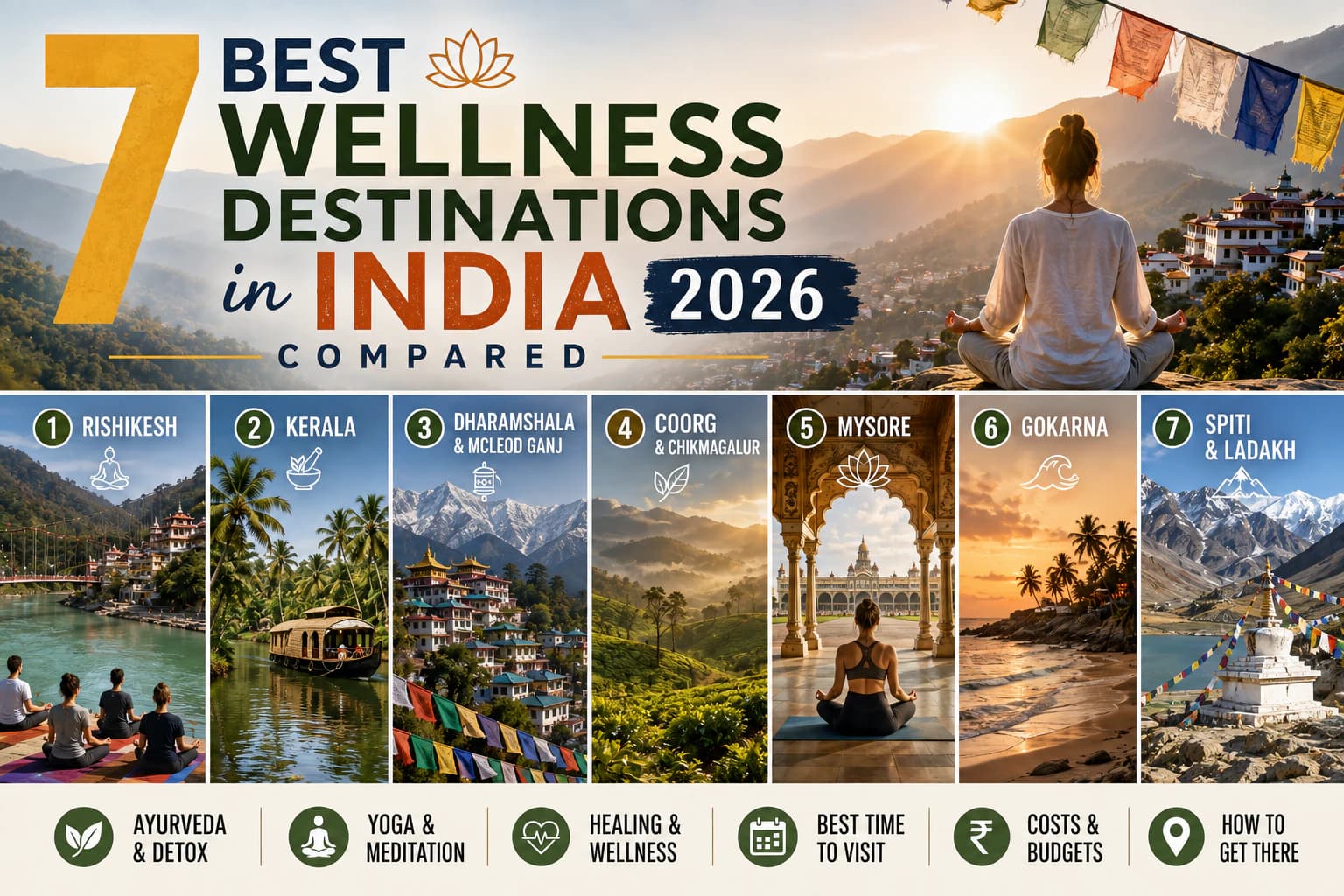
7 Best Wellness Destinations in India 2026, Compared
Wellness destinations in India compared: Ayurveda in Kerala, yoga in Rishikesh, Buddhist retreats in Dharamshala and 4 more.
The best wellness destinations in India are having a moment, not for tourism marketing reasons, but because the traditions here (yoga, Ayurveda, meditation, sound healing) are being rediscovered by travellers who need them more than they expected to.
We looked at the wellness destinations that dominate the conversation and kept the ones that hold up. Here are seven, ranked by what you get back for what you spend.
Each entry sets out what the destination is actually good for, roughly what it costs, how long to stay and when to go.
A note on prices: Costs vary widely across these destinations by state, season, provider, room category and package inclusions, and change over time. Treat every figure here as an indicative planning range, not a quote, and confirm current rates directly with each centre before booking.
The 30-second answer
The strongest wellness destinations in India are Kerala for Ayurveda, Rishikesh for yoga and Dharamshala for Buddhist meditation. Coorg suits burnout without the spirituality, Mysore is for established Ashtanga practitioners, and Spiti and Ladakh are the extreme option. Book 2-3 months ahead for November-February.
- For Ayurveda: Kerala, the birthplace, and the one place here where it is practised clinically rather than as a spa treatment
- For yoga: Rishikesh to begin, Mysore if you already practise Ashtanga
- For meditation: Dharamshala, where a ten-day silent course costs nothing but the effort
- For burnout, without doctrine: Coorg and Chikmagalur
- For the extreme version: Spiti and Ladakh, May to September only
- For coastline: Gokarna
The best wellness destinations in India, ranked
Seven places, each answering a different question. Where a single property is the whole reason to go, it is named inside the destination rather than given its own entry, a hotel is not a destination, and lists that treat them as equivalent end up recommending the same trip three times over.
1. Rishikesh, Uttarakhand
For yoga, and for a first trip.
Rishikesh earns the cliché. A very large number of registered yoga schools, more ashrams than anywhere else in the country, the Ganga running through the middle of it and the Himalaya starting immediately behind. It is also traffic-choked, aggressively priced for foreigners in places, and busier than the photographs suggest. Both things are true at once.
What makes it the right first stop is range. You can do a donation-based ashram stay, a mid-range guesthouse with a daily drop-in class, or a teacher training that runs a month, in the same town, within walking distance. Nowhere else in India gives you that much room to find out what you actually want before committing money to it.
The practice here skews Hatha and Vinyasa, with Iyengar and Kundalini available. Teacher training is the local industry, which cuts both ways: standards vary enormously, and a Yoga Alliance registration is a floor rather than a recommendation.
- Best for: Yoga across styles, meditation, a first wellness trip
- Budget: Rs 1,500-5,000/day (about USD 16-52)
- Minimum stay: 7 days; many people find 14+ gives the practice more time to become a habit, though how much it sticks depends on you, not the number of days
- Best months: September-November, February-April
- Signature experience: Ganga Aarti at Parmarth Niketan, at dusk
Where to stay at the top end: Ananda in the Himalayas sits above the town on a former Maharaja's estate, a 100-acre (about 40-hectare) property with a 25,000 sq ft spa and physician-led Panchakarma. Rates are package-based rather than room-only and should be confirmed directly with the property. Six Senses Vana, about three hours away in the Doon Valley, offers a comparable programme combining Ayurveda, Sowa Rigpa and modern diagnostics.
Full detail on ashrams, prices and timings is in our Rishikesh yoga ashram guide.
2. Kerala
For Ayurveda practised as a structured protocol, not just a spa treatment.
Kerala is where Ayurveda is practised as a structured, supervised system rather than as a spa menu. The distinction matters more than any other in this article. A "90-minute Ayurvedic massage" at a resort is a massage. Panchakarma, by contrast, is a supervised traditional protocol running two to three weeks, with a prescribed diet and a physician assessment at the start. Traditional accounts and practitioners often describe people feeling worse before they feel better partway through, though this isn't established as a guaranteed or medically proven pattern, and individual experience varies.
If you have a fortnight and want the traditional Panchakarma protocol for a specific concern, chronic pain, a digestive issue, a body that has stopped recovering, this is the destination for it, though it's worth treating this as a traditional wellness programme alongside, not instead of, any medical care you're already receiving. If you have four days and want to feel nice, book a spa somewhere and save the airfare.
Look for NABH accreditation, an on-site doctor who assesses you before prescribing anything, and a centre that asks about your medical history rather than your preferences. Somatheeram, Kairali Ayurvedic Village and Sitaram Ayurveda are the names that recur among people who went for treatment rather than a holiday.
- Best for: Ayurveda, supervised Panchakarma protocols, chronic complaints
- Budget: Rs 2,000-6,000/day (about USD 21-63) at a clinic; luxury Ayurvedic resorts charge several times that
- Minimum stay: practitioners typically treat 14 days as the minimum for Panchakarma; 21 for the full protocol
- Best months: November-February
- Look for: NABH accreditation and a physician consultation before treatment
Where to stay at the top end: Kalari Kovilakom in Palakkad, a restored 19th-century palace run by CGH Earth, applies the protocol strictly: no shoes, no phones, no meat, no leaving the property. It is sold as a single all-inclusive programme on a 14-day minimum rather than by the night, so pricing is programme-based and should be confirmed directly with the property. It is the least resort-like luxury option in India, which is the point of it.
The backwaters make an obvious pairing afterwards. See the Kerala backwaters guide.
3. Dharamshala and McLeod Ganj, Himachal Pradesh
For Buddhist meditation, and for silence.
The Tibetan government-in-exile is based here and the Dalai Lama's residence is in McLeod Ganj, which has made the town the centre of Tibetan Buddhist practice outside Tibet. That gives it something no purpose-built retreat can manufacture: the teaching is embedded in a living community rather than packaged for visitors.
Tushita Meditation Centre runs introductory Buddhism courses and silent retreats. Vipassana centres in the region run the standard ten-day residential course: no talking, no reading, no phones, no eye contact, 4 am starts, and no charge beyond a donation at the end if you choose to make one. It is genuinely difficult and a significant number of people leave early.
The setting does a lot of the work. The town sits at altitude, directly below the Dhauladhar range.
- Best for: Meditation, silent retreat, Buddhist philosophy
- Budget: Free (Vipassana, donation-based) to Rs 3,000/day (about USD 31)
- Minimum stay: 10 days for a full course
- Best months: April-June, September-October
- Signature experience: A ten-day silent course at Tushita or a Vipassana centre
- Also here: Sowa Rigpa, the Tibetan medical system, practised at the Men-Tsee-Khang
One caveat: book courses months ahead. Places at the well-known centres go quickly, and turning up hoping for a spot in season does not work.
4. Coorg and Chikmagalur, Karnataka
For burnout, without the spirituality.
This is the answer for people who want to stop, but do not want chanting, a guru, or a philosophy attached. Coffee country in the Western Ghats: cool most of the year, green year-round, and quiet in a way that does not require you to sign up for anything.
What is on offer is essentially forest, altitude and time. Plantation walks, waterfalls, birdlife, and a growing set of stays that have worked out how to do wellness without the incense. It suits the specific case of someone who has been working too hard for too long and needs several days of nothing in particular, rather than a programme.
It is also the easiest destination here logistically: reachable by road from Bangalore in five to six hours, with no altitude acclimatisation, no dietary restrictions and no minimum stay.
- Best for: Burnout recovery, digital detox, nature without doctrine
- Budget: Rs 3,000-8,000/day (about USD 31-84)
- Minimum stay: 4-5 days, which is genuinely enough here
- Best months: October-May
- Stays worth knowing: Evolve Back Coorg, Old Kent Estate, The Windflower
- Signature experience: A coffee plantation walk at first light, before the mist lifts
5. Mysore, Karnataka
For Ashtanga, and only for Ashtanga.
Mysore is where Ashtanga Vinyasa was systematised by K. Pattabhi Jois, and the city gave its name to the self-led practice format, "Mysore style", used in shalas worldwide. For a committed Ashtanga practitioner it is a pilgrimage. For anyone else it is a city with a palace.
Be aware that the lineage institutions have changed substantially and recently. The original institute was restructured in 2019, when Saraswathi Rangaswamy renamed it the K. Pattabhi Jois Ashtanga Yoga Shala and R. Sharath Jois opened the separate Sharath Yoga Centre. Sharath Jois, who had led the practice internationally for two decades, died in November 2024. Teaching continues in the city across several shalas, but the arrangement you may have read about in older guides no longer describes what is there.
Confirm current teachers, registration requirements and term dates directly with the shala before booking anything. This is the fastest-moving entry on this list and any figure here has a short shelf life.
- Best for: Established Ashtanga practitioners
- Budget: Rs 3,000-6,000/day (about USD 31-63) including accommodation
- Minimum stay: One month is the traditional expectation at the lineage shalas
- Best months: October-March
- Not for: Beginners. Arrive with a practice, not to start one
6. Gokarna, Karnataka
For yoga next to the sea.
Gokarna is what Goa was before Goa became Goa: a temple town on the Karnataka coast with a string of beaches reachable mostly on foot, and none of the infrastructure that follows mass tourism. It is the destination for anyone who wants a practice and a coastline without choosing between them.
The wellness scene here is small and largely built around one property. SwaSwara, run by CGH Earth, occupies 26 acres (about 10.5 hectares) of forested slope running down to Om Beach through coconut groves, and combines yoga, Ayurveda and a lot of doing nothing. Rates run roughly Rs 15,000-30,000 a night (about USD 155-315).
Outside that, Gokarna is genuinely low-key: beach shacks, a working temple town, and long walks between bays. If you want a busy schedule this is the wrong place.
- Best for: Yoga plus coastline, couples, a softer reset
- Budget: Rs 15,000-30,000/night (about USD 155-315) at SwaSwara; far less independently
- Minimum stay: 5 days
- Best months: November-February
- Signature experience: Sunrise practice on Om Beach before anyone else is up
7. Spiti and Ladakh
For the extreme version.
This is the reset for people who have found that comfortable retreats do not work on them. High-altitude desert, monasteries built into cliff faces, villages at 4,000 m, and very little between them. Night skies with the Milky Way visible without any equipment.
It is also physically demanding and genuinely restricted by season. Most roads are open only from roughly May to September; outside that window access is limited to flights into Leh and a much smaller area. Altitude sickness is a real risk, acclimatisation is not optional, and anyone with a cardiac or respiratory condition should take medical advice before committing. If an operator has already sent you a night-by-night plan, The Ascent Profile Audit checks it against the same published gradual-ascent guidance and turns any flagged night into a specific question to put back to them. For a quick gut-check on a single night before going that far, the free ascent checker runs the same comparison on just the one figure.
The wellness element here is not a programme. It is the effect of sustained quiet, thin air, physical effort and monasteries that have been running the same daily schedule for several centuries.
- Best for: Extreme reset, meditation with altitude, adventure and stillness combined
- Budget: Rs 3,500-8,000/day (about USD 37-84)
- Minimum stay: 7-10 days, including 2 for acclimatisation
- Best months: May-September only
- Signature experience: Key Monastery at dawn
- Health note: Acclimatise properly. Altitude is the one thing here that can genuinely hurt you
What did not make the list
Three places that come up constantly and were left out on purpose.
Auroville, Puducherry. A genuinely interesting experimental township built around a philosophy of human unity, and worth several days if that appeals. It is not a wellness destination, though, and treating it as one misrepresents what it is. Go for the idea, not for a programme.
Isha Yoga Center, Coimbatore. A very large campus running structured meditation programmes with an international following. Whether it suits you depends heavily on how you feel about following a single teacher's framework, which is a different question from where to go for yoga or Ayurveda.
Individual luxury resorts. Ananda, Six Senses Vana, Kalari Kovilakom and SwaSwara all appear above, under the destinations they belong to. Listing a hotel as a destination inflates a list without adding a decision to it.
How to choose (goal-based matrix)
Pick based on what you actually need, not what looks good.
| Your Goal | Suggested Destination |
|---|---|
| Burnt out from work | Coorg or SwaSwara |
| Interested in traditional Ayurveda for digestive, skin or chronic-pain concerns | Kerala Ayurveda (Somatheeram, Kalari Kovilakom) |
| Spiritual seeking | Rishikesh or Dharamshala |
| Extreme reset | Spiti or Ladakh |
| First wellness trip ever | Rishikesh or Coorg |
| Serious yoga practice | Rishikesh or Mysore (Ashtanga) |
| Luxury + wellness | Ananda Himalayas, Six Senses Vana |
| Medically supervised weight/diet programme | Kerala clinical or Vana |
| General stress support alongside (not a substitute for) mental-health care | Kerala Ayurveda or gentle Rishikesh |
| Honeymoon | Ananda Himalayas or Coorg |
| Nature + wellness | Coorg or Chikmagalur |
This table is a travel-planning starting point, not medical advice. For a diagnosed health condition or a mental-health concern, see a qualified professional first, none of these destinations are a substitute for that.
What all destinations share
Every place on this list will only "work" if you:
- Actually put your phone down (not just for the flight, for hours a day)
- Eat what you're offered without complaint
- Wake up early. Every day.
- Journal, even briefly.
- Show up to sessions even when tired.
The destination matters less than people expect. Most of it is what you choose to do while you are there.
Budget breakdown by category
Ultra-budget (Rs 500-1,500/day, about USD 5-16)
- Vipassana meditation retreats (free/donation)
- Parmarth Niketan (Rishikesh)
- Traditional ashrams (Sivananda, Yoga Niketan)
Budget (Rs 1,500-4,000/day, about USD 16-42)
- Most Rishikesh ashrams
- Auroville stays
- Dharamshala meditation centers
- Coorg budget resorts
Mid-range (Rs 4,000-10,000/day, about USD 42-105)
- Sattva Retreat (Rishikesh)
- Kalari Rasayana Ayurveda
- Old Kent Estate (Coorg)
- Sampoorna Yoga (Goa)
Luxury (Rs 10,000-30,000/day, about USD 105-315)
- SwaSwara
- Somatheeram premium villas
- Coorg premium resorts
- Wildflower Hall (Shimla)
Ultra-luxury (Rs 30,000-150,000/day, about USD 315-1,550)
- Ananda in the Himalayas
- Six Senses Vana
- Kalari Kovilakom
- Amanbagh (Rajasthan)
What Ayurveda + Panchakarma cost specifically
7-day intro Ayurveda
- Rs 15,000-40,000 total (about USD 155-420)
- Basic doctor consultation
- Daily abhyanga (oil massage)
- Sattvic meals
- Shorter than the full protocol the tradition describes
14-day standard Panchakarma
- Rs 30,000-85,000 total (about USD 315-890)
- Full protocol including panchakarma treatments
- Doctor consultations throughout
- Post-treatment consultation
- The shortest length practitioners generally treat as a complete course
21-day intensive Panchakarma
- Rs 45,000-125,000 total (about USD 470-1,300)
- The complete sequence as the tradition sets it out
- A rejuvenation phase, what the tradition calls rasayana
- The length practitioners usually recommend for long-standing complaints
28-day extended (chronic conditions)
- Rs 250,000+ total (about USD 2,600+)
- Multi-phase treatment across several weeks
- Offered for long-standing complaints. This is a clinical programme rather than a spa stay, and it is not a replacement for medical care you are already receiving
Entry requirements for international visitors
Rules depend on your nationality and they change, so confirm on the official Indian e-Visa portal before booking anything non-refundable.
The e-Visa scheme is open only to passport holders from the countries and regions the portal lists as eligible; everyone else applies for a regular visa through an Indian mission. The portal also states that the e-Visa is non-extendable and non-convertible, so settle the length you need before you travel.
A retreat or yoga stay is usually the straightforward case. The portal names attending a short term yoga programme as a permitted e-Tourist purpose. It attaches conditions to short courses, though: the course must not exceed 6 months, and it must not issue a qualifying certificate or diploma to participants. A retreat sits comfortably inside that; a certificate-bearing teacher training does not obviously do so, and if that is what you are booking, ask the Indian mission covering your country in writing.
A clinical programme may sit on a different track. The portal handles medical treatment, including treatment under Indian systems of medicine, through its e-Medical visa rather than the tourist category, and lists a dedicated e-Ayush purpose within it. That does not mean every Ayurveda booking needs one. A spa-style stay and a supervised Panchakarma programme with a physician assessment are not the same thing, and which category applies depends on the programme and your nationality. Check on the portal, or with the mission, before you commit.
Getting to these destinations
None of these sit next to an international airport. Most overseas visitors arrive at Delhi (DEL), Mumbai (BOM) or Bengaluru (BLR) and connect onward, so budget a transfer day at each end.
- Rishikesh: Dehradun Jolly Grant (DED) is the nearest airport; many arrivals route through Delhi (DEL) and continue by road or rail.
- Kerala: Trivandrum (TRV) for the south, Kochi (COK) for the centre and the backwaters. Both handle international flights.
- Dharamshala: Gaggal / Kangra (DHM) for domestic flights, with Chandigarh (IXC) and Delhi (DEL) the common alternatives and an overnight bus from Delhi the budget route.
- Coorg and Chikmagalur: Bengaluru (BLR) is the usual gateway; Mangaluru (IXE) is closer to parts of Coorg.
- Mysore: Bengaluru (BLR), then road or rail. Mysore's own airport is domestic only.
- Gokarna: Goa (GOI or GOX) from the north, Mangaluru (IXE) from the south.
- Spiti and Ladakh: Leh (IXL) by air for Ladakh. Spiti is reached overland via Shimla or Manali, and that access is seasonal, so check what is open before planning around it.
Practical tips for wellness travel in India
Book directly with retreats
Booking direct is often cheaper than going through an aggregator, and it gives you a direct line for questions about medical history, diet and cancellation. Verify: doctor credentials, Yoga Alliance certification, cancellation policy, dietary accommodations.
Pack modest clothing
Even wellness destinations respect Indian cultural norms. Covered shoulders/knees for temples and ashrams. Loose, comfortable, cotton preferred.
Prepare for early wake-ups
Almost all wellness destinations start at 5-6 AM. Shift sleep schedule 1 week before travel.
Adjust to sattvic food gradually
If you're used to spicy/rich food, sattvic diet (mild, vegetarian, no onion/garlic) can cause temporary digestive discomfort. Most people find they adjust within a few days, though this varies.
Accept the discomfort
Silence, simplicity, early wake-ups, no meat, no alcohol, this is the point. Many people find this discomfort is part of what makes the experience feel different from an ordinary holiday.
Follow post-retreat protocol
Sudden return to old habits can undo a lot of what you gained. Transition gradually over 1-2 weeks. Continue morning practice at home.
The uncomfortable truth about wellness travel
You cannot outsource inner work to a location. Rishikesh will not fix your marriage. Kerala will not fix your relationship with food. Ladakh will not fix your relationship with work.
What these places will do is give you the conditions: silence, structure, community, tradition, in which you can do the actual work yourself.
Choose one that fits what you're actually looking for, and what your schedule and budget allow. Waiting for "when things settle down" often means waiting indefinitely, so if one of these genuinely appeals, it's worth planning for rather than filing away.
Related reads:
Frequently asked questions
Answers to the most common questions about this topic.
Budget ashram-style: Rs 8,000-15,000/week (about USD 84-155). Mid-range: Rs 20,000-40,000/week (about USD 210-420). Luxury (Ananda, Six Senses Vana): package-based rather than room-only, and quoted per programme rather than per night, so ask each property for the full quote. Kalari Kovilakom also takes a 14-day minimum as a single all-inclusive programme. Panchakarma clinical (Kerala): roughly Rs 2,000-6,000/day (about USD 21-63) depending on the centre. Vipassana meditation: free (donation-based). Wellness resorts (Shreyas, SwaSwara): Rs 15,000-35,000/night (about USD 155-365). USD figures are approximate conversions at about Rs 95.5 to the dollar as of August 2026.
Yes, Kerala is widely recognised as the birthplace of Ayurveda in India. The warm, humid climate is the reason the tradition gives for favouring oil-based treatments here (abhyanga, shirodhara). Kerala also has a high concentration of NABH-accredited Ayurvedic centres. Top areas: Kovalam, Kollam, Palakkad, Wayanad. For serious Panchakarma: minimum 14 days recommended, 21 days ideal.
Rishikesh is often called the world's yoga capital, with a large concentration of schools, ashrams and retreats. For serious Ashtanga: Mysore, though the lineage shalas there restructured in 2019 and R. Sharath Jois died in 2024. Confirm current teachers before booking. For beach + yoga: Goa. For Buddhist meditation: Dharamshala. For classical hatha: Kerala (Sivananda Ashram). See our complete yoga retreats guide for depth.
Yes. India's wellness destinations are generally among the more comfortable settings in the country for solo female travelers. Rishikesh, Kerala, Coorg, Dharamshala, Auroville all have well-established solo female communities. Yoga retreats and ashrams typically have women-only dorms. Basic precautions: choose established retreats, dress modestly, share itinerary with family, avoid isolated areas at night.
Panchakarma = 'five actions' in Sanskrit, a 7-28 day intensive Ayurvedic programme that the tradition describes as detoxification. Includes: doctor consultation (dosha assessment), daily oil massages, medicated oil treatments, dietary customization, herbal medicines, yoga + meditation. Cost: roughly Rs 2,000-6,000/day (about USD 21-63) depending on the centre. Traditionally offered for concerns such as chronic pain, digestive issues, skin conditions and stress-related complaints, rather than as a proven treatment for them. Practitioners generally treat 14 days as the minimum for a full course.
Absolutely. Ayurveda is a medical system rather than a religious practice. Kerala's Ayurveda sector serves a large international clientele, and NABH-accredited centres routinely treat visitors from abroad. No religious rituals required. Consultations happen in English. Dietary customization accommodates all cultures (with some restrictions during treatment). Muslim, Christian, Jewish travelers welcome.
Many people find they help meaningfully with everyday stress and burnout, though this isn't a clinical treatment and results vary. Extended silence, movement, sleep, nature and fewer decisions to make create the kind of conditions many people find genuinely restorative in a way an ordinary vacation often doesn't. Best for burnout: 7-day silent retreats (Vipassana), nature-based stays (Coorg), Ayurveda programs (Kerala). Avoid: intensive Ashtanga (too physical), high-intensity yoga (adds stress). Choose a gentler option over an intense one initially, and if burnout is severe, persistent or affecting your ability to function, that's worth discussing with a qualified professional too.
Yes at family-friendly wellness resorts. Best options: Ananda in the Himalayas (child care available), Coorg family resorts, Kerala backwaters cruises with family bookings. Ayurveda clinics generally NOT kid-friendly (medical setting). Yoga ashrams: some accept older kids (12+), most don't. Family wellness typically: nature retreats > yoga retreats > Ayurveda clinics.
Loose cotton clothing (2-3 sets), shawl for meditation/evening, yoga clothes, own yoga mat, sarong for temples, sunblock, insect repellent (essential in Kerala), water bottle, journal, headlamp, comfortable sandals, warm layer if Himalayas October-March, basic first aid + Imodium + probiotics, modest clothing options. Skip: expensive brands, revealing clothes, high heels, formal wear.
Yes, ashrams offer authentic wellness experiences for Rs 500-2,000/day (about USD 5-21). Parmarth Niketan (Rishikesh) does not publish rates online, so ask the ashram directly. Sivananda Ashram (Kerala) about Rs 1,500-2,000/day (about USD 16-21) on a day basis; its weekly programmes are priced separately, so confirm which you are booking. Vipassana meditation retreats: FREE (donation-based). Isha Yoga Center: Rs 500-1,500/day (about USD 5-16) for basic programs. Real wellness doesn't require luxury, traditional practices work in simple settings.
Wellness travel isn't a treatment for depression or anxiety, but for some people it may support general well-being through routine, movement, nature, and time away from everyday stressors. It should not replace therapy or medication, and if you have significant, persistent or worsening symptoms, a qualified mental-health professional is the right first step, not a retreat. If you're already in treatment and considering this alongside it, gentler options (nature-based stays, structured yoga) may be easier to combine with ongoing care than intensive silent retreats, which some people find can amplify overthinking. See our anxiety guide for supporting practices, not a replacement for professional care.
Best options: (1) Direct with the retreat website, which is often cheaper and gives you a direct line for questions, (2) BookYogaRetreats.com (verified reviews), (3) BookRetreats.com (curated selection), (4) Kerala Tourism (KTDC) for Ayurveda. Booking 2-3 months ahead for peak season (November-February) is a reasonable rule of thumb, though popular centres can fill faster and quieter ones may have more last-minute availability. Expect to pay a deposit with the balance on arrival; the split varies by centre, so get it in writing. Verify: doctor credentials (Ayurveda), Yoga Alliance certification, cancellation policy, dietary accommodations.
Yes: combining destinations enhances experience. Popular combos: (1) Rishikesh yoga + Rishikesh Ayurveda = 14 days, (2) Kerala backwaters + Kerala Ayurveda = 14 days, (3) Delhi entry → Rishikesh 7 days → Dharamshala 5 days = 12 days, (4) Bangalore entry → Coorg 4 days → Mysore 5 days = 9 days. Allow 2-3 travel days between destinations.
Written by
We research travel, fitness and wellness, and publish what holds up. See our editorial policy.