Morning Meditation for Beginners: A 10-Minute Guide
Morning meditation for beginners, a 10-minute routine, 12 techniques compared, and what actually changes in 8 weeks.
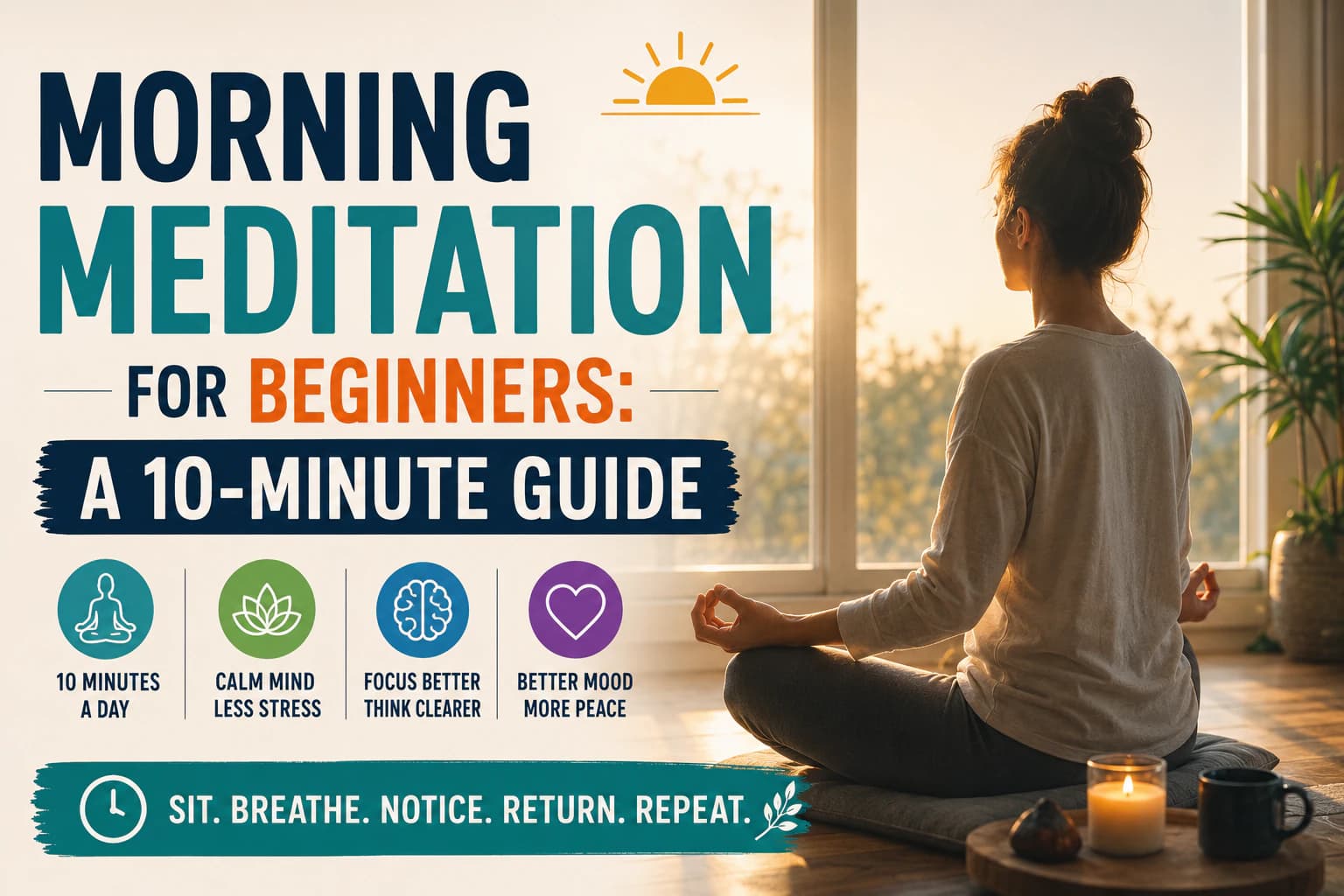
Most people who try morning meditation give up inside a fortnight, and it is almost never a discipline problem. It is that nobody told them what it is supposed to feel like, so the first time their mind wanders they assume they are doing it wrong and stop.
There are more entry points than anyone needs: Vipassana retreats, Headspace, Sam Harris's Waking Up, traditional teachers, Zen zafus. Here is the 10-minute morning routine that the evidence and the teaching traditions most consistently point beginners toward.
Sources are linked at the claims they support rather than listed up front, including the places where the evidence is more modest than the headlines. The practical side comes from traditions that have been refining this for centuries. You won't need incense, an app subscription, or the ability to sit cross-legged.
A note on costs: App subscription prices and course fees, including Transcendental Meditation training, vary by provider and change over time. Confirm current pricing before signing up.
A note on health advice: This is general information, not medical advice. Meditation is not a replacement for therapy or medication, and if a practice repeatedly makes you feel significantly worse it is worth discussing it with a mental-health professional rather than pushing through it as normal.
The 30-second answer
For a beginner, morning meditation can be as simple as sitting upright for 5-10 minutes, breathing normally, and gently returning your attention to the breath whenever your mind wanders. Your mind will wander every 10-15 seconds: noticing that and returning is the entire practice, not a failure at it. Ten minutes is a practical starting point, before your phone.
- Posture: upright on a chair or the floor, whichever you'll actually keep doing
- Technique: attention on the breath; return to it each time you drift
- Duration: 5-10 minutes is a manageable, sustainable starting point, not a scientifically fixed minimum, shorter sessions still count
- Timing: same time, same place, before you touch your phone, whatever you can realistically stick to
- First results: some people notice subtle changes within several weeks, though timing and magnitude vary considerably
- Brain changes: some studies have reported measurable changes around the 8-week mark, individual results are not guaranteed
Why 10 minutes (not 20)
The single biggest reason people quit meditation: they aim for 30-minute sessions, miss them, and give up entirely.
Ten minutes is short enough that you can't skip it. Ten minutes done every day for a year beats 30 minutes done twice a week by a mile.
Start here. Extend later when it feels wrong to stop.
The neuroscience of meditation (and what it does not prove)
Before the mechanisms, the honest headline finding. The largest independent assessment of this literature is the AHRQ evidence review behind Goyal and colleagues' 2014 meta-analysis, which pooled the randomised trials rather than the promising individual ones. Its conclusion: meditation programmes produce small to moderate reductions in anxiety, depression and stress: real, replicated, and considerably less dramatic than the popular coverage suggests.
It also found little good evidence that meditation outperforms active alternatives like exercise or medication, largely because too few trials have compared them properly. That is a gap in the research, not a verdict against meditation.
Ten minutes a day is worth doing. It is not going to rebuild your personality, and anyone telling you otherwise is ahead of the evidence.
Meditation is not "quieting the mind." That's marketing. It's better understood as training attention, repeatedly noticing when it drifts and bringing it back, a process thought to involve the prefrontal cortex.
Every time you notice your mind wandered and return to breath, you're doing a "rep", like a bicep curl for attention.
The eight-week figure comes from Hölzel and Lazar's 2011 study at Harvard, which found increased grey matter density in the hippocampus and other regions after an eight-week mindfulness course. It is the study behind almost every "meditation changes your brain" headline you have read. It is also worth knowing how small it was: 16 people in the mindfulness group and 17 controls, 33 enrolled and 31 included in the analysis. The finding is genuinely interesting and has held up directionally in later work, but it is a starting point rather than a settled number. Treat eight weeks as roughly when people report noticing something, not as a guarantee that your scan would show it.
Brain changes some studies have reported
Findings associated with Sara Lazar's Harvard research (around 8 weeks of meditation):
- Amygdala volume: some studies report decreases, associated with less fear reactivity
- Hippocampus: some studies report thickening, associated with memory and learning
- Prefrontal cortex: some studies report gray matter changes, associated with executive function and decision-making
- Temporo-parietal junction: some studies report changes here, associated with empathy and perspective-taking
- Anterior cingulate cortex: some studies report thickening, associated with emotional regulation
- Corpus callosum: some studies report changes, associated with hemisphere communication
- Default Mode Network: some studies report reduced activity, associated with less overthinking and self-focused worry
Some neuroimaging studies have reported measurable changes in brain structure or activity following mindfulness training, although the size and consistency of these findings vary, and most come from small studies that haven't been widely replicated at scale.
Behavioral outcomes (research-supported, modestly)
Consistent with the small-to-moderate effect sizes described above, not the dramatic numbers sometimes quoted elsewhere:
- May reduce symptoms of anxiety and stress, in the small-to-moderate range described by the pooled trial evidence above
- Some studies report changes in blood pressure, though effects vary by study and population
- Some studies report improvements in attention on measurable tasks
- Some studies have reported changes in stress-related measures, including cortisol
- Research has explored effects on sleep quality, results vary by person and technique
- Some studies have looked at inflammation-related markers, findings are preliminary
- Effects on immune function have been studied but are not well established as clinically meaningful
- May support lower relapse risk after depression, MBCT research is discussed further down, though it's not a substitute for appropriate treatment
The 12 major types of meditation
Different techniques suit different people and goals. Here's the complete map.
1. Breath-focused meditation (BEST FOR BEGINNERS)
Focus attention on breath sensation. Return when distracted. Simple, foundational.
Best for: First 6 months, developing basic attention skills.
2. Body scan meditation
Systematically move attention from feet to head, noticing sensations in each part.
Best for: Anxiety, insomnia, physical tension, dissociation from body.
3. Loving-kindness (Metta) meditation
Silently repeat wishes for wellbeing: self, loved ones, neutral people, difficult people, all beings.
Best for: People exploring bitterness, relationship issues or self-criticism; may be worth exploring alongside appropriate care for depression.
4. Noting practice (Vipassana-style)
Label each thought/sensation ("thinking," "planning," "worrying," "hearing") as it arises, then return to breath.
Best for: After 3+ months of practice. Powerful for deep insight.
5. Transcendental Meditation (TM)
Repeat a mantra silently. Requires paid teacher training. 20 minutes twice daily.
Best for: People who dislike focus-based meditation. Extensively researched.
6. Zazen (Zen meditation)
Sit and just be. Watch thoughts arise and pass. Very simple, very hard.
Best for: Advanced practitioners.
7. Guided visualization
Imagine peaceful scenes (forest, beach, mountain) using all senses.
Best for: Beginners, high anxiety, need for relaxation over insight.
8. Trataka (candle gazing)
Ancient Indian technique. Open-eye focus on candle flame, then closed-eye visualization.
Best for: May be used as a concentration practice and preparation for advanced practice; eye-related benefits are traditionally claimed, but evidence is limited. Warning: Traditionally not recommended for people with epilepsy; stop if you experience eye strain or discomfort.
9. Mantra meditation
Silent or spoken repetition of a word/sound (Om, So Hum, "peace").
Best for: People whose minds resist silence, cultural connection to Sanskrit tradition.
10. Walking meditation
Slow, deliberate walking with attention on foot sensations and breath.
Best for: Cannot sit still, integration of practice with movement.
11. Chakra meditation
Focus attention on each of seven energy centers, sometimes with visualizations.
Best for: Yoga practitioners, spiritual seekers, energetic sensitives.
12. Yoga Nidra (yogic sleep)
Guided body scan + visualization in lying position. 30-45 minutes.
Best for: Deep relaxation; some people find it a useful addition alongside appropriate care for insomnia, PTSD recovery or chronic pain, it is not a standalone treatment for these.
Which type is best for what goal?
| Goal | A type worth exploring |
|---|---|
| First-time beginner | Guided breath-focused |
| Anxiety/stress | Body scan can be a useful option |
| Depression/self-criticism | Loving-kindness may be worth exploring, alongside appropriate care |
| Insomnia | Body scan or Yoga Nidra can be worth trying |
| Focus/productivity | Breath-focused |
| Trauma recovery | Trauma-informed only, with therapist |
| Grief | Loving-kindness |
| Anger | Breath-focused + Metta |
| Physical pain | Body scan |
| Insight/spiritual growth | Vipassana or Zazen |
| Manifestation | Visualization |
| Deep relaxation | Yoga Nidra |
Before you begin
Time: First thing in the morning can work well, before phone, before coffee, because it's easier to protect from later distractions and helps some people build the habit. Pick whatever time you'll actually keep.
Place: Same spot every day. Corner of your bedroom is fine.
Position:
- Sitting up in a chair with feet flat on the floor, OR
- Cross-legged on a cushion, OR
- On your knees seiza-style
- Not lying down: an upright posture can help you stay alert; lying down makes falling asleep more likely
Timer: Phone timer with airplane mode ON. Or a physical timer. Or app.
Eyes: Closed, or slightly open looking down about 2 m (6 feet) ahead.
That's it. No expensive cushions. No incense. No app required.
The 10-minute morning meditation structure (breath-focused)
This is the part people mean when they ask how to meditate. Three phases, ten minutes, nothing to memorise.
Minute 1-2: Arrival
Sit down. Take three deep breaths, in through the nose, out through the mouth.
Notice: your body sitting in the chair. Your feet on the floor. The weight of your hands. The temperature of the room.
You're not trying to "empty your mind." You're just landing in your body.
Minute 3-7: Breath focus
Now breathe normally. Don't control it. Just notice it.
Where do you feel the breath most clearly? For most people, it's the nose (air moving in and out) or the belly (rising and falling). Pick one.
Every time you breathe in, notice it. Every time you breathe out, notice it.
That's the whole practice.
Your mind will wander. Within 15 seconds, you'll be thinking about work. That's meditation, not failure. The moment you notice you've wandered, gently return to the breath. That noticing is the entire skill you're building.
You'll wander 100 times in 5 minutes. That's fine. Return 100 times.
Minute 8-9: Open awareness
Stop focusing on breath specifically. Widen your attention.
Notice sounds around you, without labeling them. Just noticing. Notice sensations in your body, an itch, warmth, the seat under you. Notice thoughts arising, without following them.
You're just witnessing. Nothing to fix.
Minute 10: Intention
Before opening your eyes, take one deep breath and set a small intention for the day.
Not a goal. An intention.
"I want to be patient today." "I want to notice what I'm feeling." "I want to be present when talking to my mom."
One sentence. Something you can actually track.
Open your eyes. Done.
Breathwork techniques for deeper meditation
4-7-8 breathing (relaxation)
Inhale 4 sec. Hold 7 sec. Exhale 8 sec. Repeat 4 cycles.
Best for: A relaxation technique some people find helpful around sleep or acute anxiety, not a treatment for either.
Box breathing (focus)
Inhale 4. Hold 4. Exhale 4. Hold 4.
Best for: Pre-meditation preparation, focus tasks.
Alternate nostril breathing (Nadi Shodhana)
Close right nostril, inhale left. Close left, exhale right. Inhale right, close right, exhale left. Repeat.
Best for: Balancing energy, pre-meditation, calming.
Bhramari (humming bee)
Close ears with thumbs. Inhale, then hum on exhale. Some people find the humming sensation calming.
Best for: Stress, insomnia, tinnitus.
What to expect (week by week)
Week 1: "This is hard"
Your mind will be a chaos of thoughts. You'll feel restless, bored, distracted. You'll think you're doing it wrong.
You're not. This is what beginners always experience. Keep showing up.
Week 2: "I'm getting worse"
Meditation increases your awareness of your own busy mind. So paradoxically, in week 2 you'll feel more distracted than before. That's because you're finally noticing how distracted you already were.
Trust the process.
Week 3-4: Small shifts
You may catch yourself being more patient in traffic. Reacting less to your inbox. Sleeping a little better. If these changes happen, they're often subtle at first, easy to dismiss.
Results vary, but for many people these small shifts are real and worth noticing.
Month 2-3: Compound effects
For some people, meditation compounds. By month two, some practitioners report:
- Better sleep
- Less reactive emotions
- More space between stimulus and response
- Better focus during work
- Less social media compulsion
Results vary considerably. You're not aiming for "enlightened," just less scattered.
Month 6+: Longer-term change
Some long-term meditators report measurable changes in brain structure in research studies, though individual results vary. Some describe it as: things that used to ruin your day become annoyances instead of crises, and relationships or sleep quality may feel meaningfully different, though this isn't guaranteed for everyone.
The 10 mistakes beginners make (avoid these)
1. Waiting for a "quiet mind"
The mind is never quiet. Not in beginners, not in monks. The skill is noticing thoughts and returning to focus, not stopping them.
2. Aiming for too long
Twenty-minute sessions are ambitious. Ten-minute sessions are sustainable. Sustainable wins.
3. Judging every session
Some days feel "good." Some feel awful. This is normal. You cannot rate a meditation the way you rate a workout. Just show up.
4. Skipping "because I'm too stressed"
On stressful days, a shorter session may be easier to maintain than skipping the practice entirely. Ten minutes doesn't require you to be calm; for some people, the practice can make it easier to settle.
5. Using apps as a crutch forever
Apps like Headspace and Calm are useful training wheels. But eventually, you need to sit in silence without a guiding voice. Start weaning off around month 3.
6. Meditating in bed
You'll fall asleep. Bed strongly associates with sleep. Sit somewhere else.
7. Fighting your own timing
Meditating right after coffee can leave you jittery. Right before bed can tip into sleep. First thing in the morning works well for many people, but the timing that you'll actually stick with beats a theoretically ideal one.
8. Using meditation as escape
If you're using meditation to avoid difficult emotions or life problems, it becomes spiritual bypassing. True meditation involves meeting difficulty, not escaping it.
9. Perfectionism
Setting up an elaborate meditation "space." Buying expensive cushions. Following ancient rituals. All of this is procrastination. Just sit.
10. Comparing to others
Someone on Instagram meditating for 2 hours = probably lying or has different life circumstances. Compare only to your Week 1 self.
Meditation apps: honest comparison
Prices below are the US rates as of August 2026. Meditation apps set prices per country rather than converting one price, so what you pay may be very different. Calm, for example, charges about $70 a year in the US and about Rs 4,000 a year in India. Always check the price your own app store shows you before subscribing.
Best for absolute beginners: Insight Timer
- Cost: Free (paid tier optional)
- Library: 150,000+ guided meditations
- Community: Global meditation groups, live sessions
- Downside: Overwhelming variety
Best guided experience: Calm
- Cost: $69.99/year (US), or $14.99/month
- Content: Celebrity narrators, sleep stories, master classes
- Downside: Content-heavy, less philosophy
Best structured curriculum: Headspace
- Cost: $69.99/year (US), or $12.99/month
- Content: Animated explanations, day-by-day courses
- Downside: Best for total beginners; less depth long-term
Best for philosophical depth: Waking Up (Sam Harris)
- Cost: $149.99/year (US). Free if you can't afford it: the makers offer a no-questions-asked scholarship
- Content: Secular meditation + philosophy of mind + conversations
- Downside: Less "gentle," intellectual
Best for personalization: Balance
- Cost: $69.99/year (US), or $11.99/month, after a free trial
- Content: AI-adapted programs based on your feedback
- Downside: Newer, smaller library
Recommendation
Start with Insight Timer (free) or Waking Up (free trial). Try Headspace/Calm if you need more structure. Skip paid apps until you're sure you'll use them for 12+ months.
Common concerns and how to handle
"I get restless / can't sit still"
- Start with 3 min sessions
- Try walking meditation instead
- Fidget gently. Don't force stillness
- Set timer with pleasant chime
"My mind won't stop wandering"
- That's meditation working, not failing
- Every return-to-breath IS a rep
- Even advanced meditators wander every 15-30 seconds
- Don't judge, just return
"I feel worse after meditating"
- Some people notice this in the first couple of weeks as awareness increases, or when buried emotions surface
- If it happens occasionally: try guided vs silent, shorter sessions, or Metta instead
- If meditation repeatedly makes you feel significantly worse, stop or shorten the practice and consider discussing it with a mental-health professional, don't just push through it as "normal"
"I fall asleep every time"
- You're probably sleep-deprived (fix sleep first)
- Sit MORE upright
- Meditate after morning shower/exercise
- Open eyes slightly (soft gaze downward)
"I don't feel any benefits"
- Give it 8 weeks minimum
- Journal about small shifts you might miss
- Compare month 2 to month 1
- If truly nothing at 12 weeks: try different technique
"I have unusual sensations (visions, tingling, energy)"
- Some people experience unusual sensations during meditation
- They are not necessarily signs of progress or "advancement," and not everyone gets them
- Don't chase them, and if they're mild and not distressing, you can just return attention to breath
- If they are distressing or persistent, pause the practice and seek appropriate guidance
"I start crying during meditation"
- Common when buried emotions come up
- Sit with it, that's the practice
- If repeatedly happening: consider therapy alongside
- Don't stop practice unless overwhelming
"I get bored"
- Boredom is a valuable meditation object
- Notice "boring" as just another thought
- Try new technique (visualization, Metta)
- Boredom often precedes breakthrough
When to be more careful about meditating (contraindications)
Rarely discussed but important. Certain intensive practices may require additional caution or professional guidance for some people, rather than being appropriate for everyone by default.
Active psychosis or schizophrenia
Meditation may worsen symptoms during an active phase for some people. Consult a psychiatrist.
Severe untreated PTSD
Silent retreats especially have been reported to trigger flashbacks in some people. Trauma-informed meditation with therapist support is a more cautious starting point.
Acute severe depression
Some styles may feed overthinking for some people. Metta and guided meditations are often considered a gentler option than silent breath focus.
Severe dissociation disorders
Meditation can deepen dissociation for some people. Ground-focused practices (body scan) are often preferred over abstract ones.
After recent psychiatric medication changes
Consult prescriber. Meditation can change how medications feel.
Alternatives for these conditions
- Movement-based mindfulness (yoga, tai chi, walking)
- Guided-only, never silent
- Short sessions (2-3 min)
- With mental health support
Advanced: bringing meditation into daily life
Once formal meditation is a habit, add "informal" mindfulness moments:
- First sip of morning coffee: actually taste it, don't scroll
- Walking somewhere: feel your feet on the ground, notice surroundings
- Waiting in queue: 3 breaths, notice your body
- Driving: one intersection you fully attend to
- Eating: first 3 bites of any meal, phone away, taste fully
- Traffic lights: one deep breath at each red light
- Before opening email: 30 seconds of breath focus
These "micro-meditations" compound. Total daily practice: 10 minutes formal + scattered mindfulness moments.
Meditation across life stages
Kids (5-12 years)
- 2-3 minute sessions max
- Body scan or guided imagery
- Cosmic Kids Yoga (YouTube) works well
- Not silent, needs guiding voice
Teens (13-19)
- 5-10 min sessions
- Apps work well (Calm, Headspace youth versions)
- Focus on stress + focus benefits (avoid spiritual framing)
- Best done alone, not in family
Adults (20-60)
- Standard 10-min protocol
- Morning ideal
- Progressive increase to 20 min after 6 months
Seniors (60+)
- Chair-based practice
- Longer sessions often easier (fewer stimuli)
- Loving-kindness especially helpful
- Group meditation for social benefit
Meditation for specific goals
For sleep
Yoga Nidra (35-45 min) or body scan (20 min) 30 minutes before bed. Not in bed until sleepy.
For anxiety
Loving-kindness for 10 min + breath focus for 5 min. Twice daily during high-anxiety periods.
For focus/work
10 min breath focus before starting work. 3-minute mini-meditations between tasks.
For grief
Metta meditation. Extend loving-kindness to the deceased. Don't force positivity.
For creativity
Open awareness (rather than focused). Notice thoughts arising without following. Ideas often surface.
For anger management
Notice physical sensations of anger without acting. Breath focus. Practice makes reactivity slower.
Trataka: the Indian technique detailed
Trataka is traditional preparation for advanced meditation in yoga.
How to practice
- Sit about 1 m (2-3 feet) from a lit candle in a dark, still room
- Gaze steadily at the flame's brightest point
- Do not blink (as long as possible)
- When eyes water, close them
- Visualize the flame in your mind's eye
- Hold internal image as long as possible
- Open eyes, resume gazing
- Repeat for 10-15 minutes
Benefits
- May be used as a concentration practice
- Eye-related benefits are traditionally claimed, but evidence is limited
- Preparation for deeper meditation, in the traditional yoga sequence
- Some practitioners report enhanced visualization ability, a subjective experience rather than a measured outcome
Warnings
- Traditionally not recommended for people with epilepsy; check with a doctor if this applies to you
- Not if wearing contact lenses (irritation)
- Don't force through severe eye strain, stop if you experience pain or persistent discomfort
- Break from screens 1 hour before practice
When it's working
Possible signs that the practice is helping include:
- You catch yourself feeling angry, and can pause before reacting
- You notice a beautiful moment (sunset, song, kid laughing) more deeply
- You're less afraid of your own thoughts and emotions
- You feel less need to "fill" every silent moment with a scroll or podcast
- People say you seem "less rushed" or "more present"
- You return to breath multiple times during difficult conversations
That last one is the biggest tell. You're using the skill outside of formal practice.
What to do if you fall off
Miss a day, restart. Miss a week, restart. Miss a month, restart.
Nothing you've built is lost. The moment you sit back down, you resume where you left off. Meditation is one of the few practices where consistency across your lifetime matters more than consistency this week.
The truth about "life-changing"
Meditation is not a hack. It won't fix your finances, your relationships, or your career.
What it will do is give you a small gap between how you feel and how you react. In that gap lives every good decision you'll ever make.
Ten minutes tomorrow morning. Same place. Same time. Just show up.
Everything you need to know, you'll learn from doing it, not from reading about it.
Now close the tab. Set your morning timer. And start tomorrow.
Related reads:
Frequently asked questions
Answers to the most common questions about this topic.
Meditation = formal practice (sitting for 10 minutes focusing on breath). Mindfulness = applied skill (bringing focused awareness to daily activities like eating, walking, working). Meditation builds the mindfulness muscle; mindfulness is where you use it. You can be mindful without meditating (harder), but meditation trains the skill.
Yes, if specifically designed for meditation: no lyrics, slow tempo (60-80 BPM), ambient. Popular options: Weightless by Marconi Union, ambient nature sounds, Tibetan bowls. Regular music engages cognition and defeats the purpose. Silent meditation is the gold standard once you've built the habit.
No, but it can complement both. For mild stress or anxiety symptoms, meditation may be a useful self-care practice on its own. Persistent, severe, or functionally impairing symptoms warrant professional evaluation, meditation alongside therapy and, where appropriate, medication is generally a better approach than meditation alone for moderate-to-severe anxiety or depression. Don't skip professional care in favor of meditation for serious conditions.
Yes, for some people, especially those with PTSD, trauma history, or severe depression. Long silent retreats particularly can surface difficult emotions. If meditation increases anxiety: (1) try shorter sessions (2-3 min), (2) switch from silent to guided, (3) try loving-kindness instead of breath focus, (4) work with a therapist alongside. Discontinue if severely destabilizing.
Prayer = communication with a higher power (asking, thanking, worshiping). Meditation = quieting the mind to observe experience directly (no external addressee). Both can involve stillness and focus. Neither is superior. Many religious traditions use both, prayer for connection, meditation for insight. You can do either or both.
Vipassana ('insight' in Pali) is a traditional Buddhist technique focused on observing bodily sensations without reaction. Made famous by S.N. Goenka's 10-day silent retreats (free, held worldwide including India). Practitioners scan attention through the body, noticing sensations arising and passing. Considered one of the deepest meditation techniques, but also most intense for beginners.
Metta = 'loving-kindness' in Pali. You silently repeat wishes for wellbeing: starting with yourself, then loved ones, then neutral people, then difficult people, then all beings. Example: 'May I be happy. May I be healthy. May I be safe. May I be at peace.' Some studies suggest loving-kindness practice may help with positive affect, self-compassion and interpersonal attitudes, but results vary and it isn't an established standalone treatment for depression, it's worth exploring alongside appropriate care rather than instead of it.
TM = Repeat a personalized mantra silently for 20 minutes, twice daily. Requires learning from a certified teacher, and each country's TM organisation sets its own fee, so the cost varies widely and changes over time, check the official provider for current pricing. As current examples: in the US the standard fee has been around $980 with lower income-based rates and a student rate; in the UK the fee is calculated from your income, with a concession rate and a lower rate for children aged 10 and over. Doesn't require focused attention, just repetition. Extensively researched (300+ published studies), with some research reporting benefits for stress, blood pressure and sleep, though as with meditation research generally, effect sizes tend to be modest rather than dramatic. Downside: expensive to learn, and while mantras are presented as personalized, some research suggests generic ones may work similarly, treat that as a debated point rather than settled.
Meditation may help some people with sleep quality and stress, but it is not a guaranteed treatment for insomnia. Techniques some people use around sleep: body scan (35-40 min), 4-7-8 breathing, yoga nidra. A common practical suggestion is around 30 minutes before bed rather than immediately before, though what works varies by person. If sleep problems are persistent, see our complete sleep guide for a fuller protocol, evidence-based approaches like CBT-I are generally considered more established than meditation alone for diagnosed insomnia.
Doesn't cure them, but can reduce symptoms for some people in mild-moderate cases, alongside appropriate care. MBCT (Mindfulness-Based Cognitive Therapy) is evidence-based for preventing depression relapse: the PREVENT trial randomised 424 patients and found no significant difference in relapse over two years between MBCT and staying on maintenance antidepressants. Read that as comparable rather than proven equal, because a null result is not the same as proof the two are equivalent. MBSR (Mindfulness-Based Stress Reduction) reduces anxiety measurably: the AHRQ evidence review rates that moderate-strength evidence, with an effect size of 0.40 at eight weeks. For severe cases: meditation as adjunct to therapy + medication, not replacement.
Phones are the enemy of meditation. If using an app: (1) enable Do Not Disturb, (2) put phone face-down out of reach, (3) use only for the audio, (4) close app immediately after. Better: use a physical timer for silent meditation. A well-known 2017 study found that the mere presence of your own phone reduces available cognitive capacity, but a pre-registered replication in 2022 did not reproduce it, so treat that particular finding as unsettled. The practical case does not depend on it: a phone within reach is an interruption waiting to happen, and meditation is exactly when you do not want one.
Yes, though rarely discussed. The most detailed study of this, Brown University's Varieties of Contemplative Experience, interviewed meditators about difficult experiences and documented psychotic symptoms, derealization, re-experiencing of traumatic memories and worsening depression, with prior psychiatric history a recurring factor. Certain intensive practices may be inappropriate or destabilizing for some people with: (1) active psychosis or schizophrenia, (2) severe untreated PTSD (especially silent retreats), (3) acute severe depression (can feed overthinking in some styles), (4) severe dissociation disorders, these conditions call for additional caution rather than an automatic ban on all mindfulness practice. Alternatives worth considering: therapy-supported mindfulness only, movement-based practices (yoga, tai chi), or waiting until more stabilized. Consult a psychiatrist if unsure.
Filed under
Written by
We research travel, fitness and wellness, and publish what holds up. See our editorial policy.