Solo Travel Anxiety: An Honest 30-Day Mental Health Guide
Solo travel anxiety, honestly: what the first 30 days actually feel like, what helps, and when not to go alone.
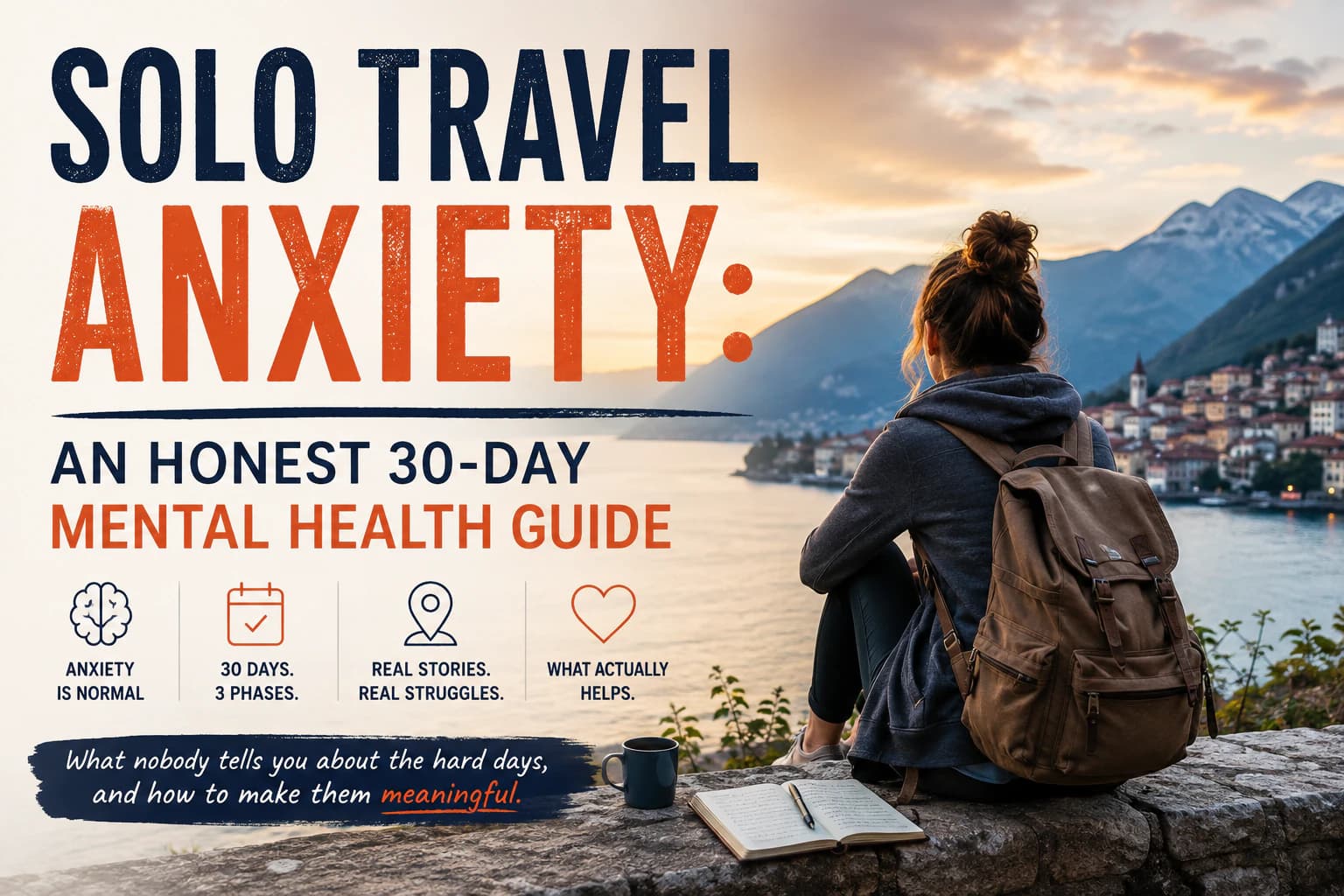
Everyone tells you solo travel will change your life. Nobody warns you about solo travel anxiety: what actually happens once the novelty wears off, the loneliness sets in, and you realise you're still carrying every part of yourself into every new city.
This is what a 30-day solo trip actually does to you, week by week, based on what the psychology research and long-form traveler accounts consistently describe.
This guide combines patterns that recur across long-form traveler accounts with what psychology research on solitude, novelty and mood actually supports, not a single personal trip.
A note on prices: Travel costs, visa fees and accommodation rates change over time. Always confirm the latest information with the official provider before booking.
A note on health advice: This is general information, not medical advice, and not a substitute for professional care. If you are in immediate danger or having thoughts of self-harm, contact local emergency services rather than working from a general guide.
The 30-second answer
Solo travel anxiety is normal and, for many travelers, tends to fluctuate once the initial novelty fades, though there's no fixed day it happens on. Solo travel can support your mental health when you are already reasonably stable, have coping tools that work at home, and plan social contact rather than hoping for it. It is not a fix for a crisis.
- Sweet spot: 14-21 days; shorter feels rushed, longer needs a routine
- Often a harder stretch: roughly the second week for many travelers, when novelty drops and loneliness can arrive, though this varies
- What helps: a fixed daily anchor, hostels over hotels, one planned social thing per day
- Beginner-friendly: Rishikesh, Bali, Chiang Mai, Lisbon, Kyoto
- Do not go alone if: you are in active crisis, or the trip is an escape plan
- The honest rule: solo travel tends to amplify whatever state you're already in, rather than transform it
What solo travellers actually report
The honest position is that solo travel has not been studied the way a treatment gets studied. What exists is mostly qualitative work on why people travel alone and what they say it gave them, not trials measuring psychological outcomes. So treat the list below as what travellers consistently describe, not as proven effects:
- Greater self-reliance (navigating, deciding and problem-solving without a fallback)
- Resilience, for many people, built through handling things that go wrong
- More time in the present, simply because there is nobody to narrate the trip to
- A clearer sense of identity, away from the roles you occupy at home
- Perspective, which most people describe as the thing that lasts longest
That is a real list. It is just not the same thing as evidence that solo travel causes those changes.
Some travelers report these feeling most noticeable a few months after the trip, though again, this comes from self-report rather than measurement.
Traveler accounts also describe recurring challenges:
- Too much time alone → loneliness (very commonly reported, though not universal)
- Identity confusion in new environments
- Difficulty readjusting home
- Stronger anxiety in unfamiliar situations
The three phases of solo travel
Many long-form traveler accounts describe a rough pattern like the one below. Treat it as an illustrative pattern, not a guaranteed timeline, the exact timing and intensity vary a lot from person to person, and plenty of people don't experience it this cleanly at all.
Phase 1: The Honeymoon (roughly the first week)
The first several days are exactly what travel blogs promise. Everything is new. Every sunset makes you cry a little. Every meal feels like a scene from a movie. You're posting sunset photos and journaling about how "free" you feel.
It's easy to assume the trip itself is what's making you feel this good. Novelty is a strong driver of that feeling too, for many people, unfamiliar experiences trigger a stronger reward response than routine ones, which can feel euphoric without necessarily reflecting a lasting change.
Phase 2: The Adjustment Period (often the second week, for many travelers)
For many travelers, something shifts once the initial novelty wears off.
The photos feel repetitive. Your journal entries start sounding the same. You catch yourself scrolling Instagram in a cafe, wondering what your friends are doing.
And then a small thing goes wrong. A missed train. A stomach bug. A hotel that isn't what the photos suggested. Instead of laughing it off, you cry in a bathroom.
For many people, this is where the more reflective part of the trip starts.
This stretch isn't something that's been formally studied, but it recurs often enough in traveler accounts that it's worth expecting: many describe this period, whenever it happens for them, as when more meaningful reflection or self-knowledge tends to show up, if it's managed well.
Phase 3: Integration (later in the trip)
If you work through this stretch: acceptance, deeper self-knowledge, real memories, are common things travelers report. If it feels overwhelming instead: cutting the trip short, or leaning on partying/scrolling to avoid it, are common alternatives, and neither is a personal failure.
This dip isn't a sign that something has gone wrong. Many travelers describe it as part of the process.
What actually helps with solo travel anxiety
The solo travelers who come back better are not the ones who resist the crash. They lean into it. Here's what works:
1. Structure, not spontaneity
Everyone tells you to "have no plans." That's terrible advice for anyone dealing with anxiety.
What actually helps: a light structure that gives you agency. A workout every morning. A journaling window at night. One "must-do" thing per day, planned the evening before.
Structure isn't the opposite of freedom. It's what makes freedom sustainable.
2. Connection over solitude
The romantic idea is that solo travel is about "being with yourself." In practice, complete isolation for weeks tends to make most people feel worse, according to traveler accounts.
Travelers who come back feeling better tend to:
- Say yes to hostel dinners even when introverted
- Take a class (cooking, yoga, language) in every new city
- Message home daily, not once a week
- Find one "regular", a cafe, running route, in every stop
Solo travel isn't about being alone. It's about choosing who and how you connect.
3. Regular movement
One of the most consistently mentioned mood regulators in traveler accounts: a 45-minute walk or run most mornings before checking your phone.
There is no clean scientific explanation for why this one matters as much as it does. But it recurs often in traveler accounts: those who keep some daily anchor tend to describe staying more level, and those who abandon it seem more likely to describe a mid-trip low point.
4. Journaling with specific prompts
"Dear diary" journaling doesn't work for most people. What does work: one specific question per day.
- What made me feel most alive today?
- What surprised me?
- What am I avoiding?
- What am I grateful for that I couldn't see a year ago?
Fifteen minutes. That's it.
5. Therapy check-ins
Scheduling video therapy every couple of weeks is among the highest-value things you can arrange before leaving. Solo travel surfaces things, and a therapist is the container that keeps them from overwhelming you.
What doesn't help
Silent meditation retreats mid-trip. If already emotionally raw, 10-day Vipassana makes it worse. Wait until stable first.
Ayahuasca or plant medicine. Everyone talks about it. Do not try to fix mental health issues with shamanic experience in a country with no support system.
Drinking. Alcohol can intensify whatever you're already feeling. Anxious? One drink can make you feel more anxious, not less. Just because it's cheap in Bali doesn't mean it's helping.
Constant social media posting. Every time you post, you fragment your attention from the trip itself. Post once a week. Live the rest.
Solo travel and specific mental health conditions
For anxiety
May be a positive experience for people managing mild to moderate anxiety who are otherwise stable, though it isn't a treatment. Solo travel can involve repeatedly facing unfamiliar situations, which may give some people a chance to practice coping with anxiety, that's not the same thing as formal exposure therapy, which is a structured clinical process. Consider: structured programs (yoga retreats) vs pure independent travel. See our anxiety guide.
Best destinations: Rishikesh, Bali, Chiang Mai (established support systems). Vietnam also works well for a first solo trip in the region, the tourist route between Hanoi, Hoi An and Ho Chi Minh City is well established and easy to travel alone.
Avoid: chaotic destinations without infrastructure.
For depression
It depends, and this is not a treatment either way. For some people managing mild, stable low mood, the routine change, sunlight, and activity involved in travel may support general well-being, but this shouldn't be treated as a treatment for clinical depression. It can also worsen moderate-severe depression through sleep disruption, diet changes, and time spent overthinking.
If you're managing depression and considering this: (1) keep your medication and therapy schedule as prescribed, (2) daily video call with support person, (3) structured days, (4) make regular exercise a priority, (5) return home if things are worsening.
For PTSD
Complex. Trauma can be triggered in unfamiliar situations. Solo travel not recommended during active PTSD treatment.
If considering: consult trauma therapist first, avoid regions triggering memories, have exit plan.
For eating disorders
Solo travel is not recommended during an active eating disorder, and it is not a treatment for one. Food variability, loss of routine control, and disrupted structure can raise relapse risk. Wait until you and your treatment team consider you in stable, sustained recovery.
For panic disorder
This can be more manageable if panic attacks are already reasonably well-controlled, ideally with input from whoever treats you. Solo travel isn't a treatment for panic disorder, but for some people it may offer a chance to practice coping without a "safety person" nearby, which some describe as building confidence over time. Untreated or poorly controlled panic disorder can make solo travel considerably harder, and that's worth being honest with yourself about before you book.
Rules: carry medication as prescribed, know emergency numbers, have exit plan. Look up the local emergency number for each country before you land, and keep Find A Helpline saved: it lists crisis services by country, which matters when you are somewhere you do not know the system.
The uncomfortable lesson
Solo travel doesn't fix you. It reveals you.
Every pattern you have at home: every avoidance, insecurity, craving, will follow you across borders. There's no destination where those disappear.
What solo travel does is give you weeks of uninterrupted time to see those patterns without the distraction of your regular life. Whether you do anything with what you see is up to you.
What people actually come back with (after 30 days solo)
Not enlightenment. Not a personality transplant. Whatever self-discovery travel is supposed to deliver, this is closer to what it actually looks like:
- A daily walking habit that outlasts the trip, often by years
- The realization that most of the anxiety was about work not yet started, rather than work actually underway
- One or two hostel friendships that are still alive a year later
- A very expensive Instagram grid
- The confidence that comes from having handled yourself alone for a month
Is it worth it? For most people who go in with realistic expectations, yes.
Is it what Instagram promised? No.
The most common verdict from people who have done it: worth repeating, but shorter, and with a therapist booked in before departure.
Should you go?
If you're in a genuine mental health crisis: no. See a therapist first. Solo travel is not a substitute for professional care. If you are in immediate danger or having thoughts of self-harm, contact local emergency services, or find a verified crisis line for your country through Find A Helpline.
If you're in a "life feels grey but functional" phase: probably yes. It won't cure you, but it may help show you what you're actually running from.
If you're burnt out from work: yes, but keep it to two weeks. Longer and you start using the trip to avoid returning to real life.
If you're heartbroken: yes, after 1-2 weeks of processing at home first.
If you're stable and curious: absolutely go.
The trip that helps you most is not the longest one. It's the one that makes you want to come home changed.
Practical preparation checklist
1-2 months before
- Establish daily meditation practice
- Discuss with therapist if in therapy
- Book accommodations for first 5-7 nights, after checking how single supplements work
- Set video therapy sessions during trip
- Test packing (30% less than you think)
- Learn 5 phrases in local language
1-2 weeks before
- Full medical checkup + medications 30-day supply
- Travel insurance (includes mental health emergency)
- Emergency contacts list (parents, therapist, embassy)
- Journaling notebook + backup digital
- Comfort items (pillow, tea, familiar snacks)
Days before departure
- Family briefing on itinerary + emergency plan
- Currency + Wise card loaded
- Downloads: offline maps, meditation apps, entertainment
- Print important documents (passport copy, insurance, hotel confirmations)
- Self-care planning for first 3 days
The final truth
Solo travel is neither magic nor mistake. It's a tool.
Like any tool, it works when used correctly, with realistic expectations, in appropriate situations.
Go if it fits your life. Skip if it doesn't. Both are valid choices.
The person you come back as won't be dramatically different, but you'll know yourself better than you did before you left. That's worth more than any Instagram post could ever show.
Related reads:
Frequently asked questions
Answers to the most common questions about this topic.
It can be a positive experience for people who are otherwise stable and managing mild-to-moderate stress, anxiety, burnout, or low mood, with travellers often describing greater self-reliance, perspective and confidence, though this isn't a substitute for treatment. For people managing anxiety or low mood, a new setting can offer a chance to practice existing coping strategies, but solo travel itself isn't a treatment for these conditions. NOT recommended: severe mental health crisis, active suicidal ideation, active eating disorder, untreated psychosis, or severe PTSD. See a therapist first. If you are in immediate danger or having thoughts of self-harm, contact your local emergency services, or use Find A Helpline to reach a verified crisis service in your country.
Sweet spot: 14-21 days. Under 10 days may not leave enough time to move past the initial novelty. 30 days can feel intense and risks burnout for first-timers. As a rough, illustrative pattern that many travelers describe (not a fixed timeline), 14-21 days can allow for initial excitement, then a reality-check stretch once novelty fades, then more reflective time later in the trip. First-timer recommendation: 14 days in a single-region trip, not 21 days across 5 countries.
(1) Stay at social hostels for first 2-3 days in each city, (2) Join structured activities (cooking classes, walking tours, yoga classes: where you'll meet people naturally), (3) Message home daily (not weekly), (4) Find one 'regular' in each city (cafe, running route), (5) Use nomad Discord/WhatsApp groups, (6) Say yes to meals with strangers, (7) Video call one friend from home weekly, (8) Accept loneliness as normal, not failure.
Coping strategies that may help, though none of these are guaranteed to work for everyone: (1) 5-4-3-2-1 grounding (5 things see, 4 touch, 3 hear, 2 smell, 1 taste), (2) Box breathing (4-4-4-4), (3) Call a trusted person from home, (4) Move to familiar environment (hostel common room, English-speaking area), (5) Return to hotel/accommodation, (6) Contact your therapist on a video call, (7) If unable to function: shorten trip and return home. Panic attacks generally peak and ease within a limited window, though how long that takes varies by person. If severe anxiety or panic is frequent or escalating, that's a reason to loop in a mental-health professional rather than manage it alone. See our anxiety guide.
Post-trip re-entry challenges are real. Strategies: (1) Book buffer day between arrival and work, (2) Journal within 48 hours (capture insights before life dilutes them), (3) Continue morning routine established during travel, (4) Meet friends slowly (not all in week 1), (5) Set 3 specific 'lessons applied' from trip, (6) Accept post-travel blues as common and usually temporary (often described as easing within a couple of weeks, though this varies), (7) Plan next trip within 2-3 weeks (something to look forward to).
Generally yes, but destination-dependent. Conditions vary by region rather than neatly by country, and they change, so check your own government's current travel advisory for the specific place you are going and follow local guidance once you arrive. Japan, Vietnam, Thailand, Portugal, Scandinavia, Ireland, New Zealand and Australia are commonly recommended starting points for solo female travellers. Rules everywhere: (1) Trust instincts, (2) Choose established accommodations, (3) Avoid overnight buses in unsafe regions, (4) Don't overdrink, (5) Share itinerary with family. Millions of women travel solo safely annually.
Recommended: start with 5-7 day solo trip in familiar culture first. Somewhere in your own country works well for this: an Indian traveller might try Rishikesh or Coorg solo for 7 days, and the same principle applies wherever you live. First international solo: choose English-speaking + safe (Bali, Portugal, Thailand). Slow start prevents overwhelm. Avoid: 30-day multi-country tour as first solo trip. Small wins build confidence for bigger adventures.
Yes, but with awareness. Solo travel post-breakup can: (1) Provide distance for emotional processing, (2) Rebuild identity outside relationship, (3) Create new memories, (4) Restore self-confidence. Risks: (1) Rebound relationships in party destinations, (2) Rushing to fill emotional gaps, (3) Making major life decisions in emotional state. Wait: 1-2 weeks after breakup before booking. Choose: healing destinations (Rishikesh, Kerala) over party spots (Ibiza, Bali).
The 70/30 rule: 70% solitary time (own choices), 30% social time (meaningful interactions). Structured social: join tours, classes, group activities. Unstructured social: hostel common rooms, shared meals. Solo time: mornings for personal practice, evenings for reflection. Adjust ratios based on your natural preference (introvert 80/20, extrovert 40/60). Force yourself to interact daily even briefly.
Homesickness is normal and universal. Solutions: (1) Message home daily 5-10 min, (2) Cook one comfort meal weekly, (3) Bring familiar items (pillow, tea, book), (4) Watch familiar shows in evening, (5) Video call family/friends 2x/week, (6) Journal about what home means to you, (7) Balance with new experiences, (8) Accept homesickness as showing you value home. Doesn't mean cut trip short: means you have loved ones missing you.
Recommended first solo destinations: (1) Rishikesh, India (yoga community, English-friendly, safe), (2) Bali, Indonesia (well-developed nomad infrastructure), (3) Chiang Mai, Thailand (cheap, safe, community), (4) Lisbon, Portugal (English-friendly, walkable, safe), (5) Kyoto, Japan (extreme safety, English-friendly), (6) Cusco, Peru (small city, adventure focus). Avoid first: Southeast Asia party islands, Latin America without Spanish, remote destinations.
Balance carefully. Documenting benefits: creates memories, shares experience, potential income (if content creator), stays connected with home. Downsides: fragments attention from experience, creates comparison anxiety, addiction to validation. Rules: post once per week (batch content), never during 'sacred moments' (sunrise, meaningful conversations), take breaks daily, real experience > social media performance. Photos for you, not likes.
Yes, video therapy works everywhere with internet. Actually recommended for extended solo trips (14+ days). Cost same as home. Schedule weekly sessions. Discuss travel goals with therapist beforehand. Benefits: processing intense experiences immediately, coping strategies for challenges, accountability for growth. Especially valuable during whatever stretch feels harder for you, which many travelers describe happening once the initial novelty fades, commonly sometime in the second week, though this varies a lot by person.
Legitimate feeling: many people discover solo travel isn't for them. Options: (1) Give it 5-7 days before deciding (adjustment period), (2) Join group tour for portion of trip (Intrepid, G Adventures), (3) Move to popular tourist hub with easy socializing, (4) Return home earlier (change flight, usually possible with Rs 5,000-15,000 fee), (5) Solo travel isn't for everyone: that's OK. Not weakness, personality preference.
Filed under
Written by
We research travel, fitness and wellness, and publish what holds up. See our editorial policy.