How to Stay Fit While Traveling: 15 No-Gym Workouts
How to stay fit while traveling: 15 no-equipment workouts, hotel room and vacation routines, plus a digital nomad plan.
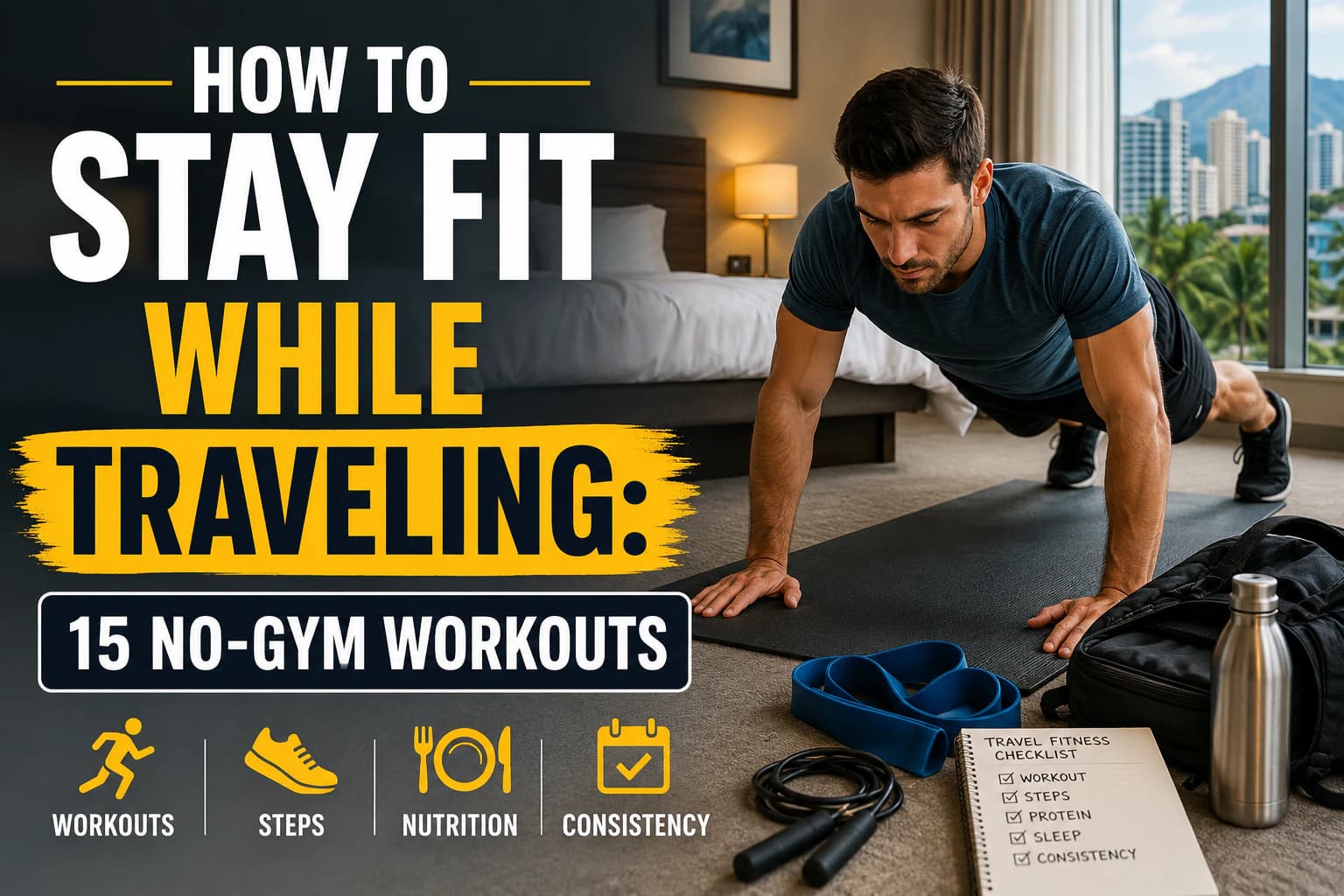
Every traveller eventually asks the same question: how do you stay fit while traveling for weeks without losing everything you built in the gym? Hotel gyms are unreliable. Local gyms are a hassle. And motivation, honestly, evaporates the moment you land somewhere beautiful.
Here's the secret nobody tells you: you don't need any of that. Short, consistent sessions and a hotel-room floor can be enough to maintain a useful level of fitness while you travel, especially when combined with regular walking and other activity.
Based on Kaiser Permanente's guidance on maintaining fitness while traveling, alongside the constraints travelers most often report: unreliable hotel gyms, limited space, and no equipment.
A note on costs: Gym day-passes, class prices and equipment costs vary by city and change over time. Confirm current rates locally rather than relying on the figures below.
A note on health advice: This is general information, not medical advice. Light movement before and during long travel can help you avoid prolonged inactivity, but it is not a substitute for medical advice or appropriate measures for people at increased risk.
The 30-second answer
To stay fit while traveling you need far less than you think: three or four bodyweight sessions a week, 15-25 minutes is a practical session length for many travelers, on a hotel room floor. These travel workouts are designed for hotel rooms, apartments, hostels, beaches, parks, and other spaces where you may not have a gym, no full gym required. Walk your exploring rather than riding it, keep protein at every meal, and try not to let two missed days become a pattern.
- Training: 3-4 sessions/week, 15-25 min, bodyweight only, no equipment needed
- Walking: exploring on foot can add substantial daily activity and may put you around common step targets without formal exercise
- The 2 km rule: consider walking trips under 2 km (1.2 miles) when safety, weather, luggage, accessibility, and time allow
- Nutrition: protein at every meal; alcohol on no more than 2 nights a week
- The one rule: do not let two missed days turn into a pattern
- Applies to: business trips, holidays and long-term travel alike, the goal is usually maintaining what you have, not maximum progression
How to stay fit while traveling: the two-rule framework
Before the workouts, adopt these two rules and the habit tends to hold:
- Any movement beats no movement. Ten push-ups against a wall count.
- Consistency beats intensity. Five short sessions may be easier to sustain than relying on one or two long weekend sessions.
That's it. That's the whole strategy.
The 15 workouts (rotate them)
For strength (do 3× per week)
Workout 1: The Classic Circuit
- 20 push-ups
- 20 bodyweight squats
- 20 walking lunges (10 each leg)
- 30-second plank
- Rest 60 seconds. Repeat 4 rounds.
Workout 2: Ladder
- Push-ups: 10, 9, 8... down to 1
- Squats: same
- Between each set, hold a 20-second plank
Workout 3: Tabata Push 20 seconds work, 10 seconds rest. 8 rounds each of push-ups, squats, mountain climbers.
Workout 4: Unilateral Focus
- 10 Bulgarian split squats per leg (foot on bed)
- 10 single-leg glute bridges per side
- 5 pistol squat progressions per leg
- 3 rounds
Workout 5: The Anti-Sitting For flight days. Just do this before bed:
- 20 hip circles each way
- 20 cat-cows
- 30-second couch stretch each leg
- 10 slow squats
For cardio (do 2× per week)
Choose lower-impact alternatives to jumping movements below (burpees, jump rope) if jumping is uncomfortable or unsuitable for you.
Workout 6: Hallway Intervals If the space is safe and clear, use short intervals of brisk walking or running the length of your hallway, 10 rounds. Rest 30 seconds between.
Workout 7: Stairs 5 minutes up-and-down at any hotel or Airbnb with stairs. Stairs are a convenient way to add a short bout of cardio when they are safe and accessible.
Workout 8: Burpee Ladder 1, 2, 3... up to 10. Then back down to 1. Under 15 minutes if you push.
Workout 9: Jump Rope (bring one) It weighs 200 grams. 3 minutes on, 1 minute off, 5 rounds.
Workout 10: Explore Runs Simplest of all: put on shoes, run 20 minutes in one direction from your accommodation, run back. You will almost always find something you would have missed.
For mobility (do daily)
Workout 11: Morning Reset 90 seconds of any movement. Cat-cow, hip circles, arm swings. That's it.
Workout 12: The 5-5-5 5 minutes yoga sun salutations, 5 minutes light walking, 5 minutes stretching.
Workout 13: The Jet Lag Killer On landing day, do 30 minutes of easy movement outside. Daylight exposure and easy movement can be useful parts of a jet-lag strategy, alongside appropriately timed sleep, meals, and activity. See our jet lag guide for the full protocol.
Workout 14: Bed Yoga Legs up the wall for 5 minutes, then supine spinal twists. Recovery-critical on travel days.
Workout 15: The 3-Minute Miracle When you're really out of time: 30 seconds each of jumping jacks, push-ups, squats, plank, glute bridges, forward fold. Done.
The one piece of gear worth carrying
A resistance band. Adds very little weight to your bag. Expands the range of exercises you can do in a hotel room for anything you couldn't do bodyweight-only: rows, presses, glute work.
Cost: Rs 800-1,500 (about USD 8-16) for a set with door anchor.
The travel nutrition secret
Travel can make it easier to eat more energy-dense restaurant food and be less active, which can affect body composition over time.
The 3 rules
Rule 1: Two meals out per day, one meal you assemble. From a grocery store: bread + cold cuts + fruit + yogurt. Restaurant portions, sauces, fried sides and drinks make calorie control harder than at home, and assembling one meal a day takes that pressure off. When you do eat out, lead with protein and vegetables.
Rule 2: Protein at every meal. Eggs, chicken, fish, Greek yogurt, beans, lentils, tofu, paneer. Protein-rich meals can support satiety and help preserve muscle when overall protein intake is adequate.
Rule 3: Alcohol max 2 nights/week (a personal travel guideline, not a medical rule). Alcohol can add calories, disrupt sleep, and make next-day choices harder for some people.
Business travel specific
Different constraints, same principles:
Pre-trip planning
- Book hotels with gyms
- Bring workout clothes (1 outfit sufficient)
- Pack resistance band
- Set morning workout as first thing
On-trip execution
- A morning workout before meetings can reduce the chance that the session gets displaced by the day's schedule
- Walking phone meetings
- Take the stairs when practical
- Lunch walks (20-30 min)
- Meal choices: protein + vegetables at business dinners
Evening strategy
- One drink max at business dinners
- 30-min walk after meals
- Keeping a reasonably consistent sleep/wake schedule can help with routine and recovery
Vacation travel: your vacation workout
Different mindset needed:
Golden rule
Enjoy while maintaining reasonable activity and nutrition habits. Vacation isn't diet time, but it isn't a free pass to abandon every habit either. Fitness maintenance = better vacation (more energy, better mood, better clothes fit).
The 80/20 rule (an editorial adherence framework, not a validated ratio)
80% of time: follow rules. 20% of time: enjoy fully.
- 6 days follow protocol
- 1 day: complete rest + indulgence
- Three to four structured sessions can be enough for a maintenance-focused travel week; additional activity is optional
The daily walk minimum
Ten thousand steps is a convenient round target rather than a medical threshold. The evidence on steps and mortality points to most of the benefit arriving by around 7,000 a day, with meaningful gains well below that. These are common practical targets, not a minimum. Most tourist days clear them without trying, so treat it as a nudge to walk rather than a bar to clear.
All-inclusive resort strategy
One of the easier travel situations in which activity can drop and food/alcohol intake can rise:
Rules for all-inclusive resorts
- Morning workout first (6-7 AM), before the day gets away from you
- Use resort gym daily (20-30 min)
- Beach walks between meals (10 min minimum)
- Water activities count (swimming, snorkeling, paddleboarding)
- Alcohol after dinner only (not throughout day)
- Protein first at buffet (fills you up, reduces overeating)
- Skip: breads, complimentary desserts most days
- Stay hydrated according to thirst, activity, climate, and individual needs
Long stays and remote work: the digital nomad fitness routine
Everything above assumes you are away for days or weeks. Living on the road for months is a different problem: nobody is going to notice if you stop, there is no return date forcing you back into a routine, and every new city resets your habits from scratch.
The fix is a fixed weekly shape that survives changing location, rather than a plan that depends on any particular gym.
The realistic target
You are not going to hit peak physique while moving between countries. Three to four hours a week can be a practical framework for maintaining a substantial amount of regular activity, strength work, and mobility for many travelers. The WHO guidance recommends at least 150 minutes of moderate aerobic activity a week alongside muscle-strengthening activity on 2 or more days, a well-structured 3-4 hour week can align with both parts of that, though the exact mix of aerobic and strength work still matters, it isn't automatic. Treat that as the goal and it is achievable almost anywhere. Treat it as a compromise and you will quit inside a month.
One example weekly template
Four sessions and one long walk, scalable to any city, any room, any energy level. Treat this as a starting example to adapt, not the correct plan for everyone.
Monday: Push (30 min)
- 4 × push-ups, 12-15 reps
- 4 × pike push-ups, 8-10 reps
- 3 × dips on a chair or bench, 10 reps
- 3 × triceps push-ups, 8 reps
- Finish with a 60-second plank
When 15 push-ups feels easy, elevate your feet on the bed.
Wednesday: Pull and core (30 min)
The hardest one on the road, because pulling needs something to pull on.
- 4 × inverted rows under a table, 8-12 reps
- 3 × resistance band rows, 12 reps
- 3 × superman holds, 20 seconds
- 3 × bicycle crunches, 20 reps
- Finish with a 60-second dead hang if you find a bar in a park
Friday: Legs (30 min)
The one people skip.
- 4 × Bulgarian split squats, foot on the bed, 10 each leg
- 3 × jump squats, 15 reps
- 3 × single-leg glute bridges, 12 each
- 3 × walking lunges, 20 steps total
- Finish with a 60-second wall sit
Sunday: Long walk or hike (60-90 min)
Not a workout, a reset. Every city has walking in it. This holds your cardio and your mood at the same time, and it is the session most likely to survive a bad week.
The long-stay kit
For a trip you carry one resistance band. For months on the road, three more items earn their weight. The whole kit is under 2 kg (4.4 lb) and costs roughly Rs 3,000-5,500 (about USD 31-58) once.
- Resistance band set, 500 g: Rs 800-1,500 (about USD 8-16). Unlocks rows, presses and glute work you cannot do bodyweight-only. The single best purchase here.
- Jump rope, 200 g: Rs 300-500 (about USD 3-5). The cheapest serious conditioning available, and it works in a car park.
- Foldable yoga mat, 600 g: about USD 10-26. Silent workouts matter when the floor below you is someone's ceiling, and your joints will notice on tile.
- Collapsible water bottle, 100 g: Rs 500-1,000 (about USD 5-10). Packs flat, and settles the hydration question in every new city.
Two optional additions once bodyweight stops being hard: a weighted vest (2-5 kg / 4-11 lb, Rs 3,000-5,000 or about USD 31-52), which also opens up rucking using the daypack you already carry, or a suspension trainer (about USD 21-37, and harder than it looks because it is unstable). A doorway pull-up bar is only worth it if you stay put for months at a time.
What each hub actually offers
Costs below are approximate monthly or per-class rates in the local market, quoted in USD because it travels better than any single local currency. Confirm them locally before you commit.
USD figures throughout this guide are approximate reference conversions at about Rs 95.5 to the dollar as of August 2026. Exchange rates move, so treat them as a sense of scale rather than a quote, and check the current rate before you budget.
Bali (Canggu): one of the densest fitness ecosystems among nomad hubs. Surf schools, yoga studios on most corners, a weekly running group at Berawa Beach, and outdoor calisthenics parks. Yoga around USD 8 a class, gyms around USD 48 a month, surf lessons around USD 30. Visas, costs and where to base yourself are in the 10-day Bali itinerary.
Chiang Mai, Thailand: Muay Thai at USD 2.50-5 a class with well-regarded instruction, gyms at USD 24-48 a month, yoga USD 6-10. Doi Suthep and Doi Inthanon give you real elevation if you want it.
Lisbon, Portugal: a 20 km (12.4 miles) coastal run from Belém to Cascais, gyms around USD 36-60 a month, an active CrossFit scene, and highly regarded surf at Ericeira and Nazaré within reach.
Mexico City: Ajusco at 3,900 m for altitude work, cheap and abundant boxing gyms, a growing CrossFit scene, and running loops in Chapultepec.
Playa del Carmen, Mexico: cenote swimming as a genuinely different cardio session, beach running along the whole coast, gyms around USD 18 a month, and established beach volleyball communities.
Medellín, Colombia: the hills are the cardio, and the city's escalators exist because of it. Gyms USD 30-48 a month, with boxing embedded in the local culture.
Use the community
Training alone for months can make consistency harder for some travelers, and every hub has an existing answer to this. Nomad Discord servers and per-city WhatsApp groups run active workout channels. Co-working spaces, Selina, WeWork and the local equivalents, host fitness events precisely because their members ask for them. Meetup still works for finding running and climbing groups.
The point is not motivation. It is that a scheduled session with other people is far harder to skip than one with yourself.
A practical first-90-day framework
Days 1-30: foundation. Fix a workout time and defend it. Learn the weekly template well enough that you are not deciding what to do. Track two metrics, not ten.
Days 31-60: consistency. Add progressive load. Settle the nutrition rules above into defaults rather than decisions. Sort out your sleep setup so it travels between rooms. Find the local community.
Days 61-90: refinement. Adjust based on what the numbers say rather than how you feel. Add sport-specific work if a goal has emerged. Get a trainer for anything that has plateaued.
By day 90 this is no longer something you are doing. It is something you are.
The travel day playbook
Flying day. Sitting for 12 hours. Everything hurts.
On the plane
- When practical and safe, move periodically: walk to the bathroom, stretch there
- Ankle circles, shoulder rolls at your seat
- Stay hydrated according to your needs and the flight conditions
On landing
- Daylight exposure, for example around 20 minutes, is a practical example, not an exact requirement
- 15-minute mobility routine
- Full meal at local dinnertime (not body clock time)
First 24 hours after arrival
- Walk as much as the day allows
- Light stretching only
- After a long flight, consider starting with easy movement and resume harder training when you feel recovered
- Extra sleep priority
The mental game
The hardest part isn't the workouts. It's the psychology.
Every new city feels like a "fresh start." Tempted to say "I'll begin the routine on Monday" for six Mondays straight.
Don't. Start the day you land. Even if it's five push-ups in a hotel bathroom.
Momentum is 90% of it. Showing up matters more than perfection.
Sleep + fitness while traveling
Poor sleep can make training, appetite, and recovery harder while traveling.
Sleep rules on the road
- Blackout curtains or eye mask
- A comfortably cool, dark room, 18-20°C (64-68°F) is a common preference, can make sleep easier for many people
- No phone in bed
- 45 min no-screen before sleep
- Same local wake time daily
See our complete sleep guide for the full protocol.
The metrics that matter
Forget the scale. Track:
- Can you do the same push-up count as a month ago? (Strength)
- Can you walk 5 km (3.1 miles) without soreness? (Endurance)
- Can you move comfortably through your usual range of motion? (Mobility)
- 7+ hours sleep most nights? (Recovery)
- Hitting your step target most days? (Baseline activity. See how many steps a day you actually need)
If yes to all four, you're winning.
The uncomfortable truth
You'll fall off. Everyone does. What separates travelers who stay fit for years from those who lose it in three months is how fast they come back, not discipline.
A missed week is a missed week. It only becomes a problem when you decide it means something about you, because that is the version people don't come back from.
That's the whole game.
Quick reference card
Save to phone. Bookmark. Print. Pull it up on your next trip.
Morning routine (20 min)
- 3 min warmup (jumping jacks, arm circles)
- 15 min circuit (see workouts above)
- 2 min cool down (stretching)
Daily targets
- Regular walking / a step target appropriate for your current level
- Hydrate according to your needs
- Protein-rich meals
- Aim for sufficient sleep, ideally with a consistent wake time when practical
Weekly targets
- 3-4 workouts/week as a practical maintenance target
- 1 long walk/run
- 1 rest day
- 2 alcohol nights max
Worth avoiding
- Taking Uber under 2 km (1.2 miles) when walking is safe and practical
- Sitting for 2+ hours without moving
- Keep alcohol away from workouts when it affects your sleep or recovery
- Choose a meal pattern that fits your hunger, schedule, and nutrition needs, breakfast isn't required for everyone
Follow these consistently and you give yourself a much better chance of returning from a trip having maintained your fitness and activity. That's the game.
Related reads:
Frequently asked questions
Answers to the most common questions about this topic.
Yes. HIIT (High Intensity Interval Training) is genuinely time-efficient, and a meta-analysis of 13 controlled trials found interval training improved VO2max more than steady moderate cardio in healthy adults. That does not mean a fixed minute-for-minute trade against longer sessions, and it is demanding, so build up if you are deconditioned. Structure: 30 sec work + 30 sec rest × 15 rounds. Exercises: burpees, mountain climbers, jump squats, high knees. Or Tabata: 20 sec × 8 rounds (4 min per exercise). Multiple 15-min sessions per week can be easier to sustain than relying on a single 90-min weekend session.
Before flight: a light workout 4+ hours before can be a reasonable choice for some travelers and may help with sleep on the flight. Light movement before and during long travel can help you avoid prolonged inactivity, but it is not a substitute for medical advice or appropriate measures for people at elevated DVT risk, follow clinician guidance if that applies to you. After flight: not immediately at full intensity. After a long flight, fatigue, dehydration, disrupted sleep, and jet lag can make hard training feel more difficult, start with easy movement and increase intensity as you recover. Day 1 after flight: walking + stretching only. Day 2: light workout. Day 3+: normal intensity, if you feel recovered. See our jet lag guide.
Kids workouts: (1) Pool time (swimming counts), (2) Beach games (frisbee, running), (3) Hiking/exploring (any 1-hour walk works), (4) Family yoga (many hotels offer), (5) Bike rides in bike-friendly destinations. Include kids in your workouts: they'll enjoy 15-min bodyweight circuits. Prioritize: sleep for you AND them (poor kid sleep = zero parent fitness).
(1) 30-min workout at each stop (rest area burpees + squats), (2) Every 2 hours: walk 5 minutes, (3) One decent meal preparation per day (assemble from grocery), (4) Hotel gym check before booking, (5) Weight training with resistance bands in hotel evenings, (6) Choose hotels with pools, (7) National parks: use trails for hiking cardio, (8) Track steps daily as accountability.
Options: (1) Common area early morning (before others wake), (2) Rooftop or garden if available, (3) Outdoor spot 5 min walk away, (4) Hotel gym (if hostel has one), (5) Nearby parks with calisthenics equipment, (6) Local gym drop-in (Rs 200-500, about USD 2-5 in India; day passes cost more in most other countries). Silent workouts (yoga, isometrics) if only bedroom option. Shared space does not have to prevent you from finding a practical way to move.
Free options: (1) Nike Training Club (curated workouts), (2) FitOn (variety of trainers), (3) 7 Minute Workout (quick sessions), (4) Down Dog (yoga customization). Paid: (1) Peloton App (Rs 1,000/month): best variety, (2) Athlean-X (specific programs), (3) MadFit (30-day challenges). Download workouts offline before flights. Choose apps with app for offline viewing.
Plenty of options: (1) Hotel room workout (20 min covers everything), (2) Nearby gym drop-in (Rs 200-500/day in India, about USD 2-5; more elsewhere), (3) Public park calisthenics equipment, (4) Beach workout, (5) Stairs of the hotel (climb 10 floors), (6) Local yoga class, (7) Running route mapped in advance, (8) Free walking tour (60-90 min cardio). Creativity + intention = fitness anywhere.
Common practical targets rather than medical thresholds: most of the mortality benefit arrives by about 7,000 steps, 10,000 is a convenient round goal, and 15,000+ is a genuinely active sightseeing day. Structured walking (destinations, tours) counts. Track with phone or watch. Consider walking trips under 2 km (1.2 miles) when safety, weather, luggage, accessibility, and time allow. Walk unless: (1) Safety concern, (2) Time-sensitive, (3) Heavy luggage, (4) Health limitation. Walking is the underrated travel fitness.
Weight loss while traveling is possible, but the rate varies substantially and there's no guaranteed number. A modest calorie deficit, regular activity, protein-rich meals, and adequate sleep can support the goal, but travel makes intake and activity harder to predict than at home, restaurant portions, alcohol, disrupted sleep and unfamiliar food all add noise to the calorie math. See our belly fat guide. Trip-based weight loss requires discipline: most vacations end up closer to maintenance, and that's a reasonable outcome too.
A protein-rich meal or snack, a 20-30g serving with some carbs is a practical example, can be a reasonable choice after training, but there is no need to rush: a meta-analysis of 23 studies found the apparent benefit of eating immediately after a workout largely disappeared once total daily protein was equated, and the useful interval runs to several hours. Total protein across the day matters more than hitting an exact post-workout window. Options: (1) Chicken/paneer curry + rice, (2) Eggs + toast, (3) Whey protein + banana, (4) Greek yogurt + fruit + granola, (5) Local protein-rich cuisines (Thai chicken satay, Balinese chicken sate). Skip: sugary drinks, only carbs, high-fat post-workout. Available everywhere internationally.
(1) Longer warm-up in cold/humid environments (5-10 min vs 3), (2) Test surface (hotel carpet vs marble = different traction), (3) Bring own resistance bands (unknown gym equipment quality), (4) Hydration becomes especially important in hot or humid environments, (5) Adjust intensity if jet-lagged, (6) Listen to body: travel isn't PR time. Better: maintain fitness. Worse: injure yourself abroad, expensive medical.
Post-travel day recovery: (1) 20-min walk on arrival, (2) 15-min stretching + foam roller (or tennis ball substitute), (3) Legs-up-the-wall pose 5 min, (4) A normal meal, hydration, gentle movement, and sleep are the fundamentals, some people also like a contrast shower, (5) Light dinner (avoid heavy meal), (6) Bedtime by 10 PM local, (7) if you already use supplements like magnesium, follow appropriate product or clinician guidance rather than a fixed dose. Full workouts resume day 2. Rest and recovery can become more important when travel adds jet lag, long periods of sitting, disrupted sleep, or unusual activity.
Filed under
Written by
We research travel, fitness and wellness, and publish what holds up. See our editorial policy.