How to Improve Gut Health (Probiotics Aren't Step One)
How to improve gut health: probiotics are rarely step one. The evidence points to fiber targets and 30 plants a week.
Ask how to improve gut health and you will mostly be sold something. Probiotic capsules, cleanse kits, powders promising to seal a leaky gut. The evidence points somewhere considerably cheaper and less exciting: feed the microbes you already have, mostly with plants.
This guide covers what the research supports, where a widely repeated trend gets ahead of the evidence, and what to do first if you are starting from an ordinary diet.
A note on health advice: This is general information, not medical advice. Persistent digestive symptoms need proper assessment rather than self-directed dietary experiments. Speak to a doctor before making significant changes if you have an existing condition or take regular medication.
The 30-second answer
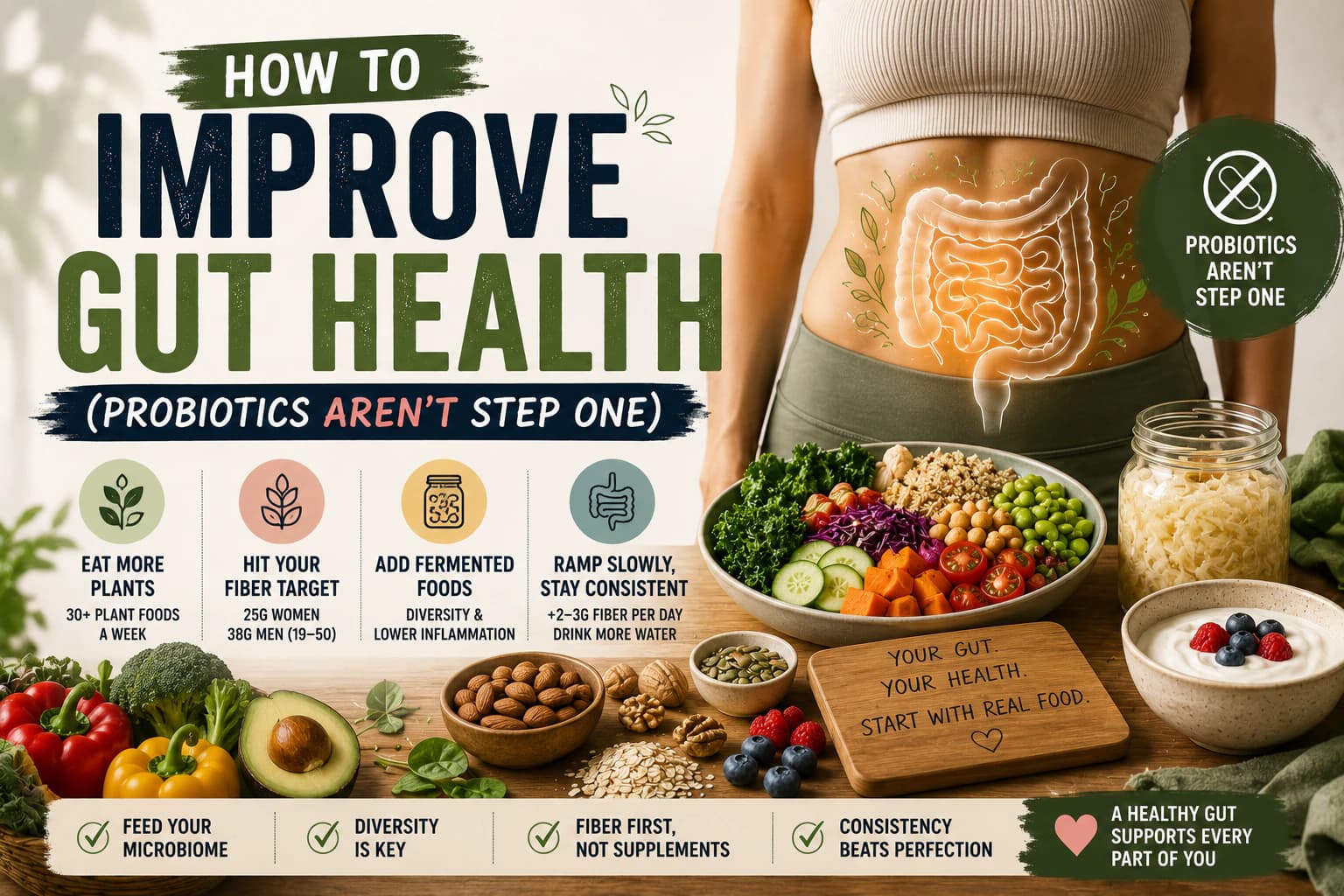
How to improve gut health starts with eating more plants, and more different plants: the most diverse microbiomes in the American Gut Project belonged to people eating 30+ plant foods a week. Hit a real fiber target, add fermented foods, and increase fiber slowly. Probiotic supplements are not step one.
- 30 plants a week: the single strongest dietary signal for microbiome diversity
- Fiber target: 25g/day for women, 38g for men under 50 (21g and 30g after)
- Typical intake: 15-17g, most people are roughly half short
- Fermented foods: raised diversity and lowered inflammatory markers in a Stanford trial
- Ramp slowly: +2-3g fiber per day, with more water, to avoid bloating
- Probiotics: strongest evidence is narrow, IBS and antibiotic-associated diarrhea
Fibermaxxing: the trend, and what it gets right
"Fibermaxxing" started on TikTok and Reddit and describes deliberately maximizing daily fiber, engineering meals around high-fiber foods to reach 30-40g or more, rather than just clearing a minimum. Health media in 2026 widely described it as displacing protein as the nutrient of the moment, though that is a read on attention rather than a measured figure.
What it gets right: most people genuinely are under-eating fiber, and fiber has strong evidence behind it for all-cause mortality, insulin sensitivity and microbiome diversity. The mechanism is reasonably well understood, gut bacteria ferment fiber into short-chain fatty acids, which feed the cells lining the gut and moderate inflammation.
What it gets wrong: the speed. Going from 17g to 40g overnight reliably produces gas, bloating and cramping, and that's often enough for people to conclude fiber "doesn't agree with them" and stop. There is also no evidence that pushing far past the recommended range keeps adding benefit.
How much fiber you actually need
The widely cited targets are 25g a day for women and 38g for men, against an average intake of roughly 15-17g, so most people are 10 to 20 grams short every day.
Those figures are the Institute of Medicine's Adequate Intake values, and they are age-banded, which most articles quoting them leave out:
| Ages 19-50 | Ages 51+ | |
|---|---|---|
| Women | 25g/day | 21g/day |
| Men | 38g/day | 30g/day |
The underlying basis is 14g of fiber per 1,000 calories eaten, so someone eating less food needs proportionally less fiber. Other authorities frame it differently: Harvard's Nutrition Source gives a single range of 25-35g a day for adults and puts average US intake near 15g. The exact number is contested; the shortfall is not.
That is the more useful figure. Almost everyone is meaningfully under, so the practical question is not "what is my exact target" but "how do I close a 15-gram gap without spending two weeks bloated."
Soluble and insoluble fiber
Both matter, and most plant foods contain both.
| Soluble | Insoluble | |
|---|---|---|
| Behavior | Dissolves, forms a gel | Does not dissolve |
| Main jobs | Feeds gut bacteria, slows fat absorption, lowers cholesterol and blood sugar, increases fullness | Adds bulk, moves waste through the intestines |
| Helps with | Metabolic markers, satiety | Constipation, regularity |
Oats illustrate the split well: roughly 100g of dry oats provides about 10g of total fiber: approximately 5.8g insoluble and 4.2g soluble.
Soluble fiber's effect on post-meal blood sugar pairs with another simple habit: a short walk after eating blunts the same glucose rise, as covered in our guide to daily step counts.
Prebiotics are simply the fermentable fibers, such as pectin, that your existing bacteria break down. That is the whole concept, and it is why prebiotic fiber is generally recommended before probiotic supplements: you are feeding the ecosystem you have rather than importing a new one.
How to improve gut health: start with 30 plants a week
The most widely repeated finding in this area comes from the American Gut Project, now continued as The Microsetta Initiative at UC San Diego: people with the most diverse gut microbiomes ate more than 30 different plant foods per week.
Worth knowing what that study was and was not. It compared people eating more than 30 plant types against people eating 10 or fewer, with roughly 40 people in each group, and it was observational and self-reported: participants were not assigned to eat differently. So it shows an association, not proof that eating more plants causes a more diverse microbiome, and "30" is the upper bin of a comparison rather than a validated threshold. The direction is well supported and the advice is low-risk; the precision of the number is not.
The critical detail is that this measures variety, not volume. It counts:
- Herbs and spices
- Nuts and seeds
- Whole grains
- Beans, lentils and pulses
- Vegetables and fruit, across different colors
Thirty sounds daunting until you count a single meal properly. A mixed-bean salad with tomato, red onion, parsley, olive oil and a few seeds is six or seven plants in one bowl. Most people already eat 12-15 and simply repeat the same ones.
What the Stanford trial actually found
Most gut-health content skips this part.
A Stanford School of Medicine trial published in Cell in 2021 took 36 healthy adults and randomly assigned them to ten weeks of either a fermented-food diet or a high-fiber diet.
| Arm | Microbial diversity | Inflammatory markers |
|---|---|---|
| Fermented foods | Increased: larger servings, stronger effect | Decreased |
| High fiber | Stayed stable on average | None of the 19 proteins measured decreased |
That result cuts against the simple "eat more fiber" message, and it deserves honest handling rather than being quietly dropped.
It does not mean fiber is useless. Fiber's strongest evidence is in long-term outcomes: all-cause mortality, insulin sensitivity, short-chain fatty acid production, which a ten-week trial measuring diversity and inflammation is not designed to capture. The most reasonable reading is that ten weeks is too short to shift diversity through fiber alone, and that the two approaches work through different mechanisms on different timescales.
The practical conclusion is to do both.
Fermented foods: which ones have evidence
An important distinction first: a fermented food is not automatically a probiotic. Containing live cultures does not meet the scientific definition, which requires specified strains, in adequate amounts, with a demonstrated benefit. Fermented foods can be worth eating without clearing that bar.
The evidence is uneven within the category. Nearly all of these have been through some human randomized trial, but the depth varies enormously, and the outcomes measured are often not gut-related at all:
| Food | Strongest human evidence | Strength |
|---|---|---|
| Yogurt | Multiple systematic reviews; RCTs on lactose digestion and diarrhea | Strong |
| Kefir | Systematic reviews and meta-analyses of RCTs (glycemic control, cardiometabolic) | Moderate |
| Sourdough | Systematic review plus RCTs on post-meal glucose | Moderate |
| Kimchi | Scoping review of 11 RCTs, 638 participants (mostly lipids and body fat) | Moderate |
| Sauerkraut | Pilot RCT in 34 IBS patients; included in an IBS meta-analysis | Weak |
| Kombucha | Two small RCTs (n=12 and n=11), glucose outcomes | Weak |
| Miso | One 6-week RCT (n=64) on low-sodium miso and blood pressure | Weak |
| Natto | Many RCTs, but on nattokinase, the isolated enzyme, not the food | Weak for the food |
| Tempeh | No randomized controlled trial identified | Insufficient |
Two things follow. Most of this evidence measures metabolic outcomes rather than gut health directly, so it does not straightforwardly support gut-specific claims. And the Stanford trial used a mix: yogurt, kefir, fermented cottage cheese, kimchi, fermented vegetables, brine drinks and kombucha, so what it demonstrated was a benefit from the pattern, not from any single food.
The practical reading: eat a variety of them rather than betting on one.
Do you need probiotic supplements?
For general gut health, usually not. Experts rarely lead with probiotics, recommending instead that people nourish the ecosystem already present.
Where the evidence is strongest: though still contested:
- Irritable bowel syndrome: specific strains reduce overall symptom burden and abdominal pain in some patients
- Antibiotic-associated diarrhea: a Cochrane review found moderate-certainty evidence for preventing C. difficile-associated diarrhea
Worth knowing that expert bodies disagree here. The American College of Gastroenterology recommends against probiotics for preventing C. difficile infection, taking a different reading of the same evidence than Cochrane or the American Gastroenterological Association. So "strongest evidence" means strongest relative to general wellness use, not settled.
Both are specific clinical situations, not general wellness. Effects also vary substantially by strain, dose and individual, so a generic multi-strain capsule is not reliably useful. If you have a specific reason to take one, choose a strain with research behind that particular need and discuss it with a healthcare provider.
High-fiber foods worth building around
These are total fiber figures, which is what the daily targets refer to. Values from the Mayo Clinic high-fiber food chart.
| Food | Total fiber |
|---|---|
| Split peas, 1 cup cooked | 16.3g |
| Lentils, 1 cup cooked | 15.6g |
| Black beans, 1 cup cooked | 15.0g |
| Lima beans, 1 cup cooked | 13.2g |
| Artichoke, 1 medium cooked | 10.3g |
| Green peas, 1 cup cooked | 8.8g |
| Broccoli, 1 cup boiled | 5.1g |
One cup of lentils covers roughly two-thirds of a woman's daily target on its own, so legumes do most of the work in any realistic plan. Beyond these, reliable contributors include chickpeas, berries, pears eaten with the skin, chia and flax seeds, and nuts.
Whole foods generally beat fiber supplements here, because they deliver variety alongside the fiber, and variety is what the 30-plant finding actually rewards. For how fiber interacts with appetite and a calorie deficit, our belly fat guide covers the satiety side in more detail.
How to increase fiber without wrecking your week
The bloating that puts people off fiber is avoidable, and it comes down to pace.
- Increase gradually. The NIDDK advises adding fiber to the diet gradually so the body adjusts, without specifying a rate. Commonly used practical guidance is around 2-3g a day, or no more than about 5g a week if you are sensitive.
- Raise water alongside it. Fiber absorbs water, and the NIDDK explicitly advises drinking plenty of water and other liquids when you increase fiber or take a supplement. Fiber without fluid makes constipation worse, not better.
- Expect a transition period. Gas happens because bacteria ferment fiber, and a sudden jump outpaces the bacterial balance available to process it.
- Give it three to four weeks. Research on people adding beans found gas production returned to normal levels within about that window as the body adapted.
If the reaction is severe, or symptoms do not settle after several weeks, raise it with a medical professional rather than pushing through.
Gut health myths worth dropping
"You need to detox or cleanse your gut." No. The liver and kidneys handle this continuously. There is no evidence commercial cleanses improve on that, and they can cause nutrient deficiencies and disrupt the very microbiome you are trying to support.
"Leaky gut syndrome is a diagnosis." Intestinal permeability is a real phenomenon, but "leaky gut syndrome" is not a well-defined medical diagnosis, and the term is widely used to sell supplements and elimination protocols. Persistent symptoms deserve assessment, not a purchased protocol.
"One superfood fixes your gut." The diversity finding points the opposite way: thirty different plants beat a large quantity of one.
"More fiber is always better." There is no evidence that pushing far beyond the recommended range keeps adding benefit, and rapid increases cause real discomfort.
Gut health and mental health
The connection is genuine, but one popular version of it is wrong, and it is worth separating the two.
You will often read that around 90% of the body's serotonin is produced in the gut, presented as if that explains mood. The figure is accurate. The inference is not: gut-derived serotonin does not cross the blood-brain barrier, so it does not top up the serotonin your brain uses. Peripheral serotonin does other jobs: regulating gut motility, coordinating digestive reflexes, signalling along the vagus nerve.
The real mechanism is that vagus nerve, which carries two-way signals between gut and brain. Animal work shows changes in gut signalling can alter behaviour, and that some of those effects disappear if the vagus nerve is cut. Some trials of probiotic supplementation and fiber-rich diets have reported anxiety reductions in a share of participants, though effect sizes and study quality vary.
Two caveats. This is not a substitute for treatment, and it is slow. Expect around eight weeks before judging any effect. Our anxiety techniques guide covers the approaches with the strongest clinical evidence.
Does exercise improve gut health?
Probably, though less dramatically than diet. A 2025 systematic review and meta-analysis of randomized trials in overweight and obesity found a significant effect of exercise on beta diversity, the difference in microbial composition between people.
The caveat: short-chain fatty acid results have not held up. Across 18 studies, only one reported a significant increase in fecal SCFAs, and that trial combined exercise with probiotic yogurt. Exercise appears to shift composition; the downstream benefit is unproven.
Does poor sleep affect gut bacteria?
The signal is real but weaker in humans than headlines suggest. A 2026 systematic review and meta-analysis of 20 studies found sleep deprivation reduced alpha diversity and raised the Firmicutes-to-Bacteroidetes ratio, but most of that came from rodents, and the human studies showed non-significant trends limited by small samples.
One human trial found severe sleep restriction cut microbial richness by 21% on one measure while two other indexes were unchanged, and intestinal permeability did not change. Worth protecting sleep; not worth claiming more. See our sleep reset guide.
Does stress affect your gut?
The mechanism is well described. Psychological stress activates the HPA axis and sympathetic nervous system, releasing catecholamines and glucocorticoids. Cortisol influences gut motility, secretion and immune function directly, and sustained activation is associated with increased intestinal barrier permeability and dysbiosis. Cortisol itself is not the villain it is often made out to be, as our guide to the cortisol detox claims sets out.
What is missing is human trial data, researchers consistently note that controlled human studies remain limited and inconsistently designed. A coherent pathway, not a quantified one. Our anxiety techniques guide covers stress reduction with clinical evidence behind it.
Does drinking more water help?
For constipation, yes, a systematic review in the Journal of Clinical Gastroenterology found increased fluid intake significantly improves symptoms in functional constipation, and low intake reduces fecal water content. Fiber without fluid backfires for the same reason.
For the microbiome itself, the evidence is associational: bacterial abundance differs between low and high water intake groups. Useful, but not a reason to drink beyond thirst.
Common mistakes
- Buying probiotics before changing diet. The most expensive intervention has the weakest general-population evidence.
- Increasing fiber too fast. The resulting bloating gets misread as intolerance.
- Adding fiber without water. Reliably makes constipation worse.
- Eating the same five vegetables. Volume without variety misses what the diversity research actually measured.
- Treating fermented foods and probiotics as interchangeable. Different definitions, different evidence.
- Expecting results in a week. The trial that found diversity changes ran ten weeks.
- Self-diagnosing from a symptom list. Bloating and fatigue are non-specific and overlap with conditions that need proper assessment.
What nobody tells you
- Herbs and spices count toward your 30 plants. Most people never count them, and a well-seasoned meal can add three or four.
- The fermented-food result outperformed the fiber result in the one trial that compared them head to head. Almost no gut-health content mentions this, because it complicates the message.
- Frozen vegetables count. They are cheaper, last longer, and contribute to plant variety identically.
- Gas during a fiber increase is a sign the fermentation is happening, not a sign of intolerance, provided it settles within a few weeks.
- Kombucha has less gut-specific trial evidence than sauerkraut, despite costing several times more.
- Your existing microbiome is more valuable than any capsule you can buy. The entire logic of prebiotics is that feeding it beats replacing it.
A realistic 4-week plan
| Week | Focus |
|---|---|
| 1 | Count, don't change. Track how many different plants you eat in a week and roughly where your fiber sits. Most people are surprised. |
| 2 | Add one bean or lentil serving most days, and increase water. Target roughly +2-3g fiber per day, no faster. |
| 3 | Add variety rather than volume: different colors, herbs, seeds, a new grain. Aim to add 5-8 new plants to your weekly rotation. |
| 4 | Add one fermented food daily. Kefir, sauerkraut or plain yogurt are the easiest starts and have the better evidence. |
Hold this pattern rather than escalating. If week two produces significant bloating, repeat it rather than advancing, the adaptation window is three to four weeks.
When to see a doctor
Some symptoms are not dietary problems. Seek medical advice for:
- Blood in the stool
- Unintentional weight loss
- Persistent vomiting or difficulty swallowing
- Severe or worsening abdominal pain
- Symptoms that wake you at night
- Any change in bowel habit lasting more than a few weeks
- A family history of bowel disease or bowel cancer
General information on digestive conditions is published by the NIDDK.
The bottom line
The commercial version of gut health sells capsules. The evidence version is mostly a shopping list: beans, oats, a wider range of vegetables, some herbs, and something fermented most days.
If you do one thing, count your plants for a week, not portions, varieties. Widening the range is low-risk, costs less than a month of probiotics, and the supporting evidence points consistently in one direction, even if the specific figure of 30 comes from an observational comparison rather than a trial. Add Harvard's fiber guidance as a reference if you want to go deeper on targets, and increase slowly enough that you actually stick with it.
References
- American Gut: an Open Platform for Citizen Science Microbiome Research. mSystems, 2018. Link
- Gut-microbiota-targeted diets modulate human immune status. Cell, 2021. Stanford Medicine summary
- Harvard T.H. Chan School of Public Health, Nutrition Source: Fiber. Link
- NIDDK, Digestive Diseases and Treatment for Constipation. Link
- Institute of Medicine, Dietary Reference Intakes for total fiber, via Linus Pauling Institute
- Mayo Clinic, Chart of high-fiber foods.
- Effects of kimchi on human health: a scoping review of randomized controlled trials. Journal of Ethnic Foods, 2023.
- Lacto-fermented sauerkraut improves symptoms in IBS patients independent of product pasteurisation. 2018. PubMed
- Cochrane Database, Probiotics for preventing C. difficile-associated diarrhoea.
- American College of Gastroenterology, guidance on probiotics and C. difficile prevention.
- Effect of exercise on the human gut microbiota in overweight and obesity: systematic review and meta-analysis of RCTs. 2025.
- Sleep Deprivation Alters Gut Microbiome Diversity and Taxonomy: A Systematic Review and Meta-Analysis. Journal of Sleep Research, 2026. PubMed
Related reads:
Frequently asked questions
Answers to the most common questions about this topic.
The microbiome responds to dietary change within days, but meaningful, measurable shifts take longer. The clearest anchor is the Stanford trial, which ran ten weeks to detect changes in diversity and inflammation. Reported timelines for digestive comfort after a fiber increase are shorter, commonly given as a few weeks, though these come from general clinical guidance rather than a single definitive trial. Treat gut health as a dietary pattern rather than a protocol with an end date.
This is an active research area rather than a settled question, and the honest position is that the evidence is mixed and still developing. Some studies suggest certain sweeteners may alter microbial composition, but findings vary by sweetener, dose and individual, and much of the work is in animals or short-term. It is not currently possible to give a confident general recommendation. If you want to be cautious while the evidence matures, treat them as something to moderate rather than something proven harmful.
Antibiotics affect gut bacteria as well as the infection being treated, which is why antibiotic-associated diarrhea is common. Probiotics have reasonable evidence for reducing that specific complication, which is one of the situations where supplementation is genuinely supported. Never skip or shorten a prescribed course over microbiome concerns. Support recovery afterwards with varied plant foods and fermented foods, and raise persistent symptoms with your prescriber.
Common indicators include persistent bloating, gas, irregular bowel habits, unexplained fatigue and food intolerances that develop over time. The difficulty is that these are non-specific and overlap with many other conditions, which is exactly why self-diagnosis from a symptom list is unreliable. Symptoms that persist for weeks, or that are severe, warrant medical assessment rather than a self-directed protocol.
Seek medical advice for blood in the stool, unintentional weight loss, persistent vomiting, difficulty swallowing, severe or worsening abdominal pain, symptoms that wake you at night, or any change in bowel habit lasting more than a few weeks. Also seek advice if you have a family history of bowel disease or bowel cancer. These are not situations for dietary experimentation. General information on digestive conditions is published by the NIDDK.
Yes, and the cheapest options are among the best. Dried beans, lentils and oats are inexpensive, high in fiber and among the most useful foods for the microbiome. Frozen vegetables and fruit count toward plant variety and cost less than fresh. Sauerkraut can be made at home from a cabbage and salt. Meanwhile the expensive end of this category: probiotic supplements, cleanse kits, specialty powders, carries the weakest evidence per unit of spend.
Filed under
Written by
We research travel, fitness and wellness, and publish what holds up. See our editorial policy.