Creatine for Women: What the Evidence Actually Shows
Creatine for women: what the research supports on dose, muscle, menopause, hair loss and bloating, and what it does not.
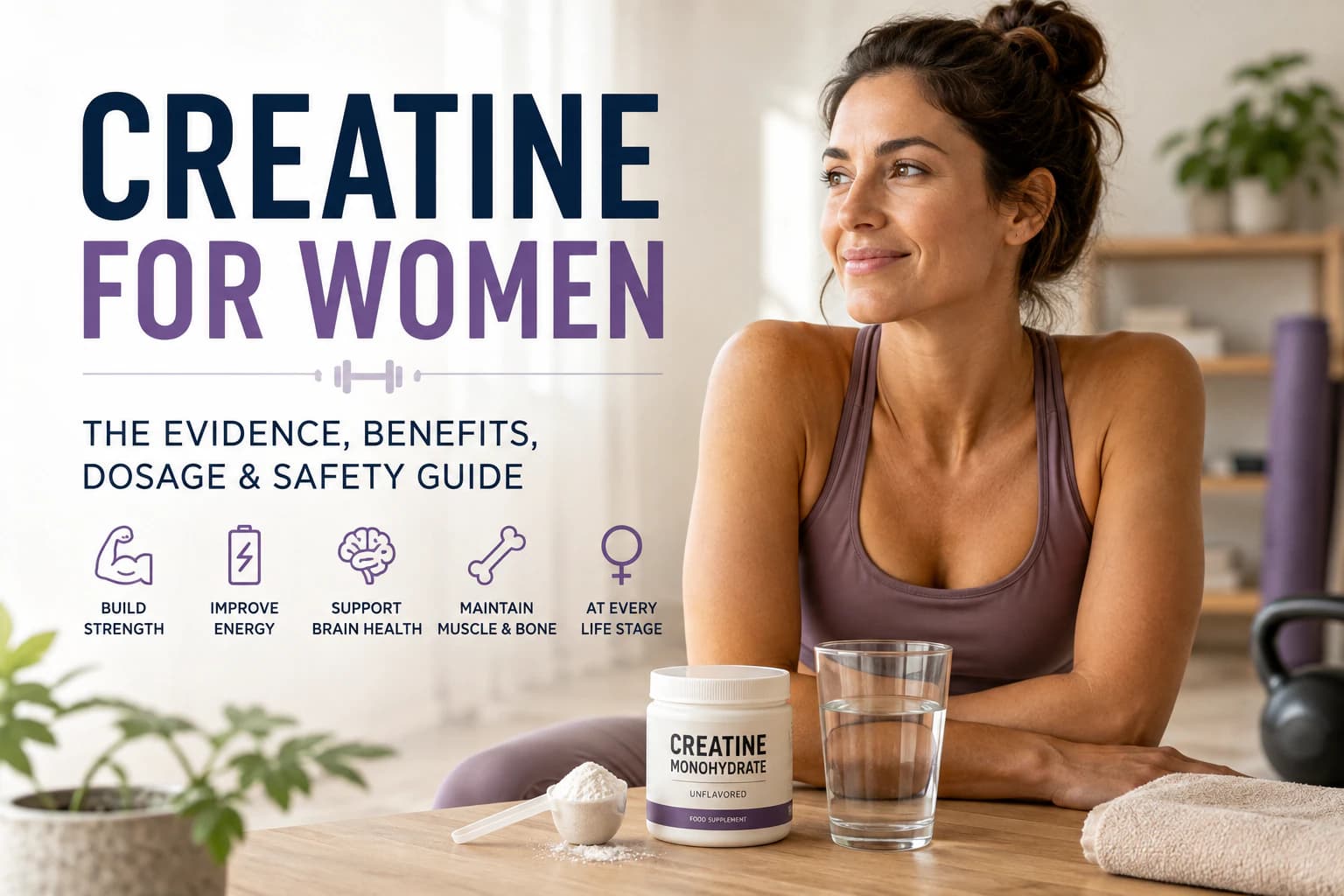
Creatine has moved out of the weights room and into women's health, and the claims have expanded with it. Depending on which page you land on, it builds muscle, protects your bones, sharpens your memory and eases the menopause transition.
Some of that has decent evidence behind it. Some of it does not, and one widely reported 2026 trial was paid for by the company selling the product it tested.
This guide covers what the research on creatine for women actually supports at each life stage, what dose the trials used, and which of the common worries hold up.
A note on health advice: This is general information, not medical advice. Supplement research in women is thinner than in men, and much of the strongest data comes from postmenopausal participants rather than women of all ages. Anyone who is pregnant or breastfeeding, has kidney disease or another medical condition, or takes regular medication should speak to a clinician before starting creatine.
The 30-second answer
Creatine is one of the best-studied supplements available, and it is inexpensive and well tolerated by most women at customary doses. The benefits are also smaller and more conditional than the marketing suggests. In postmenopausal women the strongest evidence comes from pairing at least 5 g a day with resistance training. Evidence in younger women is thinner.
- Typical dose: 3 to 5 g a day of creatine monohydrate, taken consistently
- Loading is optional: around 20 g a day for 5 days saturates faster, not better
- Muscle effect: small in women, and not statistically significant in the best sex-stratified analysis
- Postmenopausal: 0.37 kg lean mass and 7.5 kg leg press in a 2026 meta-analysis, with training
- Bone density: unchanged in that same analysis, despite the common claim
- Which form: plain monohydrate, the cheapest and by far the best studied
What creatine actually does
Creatine is a compound your body makes and also obtains from meat and fish. Most of it is stored in muscle as phosphocreatine, where it helps regenerate the energy currency your muscles use during short, hard efforts.
Supplementing raises those stores. The practical consequence is that you can do slightly more work before fatigue sets in: another repetition, a little more load, a slightly better session.
That mechanism matters for reading the rest of this guide. Creatine does not build muscle by itself. It improves the quality of the training that builds muscle, which is why the evidence looks so different depending on whether the people in a trial were lifting or not.
Does creatine work as well for women as for men?
For muscle, the honest answer is that it appears to work less well, and this is the finding most often left out.
A systematic review and meta-analysis published in Nutrition in 2022 examined how age, sex and exercise type affect creatine's impact on lean body mass. The sex-stratified result:
| Group | Change in lean body mass | 95% confidence interval |
|---|---|---|
| Men | +1.46 kg | 0.47 to 2.46 |
| Women | +0.29 kg | -0.43 to 1.01 |
The women's confidence interval crosses zero, which means the result is compatible with no real effect. The same analysis found that creatine taken without any training was ineffective for lean mass in either sex.
This does not mean creatine does nothing for women. Strength and performance outcomes look more consistent than lean mass, and the postmenopausal evidence below is more encouraging. It does mean the muscle-building claim that drives most creatine marketing rests on weaker ground in women than the marketing implies.
What the evidence shows at each life stage
The research is not evenly distributed, and the differences matter enough that lumping all women together produces a misleading picture.
Premenopausal women
A review of creatine across women's lifespan concludes that supplementation in premenopausal women appears effective for improving strength and exercise performance. That is a narrower claim than body composition change, and it is the claim best supported at this life stage.
The same review is candid that the female evidence base is thin relative to the male one, and that the interaction between creatine and the menstrual and reproductive cycle has not been properly studied.
Perimenopause
This is where the evidence is weakest, and where the most confident marketing currently sits.
The main perimenopausal data comes from CONCRET-MENOPA, a 2026 randomised controlled trial in the Journal of the American Nutrition Association. It enrolled 36 perimenopausal and menopausal women, average age 50.1, across four groups over eight weeks: creatine hydrochloride at 750 mg a day, hydrochloride at 1,500 mg a day, hydrochloride plus ethyl ester at 800 mg a day, and placebo. That works out at roughly nine women per group.
The medium dose outperformed placebo on reaction time and raised frontal brain creatine levels, and the authors reported improvements in several clinical measures.
Two things need saying about that trial. The first is its size: 36 participants split four ways is a pilot-scale study, not a basis for firm recommendations. The second is its funding. The trial was sponsored by Vireo Systems, the company that manufactures the branded creatine hydrochloride and ethyl ester it tested, and which markets those forms as offering superior bioavailability at lower doses. The trial concluded that low doses of those forms worked.
That does not make the results wrong. Industry-funded research can be perfectly sound, and this one was registered in advance as NCT06660004. It does mean the finding needs independent replication before anyone builds a dosing recommendation on it. The study's own lead researcher said a direct comparison against creatine monohydrate at equivalent amounts is a critical next step, and called for longer trials that analyse perimenopausal and menopausal women separately.
Postmenopausal women
This is the strongest evidence available, and it is recent.
A 2026 systematic review and meta-analysis pooled seven randomised controlled trials covering 608 postmenopausal women, average age around 62, with trial durations from 12 to 104 weeks and a median of 38 weeks.
| Outcome | Result |
|---|---|
| Lean mass | +0.37 kg |
| Leg press 1RM | +7.5 kg |
| Bone mineral density | Unchanged |
| Adverse events | Mild, comparable to placebo |
| Kidney function markers | Unchanged |
The conditions attached to that result are as important as the numbers. Benefits appeared when at least 5 g a day was combined with resistance training. Trials using 3 g a day or less without resistance training showed no measurable effect.
Read plainly: this is a small but real gain, in a specific population, achieved over months, alongside training that was doing most of the work.
How much creatine should a woman take?
Three to five grams a day of creatine monohydrate is the standard maintenance dose, taken consistently rather than timed around sessions.
The 5 g threshold in the postmenopausal analysis is worth knowing, but it was established in postmenopausal women specifically and should not be treated as a universal minimum for every woman at every age. Nor does the finding that low doses without training did nothing for lean mass mean creatine is useless below 5 g for every purpose. Cognitive research, for example, has used quite different protocols.
One popular rule is worth ignoring: the idea that women under a certain body weight need 3 g while heavier women need 5 g. That figure circulates widely on supplement sites and does not appear to rest on trial evidence.
Do you need to load?
No, unless you are in a hurry.
The standard loading protocol is around 20 g a day, split into four doses, for five days, after which a maintenance dose keeps stores topped up. Loading saturates muscle faster. It does not produce a better end state.
Taking 3 to 5 g a day from the start reaches full muscle saturation in about three to four weeks and tends to cause fewer digestive complaints. For most people that is the sensible route.
Does creatine cause hair loss?
This is one of the most common reasons women avoid creatine, and the evidence does not support it.
Where the fear came from. A 2009 study in college rugby players reported a short-term rise in dihydrotestosterone, a testosterone metabolite associated with pattern hair loss. That study did not measure hair loss, did not examine hair follicles, and did not follow anyone beyond three weeks. It measured a hormone and the internet supplied the conclusion.
What has happened since. A 2025 randomised controlled trial gave 5 g a day of creatine monohydrate for 12 weeks and measured what the 2009 study did not: hair density, follicular unit count and cumulative hair thickness, alongside dihydrotestosterone and total and free testosterone. It found no significant change against placebo on any of them. Around a dozen further studies measuring creatine's effect on androgen levels have found no significant changes, and the 2009 result has not been replicated.
The limitation. That 2025 trial was conducted in young men. No equivalent trial has been run in women. So the accurate statement is that the mechanism the fear depends on has repeatedly failed to show up, not that a trial in women has cleared it.
Bloating, water weight and the scale
These are two different things that get discussed as one.
Water into muscle. Creatine draws water into muscle cells. This is intracellular, and it can nudge the scale up by a small amount in the first weeks. It is not fat, and it is not the same as looking puffy or feeling bloated around the middle.
Digestive symptoms. Some people do get genuine gastrointestinal discomfort, and it appears common enough to be worth planning around. A 2025 preprint tracking 28 days of creatine monohydrate, with and without a loading dose, reported bloating, water retention, puffiness and stomach discomfort among participants, including the women in the study.
That paper has not been peer reviewed, so it is preliminary rather than settled. The specific percentages circulating from it are worth treating with caution until it has been through review.
What is not in dispute is the practical fix. Skip loading, keep the dose at 3 to 5 g, take it with food and fluid, and split it if a single dose sits badly. Large amounts arriving at once are a common trigger.
Which form should you buy?
Creatine monohydrate. It is the form used in the overwhelming majority of the research, including the trials underpinning its safety record, and it is usually the cheapest thing on the shelf.
Hydrochloride and ethyl ester are marketed as more bioavailable, requiring smaller doses. That claim has not been established against monohydrate in a head-to-head trial at equivalent amounts, which is precisely what the researcher behind the 2026 perimenopause trial said was needed next. Until that comparison exists, paying a premium for a less-studied form is not supported by the evidence.
Look for plain monohydrate with no proprietary blend, and check whether the product carries third-party testing, which is the more useful thing to pay attention to than the form.
What creatine will not do
Being clear about the ceiling is more useful than another list of benefits.
- It will not build muscle on its own. The training does that, and creatine without training was ineffective for lean mass.
- It will not increase bone density, on the pooled evidence in postmenopausal women. Resistance training remains the better-supported route, and our beginner home workout plan needs no equipment to start.
- It is not a menopause treatment. It may support strength work during and after that transition. Symptoms are a conversation to have with a clinician.
- It is not established for brain fog. Reviews describe cognitive effects as most defensible under metabolic stress such as sleep deprivation, with broader claims still unproven.
- It will not compensate for the basics. Protein intake, resistance training and sleep all move the needle more, which our belly fat guide covers in more detail.
Who should be more cautious
Creatine has a good safety profile at customary doses, but a general guide is not a substitute for individual advice. Speak to a clinician first if any of these apply:
- Pregnancy or breastfeeding. No human trials have evaluated creatine supplementation during pregnancy. Animal models are the only available data.
- Kidney disease, or risk factors for it. This is the clearest reason to get advice rather than self-direct.
- Regular medication, particularly anything affecting kidney function.
- An upcoming blood test. Creatine can raise blood creatinine, one of the markers used to estimate kidney function. That does not indicate damage, but it can muddle interpretation. Mention it to whoever ordered the test.
- Any existing medical condition, where a supplement decision is better made with someone who knows your history.
The bottom line
Creatine monohydrate is cheap, well studied and safe for most women at 3 to 5 g a day. Taken alongside resistance training it makes a modest, real contribution, and the strongest recent evidence for that sits in postmenopausal women.
What the research does not support is the version currently being sold: a supplement that reshapes your body, protects your bones and clears your head. The measured gains are small, they arrive over months, and they depend on the training you do around them.
If you want the honest version of the trade, it is this. Creatine is a reasonable, low-cost addition to a programme that already includes lifting something heavy a few times a week, and our guide to weekly strength training covers how much that should be. It is a poor substitute for starting one.
Related reads:
Frequently asked questions
Answers to the most common questions about this topic.
No. Creatine does not itself build muscle; it lets you train slightly harder, and any muscle gained comes from the training. The best sex-stratified analysis found the lean mass effect in women was small and not statistically significant, and a 2026 meta-analysis in postmenopausal women found an average gain of 0.37 kg over a median of 38 weeks. That is a modest amount of tissue accumulated slowly, not a change in physique.
The best available evidence says no. The 2026 meta-analysis in postmenopausal women measured bone density and found it unchanged overall. Earlier work was mixed, including one 52-week study that found increased femoral shaft sub-periosteal width and reduced loss of hip bone mineral density. Given the pooled result, the confident bone-building claims attached to creatine in women are running ahead of the evidence. Resistance training itself remains the better-supported approach for bone and strength.
The safety record at customary doses is good. The 2026 meta-analysis in postmenopausal women reported adverse events that were mild and comparable to placebo, with kidney function markers unchanged across trials lasting up to 104 weeks. That said, most long-term data comes from specific populations rather than women of all ages, and anyone with kidney disease, an existing medical condition or regular medication should speak to a clinician first.
There is no human trial evidence to guide this. Reviews of creatine in women's health note that no human studies have evaluated supplementation during pregnancy, with only animal models available. In the absence of human data, this is a decision to make with your own clinician rather than from a general guide.
Consistency matters far more than timing. Muscle creatine stores build up over weeks, so the useful habit is taking it every day at a time you will not forget, including on rest days. Taking it with food and a full glass of water is a reasonable default if you have had any digestive discomfort.
The picture is more complicated than the popular version. Women do have substantially lower endogenous creatine stores than men, with one review citing 70 to 80% lower levels. The same review also notes that women have roughly 10% higher resting intramuscular creatine concentrations, which could in theory make them less responsive to supplementation rather than more. Both facts are real, and the common claim that women therefore need more creatine draws on only half of them.
This has not been properly studied. Reviews of creatine in women's health identify the interaction between creatine metabolism and the menstrual and reproductive cycle as an area that warrants further exploration, which is a polite way of saying the research has not been done. Anyone claiming to know how creatine should be timed around your cycle is going beyond the evidence.
There is early and limited evidence. A review of creatine in women's health notes that creatine monohydrate alongside regular antidepressant use reduced depressive symptoms in females with major depression. In the study behind the most-quoted figure, adolescent girls taking 4 g daily for eight weeks saw depression scores fall by 56%. This is adjunct research in clinical populations rather than evidence that creatine treats low mood in general, and it is not a reason to change or delay any prescribed treatment.
It can, and this is worth knowing before a routine test. Creatine supplementation can raise blood creatinine levels, which is one of the markers used to estimate kidney function. That does not mean kidney damage is occurring, but it can complicate interpretation of a result. Telling whoever ordered the test that you take creatine is the simplest way to avoid confusion.
The commonly reported ones are digestive: bloating, stomach discomfort and a feeling of puffiness, most often when large doses are taken at once. Trials in postmenopausal women found adverse events that were mild and similar to placebo. Reducing the dose, splitting it, skipping the loading phase and taking it with food and fluid address most complaints. Anything persistent or severe is worth raising with a clinician rather than working around.
Muscle stores reach saturation in roughly three to four weeks on 3 to 5 g a day, or within about a week if you load. Noticing anything is a different question, and the changes measured in trials are small enough that they are easier to detect on a training log than in the mirror. The postmenopausal trials in the 2026 analysis ran for a median of 38 weeks, so the realistic timeframe for the measured benefits is months rather than weeks.
Filed under
Written by
We research travel, fitness and wellness, and publish what holds up. See our editorial policy.