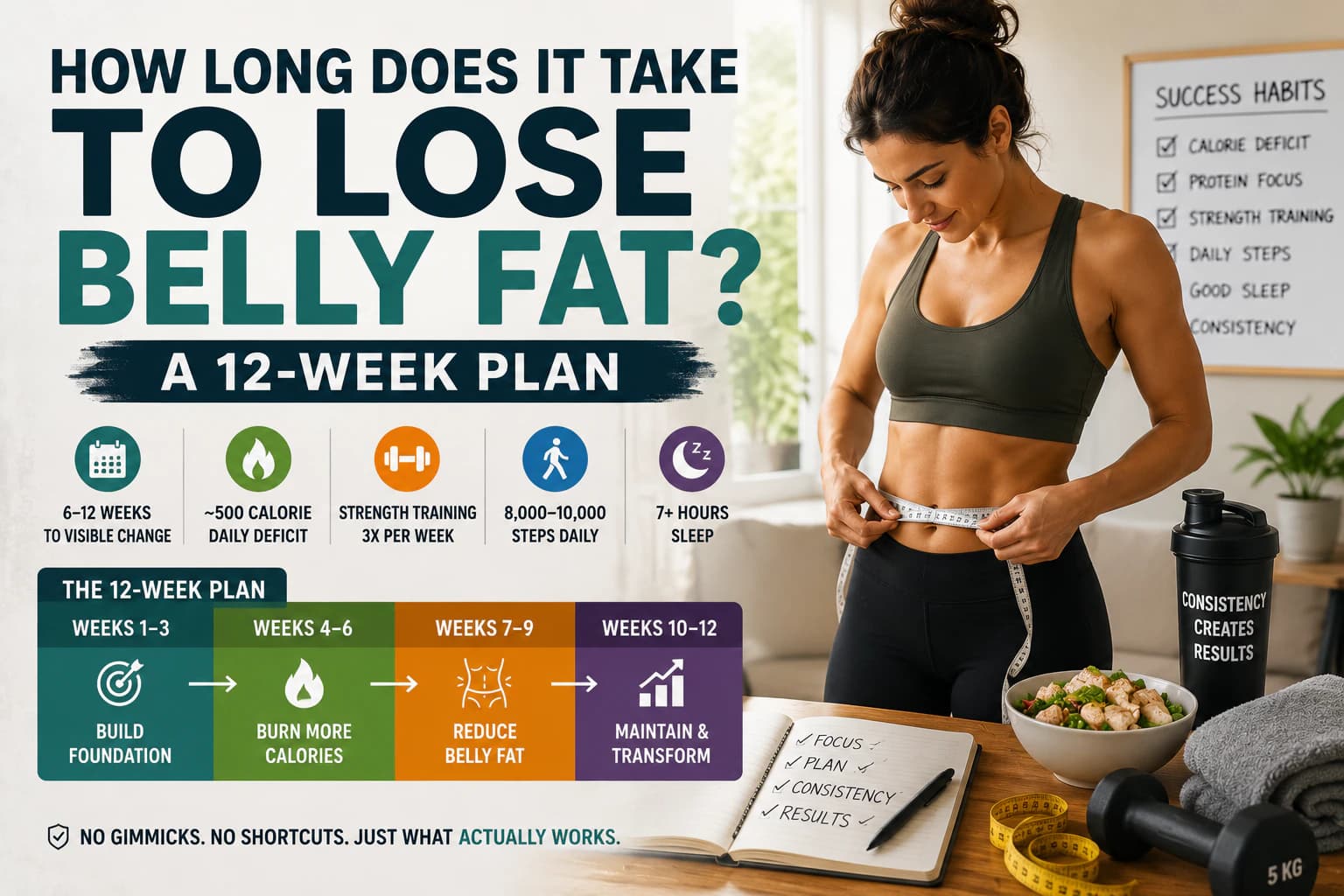
How Long Does It Take to Lose Belly Fat? A 12-Week Plan
How long it takes to lose belly fat, realistically: a 12-week plan, how to measure progress, and the hormones involved.
How long does it take to lose belly fat? It is one of the most-searched health questions in the world, and one of the most consistently answered badly, usually not for lack of trying, but because the information people find is either wildly oversimplified or written by someone selling something.
So this one is built the slow way. Sources are linked at the claims they support rather than listed up front, and where the evidence is thinner than the popular version suggests, that is said outright. The protocols are the ones that hold up when people actually stick with them, rather than the ones that only work on paper.
No gimmicks. No supplements to sell. No ab machines from teleshopping.
For most people, following the 12-week plan below consistently will reduce belly fat, because a sustained calorie deficit combined with resistance training is what actually works. Results vary, and conditions such as thyroid disorders, PCOS and some medications materially change the picture (all covered further down). Sticking with it is usually the hard part.
A note on costs: The diagnostic costs mentioned here (body-composition scans, blood tests and hormone panels) vary widely by country and provider, and change over time. These figures are for planning, not a quote; confirm current pricing locally before booking one.
A note on health advice: This is general information, not medical advice. Results vary, and conditions such as thyroid disorders, PCOS and some medications materially change the picture, so these should be ruled out before assuming it's about willpower.
The 30-second answer
There is no single timeline for losing belly fat. With a sustainable calorie deficit and consistent activity, some people notice measurable waist changes within several weeks, while visible changes often take longer. The pace depends on starting body composition, calorie deficit, activity, sleep, genetics, sex, age and health conditions. Protein, sleep and strength training decide how much of the loss is fat rather than muscle.
- Timeline: results vary considerably; a common planning range is several weeks for a measurable change and 6-12 weeks of consistency for a visible one
- Deficit: a moderate deficit sized to your body and goals, larger deficits tend to cost you more muscle
- Protein: roughly 1.6-2.2g per kg bodyweight is a common target, ~30g per meal
- Training: strength most weeks, plus regular daily walking
- Sleep: 7+ hours is a reasonable target, since under-sleeping can shift loss from fat toward muscle
- No shortcut exists that reliably skips trading away muscle or health
Everything below explains how to execute each of these.
How to actually measure belly fat (skip this and you're guessing)
Before any plan, you need a baseline. Weight alone is misleading: the scale can stay identical while your body composition changes dramatically.
The waist tape method (most important measurement)
Get a soft cloth tape measure. Stand upright, feet shoulder-width apart, breathe out normally. Do not suck in.
Place the tape at the level of your belly button (not higher, not lower). Wrap around, keeping it parallel to the floor. The tape should touch skin but not compress it.
Measure in the morning, after emptying your bladder, before eating or drinking. Same conditions weekly.
Waist circumference: a risk marker, not a diagnosis
Waist circumference is a useful population-level risk marker, not a direct measurement of visceral fat itself, actual visceral fat is only confirmed by imaging (CT or MRI). Commonly cited reference thresholds:
- Men: > 40 inches (102 cm) = associated with elevated health risk
- Women: > 35 inches (89 cm) = associated with elevated health risk
- South Asian populations (Indians): > 35 inches (men) and > 31 inches (women) = associated with elevated risk (WHO uses lower thresholds for Indians due to different fat distribution patterns)
Waist-to-hip ratio (another useful risk marker)
- Waist measurement (belly button) ÷ hip measurement (widest point of hips)
Commonly cited reference ranges:
- Men: < 0.90
- Women: < 0.85
Above these numbers, visceral fat is more likely to be elevated and metabolic risk tends to rise, though, as above, this is a risk indicator rather than a diagnostic test.
Bonus: body fat percentage (optional)
Body-composition scans at gyms (InBody, DEXA or similar) give you a body fat percentage. Cost varies enormously by country: roughly USD 3-6 in India, USD 30-60 in the US, and often free as a member perk at larger UK and Australian chains. Aim for:
- Men: 15-20% (fit), 10-15% (very lean)
- Women: 22-27% (fit), 18-22% (athletic)
Below these, health starts declining.
How long does it take to lose belly fat? Start with which type you have
There are two kinds of belly fat, and they behave very differently. Knowing which one you are carrying changes what you should do about it.
Subcutaneous fat
The soft, pinchable fat just under your skin. Can be grabbed with fingers.
- Health risk: Low. Cosmetically annoying, minimally dangerous.
- Behavior: Comes off with a steady calorie deficit.
- Common in: Women pre-menopause, men with mild belly.
- Proportion: Makes up most of total body fat for most people.
Visceral fat
Deep fat wrapped around your liver, pancreas, and intestines. Cannot be pinched, and makes your belly firm and protruding.
- Health risk: HIGH. Linked to type 2 diabetes, heart disease, stroke, some cancers, cognitive decline, and premature death.
- Behavior: Highly metabolically active. It releases hormones and inflammatory cytokines that damage other organs.
- Common in: Men, post-menopausal women, high-stress individuals, and those with insulin resistance.
- Proportion: A relatively small share of total body fat but disproportionately drives disease risk. See Harvard Health on abdominal fat. Visceral fat is metabolically active in a way subcutaneous fat is not: it produces inflammatory proteins, and higher volumes track with raised blood pressure, blood sugar and triglycerides alongside lower HDL. Subcutaneous fat, by contrast, is largely an energy store and may be mildly protective. That difference is what makes waist measurement more informative than the scale.
The visceral fat advantage
Good news: visceral fat can respond relatively quickly to sustained weight loss, so metabolic improvements may occur before the change is obvious in the mirror.
Studies show even a 5-10% total weight loss produces measurable health improvements: reduced blood pressure, better blood sugar, lower inflammation. You don't need to reach an ideal weight to see benefits.
Why belly fat is uniquely hard to lose (the biology)
Belly fat isn't a moral failing. It's biology working against you. Three reasons:
1. Blood flow
Belly fat is thought to receive relatively less blood flow than fat in some other areas. Fat breakdown requires blood to transport released fatty acids for burning, so reduced blood flow may partly explain why belly fat can be slower to shift and is often among the later areas to visibly change for many people.
2. Cortisol receptor concentration
Abdominal fat cells appear to carry more cortisol receptors than fat cells elsewhere in the body. Chronic stress and the resulting cortisol are associated with a tendency to store fat in the belly, which is part of why "cortisol belly" has some real biology behind it, though stress is one contributing factor among several rather than the sole cause.
3. Sex hormones
- Men: Testosterone is associated with directing fat away from the belly toward arms/chest, so lower testosterone can play a role in increased belly fat, alongside other factors.
- Women pre-menopause: Estrogen is associated with directing fat to hips/thighs.
- Women post-menopause: Estrogen drops → belly becomes a fat storage site. Tracking women through the menopausal transition shows visceral fat rising sharply and resting energy expenditure falling at the same time, a combination that makes weight gain easy and abdominal gain likely.
The 3 hormones that drive belly fat
1. Cortisol (stress hormone)
Chronic stress elevates cortisol, and cortisol is associated with fat storage, including visceral fat, which is one reason chronically stressed people can carry more weight in their midsection even while eating reasonably. Stress doesn't automatically cause belly fat on its own, it's one contributing factor among several (diet, sleep, activity, genetics). The online version of this goes much further than the evidence does, which we unpack in what a cortisol detox actually does.
Helps: Sleep, meditation, journaling, therapy, cutting caffeine. See our anxiety relief guide.
2. Insulin
When you eat refined carbs (sugar, white rice, cookies and biscuits, white flour), insulin rises to shuttle glucose into cells, this is a normal process, not itself harmful. Chronically elevated insulin over time, common with a diet high in refined carbs, is associated with insulin resistance, where cells respond less well and the pancreas releases more insulin. Insulin resistance is linked with increased abdominal fat storage for many people, though it's one factor among several rather than the sole driver.
Helps: Whole carbs (not refined), fewer meals per day, protein first, fiber-rich vegetables. Fiber is the lever most people under-use here. See the daily fiber targets and how to reach them without a week of bloating.
3. Testosterone (men) / Estrogen (women)
Lower testosterone in men (which can decline with age, poor sleep, and inactivity) is associated with easier belly fat storage for many men, though it's one influence among several. Post-menopausal estrogen decline is linked with a shift in women's fat storage from hips/thighs toward the belly.
Helps: Strength training, sleep, and preserving muscle through resistance training, all of which support overall hormonal and metabolic health. Routine hormone testing isn't necessary for most people trying to lose belly fat; it's more relevant if you have symptoms suggesting a hormonal condition (see the medical conditions section below).
The bonus factor: brown vs white fat
A 2025 paper in Nature Metabolism found that calorie restriction triggers "browning" of white fat, shifting cells from storing energy toward burning it as heat. The human side came from tissue samples in the CALERIE-II trial, where adults cut intake by roughly 14% over two years.
Read the caveat with it: the mechanism the paper proposes, cysteine depletion driving the effect, was worked out in mice. What holds in humans so far is the observation, not the explanation. Interesting, not actionable.
Brown fat actively produces heat and burns calories. Ways to get the most out of brown fat:
- Cold exposure (cold showers, cool bedroom)
- Adequate sleep
- Regular exercise (especially HIIT)
- Sustained calorie deficit
Calorie restriction + strength training works better than either alone: you're not just losing fat, you're changing your fat cells' behavior.
The 8 biggest myths that keep you stuck
Before what works, let's dismantle what doesn't.
Myth 1: "Sit-ups burn belly fat"
They don't. But the reason is more interesting than the usual flat "spot reduction is a myth."
The study everyone cites had 24 sedentary adults do seven abdominal exercises five days a week for six weeks. Abdominal fat did not shrink. Note the detail that gets left out: those participants lost no total body fat either, so the test could not really have shown localised loss even if it existed. Later work has been less tidy: a 2023 randomised trial reported localised reductions from abdominal endurance exercise, and the question is more open among researchers than fitness writing admits.
None of which changes what you should do. Ab exercises strengthen the muscles, but they are not a reliable way to selectively remove the fat covering them, any localised effect is small next to total energy balance, and crunches burn almost nothing. Train your core because a strong core is worth having. Lose the fat with a deficit.
Myth 2: "Fat burners melt belly fat"
Nearly every "fat burner" is caffeine + green tea extract + marketing. Actual effect: 30-50 calories/day burn (5 extra minutes of walking). Many contain stimulants that raise cortisol, which stores MORE belly fat.
Myth 3: "You can eat 'clean' and forget calories"
Almonds are healthy. So is ghee. So is olive oil. All are calorie-dense enough to blow through your deficit. Clean eating without any calorie awareness is one of the most common reasons progress stalls.
Myth 4: "Waist trainers reduce belly fat"
Zero effect on fat cells. Redistribute soft tissue temporarily. Pure gimmick.
Myth 5: "Lemon water burns fat"
Lemon water is fine hydration. Zero fat-burning compounds. Any effect is placebo + hydration.
Myth 6: "Carbs are the enemy"
Refined carbs are problematic. Whole carbs (rice, roti, oats, dal, millets, fruits) are not. The Indian diet has been carb-heavy for millennia. The problem is portion size, quality and refined additions rather than carbs themselves.
Myth 7: "You need a gym"
Zero evidence. Home training with bodyweight or 5-10 kg (10-20 lb) dumbbells produces excellent results. See our 30-day home workout plan.
Myth 8: "Cardio is the best fat burner"
Both cardio and strength training can contribute meaningfully to fat loss, they're not interchangeable, though. Cardio burns calories during and shortly after the session and improves cardiovascular fitness. Strength training helps build and preserve muscle, which has its own metabolic and long-term health benefits. Some research suggests resistance training may be particularly useful for visceral fat specifically, but it isn't a case of one being universally superior, combining both tends to work better than leaning on either alone. Worth knowing how much strength training to aim for before you restructure your week around it.
The 5-part protocol (this is what actually works)
Every successful fat loss plan reduces to five levers. Miss any one and you'll stall.
Lever 1: Protein, the single most impactful change
Target: 1.6-2.2g per kg of body weight daily, spread across 3-4 meals (30g per meal is best).
For a 70 kg (155 lb) person: 112-154g of protein daily.
Why protein is the biggest lever:
- Preserves muscle in a deficit. On diet alone roughly a quarter of the weight you lose is lean tissue rather than fat; add training and that falls to around a tenth. A meta-analysis of resistance training during calorie restriction found it prevented the large majority of that lean-mass loss
- Burns 20-30% of its own calories during digestion (thermic effect)
- Kills hunger better than carbs or fats
- Prevents rebound weight gain
Why spreading matters: Muscle protein synthesis is highest when you eat 20-30g of leucine-rich protein every 4-5 hours. Bombing 100g at dinner doesn't work. Spread it.
Protein sources by typical serving:
| Food | Protein | Calories | Notes |
|---|---|---|---|
| Chicken breast (100g) | 31g | 165 | Best protein per calorie |
| Whole eggs (2) | 12g | 140 | Cheapest complete protein |
| Fish: salmon, mackerel, cod, carp (100g) | 22-26g | 130-200 | Oily varieties add omega-3 fats |
| Greek yoghurt (200g) | 20g | 130 | Thick strained yoghurt, not regular |
| Cottage cheese (150g) | 25g | 160 | Very high protein per calorie |
| Lean beef or lamb (100g) | 26g | 215 | Also a good iron source |
| Paneer (100g) | 18g | 265 | Indian pressed cheese; high-fat, use in moderation |
| Tofu (100g) | 17g | 145 | For anyone avoiding dairy |
| Kidney beans / rajma (1 cup cooked) | 24g | 220 | Pairs with rice for a full amino profile |
| Chickpeas / chana (1 cup cooked) | 19g | 210 | Best budget protein snack |
| Lentils: moong, masoor, red (1 cup) | 24g | 210 | Highly digestible |
| Plain yoghurt / curd (1 bowl) | 11g | 100 | Probiotic bonus |
| Soya chunks / TVP (30g dry) | 15g | 100 | Cheapest plant protein by weight |
| Whey or pea protein (1 scoop) | 24g | 120 | Convenience only, not required |
Lever 2: Calorie deficit, the math, not the magic
You cannot lose fat without a deficit. Full stop. The exact size of that deficit, though, should depend on your body size, activity, goals and health status, not a single fixed number.
A common starting point for calculating one:
- Maintenance ≈ body weight (kg) × 30 for sedentary, × 33 for active
- A moderate target is often maintenance minus roughly 500, though this is an illustrative example, not a prescription for everyone
Worked example, for a 70 kg (155 lb) sedentary person:
- Maintenance: roughly 2,100 calories
- Illustrative fat-loss target: roughly 1,600 calories
Why a moderate deficit rather than an aggressive one:
- A roughly 500-calorie deficit works out to about 0.5 kg (1 lb) loss per week for many people, a pace that's generally easier to sustain, though the appropriate rate varies with starting body weight, health status and how large the deficit is
- Aggressive deficits (1000+) tend to cost more muscle, and a large share of people regain weight lost this way
- Even a 5-10% weight loss is associated with measurable health improvements for many people: blood pressure, blood sugar and inflammatory markers can move before the mirror does
- Slower is not weakness. It's strategy. If you have a health condition or are unsure what deficit is appropriate, check with a clinician or dietitian.
How to track:
- MyFitnessPal or HealthifyMe for first 2 weeks
- Weigh food with a digital kitchen scale, around USD 10-15, and non-negotiable initially
- After 2 weeks, you'll estimate correctly and can stop weighing
Lever 3: Movement, walking + NEAT + strength
Not just exercise. Total daily movement matters.
Target daily:
- 8,000-10,000 steps. Worth knowing where that number comes from: 7,000 a day captures most of the general health benefit, and 10,000 originates from a 1965 pedometer advert rather than a study. The figure that shows up in the research specifically for weight control is closer to 8,500. See our guide to daily step counts
- 3 strength sessions per week
- 1-2 HIIT sessions per week (optional, after week 4)
- Move as much as you can through the day (NEAT)
If time rather than willingness is the constraint, adding load to walks you already do is one option. The effect is real but modest, and our beginner guide to rucking sets out what it actually adds.
NEAT (Non-Exercise Activity Thermogenesis):
This is movement that isn't formal exercise: fidgeting, standing, walking to the kitchen, taking stairs, cleaning, cooking. NEAT can differ substantially between people, and research suggests naturally more active people can burn meaningfully more calories a day this way than more sedentary people, in some cases more than a formal workout would burn. Increasing your own everyday movement can meaningfully increase total daily energy expenditure, even if the exact amount varies by individual.
Practical NEAT tactics:
- Standing desk (can add up over a full day compared with sitting)
- Walking meetings (calls on speaker while pacing)
- Take stairs always
- Park furthest from entrances
- Do calf raises during shower
- Fidget consciously; leg tapping burns calories
- Cook your own meals (calorie-burning + calorie-controlling combo)
- Clean house yourself
- Play with kids/pets on the floor
Strength training essentials (3 sessions per week, 45 min each):
Compound movements only. Skip machines.
- Squats (or goblet squats with dumbbells)
- Deadlifts (Romanian or standard)
- Push-ups or bench press
- Pull-ups or rows
- Overhead press
Add 2 kg (5 lb) or 2 reps per week. That's it. Follow our 30-day home workout plan for the beginner protocol.
Walking specifically:
- Burns 300-400 calories per hour
- Doesn't spike cortisol like intense cardio
- Doesn't create compensatory hunger like heavy cardio
- Sustainable forever
Lever 4: Sleep, the invisible variable
Target: 7+ hours nightly.
Sleep deprivation:
- Raises the hunger hormone ghrelin and lowers the satiety hormone leptin
- Raises cortisol (belly fat storage)
- Reduces testosterone (fat loss enemy)
- Reduces insulin sensitivity
- Can increase appetite and make higher-calorie food choices more likely
The cleanest demonstration is a randomised crossover trial published in JACC: 14 days on 4 hours of sleep versus 9, same participants, food freely available. The short-sleep arm ate about 300 calories more a day, energy expenditure did not change, and total body fat did not differ between conditions, but abdominal visceral fat rose around 11%. The fat did not just arrive; it went to the worst possible place.
You cannot out-diet or out-exercise chronic 5-hour nights. Fix sleep first if broken. See our complete sleep guide for the exact protocol.
Lever 5: Stress, the underrated killer
Chronic stress = chronic cortisol = chronic belly fat storage.
Non-negotiable stress fixes:
- 10 minutes of daily meditation (see our beginner's meditation guide)
- Morning sunlight for 10 minutes (regulates cortisol curve)
- Journal 5 minutes before bed
- Say no to at least one thing per week
If severe anxiety is present, see our anxiety relief techniques or consider therapy. Belly fat driven by burnout won't shift until the burnout does.
The 12-week execution plan
Here's the exact week-by-week roadmap.
Weeks 1-2: Foundation (no calorie tracking yet)
Goal: build habits without diet stress.
- Walk 8,000 steps daily
- 3× strength sessions
- Same wake time every day
- No calorie tracking yet
- Add protein to every meal
- Cut sugary drinks completely
Common experience: some people notice an early water weight drop, roughly 1-2 kg (2-4 lb) is a typical planning range, though this varies. The main goal here is the habit foundation.
Weeks 3-4: Add calorie awareness
- Continue Week 1-2 habits
- Start tracking calories (MyFitnessPal / HealthifyMe)
- Target 500-calorie deficit
- Walk 8,000-10,000 steps daily
- Weekly measurements: waist, hip, thigh, weight
A common planning range: some people see roughly 1-2 kg (2-4 lb) of loss here, results vary considerably. Clothes may start fitting slightly better.
Weeks 5-8: Momentum (visible changes)
- Continue everything
- Add 1 HIIT session per week (15 min max)
- Increase strength training weights
- Progress photos every 2 weeks
A common planning range: some people see roughly 2-3 kg (4-7 lb) further loss here, though this varies. For many people the face and arms show visible change before the belly does.
Weeks 9-12: Compound results
- Continue everything
- If plateau: cut 100 calories or add 1,000 daily steps
- Some people find a planned weekly maintenance meal helps with adherence (see the plateau section below for what it can and can't do)
- Habit is now automatic
A common planning range: some people see roughly another 2-3 kg of loss by this stage, with belly change visibly underway and the waist down several centimetres, but results vary considerably person to person.
Over a full 12 weeks, a common planning range for total loss is roughly 4-8 kg (9-18 lb) and 3-5 cm (1-2 in) off the waist for people who stay consistent, though individual results vary a great deal depending on starting point, adherence and the factors covered throughout this article.
A worked day: 1,600 calories, 120g protein
Not a diet. A template. Each meal below gives the calorie and protein target, then several ways to hit it from different food cultures. Swap freely between them, or build your own within the same bracket.
First, check the number applies to you. 1,600 calories is a moderate deficit for someone around 65-70 kg (145-155 lb). If you are significantly heavier, this is too aggressive and you will lose muscle; scale up by roughly 100 calories for every 5 kg (11 lb) above that, keeping protein at 1.6-2.2g per kg. If you are lighter or shorter, scale down. A plan you can hold for twelve weeks beats an aggressive one you abandon in three.
Breakfast: 400 calories, 30g protein
Option A: Eggs and toast (anywhere)
- 3 whole eggs, scrambled or as an omelette (210 cal, 18g protein)
- 2 slices wholegrain toast (160 cal)
- 1 orange (60 cal, added fibre)
Option B: Yoghurt and oats (quickest, no cooking)
- 200g Greek yoghurt (130 cal, 20g protein)
- 40g rolled oats (150 cal)
- A handful of berries (50 cal)
- 1 boiled egg if you need the protein higher (78 cal, 6g protein)
Option C: Idli and sambar (South Asian: steamed rice cakes with lentil broth)
- 2 idlis + sambar (220 cal, 8g protein)
- 1 boiled egg (78 cal, 6g protein)
- 1 cup low-fat curd (plain yoghurt) (100 cal, 10g protein)
Option D: Congee or savoury porridge (East Asian)
- 1 bowl rice congee (180 cal)
- 100g poached chicken or 2 eggs stirred through (165 cal, 25g protein)
- Spring onion, ginger, a little sesame oil (40 cal)
Lunch: 500 calories, 40g protein
Pick one protein, one carb, and vegetables.
Protein (aim 30-45g):
- 150g chicken breast, grilled, roasted or in a curry (250 cal, 45g protein)
- OR 150g white fish or salmon (250 cal, 30g protein)
- OR 1 cup kidney beans or chickpeas (rajma, chana) (220 cal, 24g protein)
- OR 100g paneer (Indian pressed cheese) or firm tofu (260 cal, 18g protein)
- OR 150g cottage cheese (160 cal, 25g protein)
Carb (about 200 cal):
- 1 cup brown rice, OR 2 flatbreads (roti, tortilla or pita), OR 1 medium baked potato, OR 200g pasta cooked weight
Plus:
- A large salad or plate of vegetables (50 cal)
- A bowl of plain yoghurt (100 cal, 10g protein)
Snack: 200 calories, 15g protein
- 1 scoop whey or pea protein with water or skimmed milk (120 cal, 24g protein)
- OR 1 boiled egg + a piece of fruit (140 cal, 8g protein)
- OR 30g roasted chickpeas (chana) or edamame + tea (150 cal, 7g protein)
- OR 150g cottage cheese with pepper (160 cal, 25g protein)
Dinner: 500 calories, 35g protein
Protein:
- 150g fish, baked, grilled or as a curry (250 cal, 30g protein)
- OR 2 eggs, any style (160 cal, 12g protein)
- OR 100g paneer, tofu or halloumi (250 cal, 18g protein)
- OR 120g lean beef, lamb or pork (250 cal, 30g protein)
Plus:
- 1 flatbread or half a cup of rice (150 cal)
- A cooked vegetable dish, any dry-cooked or roasted vegetables (100 cal)
- No dessert. Save it for one planned meal a week
Daily total: 1,600 cal, 120g protein ✓
The regional labels are only shorthand for where a dish is common. Nothing here is off-limits by geography: if congee suits your Tuesday and idli suits your Wednesday, the arithmetic does not care.
Belly fat by age group
Different ages tend to need different strategies, though people of the same age can lose fat at very different rates depending on muscle mass, recovery, activity, hormonal status and energy needs. Treat the ranges below as common planning references, not biological limits.
In your 20s
Often a comparatively easier fat loss period, metabolism tends to be higher and recovery faster, though this varies by individual.
- Standard protocol works well for most people
- Some people see a faster pace of loss with consistency, results still vary
- Habits built now tend to shape your body for years to come
In your 30s
Career stress, kids and poor sleep commonly create a first real belly for many people.
- Protein becomes more important as muscle decline can begin
- Sleep quality often drops, so protect it
- Stress management becomes more important
- Pace of loss varies; a somewhat slower pace than in your 20s is common for many people
In your 40s
Age-related muscle loss (sarcopenia) tends to accelerate. Hormones shift.
- Strength training becomes more important. It affects how much of the loss is fat rather than muscle
- Protein needs often increase, commonly discussed around 2g/kg body weight as a reference point
- Sleep protection matters more
- Cortisol can rise with age for some people, so stress management matters more
- Pace of loss commonly slows further for many people, though this varies a lot
- Hormone testing can be worth discussing with a doctor if you have relevant symptoms (thyroid, testosterone/estrogen, cortisol), it isn't a routine requirement for everyone
Women in their 40s specifically
Perimenopause starts for many women. Estrogen fluctuations are associated with a shift in fat storage toward the belly.
- Add strength training if not already
- Track your cycle: hunger and cravings can tie to hormones
- Consider reducing alcohol (how it's metabolized can change with age)
- Some women benefit from HRT (Hormone Replacement Therapy), which is worth discussing with a doctor
- Loss often continues at a slower pace, but real results remain achievable for most people
In your 50s+
Post-menopause (women) or continued testosterone decline (men). Sarcopenia often accelerates.
- Protein: often discussed around 2-2.2g/kg body weight
- Strength training: recommended most weeks
- Focus on functional strength (squats, hip hinges)
- Prioritize compound movements
- Pace of loss commonly slows further for many people; individual results vary a lot
- Bone density becomes more of a concern for many people, so resistance training matters
- Women post-menopause: creatine paired with this training has small but measurable trial support, covered in our creatine guide
In your 60s+
Achievable for most people but requires patience and attention to safety.
- Consult a doctor before starting, especially with existing health conditions
- Chair-supported variations for exercises where useful
- Focus on mobility + strength combined
- Protein absorption can decline somewhat, so some people find supplements helpful
- Pace of loss is often slower and more gradual; individual results vary considerably
- Health metrics (blood pressure, blood sugar, cholesterol) can improve relatively quickly for some people once changes take hold
Medical conditions that affect belly fat
Rule out these before assuming it's about willpower:
Hypothyroidism (underactive thyroid)
Can meaningfully slow metabolism. Common symptoms: fatigue, cold sensitivity, hair loss, weight gain despite normal eating, constipation, dry skin.
- Test: a TSH blood test is a common screening step. Inexpensive and widely available, free at the point of use under most public health systems, and typically USD 5-40 privately depending on the country
- If T3, T4, TSH abnormal → see an endocrinologist for proper interpretation, a single value shouldn't be self-diagnosed
- Treatment: thyroid hormone replacement, prescribed and monitored by a doctor. Treatment addresses the underlying metabolic issue; belly fat doesn't necessarily disappear automatically once levels normalize, fat loss generally still requires the usual deficit and activity approach on top of treatment
PCOS (women)
Polycystic Ovary Syndrome is associated with insulin resistance, elevated androgens, and inflammation. The WHO estimates it affects 8-13% of women of reproductive age, and that more than half of cases go undiagnosed.
- Symptoms: irregular cycles, acne, facial hair, belly weight, insulin resistance
- Test: hormone panel, ultrasound, HbA1c, evaluated together by a clinician
- Treatment: commonly metformin, inositol, dietary changes (a lower-carb approach helps some people, though it isn't established as universally better), and sometimes hormonal contraception. The prescription side is a clinician's decision and first-line choices differ by country
Insulin resistance / Type 2 diabetes precursor
Many people with pre-diabetes are unaware they have it; estimates of the undiagnosed share are substantial across several countries studied.
- Test: HbA1c is a common screening tool; roughly 5.7-6.4% is generally used as a pre-diabetic screening range and 6.5%+ as a diagnostic threshold for diabetes in many guidelines, but interpretation depends on the full clinical picture and should come from a clinician, not a single number in isolation
- Fasting insulin above the local reference range can also be suggestive, again best interpreted by a clinician
- Treatment: usually dietary changes and weight loss, with metformin where a doctor prescribes it
Cushing's syndrome (excess cortisol)
Rare but serious. Symptoms: rapid weight gain (especially belly + face), purple stretch marks, muscle wasting, easy bruising.
- Test: 24-hour urinary free cortisol, dexamethasone suppression test
- Treatment: depends on cause (often surgical)
Sleep apnea
Common in overweight men, and possible in others too. Can cause fatigue, high blood pressure, and hormonal disruption.
- Test: home sleep study or overnight polysomnography
- Treatment: CPAP machine, which can meaningfully improve sleep and related health markers; weight change after starting CPAP varies by person and isn't guaranteed
Testosterone deficiency (men)
May be underdiagnosed. Symptoms: low energy, low libido, belly fat, mood issues.
- Test: total testosterone + free testosterone (morning blood draw), interpreted by a doctor
- Treatment: lifestyle first (sleep, weight loss, strength training); TRT (Testosterone Replacement Therapy) is a clinical decision for confirmed deficiency with a doctor, not a routine fat-loss treatment
On cost: a full hormonal panel runs from around USD 35 in India to USD 200-400 in the US without insurance, and is often covered where a clinician orders it. Either way it can save years of frustration.
Tracking progress (what to measure and how often)
Weight is the least reliable metric. Use these:
Weekly (same day, same time, morning, after emptying your bladder)
- Waist: at belly button
- Hip: widest point
- Weight: trend only, not day-to-day
Photos every 2 weeks
- Same lighting, same time, same position
- Front + side view
- The mirror lies. Photos don't.
Body composition (optional)
- A body-composition scan at any decent gym
- Once a month maximum
What "good progress" looks like
- 0.4-0.7 kg (1-1.5 lb) weight loss per week on average
- 0.5-1 cm waist reduction per 2 weeks
- Clothes fitting looser
- Better energy
- Better sleep
Breaking a plateau
After 4-6 weeks, most people plateau. Systematic fix:
Step 1: Audit tracking (Week 1)
Are you actually eating what you think? Track everything for 7 days including:
- Cooking oils (ghee, oil = 45 cal per teaspoon)
- Sauces, chutneys, dressings
- The "small bites" you forget
70% of plateaus dissolve here alone.
Step 2: Cut 100 calories OR add 1,000 steps (Week 2)
Small change, big compounding effect. Don't do both.
Step 3: Weekly maintenance meal (Week 3)
Some people find it helpful to eat at maintenance with more carbs once a week. This isn't a guaranteed metabolic reset, the physiological picture is more complicated than "restores leptin", but planned maintenance periods can help with adherence and psychological relief from dieting for some people.
Step 4: Diet break (Week 4)
If nothing works, eat at maintenance for 7 straight days, then restart the deficit. This can help some people get past a stall, particularly if adherence had quietly slipped, but it isn't a guaranteed plateau cure, and true plateaus sometimes need a genuine reassessment of the deficit itself.
Loose skin during weight loss
Prevention is easier than fix.
Factors that may help reduce loose skin (none of these guarantee an outcome, skin elasticity, age and genetics play a large role too):
- A more gradual pace of loss, which may give skin more time to adapt
- Adequate protein (roughly 1.6-2g/kg is a common reference range), which supports collagen and elastin
- Strength training: muscle underneath can help fill the space
- Staying well hydrated, roughly 2.5-3L a day is a common reference range for adults, individual needs vary
- Vitamin C + protein for collagen
- Adequate sleep: skin repair happens partly during sleep
If loose skin appears after loss:
- Give it 12-18 months to naturally tighten
- Continue strength training
- Consider dermatology consultation
- Extreme loose skin (20+ kg lost) may need surgery (panniculectomy, tummy tuck)
- No cream fixes serious loose skin. That is dermatology reality
Special cases (dietary preferences)
Vegetarian
Fully possible. Protein targets from:
- Paneer, tofu, dal combinations, chana, rajma
- Whey protein (if you consume dairy)
- Eggs (if lacto-ovo)
- Combine 2 plant proteins per meal for complete amino acids
Vegan
Harder but doable. Protein sources:
- Tofu, tempeh, soy chunks (highest protein density)
- Pea protein powder (works as well as whey)
- Lentil + rice combos
- Nuts and seeds (careful with calorie density)
Vegans usually need 20% more food volume to hit protein targets.
Jain (no root vegetables)
Focus on paneer (Indian pressed cheese), yoghurt, lentils cooked without onion or garlic, and above-ground vegetables. Add whey protein. Nuts and seeds for healthy fats.
Post-pregnancy belly
- Diastasis recti (abdominal separation) is common, so see a physiotherapist or appropriate healthcare professional BEFORE doing crunches
- Timelines vary considerably by individual; there's no single minimum that applies to everyone, and getting clearance from your healthcare provider before starting any structured program matters more than hitting a specific date
- Focus on pelvic floor + deep core (transverse abdominis)
- Breastfeeding increases energy needs, the exact amount varies by person, and aggressive calorie restriction can be inappropriate while breastfeeding, so talk to a doctor or dietitian about what's appropriate for you rather than applying a generic deficit
The 6 supplements: what's worth it
Worth considering, not required:
- Creatine monohydrate: one of the cheapest supplements there is, roughly USD 5-15 a month; a commonly studied dose is around 5g/day, but check with a clinician or pharmacist if you have relevant health conditions. Can help you train harder over time. Generally considered well-tolerated for most healthy adults. A slight increase in water weight (in muscles) is normal. The evidence in women is more mixed than the marketing suggests, which our guide to creatine for women sets out.
- Whey protein: Only useful if you're falling short on daily protein from food. Not magic, and not necessary if food alone covers your protein target.
- Vitamin D3: deficiency is common wherever winters are long, sun exposure is limited, or skin is darker at high latitude, which covers much of Northern Europe, the UK, Canada and South Asia alike. Worth getting tested rather than guessing at a dose, and discussing an appropriate dose with a clinician or pharmacist if you are found to be deficient, rather than assuming a fixed dose is right for you. There's no strong evidence that vitamin D supplementation itself accelerates fat loss beyond correcting a genuine deficiency.
Skip:
- Fat burners: Overpriced caffeine + green tea extract
- Detox teas: Laxatives with marketing
- Waist trainers: Cosmetic only
- BCAAs: Unnecessary if eating enough protein
- Apple cider vinegar shots: Trace benefit, mostly gimmick
- Thermogenic supplements: Tiny effect (30-50 cal/day burn)
Realistic timeline chart
| Weeks | A common planning range, not a guarantee |
|---|---|
| 1-2 | Some water weight drop, often 1-2 kg (2-4 lb). Nothing visible yet for most. Energy often improving. |
| 3-4 | Roughly 1-2 kg (2-4 lb) fat loss is a common range. Clothes may fit slightly better. Face often slims first. |
| 5-8 | Roughly 2-3 kg (4-7 lb) further loss is a common range. Arms and face often show change before the belly does. |
| 9-12 | Roughly another 2-3 kg (4-7 lb) is a common range. Waistline change often more noticeable by this stage. |
| 13-24 | Roughly another 4-8 kg (9-18 lb) if you keep going, for people who stay consistent. Individual results vary a great deal. |
The one thing you must never do
Do not stop when you see results.
The single biggest reason people rebound is quitting when clothes fit. Maintaining a new weight for an extended period, commonly discussed as roughly 6-12 months, is thought to make rebound less likely for many people, though there's no guarantee, and the physiology of long-term weight regulation is more complex than a fixed reset point.
Once you hit your target, transition to maintenance calories for at least 3 months before reducing further. This is where most transformations get lost.
The final rule
Belly fat loss is neither easy nor mysterious. It's a math problem (calories, protein, movement) with an execution problem (consistency for 12+ weeks).
The math is above. The execution is up to you.
Start today. Not Monday. Not "when work slows down." Today. Because the person who started 12 weeks ago is standing where you want to be, and the person who starts today will be there in 12 weeks.
Bookmark this page. Track your progress in a simple notebook. And in three months, message us on Instagram with your progress. We read every message.
Related reads:
Frequently asked questions
Answers to the most common questions about this topic.
Use a soft tape measure at the level of your belly button, standing upright, breathing out normally. Don't suck in. Measure in the morning after emptying your bladder, before food. Waist circumference and waist-to-hip ratio are useful risk markers, not a direct measurement of visceral fat itself, commonly cited reference points are a waist-to-hip ratio above roughly 0.90 for men or 0.85 for women, and a waist circumference above roughly 102 cm / 40 in for men or 89 cm / 35 in for women, with lower reference thresholds often used for South, East and Southeast Asian populations, around 90 cm / 35 in for men and 80 cm / 31 in for women. These are population-level guidelines, not an individual diagnosis. Measure weekly, same conditions.
Yes, but not because of any special magic. Intermittent fasting works because it makes maintaining a calorie deficit easier for people who struggle with snacking. Studies show 16:8 fasting produces similar fat loss to traditional calorie restriction when total calories match. See our complete IF guide for the exact protocol.
Water doesn't burn fat directly but supports fat metabolism, can reduce water retention (bloating), and often replaces empty-calorie drinks. Drinking 500ml before meals has been shown to reduce meal calorie intake by around 13% in some studies. Daily needs vary by body size, climate and activity level; roughly 2.5-3L is a common reference range for adults, more in hot climates or with heavy training, but there's no single number that fits everyone.
Aim for 1.6-2.2g of protein per kg of body weight per day. For a 70 kg person that is 112-154g daily, spread across 3-4 meals at roughly 30g each. The reason it matters in a deficit is muscle retention rather than the protein itself: intakes above the 0.8g/kg RDA measurably reduce lean mass loss during energy restriction. Protein also has the highest thermic effect of the three macronutrients and is the most satiating, both of which help, but muscle preservation is the main event.
See a doctor if: (1) gaining weight despite eating in a deficit, (2) waist exceeds 35 inches (women) or 40 inches (men), (3) symptoms like fatigue, hair loss, irregular cycles, or unexplained anxiety, (4) family history of type 2 diabetes or heart disease, or (5) consistent for 4+ months with zero progress. Rule out thyroid, PCOS, insulin resistance, and cortisol issues before self-blame.
Filed under
Written by
We research travel, fitness and wellness, and publish what holds up. See our editorial policy.