Intermittent Fasting for Beginners: The 16:8 Guide
Intermittent fasting for beginners, the 16:8 protocol, women's cycle-based fasting, and what actually breaks a fast.
Intermittent fasting became mainstream around 2018. In 2026, it's still one of the most-searched fitness topics online, and one of the most misunderstood.
This is intermittent fasting for beginners as it actually works: the science, practical meal plans including vegetarian options, women's cycle-based protocols (critical, and most guides skip it), autophagy timing, and answers to every beginner question. Built from Johns Hopkins, Mayo Clinic, Harvard Health, Medical News Today, and 40+ peer-reviewed 2024-2026 studies.
Intermittent fasting can help some people reduce their overall calorie intake and lose weight, but it doesn't guarantee a specific amount of fat or weight loss for anyone who follows the beginner protocol below. How much (if anything) you lose depends on your total energy intake, food choices, activity level, consistency, starting body size, and other individual factors. Many people who follow a structured approach like this do report gradual, sustainable improvements alongside changes to energy, sleep, and how simple daily eating feels, but results vary substantially from person to person.
A note on health advice: This is general information, not medical advice. Fasting is not appropriate for everyone, including people who are pregnant or breastfeeding, people with a history of eating disorders, people with type 1 diabetes, and people taking medications that require food timing.
The 30-second answer
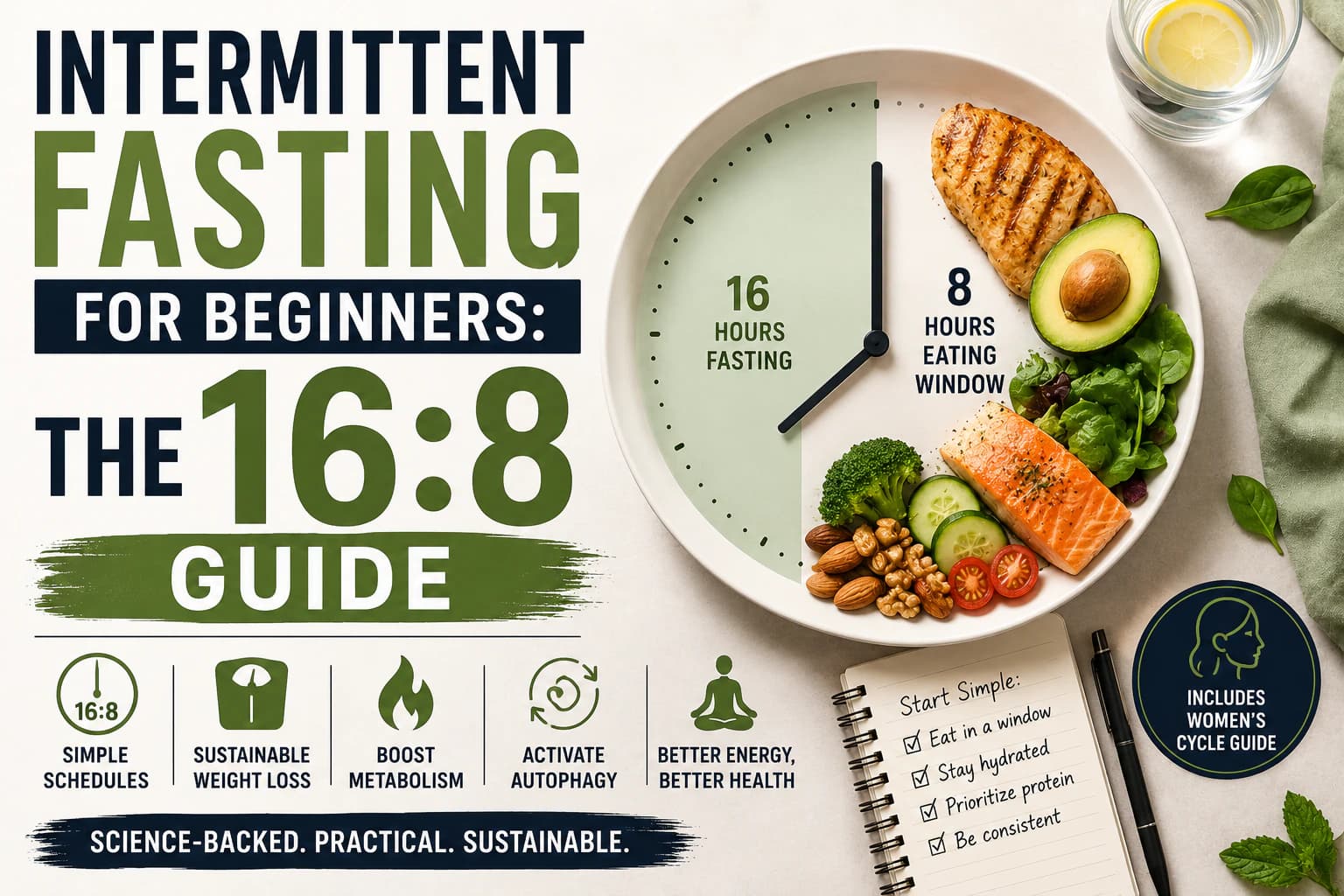
Intermittent fasting for beginners starts at 16:8: eat within an 8-hour window, usually noon to 8 PM, and fast the other 16. Build up from 12:12 over about four weeks rather than starting there. It works by making calorie control easier, not by any metabolic magic.
- The 16:8 window: typically 12 PM - 8 PM; water, black coffee and plain tea during the fast
- Ramp up: start at 12:12, add an hour every few days over 4 weeks
- Realistic rate: 0.5-1 kg (1.1-2.2 lb) per week
- Why it works: easier calorie control, not a metabolic trick
- Women: adjust the protocol to your cycle (most guides skip this)
- Autophagy: a normal cellular process that research associates with longer fasting durations, though there's no precisely established human timeline
What intermittent fasting actually is
Not a diet. A schedule.
Intermittent fasting means eating within a specific time window each day (usually 6-10 hours) and not eating for the rest.
You're not "avoiding" any food. You're compressing when you eat. That's it.
Why IF works (the actual science)
Research has associated IF with a number of effects, though the strength of evidence differs a lot between them:
- Weight loss: some short-term studies report body-weight reductions in the range of roughly 3-8% (2023 meta-analysis), though individual results vary widely
- Insulin sensitivity: some studies report improvements in markers like HbA1c, particularly alongside weight loss
- Inflammation markers (CRP, IL-6): some studies report reductions
- Autophagy: cellular activity that appears to increase with longer fasting durations in research, mostly from animal and mechanistic studies
- Growth hormone: levels have been reported to rise during extended fasting in some studies, though the practical benefit of this for most people isn't well established
- Liver fat: some studies report reductions in liver fat with sustained calorie control, though IF should not be treated as a treatment for diagnosed fatty liver disease
- Cognitive function: some working-memory studies report modest effects
- Cardiovascular markers (blood pressure, cholesterol): some studies report improvements
But, critically, most of these effects appear to be linked to the resulting calorie deficit, not to fasting itself as a mechanism.
The key insight: IF works because it makes calorie control easier, not because of any special metabolic magic.
This is the finding people find least welcome and it is well replicated. A systematic review and meta-analysis of randomised trials comparing intermittent against continuous energy restriction found comparable weight loss and comparable cardiometabolic improvement between the two. Matched for calories, fasting does not beat simply eating less.
That is not an argument against it. If a shorter eating window is the thing that finally makes you eat less without counting anything, it is the right tool for you. The evidence says you will get the same result as the person weighing their food. Pick the method you will still be doing in six months.
If you eat 3,000 calories in an 8-hour window, you will not lose weight. Period.
Autophagy: the science of cellular cleanup
The reference point for most of what follows is de Cabo and Mattson's 2019 review in the New England Journal of Medicine, written from the National Institute on Aging and Johns Hopkins. It is the most-cited overview of the metabolic switch from glucose to ketone-based energy, and worth reading before any claim about fasting and longevity. Note what it is: a review of hundreds of animal studies and a smaller body of human trials. The animal evidence is far stronger than the human evidence, and the review is clear about that gap.
Autophagy (Greek for "self-eating") is your body's process of recycling old damaged cells into new healthy ones. Nobel Prize was awarded in 2016 for autophagy research (Yoshinori Ohsumi).
Autophagy: a general pattern, not a precise clock
Based mostly on animal research, autophagy-related activity is thought to increase gradually as fasting continues and glucose/insulin levels fall, staying low in the first several hours after a meal and becoming more active over longer fasting stretches, with some research pointing to further increases the longer a fast continues (into the 24-48 hour range and beyond, where other risks like muscle loss also rise). Human data on the exact timing is limited, so treat any hour-by-hour breakdown as illustrative rather than a guaranteed schedule.
Why 16:8 specifically became popular
16 hours is a duration many people find they can sustain long-term while still getting a meaningful fasting window, which is likely a bigger reason for its popularity than any precisely proven autophagy threshold. It isn't established as a scientifically optimal minimum, and longer isn't automatically better, very long fasts carry their own risks (like muscle loss and disrupted electrolytes) that can outweigh any additional benefit.
Autophagy: what's reasonably established vs. still unproven
Reasonably established: autophagy is a normal, ongoing cellular recycling process, and fasting is one of several things that can influence its activity.
Suggested by research but not confirmed as a guaranteed human outcome from a specific fasting protocol: changes in oxidative stress markers, and various longevity-related cellular pathways studied mostly in animals.
Not established: that a specific number of fasting hours reliably produces a specific autophagy benefit in humans, or that intermittent fasting prevents or treats cancer, neurodegenerative disease, or other serious conditions. Much of the more dramatic language you'll see online about autophagy comes from animal studies that haven't been confirmed in well-controlled human trials.
Intermittent fasting for beginners: the 5 schedules
12:12 (starter mode)
Fast 12 hours, eat 12. Basically stop snacking after dinner.
Example: eat 8 AM - 8 PM. Nothing after.
Good for: Weeks 1-2, to build the habit. Many beginners find it easier to start here before extending further, though it's not a strict requirement. Any autophagy-related activity at this duration is likely minimal based on current research.
14:10 (transition)
Fast 14 hours, eat 10 hours.
Example: eat 10 AM - 8 PM.
Best for: Week 3-4. Middle ground, and the most sustainable long-term for many, especially women in luteal phase.
16:8 (the standard)
Fast 16 hours, eat 8 hours.
Common versions:
- Eat 12 PM - 8 PM (skip breakfast)
- Eat 10 AM - 6 PM (early time-restricted eating, best for circadian)
- Eat 2 PM - 10 PM (late risers)
Good for: Many people long-term as an example schedule, one of the more commonly studied and often sustainable options, though it's not universally "the best" and isn't required for everyone.
18:6 (advanced)
Fast 18 hours, eat 6 hours.
Example: eat 1 PM - 7 PM.
Good for: People already comfortable with 16:8 who want to extend their fasting window further; this doesn't guarantee better results than 16:8, and longer isn't automatically superior.
20:4 (Warrior Diet)
Fast 20 hours, eat one large meal in 4-hour window.
Best for: Very few people. Extreme. Skip unless specific reason.
5:2
Eat normally 5 days. Two days that aren't back-to-back, eat only 500-600 calories.
Best for: People who hate daily restriction but tolerate two hard days.
OMAD (One Meal a Day)
24-hour fast, one large meal.
Best for: Almost nobody. Difficult to hit protein and micronutrient needs.
Early vs late eating window (this matters more than you think)
Circadian rhythm affects insulin sensitivity. Insulin sensitivity is HIGHER in morning, LOWER in evening.
Early time-restricted eating (eTRE): 7 AM - 3 PM window
- Aligns with circadian rhythm
- Better blood sugar control
- Improved sleep
- Downside: Skipping dinner can be socially difficult in households where the evening meal is an important family routine
Late time-restricted eating (lTRE): 12 PM - 8 PM window
- Skips breakfast
- Easier socially (dinner with family)
- Slightly less ideal for insulin
- Most people default to this
If you have insulin resistance or PCOS: some research suggests eTRE may offer an edge over lTRE for blood sugar control, but individual response varies, and it's worth discussing your specific situation with a healthcare provider.
Women's cycle-based fasting protocol (critical: most guides miss this)
Some women find that fasting affects them differently at different points in their cycle, and adjusting the fasting window accordingly is an approach many report helps. The schedule below is one way to do that. It is a practical starting point rather than an established medical requirement, and the signs to back off further down matter more than following any particular week-by-week pattern.
The menstrual cycle explained
- Days 1-14 (Follicular phase): Estrogen rising, progesterone low. Body handles stress well. Longer fasts fine.
- Days 15-28 (Luteal phase): Progesterone dominant. Body needs more calories. Shorter fasts recommended.
Cycle-based schedule
Week 1 (Days 1-7: menstruation + early follicular):
- 14:10 or 16:8 fine
- Rest more, don't over-exercise
- Iron-rich foods within eating window
Week 2 (Days 8-14: late follicular, peak estrogen):
- 16:8 can work well for many people
- Often a good time for more intensive training
- High energy, low hunger
Week 3 (Days 15-21: early luteal):
- Back to 14:10
- Body needs more calories
- Add complex carbs
Week 4 (Days 22-28: late luteal, PMS week):
- 12:12 only
- No aggressive fasting
- Cravings are hormonal, not weakness
Signs to back off fasting immediately (women)
- Irregular or missing periods
- Hair thinning
- Sleep problems worsening
- Anxiety spikes
- Feeling cold constantly
- Reduced libido
- Digestive issues
These indicate your hormones are stressed. Extend eating window or take a break.
When women should NOT do IF
- Pregnancy
- Breastfeeding
- Trying to conceive
- Active eating disorder or history
- Underweight (BMI < 18.5)
- Severely irregular cycles already
How to actually start (the beginner protocol)
Week 1-2: 12:12
Fast 12 hours (mostly while sleeping). Eat within 12-hour window.
Example: eat 8 AM - 8 PM. Nothing after 8 PM except water/tea.
Why start here? Your body needs to unlearn late-night snacking. This is the biggest habit shift for most people. Autophagy minimal at this stage. The goal is habit formation.
Week 3-4: 14:10
Eat 10 AM - 8 PM. That's it.
Coffee (black) is fine in the morning. Many people find this a comfortable long-term plateau. Resist the urge to skip and eat by 10 AM before hunger passes.
Week 5+: 16:8
Eat 12 PM - 8 PM. Or 10 AM - 6 PM. Whatever fits your life.
This is a sustainable long-term pattern for many people. Autophagy-related activity is thought to increase further at this duration, though the human evidence for precise thresholds is limited.
What you can consume during the fast
Yes, freely:
- Water (2-3L daily)
- Black coffee (caffeine may cause a small, temporary rise in metabolic rate)
- Plain black or green tea
- Herbal tea (no sugar)
- Sparkling water
- Electrolytes without sugar (LMNT, sugar-free)
Technically yes, debated:
- Coffee with splash of milk (20-30 cal), most experts fine
- Bulletproof coffee with butter/MCT, some yes, some no
- Diet sodas, spike insulin in some people
- Apple cider vinegar (trace calories)
No:
- Sugar of any kind
- Milk in tea/coffee (regular amount)
- Sweetened drinks
- Chewing gum with sugar
- BCAA drinks
- Any food
Precise thresholds: what breaks a fast
| Calories | Impact |
|---|---|
| 0 cal (water, black coffee) | Definitely still fasting |
| Under 20 cal | Almost no impact on weight loss |
| Under 50 cal | Still "fasting" for practical purposes |
| 50-100 cal | Technically broken but minimal impact |
| 100+ cal | Broken fast |
| Any calories for autophagy purposes | Broken |
For weight loss: under 50 cal doesn't meaningfully break the fast. For autophagy: strict zero calories required.
What to eat in the eating window
The rules are simple:
- Protein at every meal (1.6g/kg body weight per day)
- Real food, mostly (rice, dal, sabzi, eggs, chicken, fish, curd, fruits, vegetables)
- Enough calories: do not undereat. Maintenance minus 500 for fat loss.
Sample 16:8 day: Indian options (~1,700 calories, 120g protein)
12 PM (Big lunch) (700 cal, 45g protein):
- 150g chicken curry / paneer sabzi / rajma (25g protein)
- 1 cup rice or 2 rotis (150 cal)
- Big sabzi with vegetables (100 cal)
- 1 bowl dal (100 cal, 8g protein)
- 1 bowl curd (100 cal, 10g protein)
3 PM (Snack) (300 cal, 25g protein):
- 1 whey scoop + skim milk (170 cal, 30g protein)
- 1 banana (100 cal)
- 10 almonds (70 cal)
7 PM (Dinner) (700 cal, 50g protein):
- 150g fish curry / 2 egg curry / 100g paneer bhurji (35g protein)
- 2 rotis or 1 cup rice (150 cal)
- Bhindi/karela/lauki sabzi (100 cal)
- Salad + curd (100 cal, 10g protein)
8 PM (Last bite). Fast begins.
Vegetarian 16:8 day
Just swap chicken/fish for paneer, tofu, chana, rajma, moong dal at same protein grams.
Vegan 16:8 day
Tofu, tempeh, soy chunks, pea protein powder. Combine 2 plant proteins per meal for complete amino acids.
Sample 16:8 day: global example
Same window, same rules, different shopping list. Hit protein at every meal and do not undereat.
12 PM (Break the fast):
- Eggs with whole-grain toast, or Greek yogurt with oats and berries
- A piece of fruit
3 PM (Snack):
- Cottage cheese or a protein shake
- A handful of nuts
7 PM (Dinner):
- Chicken, fish or tofu
- Rice, potatoes or whole-grain pasta
- A large portion of vegetables or a salad
8 PM (Last bite). Fast begins.
Ramadan fasting: practical guidance
Ramadan involves dawn-to-dusk fasting (12-16 hours) with no water. Similar to IF but stricter (no hydration).
If you observe Ramadan
- You're already doing intermittent fasting
- Iftar meals should focus on rehydration + slow-release energy
- Suhoor should include protein + healthy fats + complex carbs
- Post-Ramadan is ideal for transitioning to 16:8 IF to maintain habits
Adapting IF to Ramadan-style
Try "dry fasting" (no water) 12-14 hours only if experienced with IF. Never longer than 14 hours without water: dehydration risks.
The 15 reasons IF isn't working
If you've been doing IF for 6+ weeks with no results:
1. Still in calorie surplus
IF doesn't override calorie math. Track for 7 days honestly.
2. Eating window is too calorie-dense
Some people "make up for" the fast by binging. Total calories matter.
3. Breaking fast with sugar/refined carbs
Causes blood sugar crash + overeating. Break fast with protein.
4. Not accounting for milk in coffee
Multiple splashes daily = extra calories. Adds up.
5. Not consistent (skipping weekends)
IF requires 7-day consistency. Weekend cheats erase weekly progress.
6. Poor sleep
Poor sleep is linked in some research to eating meaningfully more calories the next day. Fix sleep first.
7. Chronic stress
Chronic stress and elevated cortisol are linked to increased abdominal fat storage in some research, independent of fasting.
8. Not enough protein
Consistently under 1.6g/kg protein can contribute to muscle loss and a lower metabolic rate over time.
9. Over-exercising
Combining a lot of cardio with fasting can increase the risk of muscle loss and hormonal disruption for some people.
10. Inadequate hydration
2.5-3L water minimum. Dehydration mimics hunger.
11. Hidden calories in drinks
Bulletproof coffee, "healthy" smoothies. Read labels.
12. Ultra-processed food intake
Diets high in ultra-processed food are linked to inflammation and can make fat loss harder, regardless of your fasting schedule.
13. Expecting results too quickly
Visible fat loss often takes longer than people expect, commonly a few weeks, with early changes on the scale mostly reflecting water weight.
14. Hormonal issues undetected
Thyroid, PCOS, insulin resistance can block progress. Test blood work.
15. Medications affecting metabolism
Antidepressants, birth control, steroids affect weight. Discuss with doctor.
Side effects and how to manage
Common (first 2 weeks)
Headaches: dehydration or caffeine withdrawal
- Fix: 3L water + slowly reduce caffeine
Lethargy: glucose depletion during transition
- Fix: Give body 2 weeks to adapt (fat-adaptation)
Hunger pangs: normal, wave-like
- Fix: Ride the wave, passes in 15-20 min. Water helps.
Crankiness ("hanger"): blood sugar instability
- Fix: Ensure adequate protein at meals
Constipation: reduced food volume
- Fix: Fiber + more water + magnesium. Most people are well short of the daily fiber target before they start fasting, and a shorter eating window makes it harder to reach, the actual numbers are here
Sleep disturbances: 15% of users report
- Fix: Ensure eating window includes carbs at dinner
Serious (rare)
Hypoglycemia: dangerous for diabetics
- Stop immediately, see doctor
Refeeding syndrome: after extended fasts (48+ hours)
- Slow refeeding, electrolyte monitoring
Electrolyte imbalances: cramps, palpitations
- Add electrolytes (sodium, potassium, magnesium)
Dangerous drop in body weight: especially seniors
- Stop, consult doctor
When to stop fasting
- Persistent dizziness or weakness
- Menstrual irregularities (women)
- Hair loss noticeable
- Severe mood changes
- Sleep worsening despite adjustments
- Any medical emergency
Who should NOT do IF
- Anyone under 18
- Anyone with history of eating disorders
- Pregnant or breastfeeding women
- People with type 1 diabetes (dangerous without doctor supervision)
- People on medications requiring food timing
- Anyone underweight (BMI < 18.5)
- People with hypothyroidism, or unexplained fatigue or hormonal symptoms not yet investigated (discuss first)
- Elderly with sarcopenia or bone density concerns
Common mistakes that stall progress
1. Eating too much in the window
Track calories for 2 weeks to know your actual intake.
2. Bad food during eating window
Fasting 16 hours won't offset a 3,000-calorie pizza dinner.
3. Not enough protein
1.6g/kg body weight minimum. Spread across meals.
4. Too much coffee
Multiple cups during fast raises cortisol. Max 2 before 12 PM. A short-term rise isn't the problem the internet claims: see how cortisol actually works.
5. Not drinking enough water
3L minimum on fasting days.
6. Random schedule
Consistency matters. Same time daily.
7. Ignoring cycle (women)
Fixed 16:8 year-round can wreck hormones.
8. Breaking fast wrong
Don't break with sugar. Protein first.
9. Not tracking progress
Weekly weight + measurements + energy scale.
10. Quitting after 2 weeks
Fat-adaptation often takes around 2-4 weeks for many people. Push through.
The 30-day starter plan
Days 1-7: 12:12 (eat 8 AM - 8 PM) Days 8-14: 14:10 (eat 10 AM - 8 PM) Days 15-21: 16:8 (eat 12 PM - 8 PM) Days 22-30: Maintain 16:8, focus on protein and calorie targets
Track weekly:
- Weight (same day, same time)
- Energy on a 1-10 scale
- Sleep quality on a 1-10 scale
- Waist measurement
If energy stays 7+ and weight trends down 0.3-0.7 kg (0.7-1.5 lb)/week, you're winning.
An illustrative timeline (not a guarantee)
Everyone adapts differently, and how much (if any) weight you lose depends on your calorie intake and consistency, not just time elapsed. This table describes a general pattern some people report, not a promise of specific results:
| Weeks | What some people report |
|---|---|
| 1-2 | Adjustment period. Some hunger and possibly headaches as the body adapts. Any early scale change is often mostly water weight. |
| 3-4 | Hunger often becomes easier to manage and energy tends to stabilize for many people. If in a calorie deficit, gradual fat loss may become noticeable for some. |
| 5-8 | The schedule often starts to feel automatic. Continued gradual progress is possible with consistent habits, but varies widely by individual. |
| 9-12 | For those who've stayed consistent, the routine is often well established. Any further changes still depend mainly on overall diet and activity, not the fasting schedule itself. |
How to break a fast properly
Don't binge. Especially after fasts longer than 18 hours.
The gentle break
- First: 1 glass water
- 5 min later: A handful of nuts (10 almonds)
- 10 min later: A boiled egg or bone broth
- 20 min later: Small piece of fruit
- 30 min later: Full meal
Break fast with protein, not refined carbs. Refined carbs spike blood sugar and cause crash + overeating.
Refeeding syndrome
Only relevant for fasts longer than 24 hours. Body's electrolyte balance is disrupted. Symptoms: heart palpitations, weakness, breathing problems. Slow refeeding + electrolytes required.
The honest verdict
Intermittent fasting is a useful tool, not a magic bullet.
If you struggle with snacking, IF can make a real difference for you. If you already eat 2-3 meals a day with no snacking, IF will likely barely move the needle beyond what you're already doing.
The best diet is the one you'll actually follow. If 8-hour windows make food simpler for you, do it. If it makes you miserable, don't.
Your fat loss depends on total calories and protein first. IF is a scheduling tool that makes hitting those targets easier for some people.
Women, be careful. Cycle-based approach. Listen to your body.
Start Monday. Or don't wait. Start with 12:12 tonight.
Related reads:
Frequently asked questions
Answers to the most common questions about this topic.
Fasting can signal stress to the body, elevating cortisol while reducing estrogen and progesterone. This may cause irregular periods, stronger PMS, anxiety, poor sleep, or slower thyroid function. Progesterone (peaks in luteal phase) is particularly sensitive to calorie restriction. If cycles become irregular, back off aggressive fasting immediately. Some women find IF completely fine; others struggle, listen to your body.
Generally yes, with modifications, for most healthy women, though individual response varies. Women may need shorter fasts (12-14 hours), especially around menstruation; pregnancy and breastfeeding are not a time to fast. If cycles become irregular, hair thins, or energy crashes, back off. Women with a history of eating disorders should avoid IF entirely. Some perimenopausal women find structured fasting fits their routine well, but it isn't a guaranteed fix for insulin resistance, and anyone with a diagnosed metabolic condition should check with a doctor first.
Only under doctor supervision, and IF is not a substitute for prescribed treatment. Some studies report improvements in insulin sensitivity and HbA1c for type 2 diabetics doing IF, but results vary and medication timing typically needs adjustment to avoid hypoglycemia. Type 1 diabetics should not attempt fasting without endocrinologist guidance. Any glucose-lowering medication requires monitoring. Never adjust medication yourself, always discuss any fasting plan with your doctor first.
Cautiously. The concern for older adults is losing too much weight overall, which costs bone density and muscle at an age when both are already declining, and a shorter eating window makes adequate protein harder to hit. Recommendations for 60+: (1) 12:12 maximum window shift, (2) Prioritize protein 1.2-1.6g/kg body weight, (3) Monitor weight weekly: if losing more than 0.3 kg (0.7 lb) per week, expand eating window, (4) Consult doctor first, especially if on medications. Don't fast if underweight.
Fasting doesn't automatically preserve muscle, that depends on what you do within your eating window. Factors that help: (1) hitting a solid protein target (around 1.6g/kg body weight daily) within your eating window, (2) resistance training a few times per week, (3) not dropping calories too aggressively. Some studies suggest 16:8 can lead to muscle retention comparable to standard calorie restriction when these conditions are met, but results vary between individuals. Spreading adequate protein across meals rather than one large serving is generally considered helpful.
Yes, for many people. Cardio and moderate strength training are generally fine on an empty stomach; for heavy lifting or high-intensity work, some people perform better if they eat beforehand. If you feel weak, dizzy, or nauseous, eat first. Fasted training doesn't automatically burn more fat, your total daily calories and protein intake matter more for body composition. Growth hormone levels do rise during fasting in some studies, but a temporary hormonal shift like this doesn't by itself guarantee a specific fat-loss or muscle-building outcome.
Not necessarily. Short-term IF (around 16 hours) does not appear to reliably slow metabolism based on current research, and some studies suggest a slight, temporary increase in metabolic rate, though findings vary. Regularly fasting for extended periods (48+ hours) or maintaining an aggressive calorie deficit for a long time can slow metabolism, as can chronic under-eating in general, regardless of whether IF is involved. Eating enough during your window is the main safeguard.
Depends on the medication. Some require food (must break fast to take safely): diabetes meds, blood pressure meds, NSAIDs. Some are fine on empty stomach: thyroid meds (actually preferred). Never adjust medication timing without consulting your doctor. If your medication requires food, shift your eating window to accommodate.
Fat-adaptation refers to your body becoming more efficient at using fat for fuel instead of relying mainly on glucose. Many people report this taking roughly 2-4 weeks of consistent IF, though the timeline varies by individual. Reported signs include less hunger during fasting, steadier energy through the day, and better mental clarity. The first couple of weeks tend to be hardest as the body adjusts.
Optional and debated. Some people find combining keto with IF speeds up how quickly they adapt to fasting, though the evidence for a specific autophagy boost from combining the two in humans isn't well established. Combining two restrictive approaches at once can also be too much for some people, particularly women. Starting with just IF for a few weeks before deciding whether to add keto is a reasonable approach, rather than changing everything at once.
Filed under
Written by
We research travel, fitness and wellness, and publish what holds up. See our editorial policy.